.svg)
Centralized, phased LED retrofits cut lighting energy, costs, and maintenance across multi-site facilities while unlocking rebates and smart controls.

Managing multiple facilities with outdated lighting systems? Here's the solution: LED retrofits.
Switching to LEDs can reduce lighting energy use by 50–75%, cut maintenance costs, and improve lighting quality across retail chains, warehouses, and offices. For multi-site operations, a centralized and phased approach ensures consistency, maximizes savings, and simplifies the process. Here's how to get started:
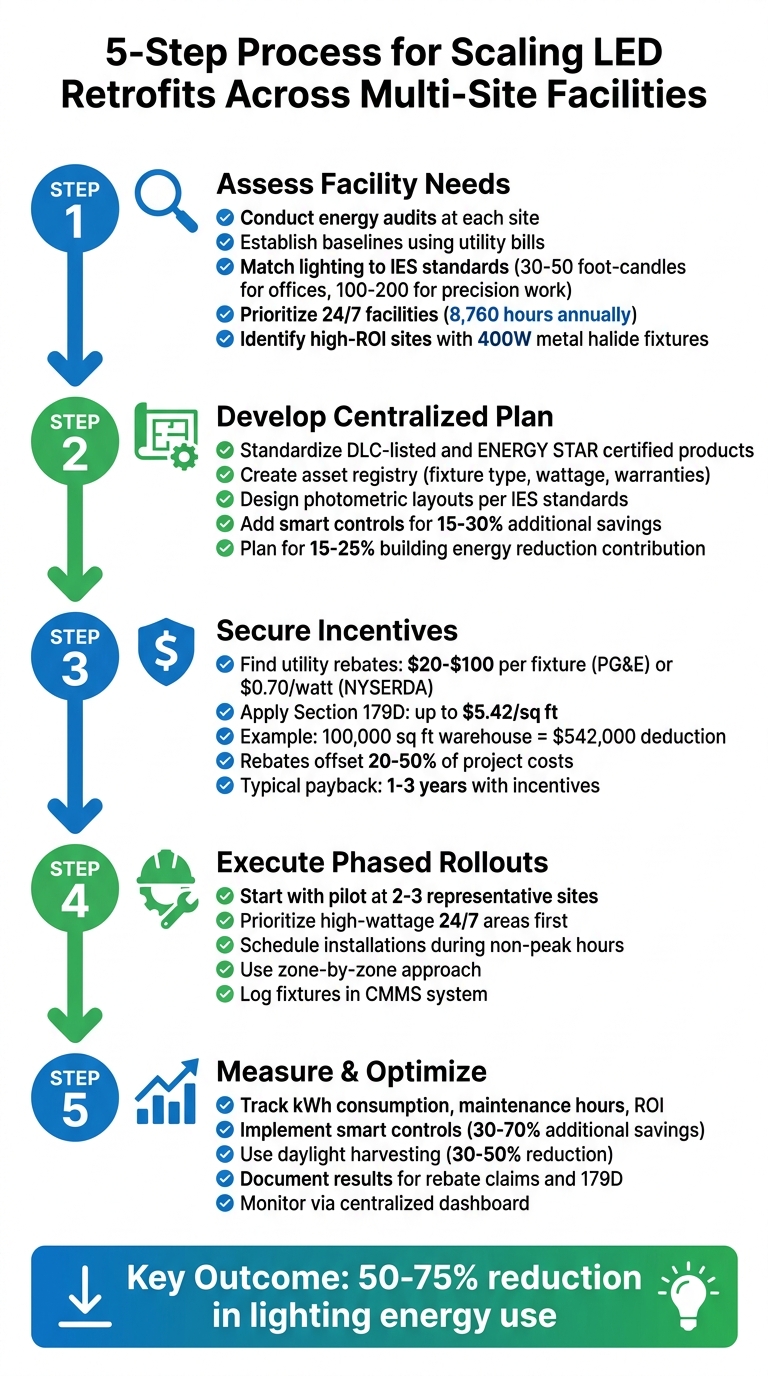
5-Step LED Retrofit Process for Multi-Site Facilities
Before ordering any fixtures, it's essential to establish an accurate energy baseline for each site. This means gathering utility bills, counting fixtures, and measuring current light levels. These steps provide a clear foundation for forecasting ROI and determining rebate eligibility. Without this data, you're essentially making educated guesses about potential savings. A proper baseline ensures precise audits and allows for tailored solutions at each location.
A thorough energy audit is key to understanding lighting requirements, and these should align with IES standards. For example, standard office spaces typically need 30–50 foot-candles, while areas requiring precision work might demand 100–200 foot-candles. Properly matching lighting levels to specific tasks helps avoid wasting energy through over-lighting or compromising safety and productivity with under-lighting. Specialized environments, like hospitals or 24/7 logistics hubs, often need more detailed audits compared to standard offices. Warehouses operating continuously (8,760 hours annually) should be prioritized as they represent significant retrofit opportunities. Additionally, audits should account for compliance with OSHA regulations and EPA guidelines, especially for safely disposing of older mercury-containing lamps.
Once audits are complete, consider the unique conditions of each site to fine-tune your retrofit strategy. For example, facilities exposed to extreme temperatures - ranging from 150°F in high-heat environments to –40°F in cold storage - require luminaires capable of withstanding these conditions without performance issues. Environmental factors like moisture, dust, vibration, or hazardous materials may also necessitate specific certifications, such as NEMA 4X, IP66/IP67, or Class I Division 2. Surge protection is another critical factor to evaluate. Sites experiencing frequent or severe power surges (e.g., Category C High vs. Category C Low) may require drivers with higher surge protection levels, such as 10kV instead of 6kV. Power surges alone cost businesses an estimated $26 billion annually due to downtime and equipment repairs. Lastly, consider how accessible fixtures are. The height and placement of lights can significantly affect maintenance costs, requiring equipment like mobile lifts or ladders, which also introduce additional safety concerns.
To maximize returns, focus on locations where older fixtures and extended operating hours promise the greatest energy savings. High-wattage fixtures running continuously, such as 400W metal halide lights in a 24/7 warehouse, offer much faster payback compared to, say, a 40W T12 fixture in a lightly used conference room. Start with facilities using outdated lighting technologies, as these not only yield the largest savings but often qualify for the most generous rebates. Timing is also critical - federal incentives like the Section 179D tax deduction are set to expire on June 30, 2026, so there's added urgency for completing projects. Additionally, prioritize facilities in areas with high utility rates or active rebate programs, as these can offset 20–50% of project costs. Keep in mind that most rebate programs require pre-approval, so ensure applications are submitted and approved before ordering fixtures. Retroactive applications are typically rejected, especially as the 2026 deadline approaches.
Once you've assessed your facilities, the next step is to create a unified retrofit strategy for your entire portfolio. Centralized management ensures installations are consistent in quality, compliant with regulations, and optimized for performance across all locations. This approach eliminates the risk of mismatched fixtures and uneven results often seen in multi-site rollouts. Plus, a well-structured plan simplifies maintenance and allows for adjustments as operational needs change. This sets the stage for precise design and smooth execution in later phases.
To achieve consistent results, start by standardizing the LED products you'll use. Choose fixtures that are DesignLights Consortium (DLC)-listed and ENERGY STAR-certified. These certifications ensure reliable performance and make your project eligible for rebates, which can offset 20–50% of costs in 75% of U.S. commercial areas. In fact, prescriptive lighting incentives rose by 17% in 2026 compared to the previous year, making certification even more critical. Without it, you risk losing out on these financial benefits.
Set up an asset registry to track key details like fixture type, wattage, installation dates, warranties, and DLC certifications. This registry is essential for managing warranties, scheduling maintenance, and ensuring compliance during audits. Standardizing also helps you avoid costly, last-minute repairs - especially as older systems like T12 and metal halide lamps are phased out. Proactive retrofits are 3–5 times less expensive than reactive maintenance.
Additionally, include smart controls in your specifications. Features like occupancy sensors, daylight harvesting, and networked management can boost energy savings by another 15–30% beyond what fixture replacements alone achieve. These upgrades also make a significant dent in the energy reductions needed to meet 2026–2030 Building Performance Standards, with LED retrofits contributing 15–25% of the total building energy savings required.
Once you've standardized your products, focus on creating tailored lighting designs. Photometric layouts ensure that lighting meets both safety requirements and specific task needs, all while maintaining a cohesive look across your portfolio. For example, offices typically need 30–50 foot-candles, but areas requiring precision work might need 100–200 foot-candles. Using Illuminating Engineering Society (IES) standards during the design phase helps prevent over-lighting, which wastes energy, or under-lighting, which can hinder productivity and safety.
Custom designs also help you avoid "plug-and-play" failures that can result in poor lighting quality or missed energy savings. Require LM-79 testing data and energy calculations for custom performance rebates to ensure compliance and maximize returns on complex projects. This documentation is useful not just for rebate applications but also for ESG reporting, helping you earn credits for programs like LEED, WELL, or BREEAM.
Your retrofit plan should include smart controls and flexible layouts to adapt as facility needs evolve. For instance, if a warehouse transitions into a distribution center or an office moves to a hybrid model, you shouldn't have to start from scratch with your lighting setup. Networked controls allow you to remotely adjust light levels, schedules, and zones across all locations.
Take advantage of incentives like Section 179D, utility rebates, and control incentives to reduce net costs to as low as 30–40% of the initial price. Also, include EPA-compliant waste management for disposing of old fluorescent lamps. This supports ESG goals and ensures proper handling of mercury-containing materials. A centralized plan not only secures long-term energy savings but also makes maintenance and future upgrades more manageable.
If you're looking for expert guidance to craft and execute a centralized LED retrofit plan tailored to multi-site facilities, partnering with Luminate Lighting Group is a smart move.
Once your retrofit plan is ready, the next step is to cut upfront costs by taking advantage of available incentives. By focusing on utility rebates and tax deductions, you can significantly lower the overall expense of implementing LED upgrades across multiple sites. The trick is knowing where to find these incentives and how to apply for them efficiently.
Start by researching utility rebates using the Database of State Incentives for Renewables & Efficiency (DSIRE) at dsireusa.org. This tool allows you to search by ZIP code to identify local rebate programs. For example, Pacific Gas & Electric (PG&E) offers rebates ranging from $20–$100 per fixture, while New York's NYSERDA provides up to $0.70 per watt for LED fixtures. In California, complying with Title 24 standards can lead to rebates that cover as much as 50% of project costs.
Next, explore the Section 179D tax deduction, which can provide up to $5.42 per square foot (adjusted for inflation in 2026) for lighting upgrades that cut energy consumption by 25–50% compared to ASHRAE 90.1 standards. For instance, retrofitting a 100,000-square-foot warehouse could result in $542,000 in deductions. To qualify, you'll need an energy audit to certify the savings, followed by filing IRS Form 7205. For multi-site projects, you can aggregate upgrades across locations to maximize the benefit.
When working across multiple states, it’s crucial to submit pre-approval paperwork before purchasing fixtures to lock in rebate rates. Engage a qualified engineer early for the 179D certification, and use centralized software like EnergyCap to manage the varying requirements state by state. A great example of this approach is Sysco Foods, which retrofitted 50 distribution centers in 2022, earning $4.2 million in utility rebates and 179D deductions, while reducing energy consumption by 65% and achieving a 2.1-year payback.
By understanding and leveraging these rebates and deductions, you can accurately estimate your total project savings.
To estimate your returns, use this formula: Annual Savings = (Baseline kWh – LED kWh) × Utility Rate + Maintenance Savings + Incentives, divided by the number of payback years. For example, if you retrofit 10 warehouses (50,000 square feet each), replacing 400W HID fixtures with 150W LEDs at $0.12/kWh and running 12 hours daily, you could save around $250,000 annually in energy costs. Add to that $500,000 in rebates, and your payback period would be under two years. Tools like the DOE LED Savings Calculator can help fine-tune these estimates.
With incentives, payback periods typically range from 1–3 years, compared to 3–5 years without them. Key factors influencing the timeline include electricity rates (ranging from $0.08–$0.20/kWh), the percentage of costs offset by rebates (30–70%), and the efficiency of the LEDs (150+ lumens per watt). For example, a national retailer retrofitted 50 locations and achieved an 18-month payback by combining bulk purchasing with aggregated 179D claims.
Having these figures in hand simplifies financial planning for multi-site LED retrofits.
Streamline your budgeting by setting a fixed cost per square foot for all locations. To manage the workload, phase your incentive applications regionally - for instance, handle East Coast rebates in Q1 and Midwest rebates in Q2. Using master service agreements with vendors can also help standardize pricing, which one industrial client used to cut planning time by 40%.
Dashboards are a great tool for tracking ROI at each site, while standardized audit templates can prevent costly mistakes. For example, one facility chain lost $200,000 in rebates because individual sites submitted inconsistent paperwork. After centralizing their process, they recovered the funding. Assigning regional leads to manage state-specific details, like Texas's demand-response programs or California's 90.1-2019 compliance requirements, can also reduce administrative headaches.
Luminate Lighting Group specializes in guiding multi-site clients through incentive applications, helping them secure utility rebates and 179D deductions to maximize the financial benefits of LED retrofits.
Once you've secured funding and developed a solid retrofit plan, the next step is execution. The trick is to implement your LED retrofits in phases, ensuring daily operations remain unaffected while you build momentum across your portfolio. By starting small, scaling thoughtfully, and aligning installations with your business schedule, you can complete the project without impacting productivity.
Begin by testing your retrofit strategy at a few high-priority sites before committing to a full-scale rollout. This pilot phase helps you fine-tune installation procedures, anticipate potential challenges, and confirm your plan works in practice. Select locations that represent different facility types in your portfolio - like a warehouse, a manufacturing plant, and an office - to identify site-specific hurdles early.
Start installations in low-traffic areas, such as storage rooms or corridors, where you can test processes without risking disruptions. This allows your team to establish safety protocols before tackling critical zones. During the pilot, conduct detailed site surveys to uncover obstacles like asbestos-containing materials, inadequate electrical systems, or structural issues that could slow down later phases.
Log all new fixtures in your Computerized Maintenance Management System (CMMS) during this phase to streamline maintenance, track warranties, and monitor energy savings across your entire portfolio. For example, a 500,000-square-foot aerospace manufacturer successfully completed a full LED retrofit without halting production by using a phased, zone-by-zone approach during scheduled maintenance windows.
Once your pilot phase confirms the process works, you’ll be ready to expand to all sites.
With the pilot complete, roll out the retrofit across the rest of your locations using a phased prioritization strategy. Instead of tackling sites based on geography, prioritize zones by their criticality and return on investment (ROI) potential. This approach ensures faster payback and maximizes rebates, especially when deadlines for incentive programs are looming.
Start with high-wattage areas like 24/7 warehouses and manufacturing floors, where longer operating hours lead to immediate energy savings. Next, focus on parking garages and canopies, which benefit from increased rebate opportunities in 2026. Save office spaces for later, as their shorter daily usage typically results in longer payback periods.
To streamline the process, use staging services that deliver pre-assembled fixture kits tailored to each phase. This reduces waste and improves job site efficiency. Maintain centralized oversight to ensure consistent quality, adherence to equipment standards (like DLC-listed or ENERGY STAR fixtures), and compliance across all locations. For instance, a 150,000-square-foot distribution center operating around the clock achieved a 62% energy reduction and hit ROI in just 19 months by using LED retrofit kits and scheduling installations during night shifts - without any downtime.
To keep operations running smoothly, plan installations around your business schedule. Schedule work during non-peak hours to avoid interfering with daily activities. For mission-critical environments - such as hospitals or logistics centers - consider after-hours installations by specialized crews experienced in high-stakes settings.
Implement retrofits zone-by-zone to avoid repeated disruptions in the same area. Use temporary lighting to maintain required light levels during the transition, ensuring safety and avoiding production delays.
For example, a food processing facility used NSF-rated, IP69K washdown fixtures in production areas and standard high-bay fixtures in storage spaces. This choice not only reduced lighting energy costs by 73% but also improved safety scores by 40%, all while maintaining continuous production. The facility achieved payback in just 18 months.
Luminate Lighting Group is experienced in managing multi-site LED retrofits with minimal disruption. Their phased rollout strategies ensure you can maintain productivity while achieving substantial energy savings across your portfolio.
Once your LED retrofit is complete, the journey isn’t over. To truly maximize your investment, you’ll need to monitor performance and make adjustments as needed. Without tracking, it’s tough to confirm whether you’re hitting your energy-saving goals or if some systems aren’t performing as expected. By keeping an eye on key metrics, using advanced controls, and documenting outcomes, you can ensure your multi-site portfolio continues to deliver results over time. These insights will also help guide future efficiency improvements.
Start by establishing a baseline before the retrofit and compare it to your post-retrofit data. Focus on metrics like kWh consumption, maintenance labor hours, and ROI (calculated as project cost after rebates divided by annual savings).
A unified dashboard can be a game-changer here, giving you a clear, consolidated view of performance across all sites. This makes it easier to spot underperforming locations that might need attention and compare results across facilities.
Smart controls are a powerful way to build on the benefits of your retrofit. In fact, adding smart lighting controls can cut energy use by 30% to 70%, depending on your building type and the strategies you use. A centralized cloud-based management system allows you to oversee and adjust lighting remotely from one dashboard, eliminating the need for on-site staff to handle these tasks.
To fine-tune performance, consider implementing zoned automation with custom settings for different areas like conference rooms, warehouses, or break rooms. Daylight harvesting sensors are another great option - they monitor natural light levels and automatically dim artificial lighting to maintain consistent brightness while saving energy. Facilities with windows or skylights can see energy reductions of 30% to 50% by using features like occupancy sensors and daylight harvesting.
Phased scheduling is another effective strategy, ensuring lighting aligns with shifts and operational hours to avoid unnecessary energy use. Additionally, remote diagnostics can provide real-time alerts, allowing you to address issues quickly and efficiently without unnecessary technician visits - this can lower labor costs and improve first-time fix rates. Don’t forget to train facility managers to use mobile dashboards for quick, real-time adjustments.
Accurate documentation is key to showcasing the success of your LED strategy. Keep detailed records of energy savings, lighting improvements, and other outcomes for stakeholder reporting and future planning. Include before-and-after comparisons of utility bills, lighting quality assessments, and carbon emissions reductions. Photos of upgraded spaces and testimonials from facility managers can add a personal touch and highlight operational improvements.
Comprehensive documentation also helps with utility rebate applications and 179D tax deduction claims by providing the performance data auditors need.
Luminate Lighting Group specializes in helping clients integrate smart controls and measurement systems, ensuring that LED retrofits deliver ongoing efficiency and long-term value across multi-site portfolios.
Rolling out LED retrofits across multiple locations can be a smooth process when you take a structured approach: assess your needs, centralize the planning, secure available incentives, implement in phases, and track performance. This method not only minimizes risks but also helps you maximize financial benefits through utility rebates and 179D tax deductions, all while reducing costs through economies of scale.
By centralizing and phasing your retrofits, you ensure consistent lighting quality and reduce financial uncertainties. Keeping track of performance and maintaining detailed documentation can refine your future projects and provide valuable insights for stakeholder reporting. A well-coordinated strategy makes it easier to partner with the right experts to simplify the entire process.
Luminate Lighting Group can help you streamline your multi-site LED retrofit projects and unlock proven energy savings. With expertise in retrofitting warehouses, industrial spaces, offices, and municipal facilities, we handle everything from energy audits and custom lighting designs to navigating complex utility rebate programs. Our phased implementation approach minimizes disruptions to your operations while delivering measurable results.
Start with thorough audits and pilot programs to test and refine your strategy before committing to a full-scale rollout.
LED technology offers more than just lower energy and maintenance costs - it boosts safety and productivity while delivering long-term operational advantages. With lifespans ranging from 25,000 to over 50,000 hours, LEDs significantly cut down on maintenance and replacement needs. Their reduced heat output can also lower cooling costs. These benefits, when applied across multiple facilities, create lasting value and help your organization stay ahead of evolving energy efficiency standards.
To decide which sites should be retrofitted first, consider key factors like potential energy savings, existing lighting conditions, and available rebates or incentives. Start with locations that consume a lot of energy, face frequent maintenance problems, or qualify for utility rebates and tax advantages. Prioritize sites with the fastest return on investment - usually between 1 to 4 years - to maximize cost savings and improve efficiency.
To take advantage of rebates and 179D deductions, you'll need proper documentation proving that your retrofit meets specific energy efficiency standards. This typically involves maintaining detailed project records and, in some cases, obtaining third-party certification. Make sure all the necessary information is accurate and thorough to make the qualification process as smooth as possible.
Smart controls can cut energy use by as much as 50%. With features like occupancy sensors and daylight harvesting, they fine-tune energy consumption, ensuring lights are used only when needed. When paired with LED retrofits, these controls not only enhance efficiency but also help recover the upfront costs through reduced energy waste.


