.svg)
Case studies of LED retrofits in manufacturing, distribution, ports and mining showing energy, safety, and fast ROI.

LED lighting is transforming heavy industrial operations by solving common challenges like high energy costs, poor visibility, and frequent maintenance. Facilities with extreme temperatures, dust, and vibrations are switching to LED systems for better durability, energy efficiency, and safety compliance. Key benefits include:
This article highlights four examples of LED retrofits across manufacturing plants, distribution centers, ports, and mining facilities. Each case demonstrates how LEDs reduce costs, improve safety, and ensure uninterrupted operations in demanding environments.
Dana Incorporated's massive 1-million-square-foot automotive manufacturing facility in Warren, Michigan, was grappling with serious lighting challenges. The plant, which operates 24/7, relied on 1,150 T8 and T5 fluorescent fixtures that struggled under extreme ceiling temperatures - reaching up to 149°F. These conditions caused the lights to degrade quickly, creating dim and uneven illumination. Workers reported dark spots in their work areas, making precision tasks difficult and raising safety concerns.
"When we sat down to discuss the different applications with the Dana team, the high temperatures on the manufacturing ceiling and uneven light levels were some of their concerns." - Michael Abraham Jr., President, Future Energy Group
Future Energy Group led the facility's lighting upgrade by replacing all fluorescent fixtures with Flex Essentials Series 4.0 LED high bays. These LEDs were chosen for their advanced thermal management and narrow beam optics, which eliminated glare and shadows while focusing light where it was needed most. The installation presented a unique challenge: the plant couldn't afford any downtime. To address this, the team coordinated with shift supervisors and carried out the work during quieter overnight hours, ensuring production continued uninterrupted. These upgrades not only improved energy efficiency but also enhanced safety and visibility for workers.
The results of the retrofit were immediate and impactful. Lighting levels on the manufacturing floor improved dramatically, with foot-candle levels increasing fivefold. This upgrade also resulted in significant energy savings, cutting annual consumption by an estimated 449,880 kWh.
Employee feedback highlighted the transformation:
"From day one, since the new Flex high bay's were installed, the employees have been really happy and mentioned how bright it is. They have increased visibility in their work cells, which improved their performance." - Paula Zuccaro, Engineering Assistant, Dana Incorporated
The new system also reduced maintenance demands. With LED fixtures boasting lifespans of over 50,000 hours, the plant no longer faces frequent bulb and ballast replacements, saving both time and money. Additionally, the upgrade included a lighted emergency egress path, ensuring OSHA compliance and enhancing worker safety during evacuations.
A bustling 750,000 ft² distribution facility in the Southeast faced mounting challenges: high energy costs and safety concerns during night shifts. With 2,800 outdated fixtures and a 24/7 operation, shutting down for a lighting upgrade wasn’t an option.
To tackle this, a six-week retrofit was planned and executed entirely during overnight hours. The team worked strategically, addressing one zone at a time and collaborating closely with shift supervisors to ensure the facility's picking and packing operations ran smoothly. The outdated 400W metal halides were replaced with 150W LED high bays, and fluorescent troffers were upgraded with LED retrofit kits. The new system featured 0–10V dimming and occupancy sensors, allowing lights in low-traffic areas to automatically dim when not in use.
"The facility manager later told us that most employees didn't even realize the project was happening until they noticed how much better the light quality was." - Soluvoll Case Study
To further reduce costs, the project secured $142,000 in utility rebates, significantly lowering the initial investment. Careful planning and seamless execution ensured the retrofit delivered outstanding results.
The results were striking. Annual energy consumption dropped by 314,000 kWh, cutting energy use by 74% and saving the facility $387,000 annually. The investment paid for itself in just 1.8 years.
The switch to LED high bays also eliminated the need for frequent scissor lift maintenance. With a lifespan of 200,000 hours and 10-year warranties, ongoing lamp replacements became a thing of the past.
Beyond the financial savings, the upgrade transformed the workplace. Light levels increased to 50 footcandles, eliminating dark spots and improving visibility for overnight crews. This not only enhanced safety but also boosted employee morale. On top of that, the facility made a significant environmental impact, reducing its carbon footprint by over 471,000 pounds of CO2 annually - the equivalent of taking 45 cars off the road for a year.
LED lighting isn’t just for warehouses and distribution centers - it thrives even in the toughest conditions.
Ports face relentless challenges: salt spray, extreme heat, and constant vibrations from heavy machinery. At the Port of Houston's Terminal 18, a sprawling 196-acre facility operating 24/7, these factors wreaked havoc on outdated high-pressure sodium lamps. Frequent lamp failures forced crews to halt operations for replacements, causing downtime and creating safety concerns.
To address this, the terminal underwent a full LED high mast conversion. The newly installed fixtures, equipped with 10 kV surge protection, were designed to handle the electrical instability common in port environments. The results? Continuous operations, lower energy costs, and better lighting that enhanced worker safety.
These successes aren’t limited to ports - LED retrofits also shine in mining environments where dust and debris dominate.
A coal mining operation in Colorado faced its own set of challenges. Dragline excavators operated in an environment filled with heavy dust, debris, and constant vibration, which caused frequent failures of traditional lighting systems. Maintenance crews often had to climb equipment to replace lamps and ballasts, leading to high costs and safety risks.
The solution? Industrial-grade LED fixtures designed specifically for harsh conditions. After the retrofit, the upgraded lighting not only withstood the rugged environment but also provided superior illumination in critical areas. Maintenance costs dropped, energy consumption decreased, and the operation ran more efficiently - proving that LED technology is up to the task in even the most demanding industrial settings.
This case delves into a complete LED lighting upgrade at the Delaco Manufacturing facility in Woodhaven, Michigan - a 24/7 supplier of logistics and steel components for Ford F-150 trucks. In facilities like this, outdated lighting systems contribute heavily to energy costs, while poor lighting in high-ceiling areas can also compromise safety and productivity.
Instead of opting for piecemeal replacements, Delaco teamed up with Future Energy Group to conduct a thorough energy audit. The audit identified the specific lighting needs, or foot-candle requirements, for various tasks throughout the plant. Based on this analysis, the team installed Flex LED high bay fixtures - 259W for higher ceilings and 224W for lower areas - ensuring consistent and effective lighting across the facility. This customized approach helped determine the optimal number of fixtures and their placement.
"We selected the product based on the application while understanding their facility's needs – what is the space going to be used for and how to best accommodate the space with the lighting solution."
– Michael Abraham Jr., Co-Founder and President, Future Energy Group
The results were striking. Light levels across the facility increased by 50–60%, eliminating the reliance on additional task lighting.
"When my employees can see what they are doing better, it increases their performance and I have less accidents."
– Jason Crout, Operation Manager, Delaco
The energy savings were equally impressive, with annual consumption dropping by 67%. Plus, the LED fixtures generated less heat, reducing the strain on the HVAC system - an essential advantage for a plant running around the clock. Utility rebates covered a large portion of the upfront costs, resulting in an average ROI of just 3.9 years. Beyond the financial benefits, the project created a safer and more efficient work environment.
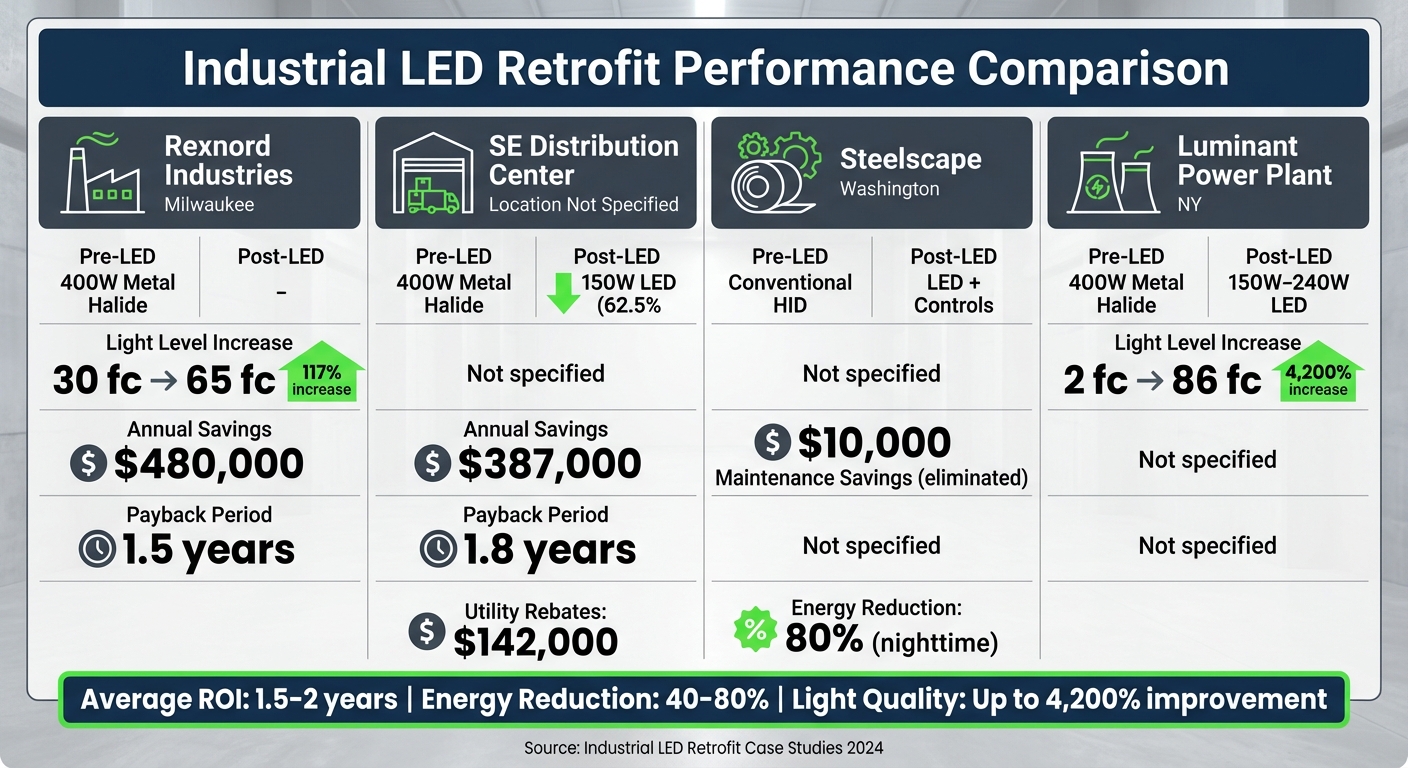
LED Retrofit Results Across Industrial Facilities: Energy Savings and ROI Comparison
The data from these case studies highlights reduced energy use, improved lighting quality, and impressive financial savings. For instance, Rexnord Industries in Milwaukee cut energy consumption by 540,000 watts, resulting in monthly savings of $40,000 - or $480,000 annually. At the same time, light levels improved from 30–35 foot-candles to 60–65 foot-candles. Another example is a 750,000-square-foot Southeast distribution center that replaced over 2,800 fixtures with 150W LED high bays and occupancy sensors. This upgrade generated $387,000 in annual savings, with a return on investment achieved in just 1.8 years after factoring in $142,000 in utility rebates.
Steelscape's Washington facility saw an 80% reduction in nighttime energy use and eliminated its $10,000 annual maintenance budget by implementing a networked LED system. At the Luminant Independence Power Plant in Oswego, NY, a 2024 retrofit led by maintenance technician Rob Godden replaced 400W metal halide fixtures with wattage-selectable LED high bays. This change boosted illumination in critical work areas from as low as 2 foot-candles to 86 foot-candles.
The following table summarizes key metrics from these projects:
| Facility | Pre-LED Wattage | Post-LED Wattage | Light Level Increase | Annual Savings | Payback Period |
|---|---|---|---|---|---|
| Rexnord Industries | 400W Metal Halide | Not specified | 30 fc → 65 fc | $480,000 | 1.5 years |
| SE Distribution Center | 400W Metal Halide | 150W LED | Not specified | $387,000 | 1.8 years |
| Steelscape | Conventional HID | LED + Controls | Not specified | 80% reduction (nighttime) | Not specified |
| Luminant Power Plant | 400W Metal Halide | 150W–240W LED | 2 fc → 86 fc | Not specified | Not specified |
These results demonstrate that the strategies employed can be effectively scaled across other industrial operations. By conducting detailed energy audits and selecting fixtures carefully, facilities can replicate similar outcomes. Luminate Lighting Group’s approach aligns with these successful methods. Their process includes performing photometric studies to determine exact foot-candle requirements, choosing wattage-selectable fixtures for flexibility, and incorporating occupancy sensors that reduce light levels to about 35% during periods of inactivity. Together, these steps deliver significant energy savings and lower maintenance costs.
This proven financial model - often achieving wattage reductions of 40–62% - is further supported by utility rebates, which help offset initial costs. Additionally, leveraging rebate programs and 179D tax deductions allows industrial clients to achieve payback periods of 1.5 to 2 years while maintaining OSHA compliance.
These lessons provide a roadmap for extending LED retrofits to other industrial settings, establishing best practices for future projects.
Industrial LED retrofits can cut energy use by 70–80%, offering a payback period of just 1.4–2 years. Real-world case studies highlight impressive annual savings and quick returns, with many facilities leveraging utility incentives to offset upfront costs.
The benefits go beyond just cutting costs. Retrofits bring operational improvements like better visibility and lower maintenance needs, creating safer and more efficient workplaces.
Success in these projects hinges on thorough planning and precise execution. Energy audits, photometric studies, and careful fixture selection - especially for harsh environments that demand thermal management up to 149°F - ensure upgrades meet OSHA safety standards and operational requirements. Adding occupancy sensors and networked controls, which dim lights to 35% during inactivity, further enhances energy savings.
Luminate Lighting Group exemplifies this strategic approach. Their process includes detailed facility assessments, tailored fixture recommendations, and proactive utility rebate management. They also use photometric layouts and wattage-selectable fixtures to help clients achieve similar results. The inclusion of 179D tax deductions sweetens the deal, making large-scale retrofits feasible even for facilities with limited budgets.
These retrofits directly address the challenges of demanding industrial environments, offering a tested path to sub-two-year ROI alongside lasting improvements in energy savings, worker safety, and operational efficiency.
When selecting the appropriate LED high bay wattage and optics, start by evaluating your ceiling height (typically 20 feet or more), the dimensions of the area, and your specific lighting objectives - whether you're aiming for energy efficiency or maximum brightness. Optics play a key role in focusing light where it's needed while reducing glare. Be sure to check product specifications to ensure the wattage and lumen output align with your requirements. Additionally, consider environmental factors, such as exposure to harsh conditions or outdoor settings, to make the best choice for your space.
To upgrade lighting in a plant that operates 24/7 without interrupting operations, a well-organized plan is essential. Consider strategies like phased installations or upgrading specific sections or zones at a time to ensure the facility remains functional. Using LED retrofit kits can also help streamline the process, as they are designed to minimize disruption. Additionally, scheduling work during periods of lower activity and integrating smart controls can further reduce any impact on daily operations. The focus should remain on a step-by-step approach, selecting compatible solutions, and timing installations effectively to keep productivity on track.
Utility rebates are a great way to cut down the cost of retrofitting by providing financial incentives for energy-efficient upgrades. On top of that, the 179D tax deduction offers up to $5.00 per square foot for eligible energy-efficient building systems, like LED lighting. These programs not only help reduce initial expenses but also encourage energy savings and environmentally friendly practices.


