.svg)
IoT sensors, machine learning, and cloud platforms convert building data into continuous portfolio-wide energy savings and compliance.


Energy inefficiency in large facilities is a costly problem. Scalable energy analytics offers a solution by processing vast energy data across multiple buildings to identify waste and optimize usage. These systems combine IoT sensors, machine learning, and advanced energy management tools to reduce costs, meet energy codes, and support sustainability goals.
Scalable energy analytics transforms raw data into actionable insights, helping facility managers cut costs, improve energy efficiency, and meet stricter regulations.
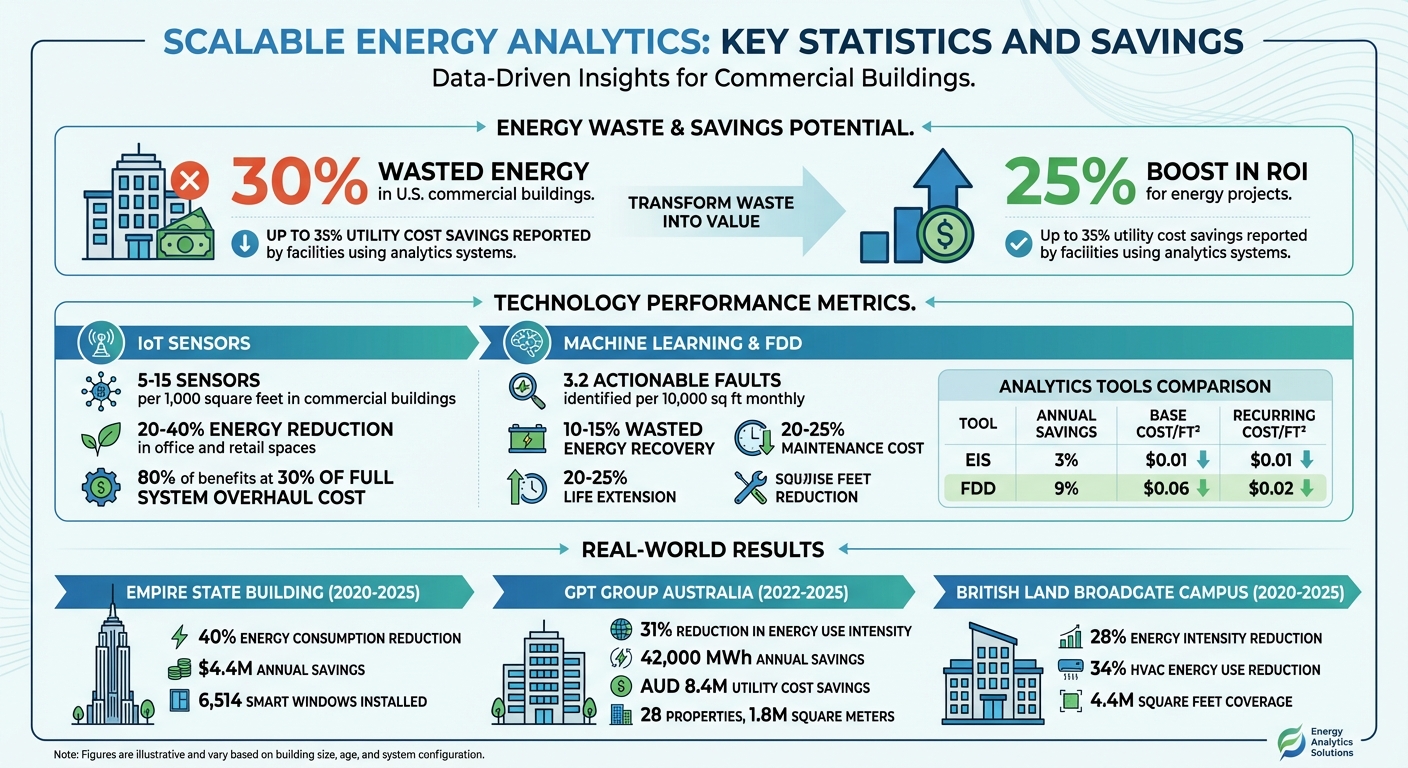
Scalable Energy Analytics: Key Statistics and Savings for Large Facilities
Scalable energy analytics rely on three key technologies working together: IoT sensors to gather data, machine learning algorithms to interpret it, and advanced building management platforms to turn insights into actionable steps. These tools build on earlier data collection methods to help large facilities monitor and optimize energy use more effectively.
IoT sensors are the backbone of scalable analytics, offering detailed, real-time monitoring for large-scale building management. These devices track energy consumption, occupancy patterns, equipment performance, and air quality at a granular level. Unlike older systems that depend on monthly utility bills, IoT sensors provide circuit- and equipment-level insights, helping facility managers identify exactly where energy is being wasted.
Typically, commercial buildings use 5 to 15 sensors for every 1,000 square feet, monitoring factors like motion, light levels, CO₂, and mechanical health. This data supports demand-based controls, where HVAC and lighting systems adjust automatically based on room occupancy and environmental conditions. The outcome? Energy usage in office and retail spaces often drops by 20% to 40%.
Modern IoT systems can work alongside existing Building Management Systems (BMS). Instead of replacing entire systems - a costly and time-intensive process - facilities can add IoT gateways and sensors that send data to cloud-based analytics platforms. This hybrid approach delivers about 80% of the benefits for just 30% of the cost of a full system overhaul. For example, between 2022 and 2025, the GPT Group in Australia implemented this strategy across 28 properties, covering 1.8 million square meters. The result? A 31% reduction in Energy Use Intensity (EUI), annual savings of 42,000 MWh, and AUD 8.4 million saved in utility costs. Once IoT sensors collect real-time data, machine learning algorithms step in to transform that data into predictive strategies.
Machine learning (ML) takes raw data from sensors and turns it into actionable insights, enabling large-scale optimization. Unlike traditional systems that rely on fixed rules, ML algorithms adapt in real time to factors like weather changes, occupancy levels, and electricity prices. For instance, ML-based Fault Detection and Diagnostics (FDD) systems can identify an average of 3.2 actionable faults per 10,000 square feet each month, recovering 10% to 15% of wasted energy without requiring new equipment.
Reinforcement Learning (RL) has also proven effective in optimizing HVAC systems. Between 2023 and 2024, a solution using the Soft Actor-Critic (SAC) algorithm was deployed across over 10,000 rooftop units at more than 200 sites. By adjusting economizer setpoints based on real-time humidity and temperature data, the system reduced power consumption by 5% compared to ASHRAE Standard 90.1-2013, saving $2.5 million in its first year.
Predictive maintenance, powered by IoT sensors and ML, can extend equipment life by 20% and cut maintenance costs by 20% to 25%. These insights are then integrated into advanced building management systems for continuous optimization.
Advanced Building Energy Management Systems (aBEMS) combine sensor data and machine learning insights to make operational decisions across entire building portfolios. Unlike traditional schedule-based systems, aBEMS adjusts performance in real time, often making updates every 15 minutes based on factors like occupancy, weather, and electricity rates.
Modern aBEMS platforms are designed for interoperability, using open protocols like BACnet, Modbus, MQTT, and Project Haystack to connect diverse equipment and legacy systems into a unified platform. This standardization allows operators to compare and optimize buildings of different ages and locations. With cloud-native designs, these systems can manage hundreds of facilities from a single dashboard, translating real-time data into practical improvements.
From 2020 to 2025, Empire State Realty Trust implemented a cloud-based BMS and 6,514 smart windows with automated daylight harvesting at the Empire State Building. The project cut energy consumption by 40% and saved over $4.4 million annually. Similarly, British Land's Broadgate campus in London, covering 4.4 million square feet, integrated Siemens Desigo CC with BrainBox AI and Clockworks Analytics. By 2025, the campus reduced energy intensity by 28% compared to 2020, with HVAC energy use dropping 34%.
"The shift from reactive, schedule-based control to predictive, data-driven optimization is the core of the smart building value proposition." – Sustainable Atlas
Large facilities leverage scalable energy analytics to tackle three main challenges: identifying retrofit opportunities through detailed audits, benchmarking performance against industry benchmarks, and ensuring compliance with changing energy codes.
Energy analytics platforms have revolutionized traditional energy audits by pulling data from HVAC systems, chillers, batteries, solar panels, and lighting circuits using protocols like Modbus or vendor APIs. Instead of relying on annual bills or occasional checks, these platforms provide real-time equipment performance data straight from the grid edge.
This level of detail enables automated processes like peak shaving, load following, and energy arbitrage, all aimed at cutting costs. With these insights, managers can model energy usage, compare tariffs, and pinpoint areas for retrofits that deliver financial savings.
The numbers speak for themselves: facilities using advanced energy analytics have reported utility cost savings of up to 35% and a 25% boost in ROI for energy projects. Lighting retrofits, often an easy starting point, are a prime example. Analytics help identify high-consumption zones, allowing facilities to target LED upgrades where they matter most. These upgrades not only improve lighting efficiency but also maximize eligibility for rebates and 179D tax deductions. Providers like Luminate Lighting Group specialize in helping clients take full advantage of these benefits.
The insights gained from these audits naturally feed into robust benchmarking and performance tracking efforts.
Benchmarking takes raw meter data and adjusts it for variables like weather, occupancy, and operating hours, creating clear performance metrics for demand management.
"Energy demand management starts with understanding how every facility in a portfolio uses energy, when costs spike, and where performance falls short of what peers achieve." – Kb3 Advisors
Analytics platforms shine here by identifying underperforming facilities within a portfolio - those using disproportionately high amounts of energy. This helps managers prioritize investments where they’ll have the biggest impact. Transitioning from one-time assessments to ongoing monthly or quarterly monitoring allows facilities to stay agile in response to market dynamics, regulatory updates, and organizational growth. Automated dashboards further simplify this process, translating technical data into actionable insights for decision-makers.
Two key tools in this space are Energy Information Systems (EIS) and Fault Detection and Diagnostics (FDD). These tools deliver measurable energy savings:
| Tool Type | Median Annual Energy Savings | Median Base Cost (per ft²) | Median Recurring Cost (per ft²) |
|---|---|---|---|
| Energy Information Systems (EIS) | 3% | $0.01 | $0.01 |
| Fault Detection & Diagnostics (FDD) | 9% | $0.06 | $0.02 |
These tools not only improve internal performance but also help meet regulatory and sustainability goals.
Scalable analytics platforms turn vast streams of time-series data into actionable insights, enabling facilities to meet regulatory requirements and sustainability targets in real time. By integrating with building management systems, these platforms can quickly identify energy-saving opportunities and detect equipment issues, eliminating the delays of traditional annual reviews.
Advanced modeling capabilities allow facilities to simulate energy portfolios and address challenges like load growth from increased electrification and data center expansion. Analytics also optimize on-site assets - batteries, solar panels, HVAC systems, chillers - for peak shaving and load balancing under updated codes.
For facilities aiming for net-zero energy, these platforms provide the baseline data needed to measure current performance and plan improvements. Continuous optimization ensures compliance and supports long-term sustainability goals.
"Advanced energy analytics solutions can empower industries to optimize energy use, improve reliability, and achieve complex energy goals through data-driven insights built by energy experts." – NextEra Energy Resources
The importance of these efforts becomes clear when considering data centers, which currently consume 4.4% of all energy in the U.S., a figure that’s only expected to grow. In January 2026, Microsoft partnered with Constellation Energy to bring the Three Mile Island nuclear plant in Pennsylvania back online, securing 835 megawatts of carbon-free electricity for its data centers. Similarly, Alphabet signed a 25-year agreement with NextEra Energy to reactivate the Duane Arnold Energy Center in Iowa for its regional data centers. These examples highlight how data-driven insights not only optimize energy use but also facilitate long-term, clean energy partnerships that align with sustainability goals.
Examples from various sectors highlight how energy analytics can lead to measurable savings and operational efficiency.
Commercial office buildings have seen notable drops in utility costs by using energy analytics platforms to uncover inefficiencies that often go unnoticed. Many building owners report double-digit reductions in utility costs within months. These platforms excel at identifying issues like equipment malfunctions, simultaneous heating and cooling, and poorly timed control sequences - problems that traditional monitoring might miss.
Centralized dashboards play a key role by consolidating energy metrics, making it easier for property managers to act quickly and prioritize fixes.
"Monitoring platforms typically deliver utility cost reductions of 20–30% within the first year of deployment, driven by the identification and correction of inefficiencies that are invisible without metered data." – MRI Software
Additionally, AI-driven audit workflows have significantly streamlined energy reporting tasks, with users reporting a 55% reduction in time spent on these activities. This allows teams to shift focus from manual data collection to more strategic energy management efforts.
Industrial facilities, with their complex needs, have also benefited from energy analytics, particularly in lighting optimization. Challenges like high-bay spaces and specialized lighting requirements are addressed effectively with tools like smart meters. These meters, which provide 30-minute interval data, help facility managers identify peak usage times and cut unnecessary consumption during off-hours. When paired with sub-metering, analytics can pinpoint exact areas of waste.
Switching to LED lighting has proven transformative, reducing energy consumption by up to 75% compared to traditional systems. Beyond the immediate energy savings, LEDs offer lifespans exceeding 50,000 hours, which slashes maintenance costs and reduces the need for frequent replacements.
Advanced network lighting control systems further enhance these savings. By integrating features like automated scheduling and occupancy sensing, facilities can manage high-bay, tube, and strip lights more efficiently. Companies like Luminate Lighting Group specialize in helping industrial clients implement these solutions, combining LED upgrades with analytics-driven controls. These efforts also make facilities eligible for utility rebates and 179D tax deductions, adding financial incentives to the energy benefits.
Cities across the U.S. are leveraging scalable analytics to hit ambitious energy reduction goals while maintaining transparency with taxpayers. For example, Charleston, South Carolina, cut municipal energy use by 47% through an energy performance contract. Other cities have set similarly bold targets: Albuquerque, New Mexico, aims for a 65% reduction in local government building energy use by 2025, while Cleveland, Ohio, plans to cut energy use by 50% by 2030. Baltimore, Maryland, has already achieved 18% renewable energy use for city-owned buildings as of 2020, nearing its 20% target for 2022.
Continuous monitoring tools like TRACE help municipalities stay on track by identifying underperforming areas and guiding interventions. Some cities, such as Arlington County, have gone a step further by using open data portals to publicly track and report energy intensity and carbon footprints for government buildings, ensuring accountability.
"Setting and codifying a clear commitment helps provide a point of reference against which a city can measure its progress." – ACEEE
These examples highlight how analytics-driven strategies enable municipalities to meet their energy goals while maintaining transparency and accountability.
Scalable energy analytics offer a clear path to financial savings and operational improvements. For example, organizations using Fault Detection and Diagnostic (FDD) tools report a median annual energy savings of 9%, while those using Energy Information Systems (EIS) see savings of 3%. These savings typically materialize within two years of implementation. Cost-wise, FDD tools have a median base cost of $0.06 per square foot with recurring costs of $0.02 per square foot annually. EIS platforms, on the other hand, cost $0.01 per square foot for both initial and recurring fees.
FDD systems are particularly effective, identifying about 3.2 actionable faults per 10,000 square feet each month. This translates into recovering 10–15% of wasted energy without requiring additional capital investment. Beyond operational savings, smart offices rated as BREEAM Excellent can command rental premiums of 12% to 20% compared to traditionally managed buildings.
Scalable energy analytics also play a key role in achieving net-zero energy targets. By focusing on operational optimizations instead of costly equipment upgrades, these platforms help reduce Scope 1 and Scope 2 emissions. For instance, smart building controls and automation can cut energy use by 20% to 40% in typical office and retail spaces. Networked lighting systems integrated with HVAC controls go even further, saving over 60% of energy compared to older systems.
Real-world examples highlight what's possible. The Empire State Building and GPT Group's portfolio demonstrate how analytics-driven strategies can deliver significant energy reductions and cost savings across diverse facilities. Grid-interactive capabilities add another layer of impact. Brookfield Properties, for example, launched an AI-driven energy management program in 2023, spanning 120 properties by 2025. This initiative achieved an average energy savings of 22% and generated $2.1 million annually from demand response programs, reducing peak loads by 15% to 20%.
"When combined with on-site renewables, battery storage, and grid flexibility, smart buildings can achieve near-zero operational carbon." – Sustainable Atlas
These initiatives underline the growing potential of energy analytics in reshaping sustainability efforts.
The future of energy management is leaning toward autonomous, AI-driven systems. Tools like BrainBox AI adjust HVAC setpoints every 15 minutes using predictive algorithms that factor in real-time occupancy, weather forecasts, and utility rates. A case in point is British Land's Broadgate Campus, where this technology reduced energy intensity by 28%.
Another trend is the use of cloud sensor overlays, which make advanced analytics accessible without replacing existing infrastructure. These IoT gateways can deliver about 80% of the savings of a full Building Management System upgrade at just 30% of the cost. Interoperability standards like BACnet, MQTT, and Project Haystack are breaking down data silos, while semantic models like ASHRAE 223P are streamlining integration. AI-powered systems are also achieving impressive results, with energy forecasting now reaching 99% accuracy.
"Building environments everywhere are becoming increasingly complex with diverse energy assets and evolving regional regulatory requirements - and digital tools are vital to simplify and improve energy management." – Mark Roces, Vice President, Digital Offer Management, Eaton
Examples of these advancements are already making waves. Eaton's Brightlayer Energy software, unveiled in March 2026, helped the Florian Hotel in Amsterdam cut electricity costs by over 25% and emissions by 27%, while also integrating nine EV chargers. Eaton's warehouse in Spartanburg, South Carolina, reduced overall energy costs by 17% and cut forklift charging costs by 66% by eliminating high-demand spikes.
Lighting strategies are also evolving with scalable analytics. At Luminate Lighting Group, advanced energy audits combined with custom LED retrofits ensure better lighting performance, lower energy costs, and adherence to energy codes. These data-driven insights are reshaping how large facilities approach lighting efficiency.
Scalable energy analytics, supported by extensive research, provide ongoing, portfolio-wide improvements for large facilities. Facilities implementing Energy Management and Information Systems report median annual savings of 7%, or $0.19 per square foot, with relatively low installation costs ($0.03/ft²) and software expenses ($0.02/ft²).
The real power of these systems lies in their ability to turn building data into actionable insights on a continuous basis. By replacing one-time audits, they ensure that strategies adapt as your facility's performance evolves. A study encompassing over 400 million square feet of installed space confirmed that analytics-driven insights can scale effectively across even the largest portfolios.
To maximize these insights, consider combining them with upgrades like LED retrofits, HVAC improvements, and smart controls. Portfolio screening tools can further refine your approach by pinpointing where investments will yield the quickest returns.
"iCD helps you understand where you are today and how to reach net-zero tomorrow." – Integrated Environmental Solutions (IES)
To kick off energy analytics for multiple buildings, start by collecting essential data. This includes energy usage metrics like electricity and gas consumption, details about building characteristics such as size, layout, and installed equipment, and contextual factors like weather conditions, occupancy levels, and operating schedules. Don’t overlook historical data - it’s key for identifying trends and uncovering potential efficiency improvements. With this well-rounded dataset, you can thoroughly analyze energy consumption and operations across all your facilities.
Energy analytics can seamlessly connect with your current Building Management System (BMS) through advanced tools that utilize your existing sensors, submeters, and controls. This means you can gain real-time insights into energy consumption, inefficiencies, and operational performance without the need to overhaul your system. By incorporating tools such as energy information systems (EIS) or fault detection diagnostics (FDD), facilities can enhance efficiency and reduce energy costs. Even better, these upgrades often deliver quick payback periods, allowing you to optimize energy use while maintaining your current infrastructure.
To see returns quickly in large facilities, concentrate on energy projects that offer short payback periods and clear savings. Start with simple yet impactful upgrades like installing LED lighting or adding lighting controls. These changes not only cut costs right away but may also qualify for utility rebates. Collaborating with specialists like Luminate Lighting Group can simplify the process, helping you align upgrades with energy objectives, available incentives, and overall efficiency goals to speed up your ROI.


