.svg)
Energy analytics can slash utility costs, automate fault detection, and make renewables measurable across commercial portfolios.


Energy analytics tools are helping commercial facilities cut energy costs, improve efficiency, and manage renewable energy sources effectively. With buildings responsible for 32% of global energy use and wasting 30% of it, these tools provide real-time insights to reduce inefficiencies, automate maintenance, and support compliance with standards like ENERGY STAR and LEED. Many platforms report savings of 20–30% in utility costs within the first year.
Here’s a quick overview of the top tools:
These platforms vary in features, scalability, and pricing, making it essential to choose based on your facility's size, goals, and renewable energy needs.
Quick Comparison:
| Tool | Key Features | Best For | Pricing |
|---|---|---|---|
| Facilio | Fault detection, renewable management | Large portfolios | Subscription-based |
| DEXMA | AI audits, cost savings, solar analysis | Multi-site operations | Tiered plans |
| Wattics | Anomaly detection, interval data | Large-scale facilities | Starts at $175/month |
| Galooli | Hybrid systems, remote issue resolution | Distributed sites | Custom pricing |
| Watchwire | Utility + renewable tracking | Enterprise operations | Starts at $100/month |
| EnergyCAP | Bill auditing, interval data | Large portfolios | Custom pricing |
| ETAP | Simulation, digital twin | Complex power systems | Custom pricing |
| EnergyElephant | Multi-resource tracking, renewables | Multi-national organizations | Custom pricing |
| Portfolio Manager | Benchmarking, renewable tracking | Basic energy tracking | Free |
Each tool offers unique benefits, so consider running a short pilot to evaluate compatibility with your systems and needs.
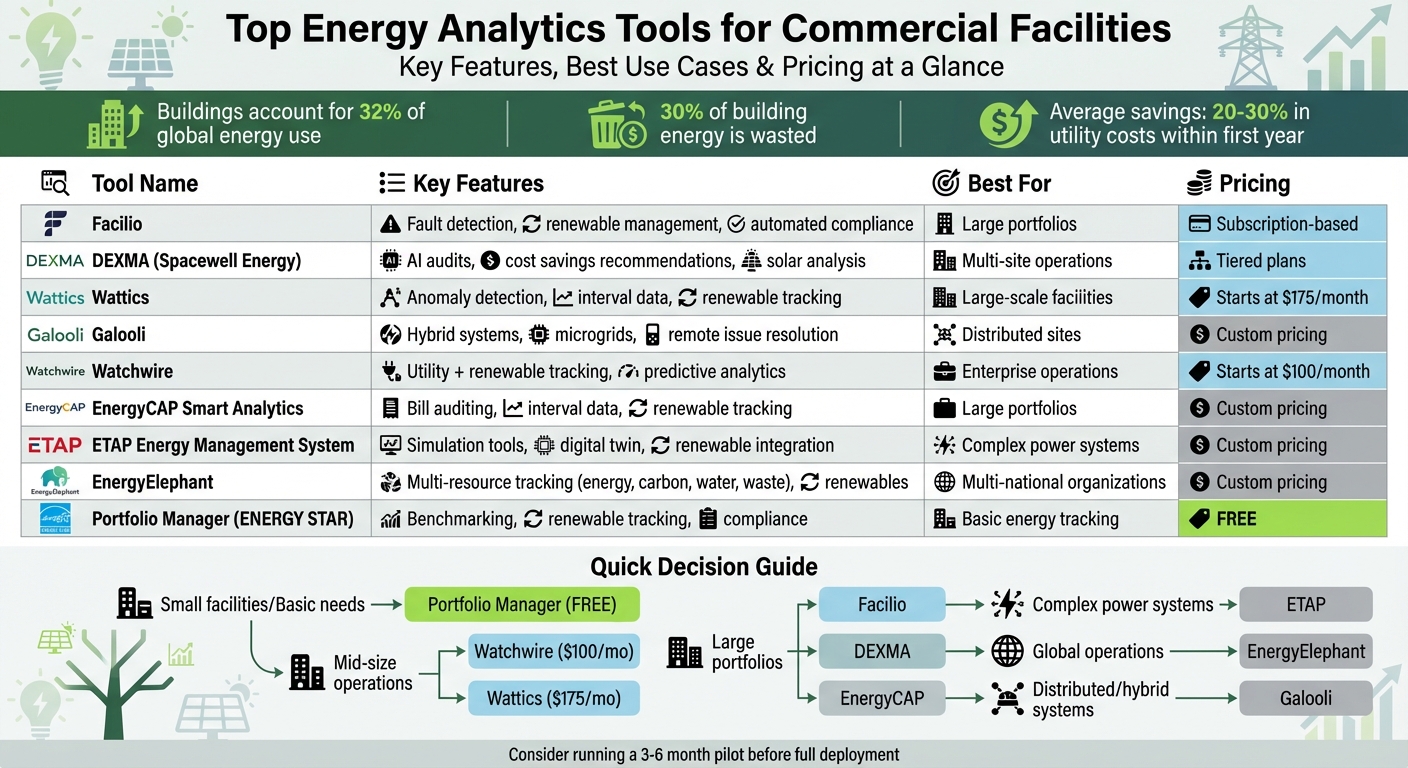
Top 9 Energy Analytics Tools Comparison Chart for Commercial Facilities
Facilio is a cloud-based platform designed for managing energy across large, multi-site commercial portfolios. It connects seamlessly with legacy Building Management Systems, meters, and IoT devices using standard protocols like BACnet, Modbus, and MQTT, simplifying energy management tasks across hundreds of buildings.
Facilio leverages machine learning-powered Fault Detection and Diagnostics (FDD) to identify energy anomalies in real time. For instance, if a chiller starts consuming 20% more power than usual, the system automatically generates a maintenance work order to resolve the issue. Facility teams can monitor energy consumption against baselines across entire portfolios through detailed dashboards.
One impressive example of Facilio’s impact is the Dubai World Trade Centre's One Central project, which achieved 8% energy savings within just four weeks of deployment in 2024. Rami Alaileh, AVP Destination Management, highlighted the project’s alignment with sustainability goals:
"Exceeding the highest benchmarks for sustainable design has been a priority from day one. Our deployment with Facilio directly supports the UAE's sustainability agenda - helping us achieve optimal efficiency in energy consumption and operations across One Central's diverse facilities."
Facilio users report significant operational efficiencies, including an 80% reduction in manual data entry and a 75% decrease in reporting efforts, with a return on investment in under six months. Compliance reporting for standards like GRESB, LEED, and ENERGY STAR Portfolio Manager is also automated, cutting regulatory paperwork time by up to 65%.
Beyond immediate cost reductions, the platform enhances its value by optimizing renewable energy management.
Facilio supports renewable energy integration through advanced analytics and AI-driven tools. Predictive load forecasting and bi-directional controls manage resources like on-site solar panels and battery storage, ensuring facilities operate efficiently and sustainably. The platform automates demand response during peak pricing periods and adjusts HVAC and lighting based on real-time occupancy and weather conditions. Additionally, it tracks carbon emissions and aligns renewable energy generation with building demands, enabling facilities to actively contribute to the energy grid rather than simply consuming power.
Facilio is built to scale effortlessly across large commercial portfolios. It can be deployed across an entire portfolio in two weeks or less and adapts to portfolios ranging from a few buildings to hundreds without requiring on-premise server upgrades. Investa’s David Breden, GM of Safety and Facilities for NSW, shared how the platform improved their operations:
"Thanks to Facilio's user-friendly platform, our team can now concentrate on strategic goals and the customer rather than getting entangled in routine operations."
Facilio offers subscription-based pricing, tailored to portfolio size and selected modules. While it boasts a 4.0/5 rating on Capterra, some users have noted it might be excessive for smaller, single-building applications.

DEXMA, a part of Spacewell Energy, is a cloud-based energy intelligence platform that monitors over 71,000 buildings and processes more than 32 million data readings every day. It’s designed to handle everything from monitoring a single site to managing reports for a global portfolio.
The platform uses AI to identify approximately 5,200 energy inefficiencies daily. Its Dexma Detect module conducts automated energy audits and provides savings recommendations tailored to real energy bills and data from over 50,000 similar buildings. Alongside this, Dexma Optimise offers 24/7 automated energy management.
Daniel Keane, General Manager at Radisson Blu, highlighted the platform's impact on their operations:
"Spacewell Energy (Dexma) helped us get through challenges with their technical expertise, analytical solutions and managed services. We are now in great place to run our hotel efficiently, ensuring our utility costs are operating as low as they can."
By leveraging machine learning, DEXMA can cut energy auditing time by 95%, incorporating weather data from 100,000 virtual stations to fine-tune energy usage patterns. These insights lead to measurable cost reductions and streamlined operations.
DEXMA’s analytics consistently help organizations lower utility expenses. Many see 15-30% savings on utility costs within the first year, with an average payback period of just 6 months. Real-time dashboards break down energy usage costs by factoring in Time of Use (ToU) tariff rates, enabling facilities to pinpoint peak demand charges and adjust consumption accordingly.
Paul Hale, Director at GETGEN for the DoubleTree by Hilton Dartford Hotel, described how DEXMA enhances project verification:
"Spacewell Energy (Dexma) has been integral for the measurement and verification of our projects on-site. It has allowed us to interrogate and analyse data intuitively and succinctly for us to report back to the client in real time."
The platform also features IPMVP-compliant verification tools, allowing organizations to demonstrate ROI to stakeholders in real time. Alerts for energy anomalies can be prioritized, ensuring maintenance teams focus on the most pressing issues with financial and environmental impacts.
Beyond cost savings, DEXMA is equipped for renewable energy management. It offers tools for solar performance analysis and microgrid management, enabling facilities to monitor on-site renewable energy assets. The platform tracks various energy forms, including exported energy, biomass, and thermal energy, giving a comprehensive view of a facility’s energy ecosystem.
DEXMA integrates seamlessly with over 200 pre-built connectors and an open API, making it compatible with sensors, SCADA, and BMS systems without locking users into specific vendors. It also tracks energy-related emissions and generates reports compliant with carbon disclosure regulations and ISO 50001 standards, aiding the shift to carbon-neutral operations.
DEXMA is built for scalability, enabling rapid deployment across large portfolios. With an Excel-based project importer, new sites can be set up in under 15 minutes, regardless of portfolio size. Currently, the platform serves over 10,000 organizations in 35+ countries, with Spacewell managing more than 50 million square feet of workspace globally.
To cater to different needs, DEXMA offers three pricing plans:
Wattics, acquired in August 2022 and now part of EnergyCAP Smart Analytics, is designed to meet the energy data needs of large commercial operations. With the ability to process over 500 billion data points and a presence in more than 55 countries, it provides a robust solution for monitoring energy use and generation on a large scale.
The platform's Sentinel feature uses four weeks of historical data to establish a baseline consumption model. Once set up, it automatically detects anomalies, such as unexpected consumption spikes or abnormal equipment behavior, and sends alerts via email, SMS, or in-app notifications.
Ian Beynon, Head of Energy at Royal Mail, highlighted the value of this functionality:
"We have over 500 billion data points and weren't getting any value out of it. With EnergyCAP, we can finally unlock that insight and drive action."
This software also cuts down the time energy analysts spend on repetitive tasks like data collection and reporting by 80–90%. Features like heatmaps help identify inefficiencies, such as HVAC systems running during unoccupied hours [25,26].
In addition to real-time monitoring, Wattics offers tools for tracking renewable energy, making energy management even more efficient.
Wattics simplifies renewable energy tracking through formula-based meters. These meters combine real readings, data points, and constants to monitor both on-site solar generation and grid energy use - all within a single dashboard [21,25,26]. The platform also includes a Carbon Hub, which provides financial-grade emissions data to measure the carbon reduction benefits of renewable installations. Automated IPMVP tools further validate the savings from these projects [21,22,26].
Commercial and industrial users frequently see energy savings of over 20%, with average annual reductions around 10% [22,23]. The tariff analytics tool is another standout feature, allowing facility managers to compare the past 12 months of energy usage against new utility contracts to secure the best rates [21,26].
John Corroon from Jurys Inn shared his experience with the platform:
"EnergyCAP Smart Analytics (Wattics) helped me immensely in energy-saving by identifying hidden areas. The technology is unique in what it can do and can find out when HVAC plant is on & off."
Wattics is built to scale across large operations, from whole-building monitoring down to device-level interval data. This capability helps facilities identify specific equipment contributing to energy waste [23,26]. It also supports integration with multiple meter brands, such as AcuRev, Verdigris, and EpiSensor, through API connections, ensuring centralized monitoring regardless of existing hardware. Pricing starts at $175 per month (billed annually) and $2.17 per meter per month for meter-based services.
Galooli is designed for large-scale commercial operations that need to manage hybrid energy systems and microgrids from a single, centralized platform. By collecting an impressive 10 billion data points daily from numerous IoT assets, it’s particularly effective for facilities with distributed energy sources. This capability aligns with the growing demand for data-driven, sustainable energy management, offering a streamlined way to integrate renewable energy resources.
Galooli’s hardware-agnostic platform connects renewable energy assets - like solar panels, backup generators, grid power, and battery storage - with existing sensors. This integration provides a unified dashboard that simplifies microgrid management. The result? Customers achieve an average annual reduction of 10% in greenhouse gas emissions.
With live KPI monitoring, Galooli transforms traditional equipment into smart assets through IoT sensors that track performance in real time. Facility managers receive instant alerts on web and mobile devices, enabling them to quickly address inefficiencies or malfunctions. The platform even supports remote control functions, allowing power adjustments without the need for on-site technicians.
Peter McCulloch, Technical Director, shared the platform’s impact:
"Over the past 12 months, 87% of operational issues across our fleet were resolved remotely, a major achievement in both performance and sustainability."
Galooli’s solutions delivered $300 million in energy savings for customers last year. The ability to resolve issues remotely reduces the need for on-site visits, cutting maintenance costs and lowering carbon emissions. Chris Glade, Executive VP of National Business Operations at Motive Infrastructure, highlighted this benefit:
"We have seen an immediate impact, saving Motive Infrastructure, and our customers, several hundred thousand dollars."
Additionally, for data centers and other large facilities, the platform focuses on optimizing HVAC systems and reducing energy waste, further driving operational savings.
Galooli is built to scale, making it ideal for multi-site operations. Its visual geographic map overlay provides a centralized view of remote facilities and energy assets across different locations. This feature helps facility managers identify regional performance outliers and address issues across their portfolios. Thanks to its hardware-agnostic design, scaling doesn’t require expensive proprietary upgrades, resulting in multi-million-dollar savings.
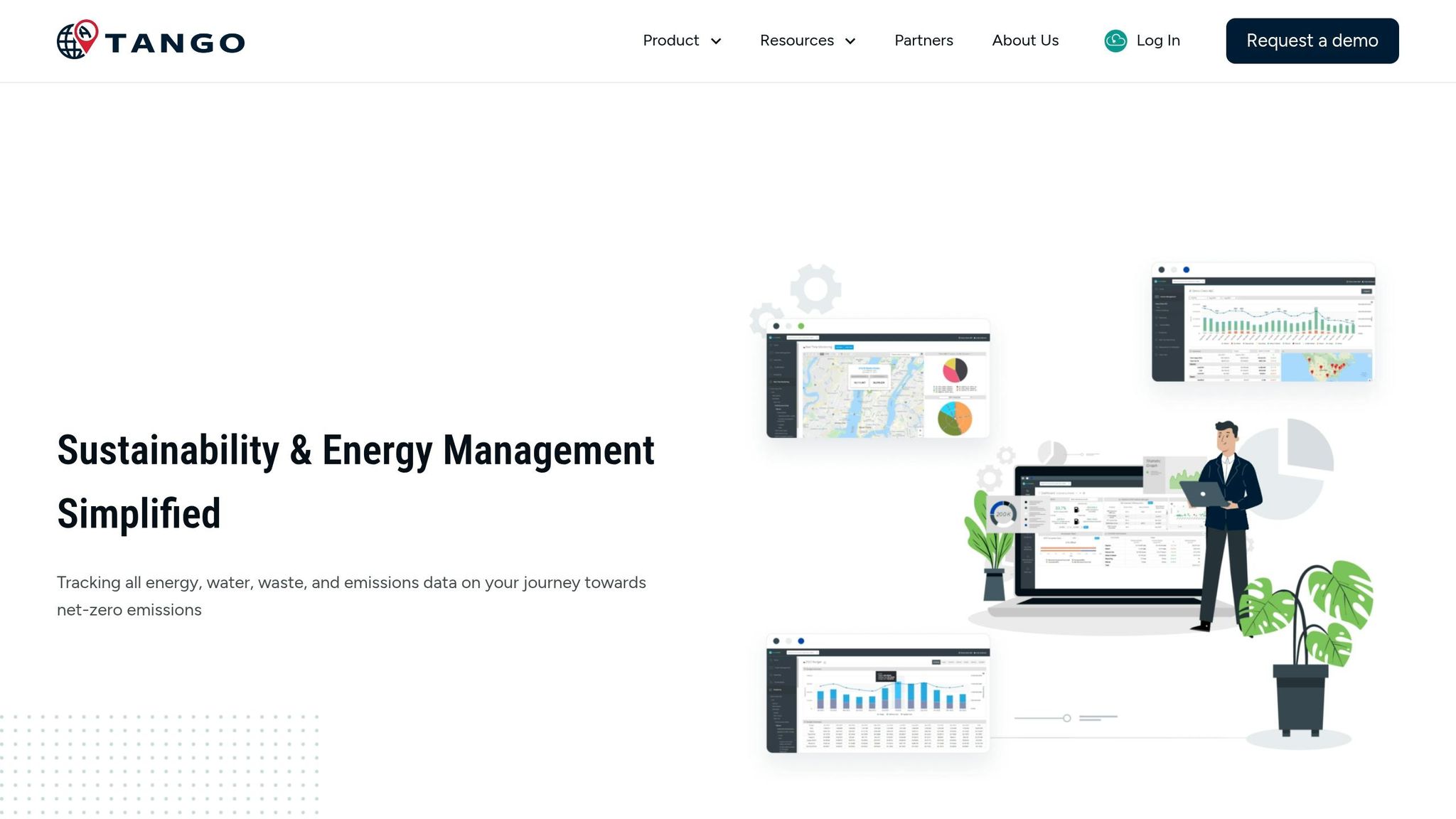
Watchwire, developed by Tango, is a cloud-based platform designed for large corporations that juggle complex utility data across multiple locations. With a stellar 4.9/5 rating from 28 reviews on SoftwareReview.com, users highlight its easy-to-navigate interface and detailed reporting features. What sets Watchwire apart is its ability to combine utility data with renewable asset performance, making it an essential tool for improving energy efficiency in expansive commercial operations. It builds on the strengths of earlier platforms, offering a streamlined approach to utility data analysis and renewable energy integration.
Watchwire brings together renewable production data - such as solar, fuel cells, and battery storage - and compares actual output against guaranteed levels, ensuring systems perform as expected. It also tracks Renewable Energy Credits (RECs) and manages Scope 1, 2, and 3 emissions, helping organizations meet net-zero goals. Its Measurement & Verification (M&V) feature provides clear insights into the return on investment for renewable energy initiatives.
Beyond renewable integration, Watchwire shines with its real-time monitoring capabilities. It analyzes interval data using visual tools that expose energy inefficiencies and unusual consumption patterns. The platform’s peak load management feature uses predictive analytics to alert users when utility grids - like PJM, NYISO, and ISONE - are likely to peak. This enables facilities to cut consumption and lower capacity charges. Automated alerts also flag equipment failures, ensuring swift action.
Richard Bachia, Executive Vice President of Operations at Brookfield Properties, shared his experience with Watchwire:
"The reporting platform helps our property managers, engineers, and executives monitor cost and consumption trends across all commodities nationally and has also decreased the time and effort required for our annual GRESB reporting."
Watchwire eliminates the need for manual data entry and validates energy-saving measures with its M&V tools, leading to tangible cost reductions. Pricing starts at $100 per month, while implementation costs range from $10,000 to $200,000, depending on the size and complexity of the organization.
Built for enterprise use, Watchwire is scalable for portfolios of any size, consolidating data from multiple locations into a single, searchable database. It integrates seamlessly with platforms like ENERGY STAR Portfolio Manager, LEED Arc, GRESB, CDP, and SASB, simplifying sustainability reporting. With SOC 2 compliance, it also ensures secure data management for enterprise-level operations. This robust integration not only streamlines sustainability efforts but also boosts overall operational efficiency, aligning with the broader energy analytics capabilities discussed earlier.
EnergyCAP Smart Analytics is a platform designed to handle the complexities of managing utility portfolios for organizations with thousands of facilities. With over US$100 billion in annual bill value under its management and a user base exceeding 26,000, the platform is built to deliver precision and efficiency at scale. It combines utility bill management with interval data analysis, identifying errors in 20% of processed utility bills and flagging approximately 375,000 unusual-use bills annually. Most organizations using the platform report an average of 10% annual energy savings.
EnergyCAP Smart Analytics goes beyond bill management by offering advanced tools for renewable energy tracking. Leveraging customizable formula-based meters, the platform enables users to monitor both energy consumption and renewable energy generation. This gives facilities a comprehensive view of their renewable energy performance. Users can set up custom formulas to calculate metrics like net energy use or specific renewable energy outputs by combining data from real meters and other data points.
The platform consolidates energy, utility, and carbon data into a single system, making it easier to assess how renewable energy sources influence carbon footprints at the meter, building, and portfolio levels. Its Measurement and Verification (M&V) tools adhere to IPMVP standards, helping users establish baselines and calculate savings from renewable energy initiatives.
The Sentinel machine-learning tool is a standout feature, learning building and equipment behavior over a four-week period to create models that compare actual energy loads with expected ones. When anomalies are detected, the system sends automated alerts via email, SMS, or in-app notifications. Tools like heatmap visualizations and power quality analysis further enhance the platform, helping users identify changes in peak demand and optimize consumption schedules. These insights often highlight the need for hardware upgrades, such as commercial LED lighting retrofits, These real-time insights drive actionable cost reductions and improve facility efficiency, while also supporting renewable energy optimization efforts.
EnergyCAP Smart Analytics delivers measurable financial benefits. For example, the County of Riverside in California saved US$336,697 through bill auditing, US$25,250 annually with electronic billing, and projects an additional US$45,000 in savings using automated invoice processing. Nick Wood, Technology Director, highlighted the platform's efficiency, noting that it could reduce the time energy analysts spend on repetitive tasks like data collection and handling by 80–90%.
The platform is designed to scale effortlessly, accommodating portfolios of all sizes - from a few buildings to thousands of facilities. Its unified data tree structure simplifies the management of campuses, buildings, and meters, even in complex submetering and deregulated utility environments. EnergyCAP Smart Analytics identifies 900,000 duplicate or overlapping bills annually and supports API integrations with smart meter brands like AcuRev, Verdigris, and EpiSensor.
Aref Abouzahr, CEO of Ark Energy, praised the platform, saying:
"probably the most state-of-the-art energy management information system I have encountered in over 25 years in the industry".
ETAP Energy Management System is a powerful, model-based platform designed for simulating, planning, and controlling power systems. By using an integrated electrical digital twin, it allows operators to monitor, simulate, and fine-tune renewable power plants effectively. With over 50,000 licenses sold across 100+ countries and 93% of U.S. nuclear power plants standardizing on ETAP, the software has demonstrated its reliability for managing large-scale, critical operations.
ETAP leverages its robust simulation capabilities to seamlessly incorporate renewable energy assets. Its Power Plant Controller (ePPC) directly interfaces with renewable inverters, battery energy storage systems (BESS), and capacitor banks, enabling real-time generation management. The platform also includes specialized tools for modeling wind and solar farms, facilitating grid interconnection studies and assessing wind energy penetration to ensure secure renewable integration.
ETAP's BESS solutions stabilize renewable energy output, enhancing system reliability while increasing profitability for farm operators. For instance, Vu Duc Quang, Deputy Director at PECC2 in Vietnam, used ETAP to model the country's power system, identifying optimal locations and capacities for BESS. This effort reduced system overloads and enabled peak shaving. Additionally, ETAP conducted an arc flash analysis for a 2.3 MW photovoltaic facility, covering both AC and DC systems, and addressed equipment operating outside IEEE 1584-2018 voltage limits. These capabilities solidify ETAP's role in advancing renewable energy solutions for large-scale operations.
ETAP’s Power System Monitoring & Simulation (PSMS™) provides operators with intelligent monitoring and predictive simulation tools. These features allow users to test scenarios before implementing changes, improving decision-making. Real-time load forecasting uses weather-adaptive algorithms to correlate environmental conditions with system load.
The Energy Accounting feature further tracks energy usage and costs in real time, helping facilities avoid peak demand penalties and secure better utility rates. For example, Skyworks, a semiconductor manufacturer in Mexicali, Mexico, utilized ETAP's Digital Twin and PSMS over a five-year span, expanding their system model to include low-voltage equipment and predictive simulations. This initiative improved system reliability and cut CO₂ emissions by 29,173 tons.
ETAP’s modular design enables it to manage power systems comprehensively, scaling from single facilities to multi-site portfolios. Major utilities like Exelon and Novec, as well as nuclear facilities such as ITER and FirstEnergy, depend on ETAP for their large-scale operations. Ontario Power Generation highlighted the platform's transformative impact:
"ETAP is an intelligent tool that has brought a very large and complex electrical system within our reach, enabling us to achieve all the things that we could not do before".
Additionally, ETAP’s Economic Dispatch and Unit Commitment algorithms help reduce operating costs by optimizing fuel usage and distributing demand efficiently across controllable units. These features position ETAP as a versatile tool for addressing the evolving needs of energy management systems.
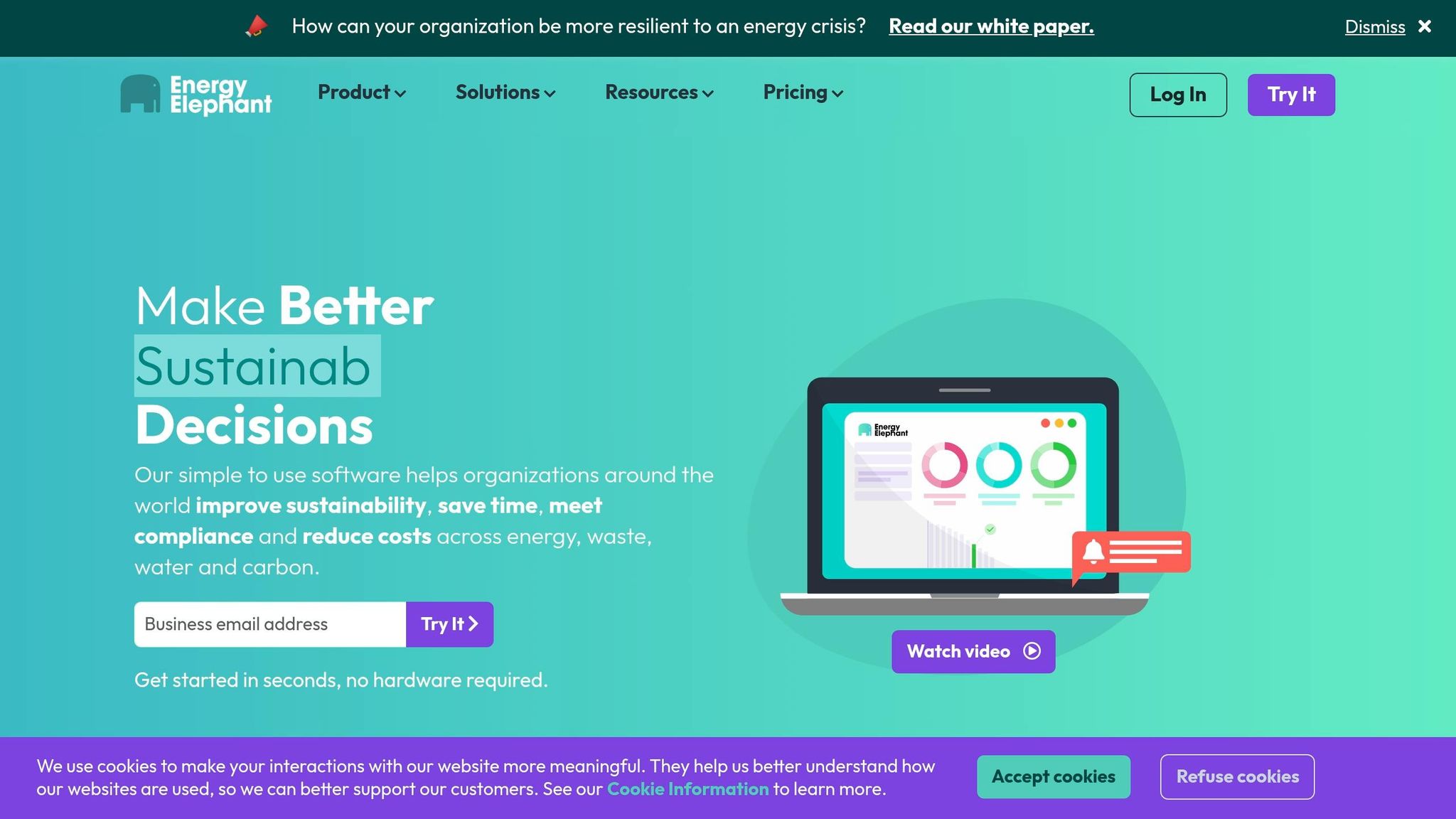
EnergyElephant stands out as a cloud-based platform that seamlessly combines utility management with tools for decarbonization and renewable project tracking. Designed for multi-site organizations, it consolidates data on energy, carbon, waste, and water across various locations. With over $3 billion in energy and sustainability costs managed so far, the platform offers robust utility bill management, operational analytics, and decarbonization planning - all without requiring proprietary hardware. It integrates effortlessly with existing IoT sensors and sub-metering systems for immediate deployment.
The platform excels in helping organizations plan and monitor renewable energy and storage projects. Using Marginal Abatement Cost Curves, EnergyElephant evaluates the costs and savings of different decarbonization strategies, such as transitioning to solar panels or biomass boilers, tailored to specific sites.
Asset-level tracking ensures managers can assess the performance of renewable installations across various locations. Additionally, the platform incorporates real-time grid emission factors for accurate carbon accounting, covering Scope 1, 2, and 3 emissions. This feature allows organizations to see how renewable energy impacts their carbon footprint in real-time. Its Monitoring and Verification (M&V) tools further track the performance of energy upgrades, renewable deployments, and storage solutions like Tesla Powerwall, ensuring that projects meet their expected ROI.
These capabilities are bolstered by real-time insights, enabling organizations to make immediate operational adjustments as needed.
EnergyElephant integrates with IoT sensors and sub-metering systems to provide live energy performance data. The platform automatically detects anomalies, enabling quick corrective actions. Organizations can track progress toward energy efficiency and carbon reduction goals using real-time data compared to historical baselines.
With advanced automation, the software reduces manual data processing by up to 90%, streamlining reporting and freeing up resources for other critical tasks.
EnergyElephant is widely recognized for its ability to pinpoint cost-saving opportunities. Brendan B., a Quality Executive in the transport sector, shared:
"This software is really user friendly. One of the best features is its ability to identify potential cost savings".
The platform's Smart Opportunity Register prioritizes projects based on projected savings and payback periods. Additionally, internal carbon pricing tools help organizations model the financial impact of future carbon taxes, aiding in long-term investment planning. This focus on renewable project ROI aligns with broader trends in energy analytics.
EnergyElephant also supports various data formats (PDF, CSV, Excel, EDI, XML), simplifying utility bill management across global portfolios. With multi-country and multi-currency capabilities, it’s an excellent choice for international operations.
Designed with large, multi-national organizations in mind, EnergyElephant easily handles the complexities of geographically distributed operations. Its Divisions feature organizes data into groups that mirror an organization’s structure, allowing decentralized teams to take ownership of their energy use. This approach encourages behavior-based energy savings by assigning accountability to specific units or departments.
The platform also delivers audit-ready reporting compatible with international standards, including CSRD, ISO 50001, B Corp, CDP, and the GHG Protocol. Kevin M., an Energy Manager at a city authority, praised its user experience:
"The experience has been very good, it's easy to use and the customer support has probably been one of the best I have dealt with".

Portfolio Manager is a free, web-based tool developed by the U.S. Environmental Protection Agency (EPA) to help businesses benchmark energy and renewable performance. As the go-to resource for energy benchmarking, it’s widely used across the industry, with over 450,000 buildings relying on it. The tool currently manages energy data for more than 150,000 U.S. commercial and multifamily properties through its Data Explorer feature.
This platform allows users to track on-site solar PV and wind energy production, clearly distinguishing between energy that’s consumed onsite and energy exported back to the grid. It also supports tracking Renewable Energy Certificates (RECs), enabling facilities to account for "Avoided Emissions" from both on-site renewable systems and purchased green power.
Portfolio Manager handles intricate scenarios, such as net metering and REC arbitrage, where facilities sell their own RECs and buy replacements from other sources. To claim avoided emissions benefits from on-site renewables, facilities must keep the RECs tied to their systems. The EPA even offers a concise 5-page guide to help facilities benchmark on-site renewable energy, especially when dealing with net-metered utility data. These renewable tracking features integrate seamlessly with the platform’s scalable data management tools, making it a solid choice for managing diverse property portfolios.
For large-scale operations, Portfolio Manager provides Campus Benchmarking, which allows users to treat multiple connected buildings as a single property for energy tracking. This is particularly useful for hospitals, schools, and office parks with multiple structures. Additionally, the Aggregate Meters feature simplifies data handling by combining multiple meters - such as those in an apartment complex with 100 tenant meters - into one entry.
To streamline data entry, large organizations can use the platform’s Web Services API. This automation lets utilities and third-party providers push energy data directly into Portfolio Manager, eliminating the need for manual input. With the ability to track over 100 metrics, including energy and water costs, the tool helps managers keep tabs on both resource consumption and financial performance.
Portfolio Manager compares building performance to national benchmarks. Buildings earning a score of 75 or higher are recognized as top performers, typically consuming less energy and incurring lower operating costs than average buildings. A score of 50 signals median energy performance nationwide.
The platform also identifies data gaps and overlaps through its Alert Metrics feature, ensuring accurate calculations for both energy use and financial reporting. Additionally, the "Change in EUI" metric tracks energy use intensity before and after upgrades, enabling facilities to measure the financial impact of efficiency projects.
Each platform offers its own strengths and trade-offs, making it important to choose the right tool for your specific needs. Here's a summary of what sets them apart, along with their limitations.
EnergyCAP shines in audit-grade utility bill management and automated ENERGY STAR integration. This makes it a great choice for portfolios focused on compliance. However, it relies heavily on clean and accurate utility data feeds.
DEXMA (Spacewell Energy) takes a hardware-agnostic approach, making it easy to deploy across a variety of meter types. This flexibility is one of its standout features.
Facilio integrates real-time fault detection directly with work order systems. This reduces the time between spotting an issue and resolving it, streamlining operations.
For global operations, EnergyElephant is a solid choice. It handles multi-country utility management and tracks not only energy but also water, waste, and carbon. However, its broad focus on multiple resources might lack the detailed fault diagnostics that more specialized platforms provide.
Portfolio Manager remains a go-to tool for benchmarking and meeting regulatory requirements. It’s free and allows you to compare your building's Energy Use Intensity (EUI) against national averages. That said, it primarily focuses on historical monthly data and doesn’t offer real-time control or comprehensive billing management.
Wattics simplifies energy analysis by automating data processing, cutting analysts' workloads by 80–90%. Meanwhile, Galooli specializes in managing hybrid energy systems for distributed sites, resolving 87% of operational issues remotely.
Watchwire stands out for its combination of utility data management and renewable asset performance tracking. Users rate it highly (4.9/5) for its intuitive interface and detailed reporting.
ETAP Energy Management System provides advanced tools like model-based simulation for complex power systems. It allows operators to test scenarios before implementation and optimize renewable integration using digital twin technology.
While many platforms now support hardware-agnostic data capture, the level of renewable analytics varies widely. Some offer basic production tracking, while others provide advanced modeling tools to optimize system performance and manage battery storage for peak shaving.
Selecting the right platform comes down to how well it aligns with your operational goals. If utility bill management and compliance across a portfolio are top priorities, EnergyCAP is a strong choice. It identifies billing errors in about 20% of utility bills and typically helps teams save at least 10% annually on energy costs. For facilities moving toward renewable energy, tools like EnergyCAP Smart Analytics and ETAP offer advanced modeling to guide planning and efficiency efforts.
Your budget and facility size are equally critical factors. Smaller operations might find free tools like Portfolio Manager sufficient for basic benchmarking. On the other hand, larger campuses managing more complex portfolios will benefit from enterprise platforms like EnergyCAP, which can scale based on the number of meters you need to track.
Let your operational goals drive the decision. Platforms such as EnergyCAP Smart Analytics and Portfolio Manager not only simplify utility bill management and compliance reporting but also support renewable energy tracking. If you’re managing solar, wind, or storage assets, platforms with real-time SCADA integration and AI-driven optimization can provide the most value. For those focused on meeting regulatory compliance or achieving building performance standards, Portfolio Manager is an effective tool for benchmarking and certification support.
Before committing, consider running a 3–6 month pilot with your actual data to confirm the platform’s compatibility with your systems and its ability to deliver meaningful insights. It’s also wise to ensure the platform supports open protocols like BACnet and Modbus to avoid being locked into a single vendor.
The right energy analytics platform will help reduce costs and improve efficiency while scaling to meet your future needs. A well-chosen platform minimizes manual work, identifies inefficiencies, and can deliver annual cost savings of 20–30%, all while adapting to your evolving energy management requirements.
To kick off an energy analytics pilot, it's essential to gather the right data to ensure accurate and actionable insights. Here's what you need:
By collecting this information upfront, you set the stage for thorough analysis, effective benchmarking, and uncovering opportunities to improve energy efficiency.
These tools help fine-tune the use of on-site solar panels, batteries, and net metering by identifying the most cost-effective combinations of energy storage and solar power. They can also provide backup power during outages and improve how energy demand is managed. Many of these tools use real-time data and AI-driven analytics to boost efficiency and increase savings.
The most effective way to show the return on investment (ROI) from energy savings and upgrades is through advanced energy analytics and real-time monitoring systems. These tools deliver precise, actionable insights that highlight operational improvements and cost savings, making it easier to assess the true impact of your energy investments.


