.svg)
Cut facility lighting costs 50–70% with scalable high-bay LEDs—longer life, lower maintenance, fast payback with rebates and Section 179D.

Switching to scalable high-bay LEDs can save you up to 70% on energy costs, reduce maintenance expenses, and improve lighting quality in large facilities. These systems are ideal for warehouses, manufacturing plants, and distribution centers with high ceilings. LEDs last longer (up to 100,000 hours), use less power (e.g., 150W LEDs vs. 400W metal halides), and support advanced controls like occupancy sensors and daylight harvesting for even greater savings. Combined with utility rebates and tax deductions, most LED upgrades pay for themselves within 1–2 years, making them a smart investment for cutting operational costs through our proven process for lighting solutions.
Key benefits:
Facilities upgrading to LED systems also benefit from lower HVAC loads, customizable lighting zones, and compliance with energy regulations. With rebates covering up to 40% of costs and federal tax incentives like the Section 179D deduction, 2026 is the perfect time to make the switch.
Scalable LED solutions address many of the shortcomings of older lighting systems, offering benefits in energy efficiency, durability, and light quality.
LED high-bays are a game changer when it comes to energy efficiency and cost savings. For example, while a traditional metal halide fixture consumes about 458 watts, a 150W LED fixture provides equal or better lighting using far less power. With luminous efficacy now reaching 130–160 lumens per watt, and some models achieving 175 lm/W, LEDs far outperform the 35–70 lm/W typical of metal halide systems.
"Higher wattage does not equal brighter light. In reality, the critical metric is luminous efficacy, measured in lumens per watt (lm/W)." – Steve Shepherd, Project Lead, hi-hyperlite.com
These savings multiply in large facilities. For instance, a 200,000 sq. ft. building operating 24/7 can cut annual energy usage from 1,103,760 kWh to 429,600 kWh by switching from metal halide to 150W LED fixtures - a reduction of 674,160 kWh. Even facilities with single-shift operations can save 200,100 kWh annually. LEDs also generate less heat, which can lower HVAC cooling loads by 8–15% in climate-controlled environments. Additionally, LEDs lose only 10–15% of their light due to fixture optics, compared to the 30–50% loss with HID lamps, ensuring more light reaches the intended areas.
One of the standout benefits of LED high-bays is their longevity. Unlike metal halide lamps that require frequent replacements, LEDs can last up to 100,000 hours. This extended lifespan significantly reduces the costs associated with maintenance, such as lift rentals, labor, and disposal, which can add up to $32 to $55 per fixture annually for HID systems.
"Maintenance is a hidden cost... LED high-bay lights last much longer, often between 50,000 and 100,000 hours, which means fewer replacements, less labor, and reduced downtime." – Hylton Electric
LEDs are built to handle tough conditions. Solid-state technology resists vibrations, shocks, and temperature swings, while fixtures with IP65 or higher ratings protect against dust and moisture, reducing the risk of internal damage [11, 12, 14]. Features like aluminum heat sinks and cooling fins help manage heat, while high-quality drivers ensure stable electrical flow and surge protection [9, 10, 13]. For example, in November 2025, a 50,000 sq. ft. distribution center replaced 120 metal halide fixtures with 150W LEDs, cutting system wattage from 54.9 kW to 18 kW and slashing annual energy costs by 70%, saving approximately $41,000.
LED technology doesn’t just save energy - it also improves visibility and operational efficiency. Modern LED high-bays offer CRI ratings of 70–90+, far better than the 20–65 range typical of metal halide systems. This enhanced color rendering allows workers to read labels more easily and spot defects more accurately. Facilities that have upgraded to high-CRI LEDs report reductions in order fulfillment errors by 5% to 12% [3, 8].
LEDs also eliminate the 10–20 minute warm-up period of older systems, providing instant-on performance that’s crucial for safety during power interruptions [1, 8]. Their stable, flicker-free light reduces eye strain and supports the accuracy of automated systems like sensors and cameras [2, 8]. Precision optics ensure light is directed where it’s needed, minimizing glare and providing even coverage.
Real-world examples highlight these benefits. In March 2024, a 250,000 sq. ft. cold storage facility in Ontario, California switched to 180W LED UFO high-bays, improving the CRI from 65 to 72 and reducing picking errors by 8% in monitored aisles. Smart controls can amplify these advantages further. Occupancy sensors and task tuning allow facilities to adjust lighting by zone - for instance, using 50 foot-candles in picking areas and 20 foot-candles in bulk storage - to optimize both visibility and energy usage [3, 8]. In September 2024, a 150,000 sq. ft. e-commerce center in Columbus, Ohio installed 135W linear LEDs with wireless controls, achieving a 78% total energy reduction through efficient fixtures and occupancy-based dimming.
These combined benefits make scalable LED high-bays an effective solution for improving efficiency and cutting costs in large-scale operations.
Combining utility rebates with the Section 179D Energy Efficient Commercial Buildings Deduction can make upgrading to high-bay LEDs an appealing investment, often delivering payback periods of just 1–4 years.
As of 2025, around 77% of U.S. regions offer commercial lighting incentive programs. These rebates come in various forms:
Some programs even offer bonus periods where rebates increase by 10%–100%. For example, Oregon’s Eugene Water & Electricity Board provided a 25% bonus for commercial lighting projects completed by September 1, 2025.
To qualify, most programs require the use of DesignLights Consortium (DLC)-certified products, pre-approval before installation, and thorough documentation, including product specs and invoices. Adding smart controls, such as occupancy sensors or daylight dimming, can further increase rebate amounts, as many incentives now reward integrating control systems alongside LED fixtures.
Federal tax incentives add another layer of savings to these rebate programs.
For projects initiated before June 30, 2026, the Section 179D deduction offers between $0.60 and over $5.00 per square foot, depending on energy performance and compliance with prevailing-wage requirements. For large commercial or industrial facilities, this can translate into tax savings worth hundreds of thousands of dollars.
When combined with utility rebates, the financial impact becomes even more compelling. Rebates typically cover 15–40% of project costs, while the 179D deduction reduces tax liability further. Together, these incentives often result in payback periods of just 1–4 years, making 2026 a pivotal year for LED upgrades before the current provisions expire. Contractors experienced in handling incentive paperwork can help ensure all technical and wage documentation is completed correctly for tax purposes.
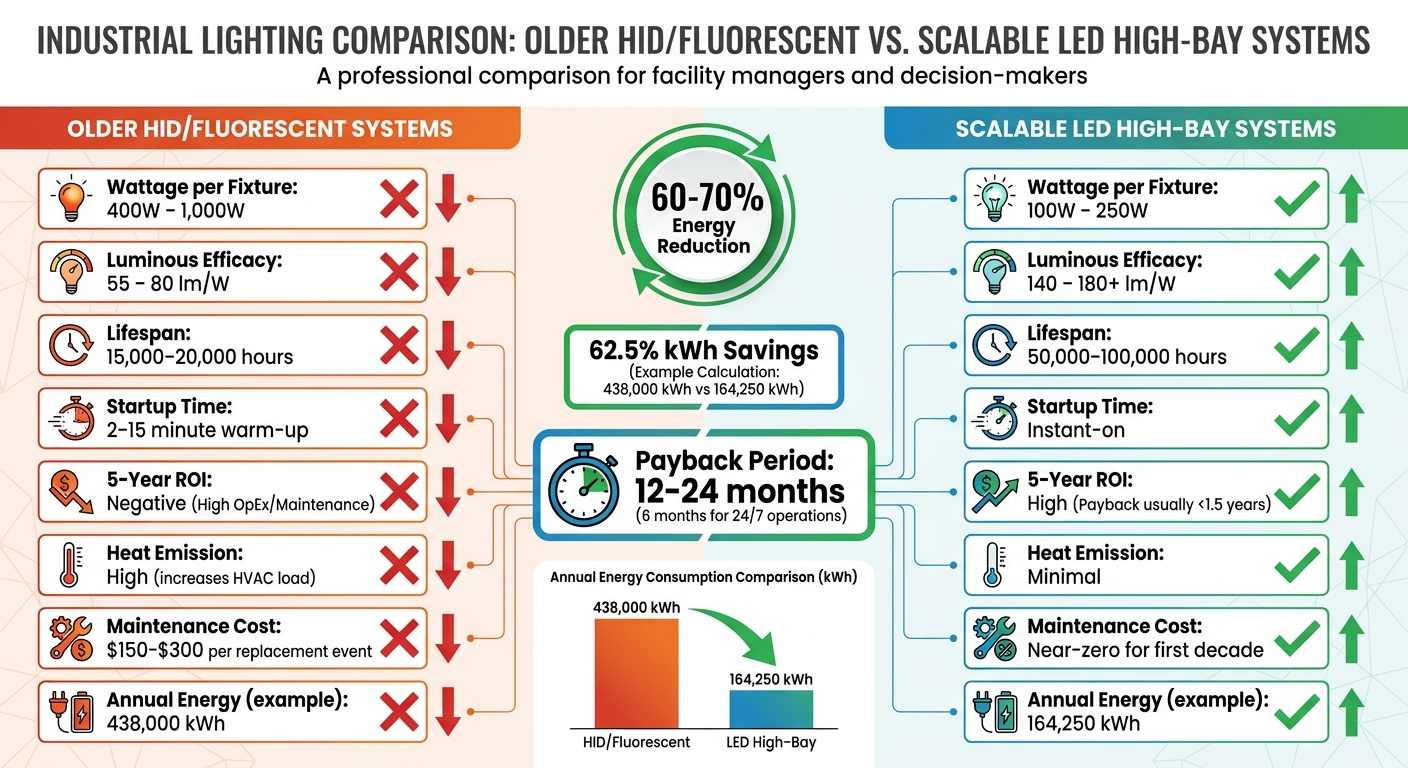
LED vs Traditional High-Bay Lighting: Energy Savings and ROI Comparison
Scalable LED systems bring adjustable features that traditional lighting just can’t match. Modern fixtures often include switches for wattage and color temperature, allowing facility managers to tweak performance right on-site. For instance, a single fixture can shift between 100W and 250W or change its color temperature from a warm 3,000K to a brighter 5,000K, depending on the specific needs of the space. These adjustments not only enhance flexibility but also cut down on energy use, saving money by avoiding unnecessary light output.
Another key feature is modular controls, which add even more adaptability. Facilities can install add-ons like "Twist-to-Lock" occupancy sensors, motion detectors, or daylight harvesting modules as their needs evolve. These controls work seamlessly with 0–10V dimming protocols, creating task-specific zones where light output can drop by 30–40% in less busy areas while staying fully lit where it’s needed most.
The optical design of these systems is also highly adaptable. Fixtures can use interchangeable beam angles - 60°, 90°, or 120° - to adjust light distribution as layouts change. For example, 120° beams are ideal for ceilings under 25 feet, 90° works well for those between 25–35 feet, and narrow 60° beams are best for ceilings over 35 feet. Plus, flexible mounting options like hook, pendant, surface, or inverted installations mean these systems can fit various ceiling structures without requiring custom modifications. This adaptability is a big step up from older lighting systems.
"Moving from a legacy system to LED is not just about a one-for-one swap. The goal is to design a system that delivers better, more efficient light."
– Steve Shepherd, Facility Audit Specialist
When you look at the numbers, the advantages of scalable LEDs become crystal clear. Traditional metal halide and HID fixtures typically use 400W to 1,000W per unit. In contrast, scalable LED high bays deliver the same - or better - brightness while using just 100W to 250W. That’s a 60–70% cut in energy consumption. And because LEDs produce far less heat than older fixtures, they also help reduce HVAC costs.
| Feature | Older HID/Fluorescent Systems | Scalable LED High-Bay Systems |
|---|---|---|
| Wattage per Fixture | 400W – 1,000W | 100W – 250W |
| Luminous Efficacy | 55 – 80 lm/W | 140 – 180+ lm/W |
| Lifespan | 15,000–20,000 hours | 50,000–100,000 hours |
| Startup Time | 2–15 minute warm-up | Instant-on |
| 5-Year ROI | Negative (High OpEx/Maintenance) | High (Payback usually <1.5 years) |
| Heat Emission | High (increases HVAC load) | Minimal |
The maintenance savings are equally impressive. Legacy systems require frequent bulb and ballast replacements every 15,000–20,000 hours, often costing $150–$300 per event. Add in scissor lift rentals and labor costs, which can run $120+ per hour, and the expenses quickly pile up. LEDs, on the other hand, last 50,000–100,000 hours, virtually eliminating maintenance for 10 years or more.
"Modern LED linear high bays offer a 60–70% reduction in energy consumption, near-zero maintenance costs for the first decade, and an ROI that typically pays back the initial investment in under 12 months for 24/7 operations."
– Richard Miller, Industrial Lighting Specialist
These technical advantages translate into real savings and faster ROI, as shown in the examples below.
A logistics center in Texas saw dramatic results in 2026 after replacing 250 HID (400W) fixtures with 250 LED high bay lights rated at 150W. This upgrade slashed annual energy use from 438,000 kWh to 164,250 kWh - a 62.5% reduction - and saved $32,850 annually. The project paid for itself in just 13 months.
Meanwhile, an Ontario, California cold storage facility tested scalable LEDs under tough conditions. In March 2024, the 250,000 sq. ft. warehouse swapped out 312 legacy 400W metal halide fixtures for 180W LED UFO high bays with adjustable wattage settings. Thanks to an $18,720 rebate from Southern California Edison, the $68,640 project saved 552,960 kWh annually - a 62% cut. Facility managers fine-tuned the wattage to 200W in active zones and 150W in storage areas, optimizing visibility and energy use. Combined with $22,464 in avoided maintenance and $8,940 in demand charge savings, the facility reaped $106,054 in annual benefits, achieving payback in just 7.8 months.
For more advice on designing scalable LED systems that maximize savings and deliver quick ROI, check out the experts at Luminate Lighting Group, who are leading the charge in high-performance lighting solutions across the U.S.
Scalable high-bay LED systems deliver impressive ROI by cutting energy use by 50–70%, requiring minimal maintenance for over a decade, and benefiting from utility rebates that can offset 20–50% of the initial costs. In fact, most warehouse LED retrofits achieve full ROI within 12 to 24 months, with facilities operating 24/7 often seeing payback in under six months.
Beyond these savings, advanced LED fixtures with features like interchangeable optics, modular controls, occupancy sensors, and daylight harvesting can add another 30–50% in energy savings. These upgrades also reduce HVAC loads, improve safety, and ensure compliance with modern building codes. This makes them a practical solution to the inefficiencies and high costs tied to outdated lighting systems.
"An LED retrofit is the most effective capital expenditure a facility manager can propose to reduce immediate OpEx."
– Steve Shepherd, hi-hyperlite.com
The combined benefits highlight the game-changing potential of scalable LED retrofits for today’s facilities. For facility managers aiming to maximize ROI, working with professionals who specialize in photometric design, rebate programs, and long-term performance is essential. Luminate Lighting Group offers expertise in energy-efficient LED retrofits, custom lighting designs, and energy audits tailored to warehouses, industrial sites, and commercial properties. Their services cover everything from baseline audits and DLC-certified fixture selection to rebate applications and 179D tax deduction assistance, ensuring projects deliver fast payback and enduring value.
Ready to cut energy costs and eliminate maintenance challenges? Contact Luminate Lighting Group today to start your scalable LED retrofit journey.
When selecting lighting, it's smarter to prioritize lumen output and beam angle optics instead of focusing solely on wattage. High-lumen fixtures with better efficiency (measured in lumens per watt) deliver brighter light while using less energy, making them both effective and energy-conscious.
For beam angles, consider your ceiling height. Narrower angles, like 60°, are ideal for higher ceilings as they focus light downward. On the other hand, wider angles, such as 90° or 120°, spread light evenly, making them perfect for lower ceilings. This ensures consistent lighting and enhances safety throughout the space.
The best way to cut down on energy use in warehouses is by using occupancy sensors, daylight harvesting, and task-tuning controls. These tools work together to make sure lights are only on when needed, adjusting brightness based on available natural light and specific tasks. With these systems in place, energy savings can reach an impressive 70-80%, as they help eliminate wasted electricity.
To tap into utility rebates and the 179D tax deduction, your LED retrofit project needs to meet specific energy efficiency standards. Utility rebates help reduce installation costs, while the 179D deduction can provide up to $5.00 per square foot for qualifying upgrades - especially beneficial for larger facilities. Make sure your project complies with these criteria to fully take advantage of the savings and incentives available.


