.svg)
Learn how 2026 global energy policy shifts shape commercial buildings, from energy efficiency rules and carbon pricing to energy costs, supply risk, and building investment.

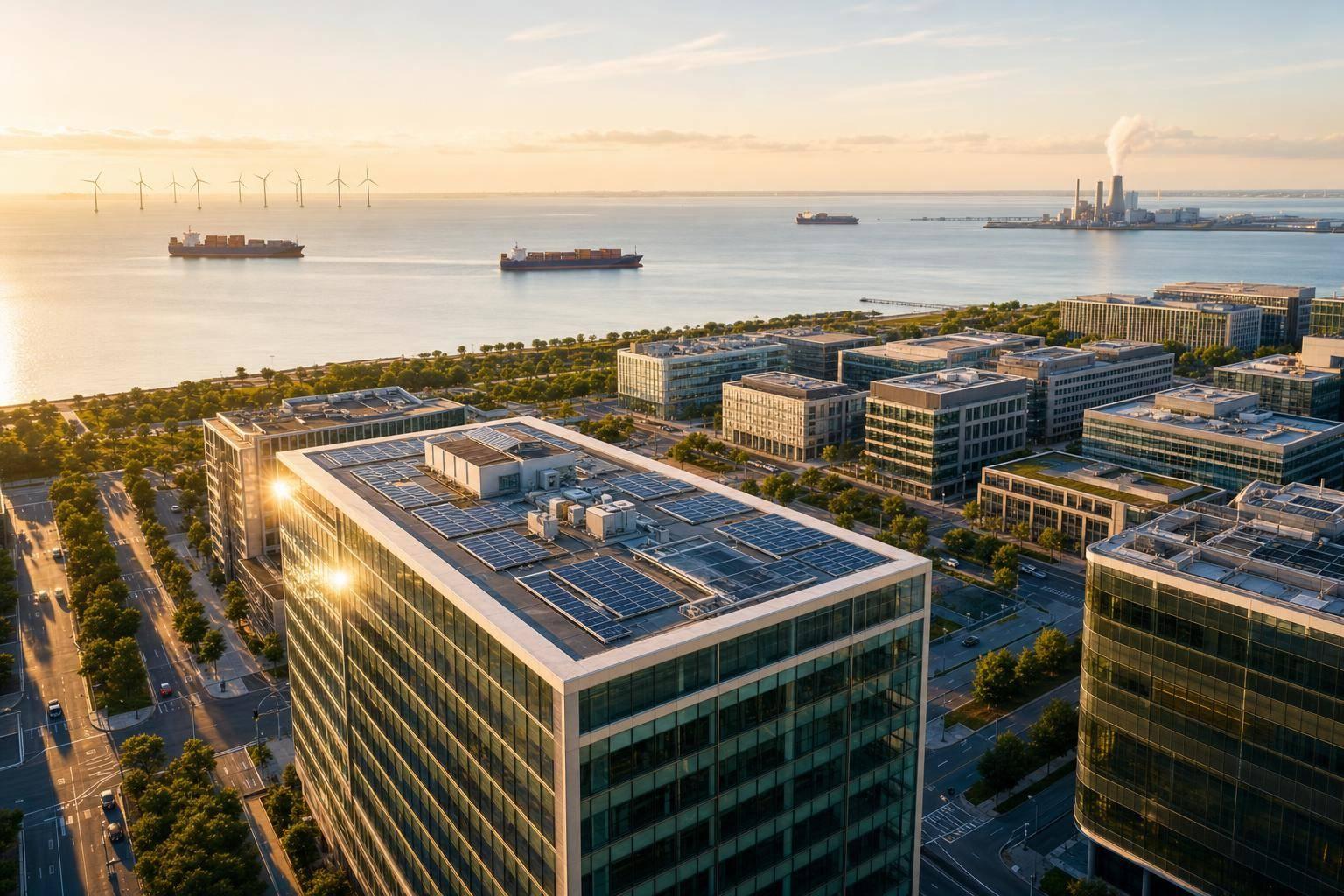
Energy policy can feel far removed from day-to-day building operations - until utility rates spike, equipment standards change, or a capital plan suddenly has to account for new compliance rules. That was the underlying message of a recent expert discussion on global energy policy trends: what governments decide about energy security, efficiency, carbon pricing, and public spending eventually shows up in the economics of commercial buildings.
For commercial real estate owners, facility managers, industrial operators, and public-sector decision-makers, the significance is practical. Policy shifts influence which technologies get funded, which retrofits pencil out, how quickly efficiency standards evolve, and where energy risk is headed next.
This article distills the discussion into what matters most for the built environment. Rather than retelling the webinar, it connects the panel’s findings to the questions building leaders are already asking:
The webinar centered on a major policy-tracking effort reviewing more than 6,500 measures across 80-plus countries. While much of the discussion was global, the implications are local.
Commercial buildings sit at the intersection of several policy currents:
In other words, buildings are where policy becomes operational reality.
A facility director may not follow international energy diplomacy, but they will feel the effects through:
The webinar made clear that policy is no longer moving in a single direction. Some governments are doubling down on long-term transition goals, while others are softening rules or revising spending commitments. That mixed picture creates both risk and opportunity for commercial properties.
One of the strongest themes in the discussion was that energy security remains the dominant force behind many policy decisions.
Historically, energy security policy focused on fuel disruptions - especially oil and natural gas. The panel described how countries have built emergency stockpiles and response plans over decades, with new urgency after Russia’s invasion of Ukraine and ongoing instability affecting major energy regions.
For building operators, this matters because energy security is no longer just about national stockpiles. It increasingly affects:
If natural gas markets remain vulnerable to geopolitical disruption, electrification can become more attractive not only for emissions reasons, but for operational stability.
Facilities may need stronger contingency planning for outages, fuel shortages, or price spikes. That could influence decisions on:
Owners may need to think more carefully about where equipment comes from and whether critical components are exposed to supply chain disruptions.
The broader lesson: resilience is becoming a financial metric, not just an engineering one.
The panel also emphasized that energy security now extends beyond oil and gas. Governments are increasingly concerned about critical minerals and clean energy technology supply chains.
That shift matters to commercial buildings because many modernization projects now depend on globally sourced components:
If governments respond with domestic manufacturing subsidies, trade restrictions, or recycling mandates, project timelines and pricing can change. For owners planning multi-site lighting retrofits or broader energy upgrades, this creates a familiar problem: equipment strategy must now account for policy risk as well as technical performance.
In practical terms, that means procurement teams should avoid assuming that today’s lead times, product costs, or sourcing patterns will remain stable.
Perhaps the most relevant finding for the built environment was the panel’s conclusion that 2025 marked the first recorded drop in global energy efficiency policy stringency and coverage.
That is not a small signal. It suggests the policy environment became less aggressive overall, with withdrawals and postponements outweighing new tightening measures.
The discussion highlighted that this trend was especially visible in transportation, but the broader implication reaches buildings too. Efficiency progress cannot be taken for granted.
When policy support weakens, some building owners may be tempted to delay upgrades. That can be a mistake.
Even without stronger mandates, efficient buildings still offer:
Lighting is a clear example. A lighting retrofit often delivers savings regardless of whether policy momentum is accelerating or slowing. If anything, uncertain policy makes high-confidence efficiency investments more valuable, because they reduce dependence on future fuel prices or incentive changes.
One of the panelists clarified an important nuance: the report measured the stringency of mandated standards, not the actual efficiency performance achieved in the market.
That distinction matters. In some product categories, global manufacturing and trade can still deliver relatively efficient equipment even if one country loosens its standards. But relying on that effect is risky. A weaker mandate generally means less certainty that the market will move quickly toward best-in-class performance.
For commercial building leaders, the implication is simple: do not let weaker policy signals become an excuse for weaker capital planning.
Another major finding was that government spending on energy has more than doubled since 2015, even after accounting for the temporary affordability measures used during the recent energy crisis.
That suggests energy remains a top-tier public policy priority. However, the composition of spending is changing.
The panel noted several trends:
For building owners and public institutions, this creates a mixed environment:
Energy-related funding is not disappearing. In many places, governments still view efficiency, electrification, and infrastructure modernization as worthwhile investments.
Incentives may be less stable than they appeared a year ago.
That means project economics should not depend entirely on one tax credit, one rebate cycle, or one policy forecast. A strong retrofit strategy is one that still works if incentives shrink, timelines slip, or program requirements change.
For public-sector institutions and large portfolio owners, this is especially relevant. Long procurement cycles can outlast policy windows. Projects should be designed with enough flexibility to proceed even if the funding landscape changes midstream.
The webinar also highlighted a major shift in industrial climate policy: more than half of industry-related emissions are now covered by carbon pricing schemes, up sharply from the prior year.
Much of that increase was linked to China’s expansion of emissions trading coverage into sectors such as cement, steel, and aluminum. The panel also discussed how carbon border policies in Europe are influencing global policy behavior.
At first glance, this may seem distant from commercial buildings. But there are at least three building-relevant implications.
If carbon pricing increasingly affects steel, aluminum, cement, and other high-emissions materials, building construction and renovation costs may change over time.
As decarbonization pressure moves upstream into industry, downstream asset owners can expect more scrutiny too. Occupiers, municipalities, school systems, and corporate stakeholders may ask harder questions about building energy use and retrofit plans.
Even where a building is not directly covered by a carbon pricing regime, the logic of carbon accountability can still shape procurement expectations, benchmarking rules, and capital priorities.
One caution from the panel was especially telling: although coverage is rising, effective carbon prices are often much lower than headline numbers suggest because of free allowances and transitional design features. That means policymakers are still trying to balance decarbonization with competitiveness.
For building leaders, the takeaway is not that carbon pricing will immediately transform operating budgets. It is that policy architecture is maturing, and the commercial building sector should expect more structured pressure - not less - around energy performance over time.
A subtle but important thread in the discussion was the tension between short-term affordability measures and long-term efficiency investment.
Governments under pressure to protect consumers from high energy prices often respond with:
Those measures can be politically necessary. But they can also reduce urgency around structural efficiency upgrades.
This is where building owners need to think differently from policymakers. A temporary reduction in utility pain should not distract from the long-term economics of retrofit work.
If a facility has outdated lighting, poor controls, aging HVAC systems, or inefficient envelope conditions, those issues do not become less important because a short-term relief measure exists. In fact, they become more important if future support is uncertain.
The smart approach is to use periods of temporary cost relief to accelerate durable improvements, not postpone them.
One of the clearest insights from the discussion was not about any single policy. It was about volatility.
The speakers described a world in which governments are simultaneously trying to:
Those goals do not always align neatly. As a result, policy can shift quickly.
For commercial buildings, this volatility creates a new kind of operational challenge. It is no longer enough to ask whether a project qualifies for a current incentive. Owners must ask whether the project remains wise if:
That is why the most resilient capital plans emphasize no-regrets investments - upgrades that improve performance under multiple futures.
Lighting retrofits often fall into this category because they usually deliver:
The webinar was global in scope, but its lessons can be translated into a practical framework for property and facility decision-makers.
Energy efficiency is often discussed as a climate initiative. But the policy trends described in the webinar show it is equally a hedge against uncertainty.
When fuel markets are unstable and policy signals fluctuate, efficient buildings are simply easier to operate.
The best retrofit projects do more than cut kilowatt-hours. They can also improve:
This matters when incentives become less predictable.
Supply chain policy, trade measures, and domestic content rules can all affect equipment choices. Specifications should account for equivalent options where feasible, especially on large-scale modernization work.
A weaker standard or delayed mandate may reduce near-term compliance pressure, but it does not eliminate cost pressure, tenant expectations, or the long-term direction of the market.
Owners should focus first on systems with strong payback and broad operational upside. In many facilities, that includes lighting, controls, and other proven efficiency measures that support both cost reduction and modernization goals.
The moderator raised an important point near the end of the discussion: the report analyzed policies through 2025, but new geopolitical disruptions in 2026 could trigger another wave of policy responses.
That matters because energy crises often accelerate contradictory behaviors at the same time. They can increase interest in renewables and electrification for security reasons, while also prompting governments to suppress prices or fall back on higher-emission fuels for reliability.
For building owners, that reinforces a central message: waiting for policy clarity is not a strategy.
A facility that reduces waste, modernizes systems, and improves controllability will be better positioned whether policy moves faster, slower, or sideways.
The webinar’s most useful lesson for commercial buildings is not that one policy trend dominates all others. It is that energy policy is becoming more complex, more security-driven, and more uneven across markets.
That complexity should not paralyze decision-makers. It should sharpen priorities.
Commercial buildings perform best when owners focus on what remains true across policy cycles:
Global policy may shift, stall, or accelerate. But for building operators, the practical path is steady: modernize systems that reduce exposure, improve performance, and make facilities more adaptable to whatever comes next.
Source: "What’s Shaping Energy Policy Worldwide? Insights from the IEA - Webinar" - IAEE, YouTube, Apr 25, 2026 - https://www.youtube.com/watch?v=x4gnGQs5YAU


