.svg)
Learn how energy efficiency lowers energy costs, cuts carbon emissions, reduces waste, and improves buildings, transport, and industry.

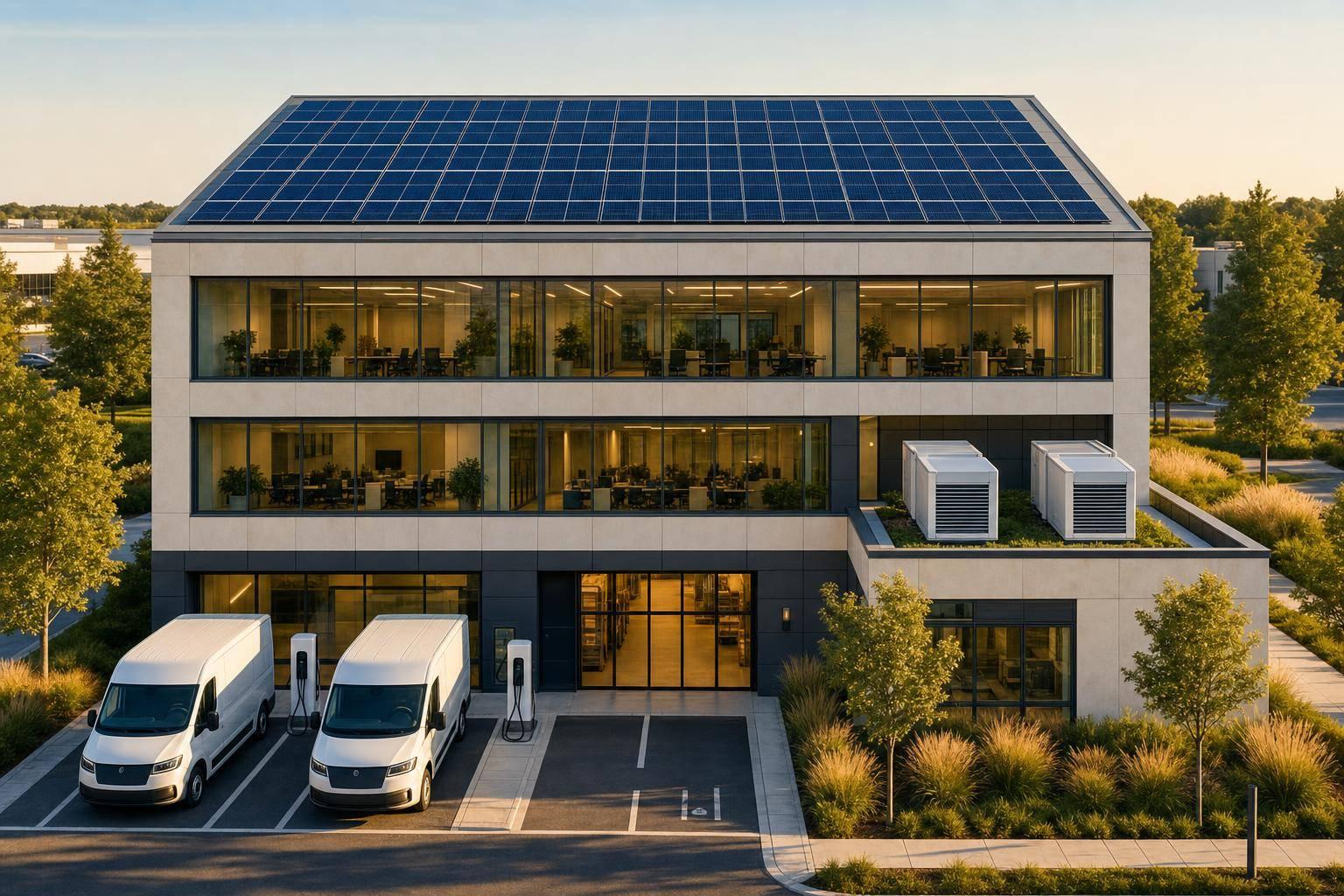
For commercial buildings, campuses, plants, and public facilities, energy strategy often starts with supply: solar, storage, backup power, or utility rates. But the video’s central argument points in a different direction: the cheapest and fastest energy to manage is the energy you never have to use.
That idea is not new, but it is still underappreciated. Energy efficiency rarely gets the same visibility as renewable energy because it is less dramatic. There is no ribbon-cutting moment for a better lighting layout, upgraded controls, or a more efficient HVAC system. Yet the impact can be enormous.
According to the video, efficiency has done more to reduce emissions over recent decades than the shift to cleaner fuels. For facility leaders, that matters for a practical reason: efficiency is not just a climate strategy. It is an operating-cost strategy, a resilience strategy, a maintenance strategy, and often a compliance strategy at the same time.
This article breaks down the video’s main ideas and connects them to what building owners, facility managers, and public-sector decision-makers should be thinking about now.
One of the most useful observations in the video is that energy waste is largely invisible. People notice trash because they physically throw it away. They rarely notice wasted energy because it disappears inside utility infrastructure, equipment losses, and inefficient end-use devices.
That invisibility creates a management problem. What goes unseen is often left unmeasured, and what goes unmeasured is rarely optimized.
For large facilities, this is especially important because waste compounds across multiple layers:
The video frames energy efficiency as a question of waste reduction. For real estate and operations teams, that framing is useful because it shifts the conversation from abstract sustainability goals to something far more actionable: finding and removing avoidable loss.
A standout point in the video is the claim that, since 1970, global energy efficiency improved by roughly 40%, while cleaner fuel switching improved by far less. The broader lesson is not that renewables do not matter. They clearly do. The lesson is that decarbonization works best when demand falls at the same time supply gets cleaner.
This has a direct facility-level parallel.
If a building reduces lighting load, improves controls, tightens schedules, and upgrades major systems, it becomes easier to:
In other words, efficiency makes every other energy investment work harder.
That is why the video describes future decarbonization as a roughly shared effort between cleaner electricity and better efficiency. For facility decision-makers, this means the real question is not "efficiency or electrification?" but rather how to sequence both intelligently.
The video uses lighting to illustrate how much energy can be lost between fuel extraction and actual useful output. Its core comparison is straightforward: old incandescent lighting wasted most of the energy put into it, while LED lighting dramatically cut that waste.
For commercial and institutional facilities, the lesson goes beyond the bulb itself.
Lighting is often one of the clearest retrofit opportunities because it can affect:
An LED retrofit is not just a lamp swap. In many facilities, it is an opportunity to rethink the entire lighting system:
A more efficient fixture can reduce wattage, but a better layout can also reduce overlighting, dark spots, and uneven illumination. That matters in warehouses, parking areas, offices, schools, and industrial spaces where visibility affects both safety and productivity.
Occupancy sensors, daylight harvesting, scheduling, and networked controls often turn a good retrofit into a much stronger one. A highly efficient fixture running unnecessarily is still wasting money.
The video focuses heavily on energy and carbon, but facility leaders should also pay attention to labor and maintenance. Longer-life LED systems can reduce relamping cycles, lift rentals, after-hours service work, and disruption in occupied spaces.
Because lighting projects are visible, measurable, and often rebate-friendly, they can serve as an entry point for broader building modernization. Once a team sees verified savings from lighting, it becomes easier to justify deeper efficiency work.
The video repeatedly emphasizes that efficiency creates multiple benefits at once. That is especially relevant for commercial real estate and public-sector facilities, where decisions are rarely based on energy alone.
Here is how those co-benefits show up in practice.
This is the most obvious benefit, but it still deserves emphasis. Well-designed efficiency improvements are meant to reduce waste, not reduce service quality.
For facilities, that can mean:
In many cases, the real financial value comes from the combination of these savings rather than any one line item.
The video notes that efficient homes tend to be warmer and healthier. In commercial and institutional spaces, the same principle applies through a different lens: better-performing systems tend to deliver more consistent environments.
Examples include:
When occupants stop complaining about lighting, temperature swings, or poorly lit workspaces, that is not just a comfort win. It is an operations win.
The video links efficiency to reduced pollution and better health outcomes. In facilities, this can play out in several ways:
The exact impact will vary by building type, and not all of it is specified in the video, but the broader point holds: efficiency can improve conditions people feel every day, not just metrics managers see on reports.
The video also positions efficiency as an energy security tool. For large facilities, that is a crucial framing.
A lower-load building is generally easier to support during grid stress, outages, or volatile utility conditions. Reducing unnecessary energy demand can help organizations:
Efficiency does not replace resilience planning, but it makes resilience planning easier.
One of the video’s strongest arguments is that switching certain end uses to electricity can produce outsized efficiency gains. The reason, it explains, comes down to physics: electric technologies often convert energy into useful work much more effectively than combustion-based systems.
The examples in the video include electric vehicles and heat pumps, each described as several times more efficient than conventional alternatives.
For facility leaders, this raises an important strategic point: some of the biggest future gains may come not from marginal optimization of old systems, but from replacing them with fundamentally more efficient electric technologies.
That could include, depending on facility type:
The video does not go into implementation detail, so issues like infrastructure capacity, capital planning, climate suitability, and tariff impacts are not specified. But its core message is highly relevant: electrification is not only about cleaner power sources; it can also be about using less energy to deliver the same result.
For owners and managers of multiple buildings, efficiency should not be viewed as a series of isolated projects. It is better understood as a portfolio strategy.
A portfolio approach allows teams to:
This is especially important in sectors with aging infrastructure, budget constraints, and public accountability, such as K-12, municipal, industrial, and multi-site commercial portfolios.
The video mentions that focusing on a relatively small number of major categories can deliver most of the available benefit. That is a valuable lesson for facility management: do not chase every possible upgrade at once. Start with the biggest, most persistent energy loads.
In many facilities, those tend to be:
The video ends by noting that, despite the clear benefits, efficiency adoption remains harder than it should be. It suggests that part of the problem lies in how organizations make decisions: many systems settle for "good enough" instead of optimal.
For facilities, that rings true.
Some of the most common barriers include:
The team paying for the upgrade may not be the same team benefiting from reduced operating costs. Capital and operating budgets often live in separate silos.
Many organizations replace systems only after failure rather than at the point where inefficiency has become costly.
Without audits, interval data, or fixture-level inventories, it is difficult to quantify waste and build a business case.
Even straightforward retrofits can feel disruptive when teams are juggling staffing shortages, compliance demands, and occupant needs.
If a project is judged only on raw kWh savings, decision-makers may miss its value in maintenance reduction, safety improvement, comfort, and future readiness.
The video does not provide a full policy or financing analysis, so those details are not specified. Still, its broader diagnosis is accurate: efficiency often loses out not because it lacks value, but because organizations struggle to prioritize invisible waste.
The most practical takeaway from the video is that efficiency should move from "nice to have" to core infrastructure strategy.
That means treating it less like a sustainability side initiative and more like a business discipline tied to performance, cost control, and asset modernization.
A strong starting framework looks like this:
Identify where the largest energy losses are happening. In many buildings, assumptions about waste are wrong until real data is collected.
Focus on systems that run the longest, consume the most, or create the most maintenance burden. Lighting is often one of the easiest places to begin.
Equipment efficiency matters, but controls determine when and how often systems run. Schedules, sensors, and automation can materially improve results.
Include maintenance, labor, replacement frequency, occupant impact, and operational resilience in the business case - not just utility savings.
Where electric technologies are significantly more efficient, plan upgrades in a way that aligns with infrastructure readiness and long-term capital needs.
Post-project verification matters. It builds confidence, supports future investments, and helps distinguish real savings from optimistic assumptions.
The video makes a compelling case that energy efficiency is not a secondary climate tool. It is one of the main tools. For facilities, that conclusion is even more powerful because the benefits show up in places decision-makers care about immediately: cost, reliability, comfort, maintenance, and asset performance.
The most important shift is conceptual. Efficiency is not about doing less. It is about delivering the same or better outcomes with less waste.
For building owners, facility managers, industrial operators, and public institutions, that is not just good environmental policy. It is good operations.
Source: "Energy Efficiency: The Most Underrated Solution to Climate Change | Energy 101, Ep 9" - chrisjardine.energy, YouTube, Jun 9, 2026 - https://www.youtube.com/watch?v=g_HUNA1Fj4I


