.svg)
Learn how utility rebates and Section 179D tax deductions reduce LED upgrade costs, boost ROI, and why projects must start before June 30, 2026.

Switching to LED lighting can save up to 90% on energy costs and reduce maintenance due to their long lifespan. But the upfront expense can be a barrier. Here's the good news: utility rebates and federal tax incentives make these upgrades more affordable, covering significant portions of the cost.
To maximize savings, combine rebates with tax incentives, ensure your products meet certification requirements (e.g., ENERGY STAR, DLC), and act quickly - rebates are often first-come, first-served, and 179D deductions require projects to start by June 30, 2026.
With LED upgrades, most businesses see a return on investment in 1–4 years, making this a practical way to lower energy costs and improve building performance.
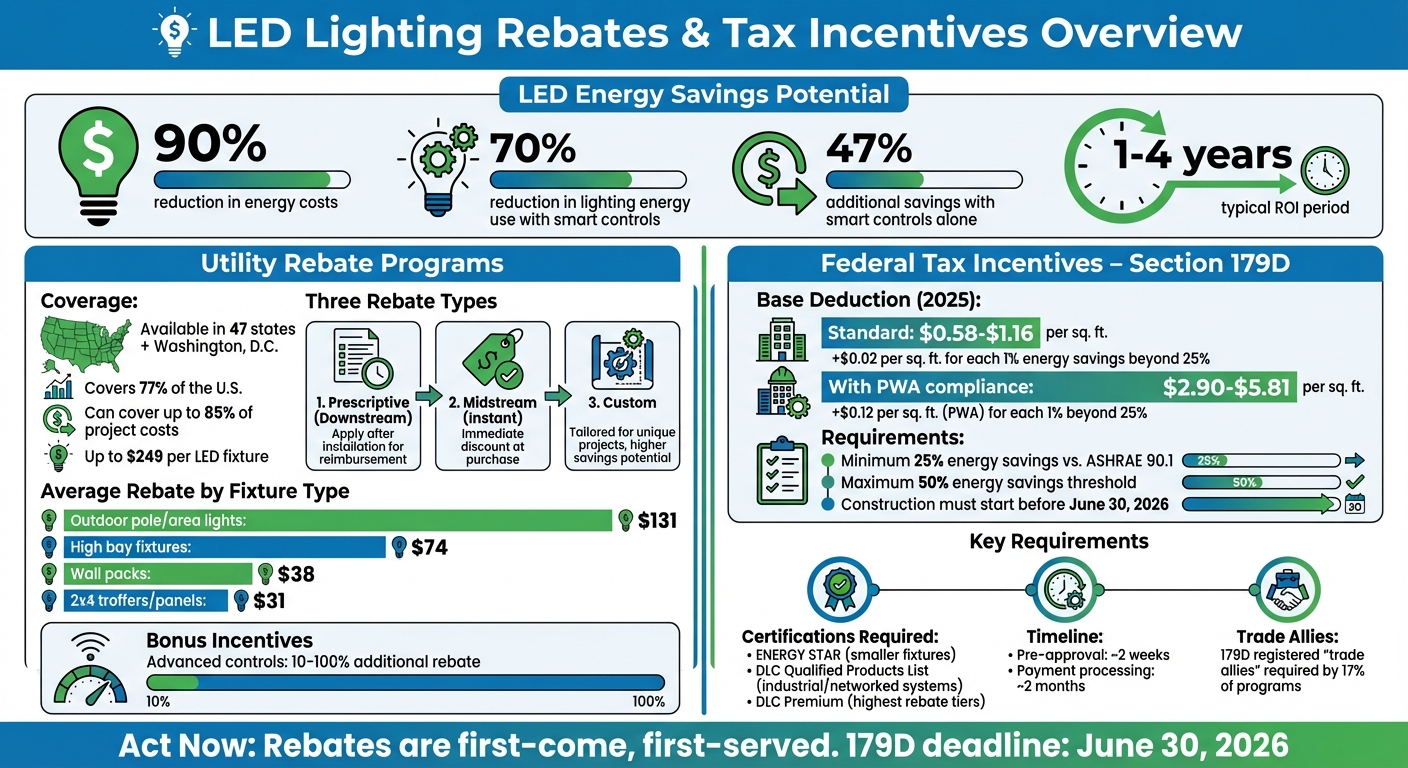
LED Lighting Rebates and Tax Incentives Guide: Savings Breakdown by Program Type
Understanding how utility rebate programs work can help you fund LED upgrades for growing facilities more effectively.
Utility rebate programs generally fall into three categories:
The availability and structure of these rebates can vary widely depending on where you’re located.
Rebates are available in 47 states and Washington, D.C., covering about 77% of the U.S., but the specifics depend on your utility provider. Some states provide broad coverage but may impose restrictions based on project type or favor performance-based models over simpler prescriptive rebates.
For example:
Rebate amounts also vary by fixture type. Outdoor pole and area lights receive the highest incentives, averaging $131 per fixture, while high bay fixtures average $74, wall packs $38, and 2x4 troffers or panels $31. Outdoor lighting rebates saw a 15% increase in 2025 in programs like TVA and Duke North Carolina, while Massachusetts’ Mass Save program reduced midstream incentives by an average of 45% in the same year.
Additionally, about 17% of programs require businesses to use registered "trade allies" - approved contractors or distributors - to qualify for rebates. Be sure to check this requirement before starting your project, as using non-approved vendors could disqualify your application.
Eligibility standards are strict, ensuring rebates go only to qualifying products and projects. Most programs require LED products to be certified by ENERGY STAR (for smaller fixtures) or the DesignLights Consortium (for industrial and networked systems) to guarantee efficiency and quality.
Rebate programs often target replacing inefficient technologies like HID lamps, T12 fluorescents, or incandescent bulbs, rather than upgrades from any baseline. Buildings with long operating hours or those in areas with high electricity costs are often eligible for higher rebate tiers. Some utilities also mandate a lighting-specific energy audit before approval.
Installation standards can also impact eligibility. For instance, some programs or facility guidelines (like the GSA P100) prohibit certain installations, such as Type B TLEDs with internal drivers wired to line voltage, due to safety concerns. On average, pre-approval for rebate applications takes about two weeks, while payments are issued roughly two months after submission. To avoid delays, ensure all required documentation is complete and that your products meet the necessary qualifications before applying.
In addition to utility rebates, federal tax incentives can help cut the upfront costs of LED lighting projects. When combined, these incentives create a robust funding strategy for large-scale lighting upgrades. One of the most significant programs for this purpose is the Section 179D tax deduction, designed specifically for commercial and industrial facilities upgrading their interior lighting systems.
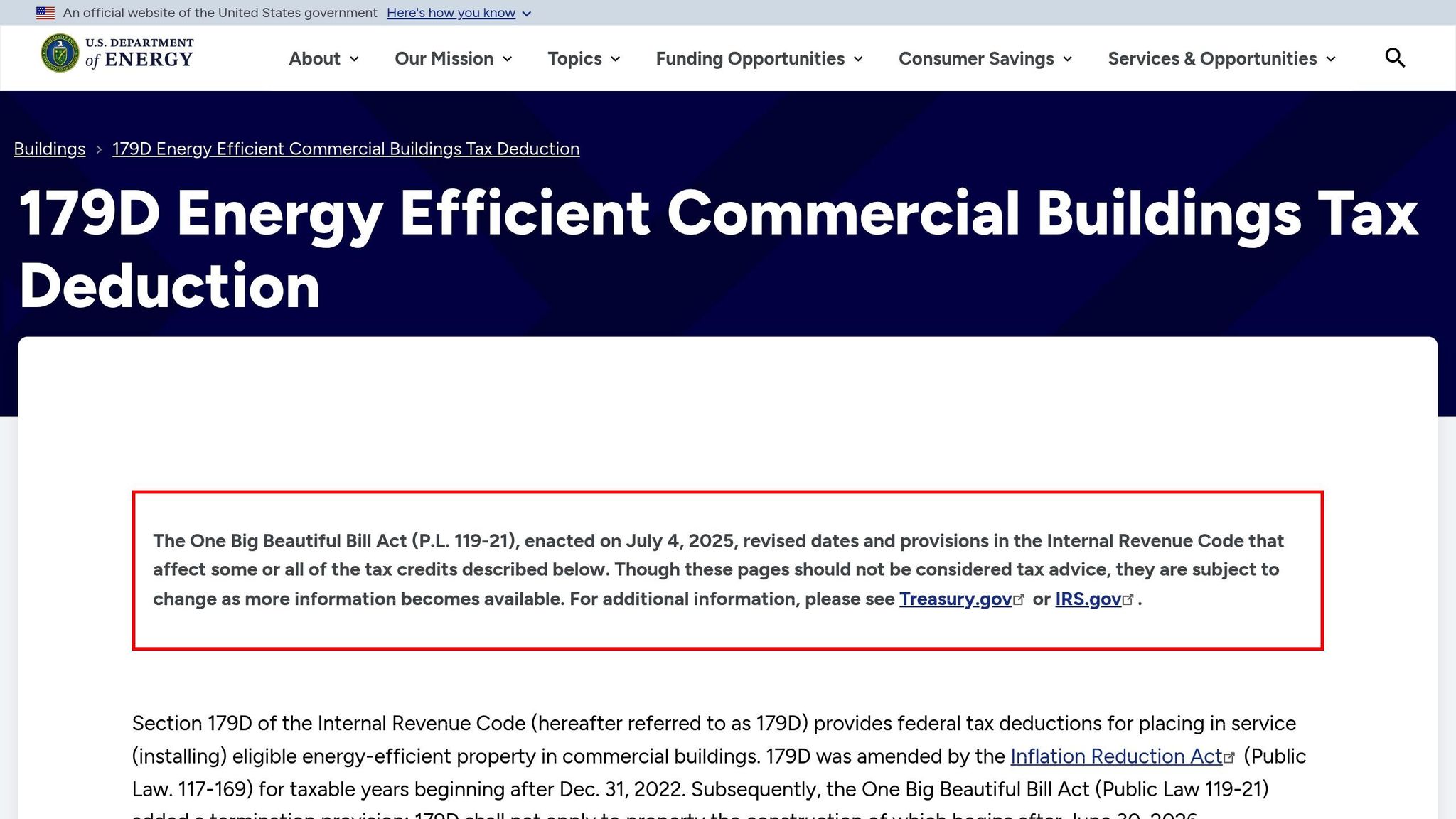
The Section 179D tax deduction offers federal tax benefits for installing energy-efficient systems like interior lighting, HVAC, and building envelope upgrades in commercial buildings. To qualify, your LED lighting project must achieve at least 25% energy savings compared to the ASHRAE Standard 90.1 baseline.
For the 2025 tax year, the base deduction ranges from $0.58 to $1.16 per square foot, depending on the level of energy savings. For every additional 1% saved beyond the 25% threshold, the deduction increases by $0.02 per square foot, up to a maximum of 50% savings. If your project meets prevailing wage and registered apprenticeship (PWA) requirements, the deduction increases significantly - ranging from $2.90 to $5.81 per square foot, with increments of $0.12 per square foot for each additional percentage point saved.
You can choose between two pathways to qualify:
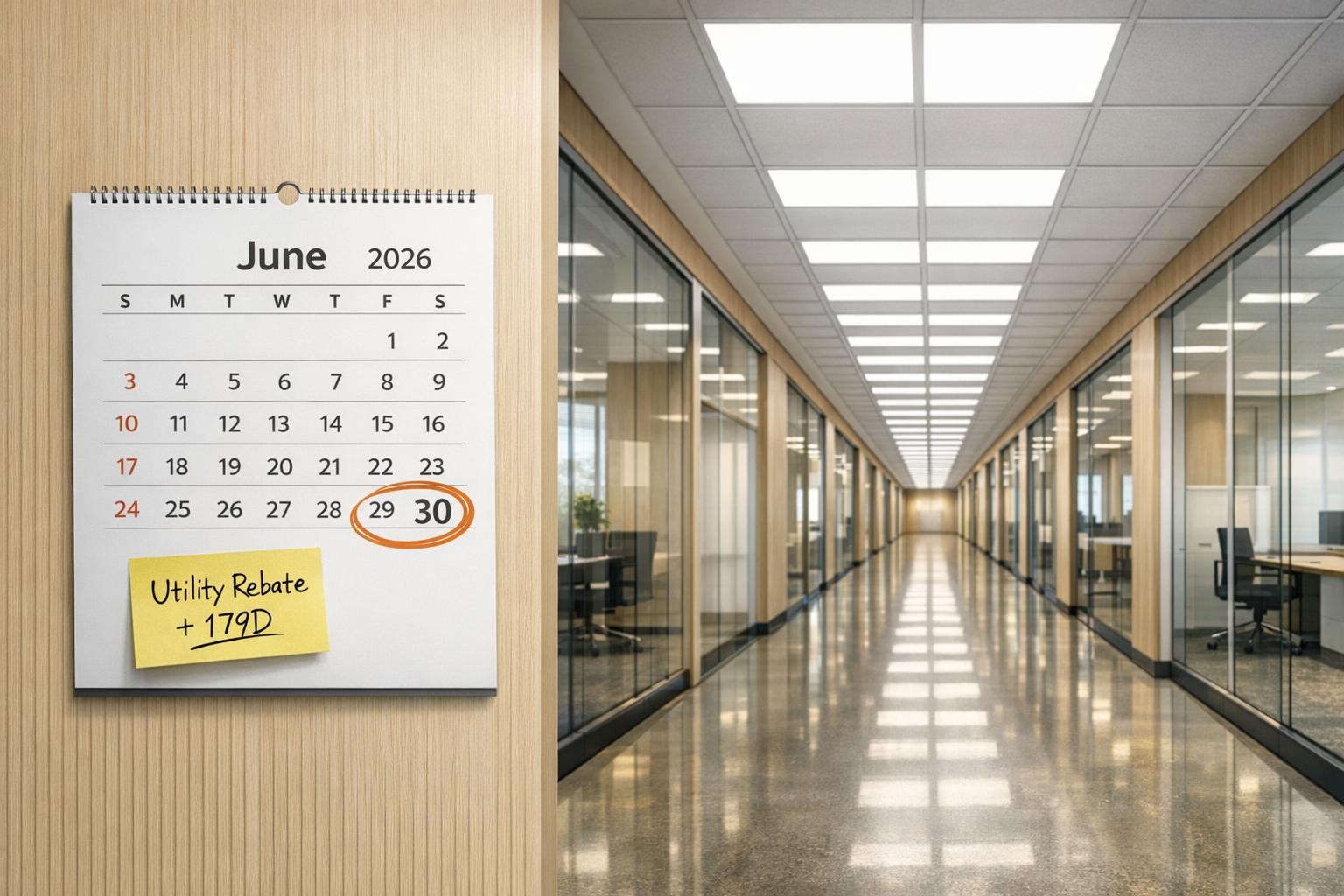
Under the One Big Beautiful Bill Act (P.L. 119-21), enacted on July 4, 2025, the 179D deduction applies only to construction projects that begin before June 30, 2026. Starting construction before this deadline is critical to remain eligible.
For tax-exempt entities like government agencies or non-profits, the deduction can be allocated to the lead designer of the energy-efficient property - often an architect, engineer, or energy services company. This allows designers to claim the deduction, which can translate into reduced fees for public facilities.
The 179D tax deduction becomes even more powerful when paired with utility rebates. However, careful planning is required to ensure compliance. The total tax deduction is capped at the actual cost of the energy-efficient property. Additionally, claiming the 179D deduction reduces the tax basis of the property by the same amount.
For example, if you retrofit a 100,000-square-foot warehouse with LED lighting at a cost of $200,000 and receive $50,000 in utility rebates, your 179D deduction would apply to the remaining $150,000. Proper documentation is crucial to avoid exceeding total project costs.
To maximize savings, ensure compliance with PWA requirements during construction. Meeting these standards can elevate a $58,000 deduction (base rate for 100,000 square feet at 25% savings) to a $290,000 deduction. Make sure your contractor or project team is well-versed in these requirements before starting the project.
Finally, all projects require third-party certification from a licensed contractor or engineer who is not affiliated with the project. Obtaining this certification early can help streamline the process and avoid delays in claiming your tax benefits.
To secure rebates for LED lighting projects, careful planning and understanding of rebate programs are essential. The process begins with identifying your utility provider, as rebate availability and rules differ widely across providers. After an energy audit, the next steps include selecting certified LED products and smoothly navigating the application process.
An energy audit is a key first step. It evaluates your current lighting setup and estimates the savings potential of switching to LEDs. Legacy lighting systems often consume a large share of energy, making them prime candidates for upgrades. A site survey helps document existing equipment, light levels, and control strategies, providing a clear picture before selecting replacement fixtures.
Once the audit is complete, focus on choosing LED fixtures that meet rebate program requirements. Products must be listed on approved registries to qualify. The DesignLights Consortium (DLC) Qualified Products List is a trusted resource for verifying commercial LED products and networked lighting controls. You can also explore the ENERGY STAR Rebate Finder or the Database of State Incentives for Renewables and Efficiency (DSIRE) for additional incentives. Some manufacturers even offer zip code lookup tools to help you find rebate amounts for specific fixtures based on your utility provider. Keep in mind that many utilities now prioritize "DLC Premium" classifications, which often qualify for the highest rebate tiers.
Most rebate programs require pre-approval before you purchase equipment or start installation. During the design phase, contact your utility to clarify documentation requirements and submission deadlines. Typically, you'll need to provide details like utility account numbers, building addresses, an inventory of existing lighting (including fixture types, quantities, and wattages), and manufacturer specification sheets showing DLC or ENERGY STAR certification. Some programs may also ask for "before" and "after" photos of the retrofit.
Rebates are often capped, either by a fixed dollar amount (e.g., $100,000) or as a percentage of the total project cost, usually around 50%. Additionally, some programs require installations to be carried out by certified "trade allies", so confirm contractor requirements in advance. Carefully reviewing all rebate criteria will help ensure your project aligns with the broader LED retrofit strategies discussed earlier.

Luminate Lighting Group simplifies the entire process of upgrading to LED lighting, building on the rebate and tax incentive strategies mentioned earlier. Their approach ensures efficient, scalable solutions tailored to each facility.
Luminate Lighting Group provides a turnkey LED lighting solution that begins with a thorough energy audit and site survey. These evaluations assess current equipment and performance, resulting in a detailed scope of work and procurement plan customized for each facility’s needs. This process is designed to deliver high-performance LED systems that adapt to the demands of modern facilities.
From there, the team creates custom lighting designs that adhere to energy codes and performance standards. By managing everything from design to installation, they remove the typical coordination challenges that can delay lighting upgrades. This approach works seamlessly across various spaces, including warehouses, offices, industrial facilities, and municipal buildings.
Navigating rebates and tax incentives can be complex, but Luminate Lighting Group’s expertise ensures clients take full advantage of these opportunities. They provide tailored incentive analyses based on the latest local utility programs. Using resources like the DesignLights Consortium (DLC) Qualified Products List and the Networked Lighting Controls (NLC) Qualified Products List, the team selects systems that meet performance standards while maximizing available incentives.
Additionally, they help clients combine utility rebates with Section 179D tax deductions, significantly reducing upfront costs and paving the way for long-term energy savings.
Luminate Lighting Group’s comprehensive approach delivers measurable results. For example, at California State University – Dominguez Hills, Central Plant Manager Kenny Seeton implemented occupancy-based unified controls at Welch Hall, enhancing building performance. Similar projects have achieved energy savings of over 50%.
Utility rebates and LED lighting upgrades offer a powerful way for commercial and industrial facilities to cut operating costs while updating their infrastructure. Across much of the U.S., these incentives are widely available to facility managers. The financial upside is clear - utility rebates often cover 15% to 40% of project costs, and Section 179D tax deductions can add another $0.60 to $5.00+ per square foot in federal tax savings.
But the clock is ticking. To take advantage of Section 179D deductions, construction must begin before June 30, 2026. This makes early 2026 a crucial period for getting LED lighting projects underway. On top of that, utility rebate programs operate on a first-come, first-served basis, so waiting too long could mean missing out on available funding.
Modern LED systems, especially those with integrated smart controls, can slash lighting energy use by as much as 70%. Smart controls alone can deliver energy savings of up to 47%. Most commercial LED projects see a full return on investment within 1 to 4 years, making these upgrades not just practical but financially rewarding.
Facility managers should consider prioritizing projects that incorporate advanced lighting controls, as these now frequently qualify for enhanced incentives. By partnering with experts like Luminate Lighting Group, facilities can navigate the maze of rebates and tax incentives while implementing state-of-the-art lighting systems.
With widespread rebates, federal tax benefits, and proven savings, 2026 is shaping up to be a key year for LED lighting upgrades. Facilities that act now will enjoy lower energy bills, better working environments, and compliance with stricter building codes.
To figure out your precise LED rebate, online utility rebate finder tools can be incredibly helpful. Simply input your project’s zip code, your utility provider, and the product details to see what rebates are available. In most cases, rebates are tied to approved products listed by DesignLights Consortium® or ENERGY STAR®. Additionally, you might need to provide documentation - like invoices and project specifics - to complete the rebate process.
Yes, you can use utility rebates alongside 179D tax deductions for LED lighting upgrades. These two incentives function independently but complement each other, helping to reduce the total cost of energy-efficient projects. This makes upgrading to LED lighting both more affordable and financially rewarding.
When it comes to the 179D tax deduction, the "start of construction" is marked by either the commencement of substantial physical work or spending at least 5% of the project's total cost. This must happen before June 30, 2026. To maintain eligibility, steady progress on the project is required, ensuring it meets the criteria for energy-efficient building incentives tied to the 179D deduction.


