.svg)
Compare tunable white and fixed-color LED classroom lighting—impact on learning, energy savings, costs, and installation trade-offs.

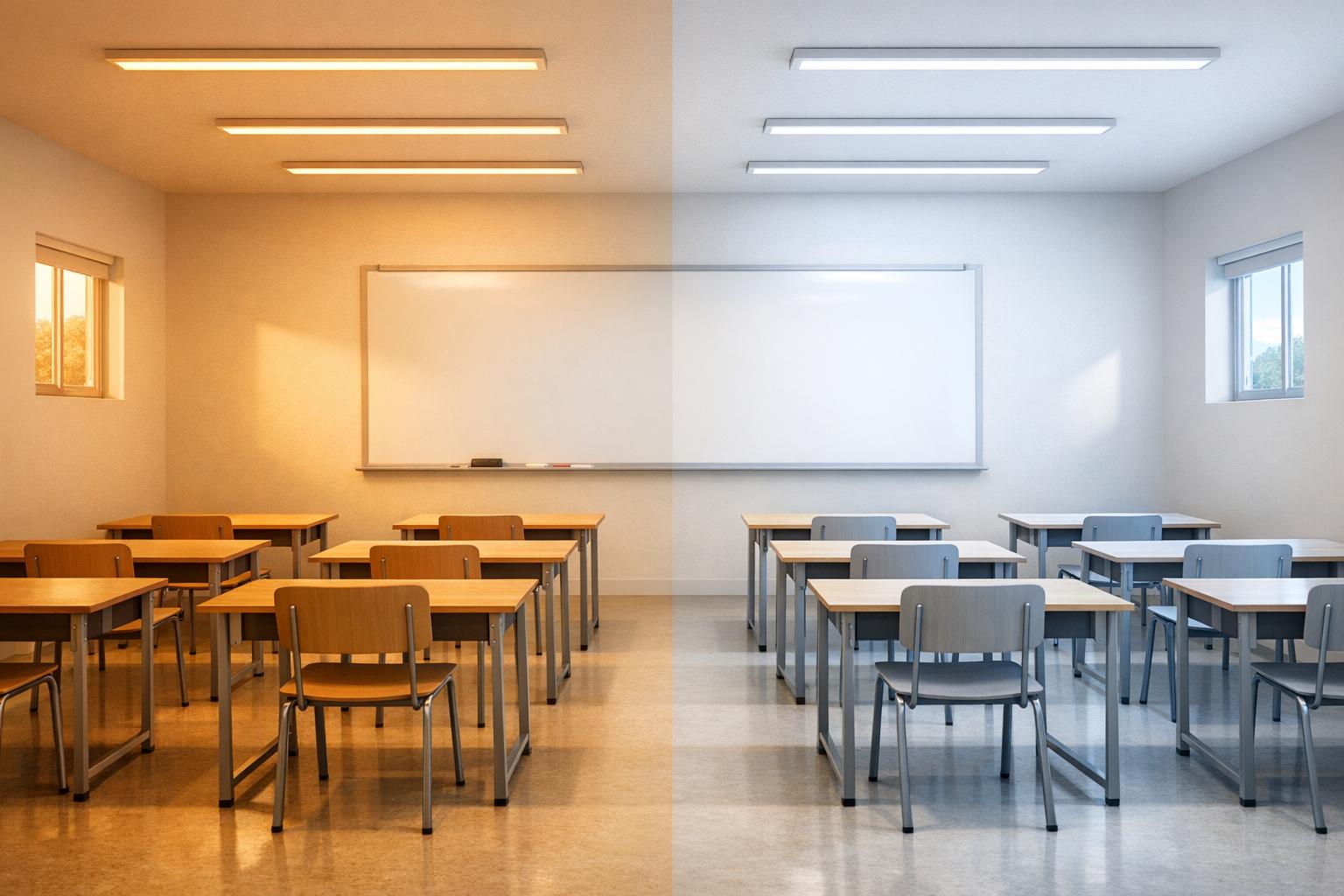
Tunable white lighting lets teachers adjust brightness and color temperature, creating flexible classroom environments. This lighting can shift from warm (2,700K) to cool (6,500K) tones, supporting student focus, energy savings, and even classroom management. But is it worth the cost? Here’s a quick breakdown:
| Feature | Tunable White LED | Fixed-Color LED |
|---|---|---|
| Learning Impact | Supports focus and mood | Static lighting only |
| Energy Savings | Up to 69% | Significant savings |
| Cost | Higher upfront costs | Lower upfront costs |
| Installation | Complex | Simple |
| Control Options | Multiple presets | Basic on/off, dimming |
For schools prioritizing student well-being and adaptability, tunable systems shine. However, fixed-color LEDs are a simpler, budget-friendly solution for consistent efficiency.
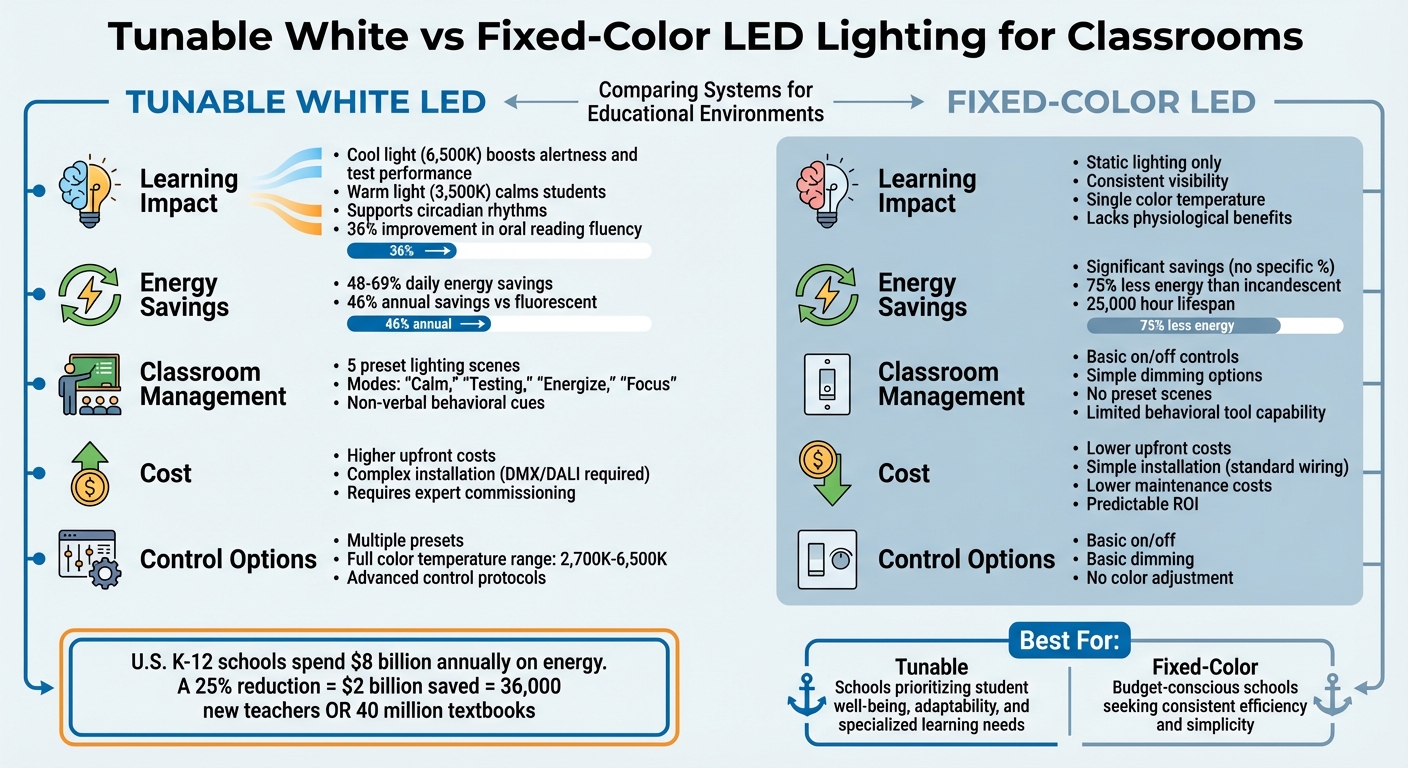
Tunable White vs Fixed-Color LED Lighting Comparison for Classrooms
Tunable white lighting systems are not just about improving classroom ambiance - they play a role in boosting student learning, enhancing classroom management, and even cutting operational costs.
These systems adjust color temperatures to align with different classroom activities, creating an environment that supports both focus and relaxation. For instance, cool white light at 6,500K can reduce melatonin levels and increase alertness, making it ideal for focused tasks like lectures and exams. On the other hand, warm white light at 3,500K helps students unwind, making it perfect for post-recess transitions.
Studies highlight the importance of lighting on circadian rhythms. A lack of blue-rich light in the morning can push the body’s internal clock back by about 30 minutes, potentially affecting academic performance. In office environments, circadian-friendly lighting has been shown to improve productivity by 18% and accuracy by 12%. These findings suggest similar benefits could extend to classrooms.
But the impact of tunable lighting goes beyond academics - it also supports smoother classroom dynamics.
Teachers have found that tunable LED lighting can grab and maintain students' attention better than traditional methods. With five preset lighting scenes, educators can shift the classroom’s mood instantly. For example, an energizing mode works well during lectures, while a calming mode helps prepare students for tests.
In classrooms for students with autism spectrum disorder, this feature proved especially helpful. Teachers reported that dimmed, warm lighting provided a non-verbal signal to help students settle after active periods like recess. This adaptability makes tunable lighting a valuable tool for diverse educational needs.
And the benefits don’t stop there - schools also see a financial upside.
The Folsom Cordova trial revealed a 46% annual energy savings with the LED system compared to older fluorescent lighting. Depending on how dimming and scene controls were used, daily savings ranged from 48% to 69%. Similarly, a study in Texas at the Carrollton-Farmers Branch Independent School District reported a 58% reduction in power use compared to fluorescent fixtures.
While energy savings are compelling, experts encourage schools to consider the broader advantages, often referred to as "Return on Objective." This includes improved student performance, better teacher satisfaction, and easier classroom management. With U.S. K–12 schools spending around $8 billion annually on energy - their second-largest expense after staffing - a 25% reduction could free up $2 billion. That’s equivalent to hiring nearly 36,000 new teachers or buying 40 million textbooks.
To maximize savings, careful planning is essential. For instance, DMX-controlled drivers in LED fixtures use minimal standby power, which can slightly reduce overall energy savings. Additionally, a case study from Emory University (April 2023) pointed out that networked lighting controls can complicate installation. For older school buildings, the cost of adding new control wiring can be a hurdle. However, wireless mesh controls offer a simpler, more cost-effective alternative.
Fixed-color LED systems offer a simpler, more consistent lighting solution compared to tunable systems. These LEDs operate at a single color temperature, such as cool white (6,000K–6,500K) for focus or warm white (3,500K) for relaxation. Their straightforward design provides energy efficiency and ease of use without the need for frequent adjustments.
Cool white fixed-color LEDs are particularly effective in enhancing focus during tasks that require concentration. For example, a 2012 study with 84 third-grade students in the midsouth United States revealed that students exposed to 6,000K lighting showed a 36% improvement in oral reading fluency over the school year. In comparison, students under 3,500K lighting saw only a 17% improvement. However, the lack of flexibility in fixed-color systems can be a drawback. Unlike tunable LEDs that can adjust to various needs, fixed-color lighting may disrupt circadian rhythms, leading to potential sleep issues or irritability.
Fixed-color systems provide basic functionality, like simple on/off controls, but lack the versatility of tunable systems. During a trial by the Folsom Cordova Unified School District in the 2017–2018 school year, teachers appreciated dimming features but viewed color-tunability as less critical. Researchers noted:
"The teachers considered the lighting system's dimmability to be particularly valuable, with color-tunability seen as a secondary benefit."
However, fixed-color LEDs don’t offer the "teaching tool" advantages of tunable systems, such as signaling activity transitions or helping to calm overactive students.
Fixed-color LED systems also stand out for their financial advantages. They use 75% less energy than incandescent bulbs and last up to 25 times longer, with lifespans reaching approximately 25,000 hours. Unlike tunable systems, they avoid the extra energy draw from controllers and eliminate higher installation costs, providing a more predictable return on investment for LED retrofits. Maintenance costs are lower as well, and studies suggest white lighting can increase productivity by 10% to 20%.
Although easier to install than tunable systems, fixed-color LEDs still require careful planning. Selecting the right color temperature is crucial: cool white (around 6,000K) is ideal for focused environments like labs or testing centers, while warmer white (around 3,500K) is better suited for social or relaxed settings. Wireless mesh controls can enable features like dimming and occupancy sensing without the expense of rewiring. Additionally, using flicker-free drivers is important to avoid eye strain and discomfort. Despite their simplicity, schools should account for potential cost increases in materials due to import tariffs projected for 2026 when budgeting for these systems. This makes fixed-color LEDs a dependable and cost-efficient option, even if they lack the adaptability of tunable alternatives.
Let’s break down the key strengths and limitations of tunable white and fixed-color LED systems, especially in the context of educational spaces.
Tunable white LED systems bring a lot to the table, particularly when it comes to supporting student well-being. These systems mimic natural daylight, which helps regulate circadian rhythms and boosts alertness during demanding tasks. For example, studies show that students perform better on math tests under 6,500K cool white light. On the flip side, a lack of blue light in the morning can delay melatonin onset by 30 minutes, as observed in 11 teenagers - a factor that could impact academic performance. Teachers also leverage tunable lighting as a behavioral tool. By switching to a warm, dimmed 2,800K setting, they can signal students to settle down more effectively than with verbal instructions.
However, tunable systems come with higher upfront costs and more complicated installations. They require advanced control protocols like DMX512 or DALI, which often need expert commissioning and can be tricky to manage. In contrast, fixed-color LEDs are far easier to install and maintain, using standard wiring and simple controls. From a financial perspective, tunable systems are harder to justify since most energy savings come from LED efficiency and dimming, not the added color-tuning capabilities.
Installation complexity can also influence how users engage with tunable systems. Fixed-color LEDs avoid these challenges entirely while still offering significant energy savings over traditional fluorescent lighting.
| Feature | Tunable White LED | Fixed-Color LED |
|---|---|---|
| Learning Impact | Boosts circadian rhythms, aids focus, and supports behavioral cues | Provides consistent visibility but lacks physiological benefits |
| Initial Cost | Higher; needs specialized drivers and controllers | Lower; uses standard hardware and installation |
| Energy Savings | 48–69% with active management but offset by phantom loads | Significant savings with no phantom load issues |
| Installation | Complex; requires DMX/DALI wiring or wireless setups | Simple; relies on standard electrical wiring |
| Teacher Control | High; includes presets like "Calm", "Testing", and "Energize" | Limited to basic on/off or dimming options |
These differences highlight the need for schools to carefully consider their priorities when investing in lighting systems.
Although tunable LEDs can save energy with active use, their baseline power draw contrasts with the straightforward efficiency of fixed-color systems. The U.S. Department of Energy summarized the challenge:
"The difficulty in documenting and assigning economic value to potential non-energy benefits poses a major challenge for color-tunable lighting systems".
For schools prioritizing affordability and consistent efficiency, fixed-color LEDs are a practical choice. On the other hand, tunable systems shine in scenarios where adaptability and enhanced learning environments are key.
The decision between tunable white and fixed-color LED systems ultimately depends on your school's priorities. If your main focus is achieving energy savings with minimal complexity, fixed-color LEDs are a solid choice. They deliver reliable performance, avoid installation challenges, and come with lower upfront costs - making them a budget-friendly upgrade from older fluorescent systems.
However, if your goal is to enhance student well-being and provide teachers with a versatile tool for managing classrooms, tunable white systems offer a range of advantages. Research highlights their impact on learning, with measurable improvements like increased oral reading fluency. These systems go beyond just saving energy, offering benefits tied to focus, behavior, and circadian rhythms - factors that, while harder to quantify, significantly impact the classroom experience.
Financial considerations also play a role. The Department of Energy notes that assigning economic value to the non-energy benefits of tunable lighting can be challenging. Yet, the improvements in engagement, behavioral cues, and overall classroom dynamics make these systems worthwhile, particularly in environments with specialized learning needs. For example, teachers in special education or ASD classrooms have successfully used tunable lighting to ease transitions and encourage participation.
To explore the potential of tunable systems, consider starting with a pilot program. Simple preset controls like "Focus", "Calm", and "Energy", placed within easy reach, can help determine whether these features align with staff and student needs.
Choosing the right color temperature is all about aligning with the natural light cycle and the activities you’re tackling. Tunable lighting systems make this easier by adjusting tones throughout the day. For instance, mornings can start with warmer tones (around 3000K) to gently boost alertness. As the day progresses, cooler tones (up to 5000K) are ideal for tasks requiring focus and precision.
Warm light is perfect for moments of relaxation or creative activities, while cooler light sharpens concentration and supports detailed work. This balance not only enhances productivity but also contributes to overall well-being.
Tunable white classrooms often use wireless controls like wall-mounted panels or app-based systems to tweak lighting intensity and color temperature. These setups provide flexibility and are simple to operate, making them a great fit for the ever-changing needs of a classroom setting.
Schools can look beyond just energy savings when evaluating the value of tunable white lighting. By considering non-energy benefits, they can account for improvements in areas like student health, academic performance, engagement, and behavior. On top of that, schools may save on maintenance and operational costs, adding another layer of financial and practical benefits. Together, these factors highlight the broader advantages of implementing tunable white lighting in classrooms.


