.svg)
Measure and mitigate LED temporal light artifacts—flicker, stroboscopic effects and phantom arrays—using PstLM and SVM metrics, tools, and audit steps.
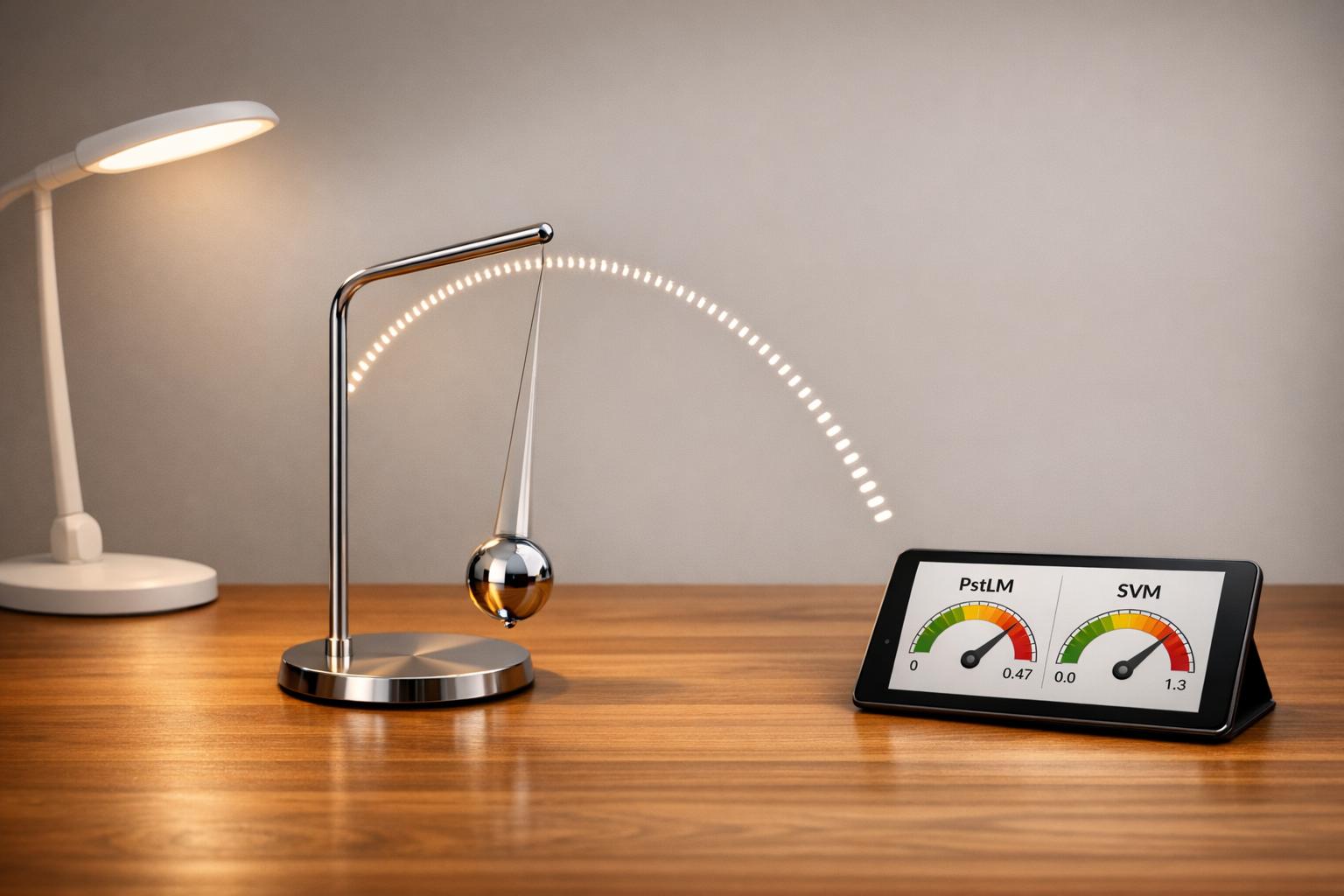
Temporal Light Artifacts (TLAs) are visual disruptions caused by fluctuations in LED light intensity, often resulting in flicker, stroboscopic effects, or phantom arrays. These issues can lead to migraines, eye strain, or even safety risks, especially in industrial settings where moving machinery may appear stationary. Regular TLA audits are essential to identify these problems and improve lighting performance.
To address TLAs, audits use tools like flicker meters and follow standards like NEMA 77-2017 and ANSI/IES LM-90-20. With precise measurements, you can mitigate risks, improve lighting quality, and enhance comfort in offices, industrial spaces, and public areas.
To ensure occupant safety and meet compliance standards, TLA (Temporal Light Artifacts) audits require precise tools capable of capturing rapid light fluctuations. For on-site assessments, handheld flicker meters are the go-to option. A standout example is the ILT710, a portable device priced at $1,299.00. It measures lux, percent flicker, flicker index, and the Stroboscopic Effect Visibility Measure (SVM) with a 50 kHz sampling rate and 12-bit resolution. This ensures accurate readings across all LED dimming levels. High-speed sampling is critical since TLA measurements typically cover luminous flux frequencies ranging from 1 Hz to 3,000 Hz.
For more detailed lab analysis, a specialized setup is necessary. This includes:
These components work together to capture the full luminous flux waveform, which is then analyzed using Fourier methods to identify harmonic contributors to TLA.
When choosing equipment, it’s essential to select a flicker meter with NIST traceable and ISO/IEC 17025:2017 accredited calibrations. This ensures compliance and accurate results for flicker audits. Additionally, relying on both Flicker Index and SVM - rather than just Percent Flicker - provides a more comprehensive understanding of duty cycles and stroboscopic effects. These tools form the foundation for applying the industry standards discussed below.
Accurate measurements, enabled by the right tools, are key to adhering to established standards. The NEMA 77-2017 standard is the leading guideline for TLA evaluation. It outlines test methods and acceptance criteria for light sources and controls, recommending limits of P<sub>st</sub> ≤ 1.0 and SVM ≤ 1.6 for general applications. These thresholds are based on detectability principles, where P<sub>st</sub> = 1 or SVM = 1 represents the point at which an average observer has a 50% chance of noticing the artifact.
For specific measurement procedures, ANSI/IES LM-90-20 provides the approved method for measuring luminous flux waveforms for TLA calculations. Available for $60.00 (non-members) or $40.00 (members), this standard covers frequencies between 1 Hz and 3,000 Hz. It also includes detailed instructions for stabilizing test conditions, minimizing stray light, and conducting uncertainty analysis. Additional supporting standards include:
"The variety of TLM patterns of solid-state lighting has brought these effects to the attention of the lighting community. Research seeks to create new metrics that predict the occurrence of visual, cognitive, and neurological effects." - Illuminating Engineering Society
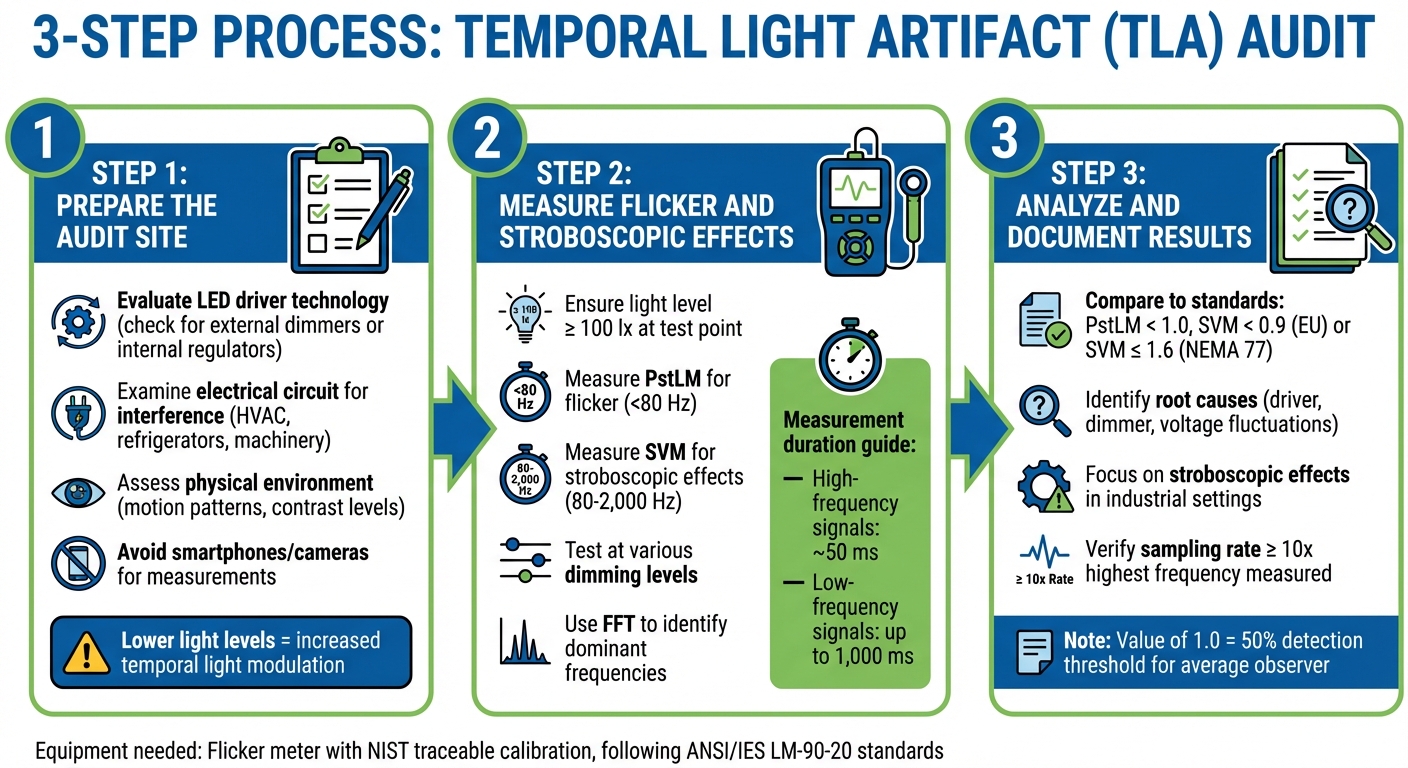
3-Step TLA Audit Process: Measure, Analyze, and Improve LED Lighting Quality
Start by evaluating the LED driver technology and the testing environment. Determine the type of LED driver technology in use. Since LEDs don’t have natural persistence, they directly reflect input current ripples. This makes the quality of the driver and the buffer capacitor’s capacity key factors in Temporal Light Artifacts (TLA) levels. Check whether the system uses external dimmers or internal regulators, as lower light levels typically lead to increased temporal light modulation.
Next, examine the electrical circuit for potential interference. Look for other devices on the same circuit - like HVAC systems, refrigerators, or heavy machinery - that might cause voltage fluctuations. Dr. James M. Gaines from FIRES points out:
"Pst may become large only when there is both 1) a disturbance on the mains voltage, and 2) the light source has insufficient immunity to prevent the disturbance from appearing as a visible light disturbance".
Such voltage disturbances are a major contributor to flicker.
Consider the physical testing environment as well. Pay attention to motion patterns and contrast levels in the area, as stroboscopic effects are more noticeable around fast-moving machinery or high-contrast backdrops. Avoid using smartphones or video cameras for objective TLA measurements, as they often introduce "temporal light interference" (banding) unrelated to human perception.
This environmental assessment is critical for selecting measurement parameters and interpreting data accurately. Once the environment is fully understood, move on to precise measurement techniques.
Begin taking measurements. Ensure the light level at the test point is at least 100 lx to achieve a strong signal-to-noise ratio for accurate results. Before recording, confirm that background noise is much weaker than the flicker signal.
Focus on two main metrics: PstLM for flicker (frequencies below 80 Hz) and SVM for stroboscopic effects (frequencies between 80 Hz and 2,000 Hz). PstLM uses time-domain analysis with normalization, filtering, and statistical processing, while SVM relies on frequency-based methods. As Jim Litynski from Gigahertz-Optik explains:
"The analyses of SVM and PstLM provides a good combination since the frequency-based method of SVM, and the temporal-based PstLM allow the quantification of stroboscopic and light flicker respectively".
If the system includes dimming controls, test at various dimming levels, as modulation tends to increase at lower light outputs. Use Fast Fourier Transformation (FFT) to identify dominant frequency components and determine if multiple light sources are overlapping. Adjust your equipment’s measurement duration based on the signal type - shorter durations (around 50 ms) are ideal for high-frequency signals, while longer durations (up to 1,000 ms) improve resolution for low-frequency signals.
After collecting data, proceed to the analysis stage.
Once measurements are complete, compare the results to established standards. The European Commission's Ecodesign Regulation specifies PstLM < 1.0 for flicker and SVM < 0.9 for stroboscopic effects. NEMA 77 offers a slightly higher stroboscopic limit, with SVM ≤ 1.6. Remember, a value of 1.0 represents the detection threshold, meaning an average observer has a 50% chance of noticing the effect. These thresholds are essential for ensuring safety and comfort in lighting environments.
Document your findings by identifying possible root causes of TLA. Determine whether the issue stems from the LED driver, dimmer circuits, or mains voltage fluctuations. In industrial settings, pay close attention to stroboscopic effects, as they can pose serious risks by making rotating machinery appear stationary or slow-moving.
Lastly, verify that your equipment’s sampling rate is at least ten times the highest frequency measured. For instance, if the signal frequency reaches 10 kHz, use a sampling rate of 100 kHz. This ensures your waveform data is accurate and provides reliable insights for addressing any issues.
Your audit results can guide significant upgrades to office lighting. Start by replacing outdated magnetic ballasts with high-frequency electronic ballasts or LED drivers. This reduces visual fatigue often caused by older fluorescent systems. Aim for audit metrics showing Pst ≤ 1.0 and SVM ≤ 1.6 to keep temporal light artifacts (TLA) below detectable levels.
Ensure horizontal illuminance levels reach at least 500 lx for tasks like reading and typing. This reduces eye strain and headaches, which are common issues in poorly lit offices. Research shows that 1 in 3 employees consider good lighting essential for their well-being. On top of that, migraines triggered by inadequate lighting cost U.S. businesses over $10 billion annually in lost productivity. Better lighting can even boost productivity by up to 12%.
Use your audit findings to implement zone-based lighting. Cooler color temperatures (5000K–6500K) at workstations can enhance focus and cognitive performance, while warmer tones (3000K–4000K) in break areas promote relaxation. As ADT Workplace highlights:
"A well-thought-out lighting plan that combines natural and artificial lighting can significantly enhance productivity, health, and comfort."
Additionally, install dimmable LED fixtures to give employees control over their lighting. This flexibility has been linked to increased motivation and alertness. Where possible, position workstations within 5 ft of windows to maximize natural light. Studies suggest people prefer a daylight-to-total light ratio (DTR) between 0.56 and 0.8 for optimal comfort.
In industrial settings like factories and warehouses, safety is paramount. Use your audit results to replace drivers in areas prone to stroboscopic effects, which can pose serious risks. Switch to drivers specifically designed to minimize flicker and stroboscopic issues. UPRtek explains the danger:
"Stroboscopic effects that occur indoors, under LED lights... strike a repetitive-motion object, like a turning power saw, and sync with the turn rate... giving the illusion that the saw is not turning at all. In a noisy factory, casually reaching over a power saw at full speed that appears stopped could have devastating consequences."
To tackle this, transition from Pulse-Width Modulation (PWM) to operational current regulation, also called Constant Current Reduction (CCR), to prevent stroboscopic effects at higher power levels. If PWM is necessary, ensure a modulation frequency of at least 400 Hz. TRILUX underscores this point:
"The modulation frequency should be ≥ 400 Hz. A visible flicker in the lighting is no longer perceived beyond ca. 100 Hz; however, physiological effects even below the perceptual threshold of vision are still possible up to a frequency of 400 Hz."
Focus on SVM metrics in areas like machine shops or production lines, as they provide a more accurate safety assessment than standard flicker percentages. Also, ensure your LED systems are equipped to handle mains voltage fluctuations, keeping Pst levels stable even during power inconsistencies.
Municipal lighting faces unique challenges, especially in outdoor environments. Use your TLA audit data to address phantom array effects, which are especially noticeable in high-contrast nighttime settings like streetlights against dark skies. Naomi J. Miller and her colleagues at the Pacific Northwest National Laboratory explain:
"The phantom array is increasingly seen on streets and roadways due to the interaction of normal eye saccades of drivers or pedestrians with modulating vehicle taillights, marker lights, daytime running lights, and even headlights."
Focus audits on these high-contrast areas to minimize distractions for drivers and pedestrians. However, avoid applying strict TLA limits across all applications. Dr. James M. Gaines from Signify North America Corporation advises:
"An overly strict universal limit would unnecessarily increase cost and complexity for all applications, including those that do not require strict TLA specifications."
Tailor TLA requirements to specific use cases to strike a balance between performance and practicality. Testing under dimmed conditions is also critical, as temporal light modulation tends to increase when light levels are lowered for energy efficiency. Finally, choose LED drivers with outdoor-specific immunity to mains fluctuations, a frequent cause of flicker in public power grids. This ensures that LED installations enhance comfort for residents and commuters while meeting energy-saving goals.
TLA audits play a crucial role in protecting occupant health, improving safety, and ensuring compliance by monitoring key metrics like Pst<sup>LM</sup> ≤ 1.0 and SVM ≤ 1.6, as outlined in industry standards. These audits help identify flicker and stroboscopic effects, which can cause migraines, eye strain, and even safety risks - such as the illusion of stationary machinery in motion. Beyond safety, they ensure LED systems provide both comfort and cost efficiency.
This shift in how we measure lighting focuses on human perception, moving away from outdated metrics like "Percent Flicker", which fail to account for how humans respond to different frequencies. By adopting perception-based measures like Pst<sup>LM</sup> and SVM, audits become more precise and actionable, ensuring lighting systems are both safe and effective.
Experts in the field emphasize the importance of these advancements. Naomi J. Miller from Pacific Northwest National Laboratory highlights the risks posed by modern LED systems:
"LED systems can deliver a much wider range of luminous waveforms than conventional lighting systems... creating a risk for adverse effects and the potential for rejection of new, energy efficient lighting technologies."
Luminate Lighting Group offers specialized TLA audits and tailored LED solutions to meet your facility's unique needs. These audits not only confirm compliance but also provide actionable insights for improving lighting performance in a variety of environments. Whether you're upgrading office lighting to enhance productivity, securing industrial spaces against stroboscopic risks, or improving public areas for comfort, our team ensures your lighting systems meet both safety standards and operational goals.
Our services include photometric layouts, fixture recommendations, and full design-to-installation solutions. We also help you access utility rebates and 179D tax deductions while working toward energy-saving objectives.
Contact Luminate Lighting Group today to schedule a TLA assessment and see how optimized lighting can enhance your workspace, lower energy costs, and support the well-being of everyone in your facility.
A Temporal Light Artifact (TLA) audit is essential for spotting and resolving flicker and stroboscopic effects in LED lighting. These audits should be conducted at specific times, such as during installation, following major system updates, or as part of routine maintenance checks. By staying ahead of potential problems, this process helps ensure lighting systems are safe, comfortable, and compliant with relevant standards. Plus, it can prevent health issues like migraines or photosensitive seizures while maintaining peak performance.
The main distinction between PstLM and SVM lies in what aspects of temporal light artifacts they measure.
Both metrics play a crucial role in ensuring lighting systems reduce unwanted visual disturbances.
To address flicker and stroboscopic effects quickly, start by tweaking the lighting setup. Adjusting driver settings or modulation parameters can make a big difference. For instance, lowering modulation depth or boosting flicker frequency often helps. Double-check that driver circuits are set up correctly and confirm the system aligns with TLA standards - this not only ensures compliance but also enhances comfort for occupants.


