.svg)
Utility rebates plus Section 179D deliver the biggest LED retrofit savings in Texas, Oklahoma, and Arkansas; timing, preapproval, and records matter.

If you want the biggest LED retrofit savings in Texas, Oklahoma, or Arkansas, I’d look at utility rebates first and Section 179D second. In most cases, there is no standard state LED tax credit, so the deal usually comes down to rebate rules, tax timing, and paperwork.
Here’s the short version:
If I were planning a retrofit, I’d check five things before ordering anything:
| State | Main incentive path | State LED tax break | Common rule to watch | Best first step |
|---|---|---|---|---|
| Texas | Utility rebates | No standard statewide LED credit | Preapproval before purchase or install | Confirm utility program rules early |
| Oklahoma | Utility rebates | No standard statewide LED credit | Rebate amounts vary by fixture and wattage cut | Match fixture list to utility schedule |
| Arkansas | Utility rebates | No standard statewide LED credit | Product eligibility and distributor/program rules | Check if instant discount or custom path fits |
The main idea is simple: stack rebates and tax deductions the right way, or you can lose part of the savings. That means keeping invoices, cut sheets, fixture counts, wattage data, and tax records in one place from day one.
Texas, Oklahoma, and Arkansas each handle LED retrofit incentives a bit differently. Some lean on utility rebates. Others change the tax side of the deal. And utility program rules can make or break your savings.
That’s why it helps to understand the main incentive types before digging into each state. A small mix-up on timing or paperwork can leave money on the table, which is why following our proven process is critical for success.
These three incentive types cut project costs in different ways:
| Incentive Type | How It Works | When You See the Savings |
|---|---|---|
| Utility Rebate | A direct payment from a utility, either per fixture (prescriptive) or based on total kWh saved (custom) | After installation and approval |
| Tax Deduction | Reduces taxable income; Section 179D is the main federal example for commercial lighting projects | At tax filing time |
| Sales and Use Tax Exemption | Removes state sales or use tax from qualifying equipment at the point of purchase | Immediately, at checkout |
The timing matters. Some savings show up right away at purchase. Others come later, after install, approval, or tax filing. In plain terms, incentives can change both your upfront spend and your payback period.
After you know the incentive type, the next thing to check is eligibility. Most programs require that the project be in a qualifying commercial property and inside the serving utility’s territory.
Product rules matter too. Many programs require DLC-listed fixtures, and some offer higher rebate amounts for DLC Premium products. Standard DLC products may still qualify for base rebates, while Premium-tier fixtures can earn 10% to 25% higher rebates than standard DLC products.
Controls can also affect the payout. Occupancy sensors, daylight harvesting, and dimming often matter a lot in custom rebate programs, since those programs usually tie incentives to total kWh saved.
This is the part that trips people up most often. Many utility rebate programs require preapproval before any equipment is bought or installed. If you install first and apply later, the project may not qualify.
Once approval is in place, paperwork becomes a big deal. At a minimum, keep:
Section 179D has its own rule set too. It requires certification by an independent licensed engineer using IRS-approved software. It’s also smart to keep disposal records for removed fluorescent lamps.
With those ground rules in place, the next step is looking at how Texas, Oklahoma, and Arkansas apply them.
Texas doesn't offer a statewide tax break just for LED upgrades. For most commercial retrofit projects, the main paths are utility rebates and Section 179D.
In practice, that means businesses usually look first at utility programs, not a state LED tax credit. Two programs stand out: Austin Energy's Power Saver Program and Oncor's Commercial Standard Offer Program. Both are performance-based, so the rebate depends on verified kW reduction or kWh savings. Austin Energy's program can go up to $300,000 per site per year. Oncor sets minimum incentives of $500 for deemed projects and $10,000 for measurement and verification (M&V) projects.
| Program | Incentive Basis | Preapproval Required | Notable Requirement |
|---|---|---|---|
| Austin Energy Power Saver | $/kW saved | Yes, before purchase | Peak hour operation (3–6 PM) |
| Oncor Commercial Standard Offer | kW/kWh saved | Yes, before installation | Must be in Oncor service area |
Texas also has location-based tax incentives that can matter for larger projects. The state offers a 25% Opportunity Zone franchise tax credit and a sales/use tax refund for qualifying investments in eligible tracts. If a business invests at least $100,000 in an eligible census tract, it may qualify for a refund capped at the lesser of 25% of taxes paid or $50,000.
These tax incentives aren't tied just to LEDs. But if a retrofit is large enough and the property sits in the right area, they may still come into play.
In Oklahoma, most commercial LED savings come from utility rebates. Which program you can use depends on your utility service area. For most businesses, that means Public Service Company of Oklahoma (PSO) or Oklahoma Gas and Electric (OG&E).
PSO offers per-fixture rebates across many lighting types. High bay and low bay fixtures can earn $50–$100 per fixture, while exterior LED upgrades can go up to $290 per fixture. Interior fixtures and linear retrofit kits usually land in the $5–$20 range. LED tube lamps, or TLEDs, run from $1.50 for 2-foot lamps to $6 for 8-foot lamps.
| Fixture/Lamp Type | PSO Rebate Amount |
|---|---|
| LED Exterior Fixtures | $30 – $290 per fixture |
| LED High Bay/Low Bay Fixtures | $50 – $100 per fixture |
| LED Parking Garage Fixtures | $40 – $60 per fixture |
| LED HID Replacement Lamps | $30 – $75 per lamp |
| LED Interior Fixtures | $6 – $20 per fixture |
| LED Linear Retrofit Kits | $5 – $12 per fixture |
| LED Permanent De-lamping with Retrofit Kit | $8 – $15 per fixture |
| LED Tube Lamps (TLEDs) | $1.50 – $6.00 per lamp |
| LED Exit Signs | $6 per sign |
Exterior jobs need a closer look. Why? Because PSO ties some rebate amounts to measured wattage reduction. For large exterior projects over 5,000 sq. ft., PSO also offers $0.03 per kWh reduced if the upgrade delivers at least a 20% wattage reduction.
OG&E runs public-sector lighting work through its Government Energy Efficiency Program. In 2024, OMES received a $42,000 OG&E rebate for an ODOT lighting retrofit. That project swapped 25- to 32-watt fluorescent bulbs for 8.9-watt LED plug-and-play replacements, cut electrical demand by 50 kilowatts, and saved 131,364 kWh per year. That works out to about $8,000 in annual electric cost savings.
For both PSO and OG&E, lighting rebates usually involve post-installation applications. With PSO exterior projects, rebate amounts depend on verified wattage reduction, so fixture counts and baseline wattage need to be right from the start. Arkansas uses a different setup, so the next section moves into that state's rules.
Arkansas, much like Texas and Oklahoma, leans mostly on utility programs for LED retrofit savings. For commercial LED retrofits in Arkansas, the main financial help usually comes from Entergy Arkansas rebates, not a direct state LED tax credit.
The fastest route is often Entergy Arkansas’s Point of Purchase Solutions program. If your building is served by Entergy Arkansas and you’re a commercial customer, you can buy qualifying ENERGY STAR or DLC-approved fixtures from a participating distributor and get an instant discount right at checkout. You’ll need to present a signed participation agreement at the time of purchase.
| Fixture Category | Lumen Range | Instant Discount (per unit) |
|---|---|---|
| LED Linear Lamp (4 ft) | 1,500 – 3,199 | $2.00 |
| LED Linear Lamp (8 ft) | 3,100 – 5,199 | $6.00 |
| Troffer/Linear Ambient Fixture | 3,500 – 5,999 | $20.00 |
| Troffer/Linear Ambient Fixture | >6,000 | $25.00 |
| Highbay LED Fixture (Small) | 12,000 – 24,999 | $55.00 |
| Highbay LED Fixture (Large) | 25,000 – 60,000 | $75.00 |
| LED Exterior | 20,000 – 54,999 | $115.00 |
| LED Garage | 7,500 – 12,000 | $85.00 |
If you’re working on a larger job, Entergy Arkansas also has custom paths. Large C&I is for customers with peak demand above 100 kW. Incentives run from $0.16 to $0.20 per kWh saved, based on measure count. Adding HVAC or VFD measures can move a project into a higher incentive tier, but there’s a catch: each measure must save at least 30,000 kWh to count toward that higher tier.
The CitySmart program pays $0.14 to $0.18 per kWh saved. Here too, the upper tiers come with a threshold. Each measure must save at least 25,000 kWh.
Before you kick off a custom project, call Entergy Arkansas’s Energy Efficiency Solutions Center at 877-212-2420. That’s the best way to check current funding, confirm open budget, and make sure the program rules still line up with your plan.
One small detail can trip people up. For HID replacements, only genuine E39 or EX39 bases qualify. E26 adapters do not.
If you want to stack more savings onto the project, Section 179D can add a federal tax deduction on top of these utility rebates.
After utility rebates cut the upfront cost, Section 179D can trim the federal tax side of a retrofit. It’s a federal tax deduction for energy-efficient work in commercial buildings, including interior lighting, HVAC, and the building envelope. For projects in Texas, Oklahoma, and Arkansas, it pairs with the state and utility rebate programs covered above.
For lighting, qualification happens inside a whole-building energy model. Under post-IRA rules, lighting is judged with HVAC and the building envelope, not by itself. To qualify, the project must hit at least a 25% reduction in total annual energy and power costs compared with an ASHRAE Standard 90.1-2019 baseline.
Some older buildings run into a wall here. If they can’t meet that baseline, they may use a qualified retrofit plan that shows a 25% reduction in energy usage intensity (EUI) instead, with the building’s own energy use serving as the reference point.
PWA stands for prevailing wage and apprenticeship requirements. If you meet those rules, you get the higher deduction rates. If the PWA paperwork is missing, the deduction can drop by more than 80%.
For 2026, deduction rates increase as energy savings go up:
| Energy Savings vs. Baseline | With PWA | Without PWA |
|---|---|---|
| 25% (minimum) | $0.50/sq. ft. | $0.10/sq. ft. |
| 30% | $1.07/sq. ft. | $0.21/sq. ft. |
| 40% | $2.14/sq. ft. | $0.43/sq. ft. |
| 50%+ (maximum) | $5.94/sq. ft. | $1.07/sq. ft. |
Once the project clears the energy test, the next step is certification.
You can’t self-certify. A licensed engineer or contractor who is not the taxpayer or the allocated designer must inspect the project, run the energy model with IRS-approved software, and provide a written certification report. The qualified energy study has to be finished before you file the tax return for the year the property is placed in service.
For a mid-size commercial project, certification usually costs $3,000 to $8,000.
Tax-exempt owners, such as government agencies, public schools, nonprofits, and similar groups, can allocate the deduction to the designer who is mainly responsible for the energy-efficient specs. That can matter during contract talks for design and engineering work.
Section 179D expires June 30, 2026, under Public Law 119-21. Projects must begin qualifying physical work, or meet a 5% cost safe harbor, by that date to stay eligible.
That certification process also shapes how the deduction is claimed and how rebate dollars affect basis.
If you take a 179D deduction, you must reduce the depreciable basis of the energy-efficient property by the deduction amount. Utility rebates may also reduce the cost of the qualifying property for tax purposes. In plain English: if you’re stacking rebates and 179D, the paperwork needs to line up so the basis adjustments are handled the right way.
Luminate Lighting Group helps keep fixture specs, wattage reductions, and installation records organized for both utility rebate applications and Section 179D certification.
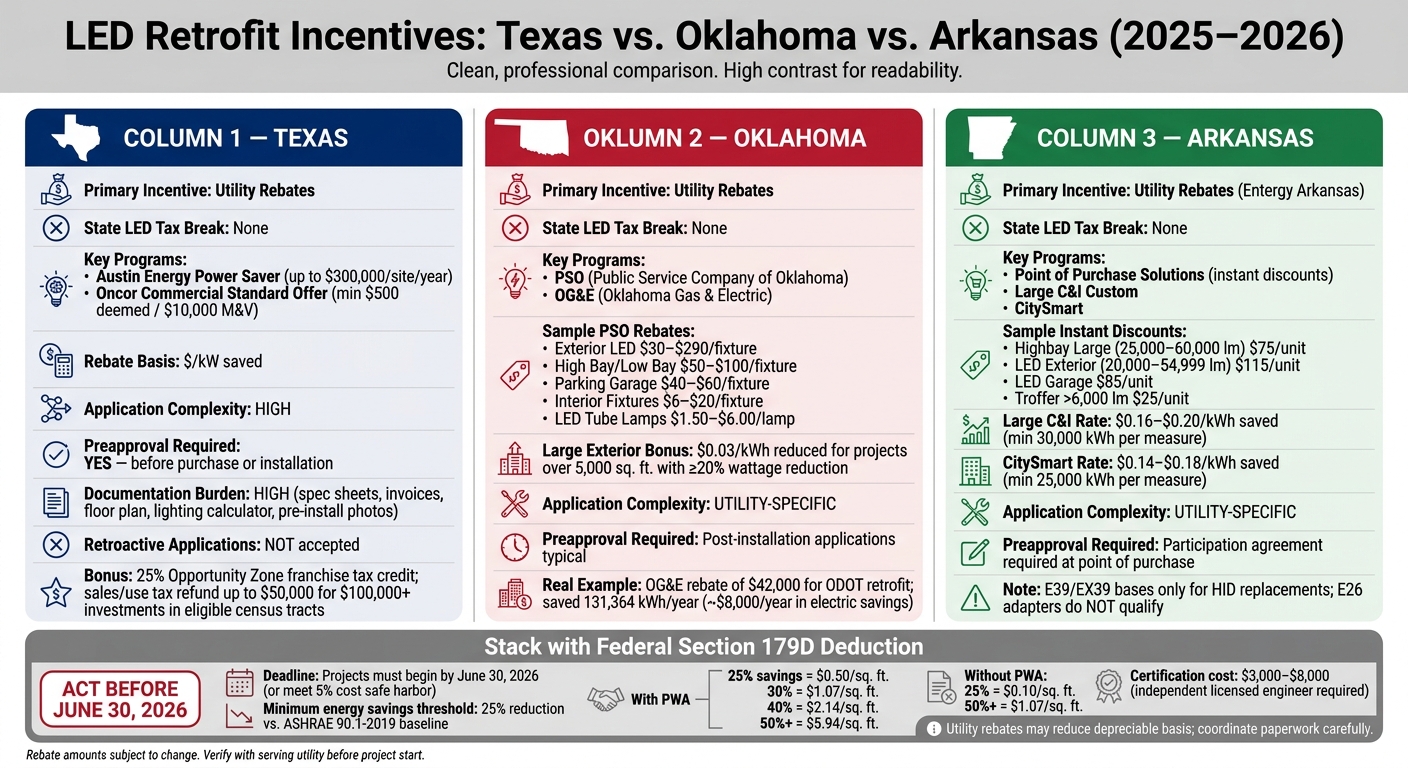
LED Retrofit Incentives: Texas vs Oklahoma vs Arkansas (2025–2026)
Across Texas, Oklahoma, and Arkansas, the main differences come down to timing, paperwork, and how you claim the rebate. In all three states, utility rebates account for most LED retrofit savings. Businesses can also stack those rebates with the federal Section 179D deduction.
| Factor | Texas | Oklahoma | Arkansas |
|---|---|---|---|
| Primary incentive path | Utility rebates | Utility rebates | Utility rebates |
| State-level LED tax break? | None standard | None standard | None standard |
| Application complexity | High - major programs require preapproval before installation | Utility-specific | Utility-specific |
| Documentation burden | High - spec sheets, invoices, a floor plan, a lighting calculator, and preinstall photos | Utility-specific | Utility-specific |
| Retroactive applications | Generally not accepted | Utility-specific | Utility-specific |
Texas has the heaviest process of the three. Large utility programs usually require preapproval before installation, plus detailed project records. That means you can't just swap fixtures, save a few receipts, and file later. If you miss the early step, you may miss the rebate.
Oklahoma and Arkansas depend more on the serving utility. So the first move is simple: confirm which utility covers the property and check whether a rebate program is live. The rules can change from one service area to another, which is why this step matters.
Federal tax treatment adds another layer. If you stack Section 179D with utility rebates, treat the federal certification step as a separate filing requirement. In plain English, the utility rebate and the tax deduction may work together, but they don't run through the same process.
Before you apply, line up the program rules with your utility territory, fixture list, and installation plan. Then verify the basics before work starts:
That up-front check can save a lot of back-and-forth later.
Before you start an LED retrofit in Texas, Oklahoma, or Arkansas, make sure the project clears a few basic checks. That helps you confirm rebate eligibility before money is spent or equipment is ordered.
Start by confirming which utility serves the property. Then check that the rebate program is open, preapproved, and still taking applications. If the program has preapproval rules, application deadlines, or install timing rules, those come from the serving utility or the state program itself.
Once you've confirmed the utility, compare the project against that program's wattage-reduction and controls rules.
Most rebates are tied to wattage reduction. Austin Energy is a good example. It uses a tiered setup: non-warehouse buildings that cut wattage by more than 40% can qualify for $370/kW, while projects below 20% reduction get $105/kW.
That means your fixture inventory matters. Document:
Pre-installation photos are often required too. And if controls are part of the job, record them clearly. They can change both rebate value and the energy model.
Once the baseline is set, check product eligibility before placing the order.
Before ordering fixtures, use the utility's approved equipment list. You'll also need manufacturer specification sheets and cut sheets for the application.
After the equipment is picked, keep rebate paperwork separate from tax documentation.
These steps help protect both rebate eligibility and tax handling. If you're going after a Section 179D deduction, you'll need records from a licensed, independent third-party certifier. That person must complete an on-site visit and use IRS-approved software to verify the energy savings.
Keep invoices, rebate approvals, cut sheets, and the 179D certification together in one file.
Across Texas, Oklahoma, and Arkansas, the biggest savings usually come from utility rebates and Section 179D. The best return tends to come from stacking incentives. In plain English, that means pairing Section 179D with utility cash rebates to cut the total project cost by a large margin.
Section 179D ends for projects that begin after June 30, 2026. To qualify, major physical work must start by then, or you need to have spent at least 5% of the total project cost by that date. So timing matters.
Before you order equipment, compare incentives early, get preapproval, and bring in a tax advisor during the design phase. Those steps can help protect both your rebate eligibility and the federal deduction.
Yes. You can combine utility rebates with the Section 179D tax deduction for an LED retrofit project.
Utility rebates can cut upfront costs. At the same time, Section 179D can lower taxable income based on the building’s energy performance.
It’s a good one-two punch: one helps at the time of purchase, and the other may help at tax time.
Still, the details matter. Talk with a qualified tax advisor to confirm eligibility and the paperwork needed for both.
It depends on the utility or incentive program.
Many utility rebate programs require formal approval before you order, buy, or install equipment. If you move ahead too soon, the project may no longer qualify.
You should also review your utility provider’s terms and conditions, since rules vary by region and by program. Some state-specific grant or rebate programs may require you to wait before signing any agreements.
Keep organized records for 179D and utility rebates. That includes payroll records, contractor and subcontractor agreements, compliance documents for prevailing wage and apprenticeship standards, energy modeling results, and the written certification from the licensed engineer or contractor who inspected the property.
You should also keep invoices and project cost records so you can separate capitalizable work from operating expenses. That split matters. If everything gets lumped together, tax reporting can get messy fast.
Luminate Lighting Group can help manage the energy modeling and certification process.


