.svg)
Define goals, pick open protocols, and commission systems to build interoperable, energy-saving smart lighting.

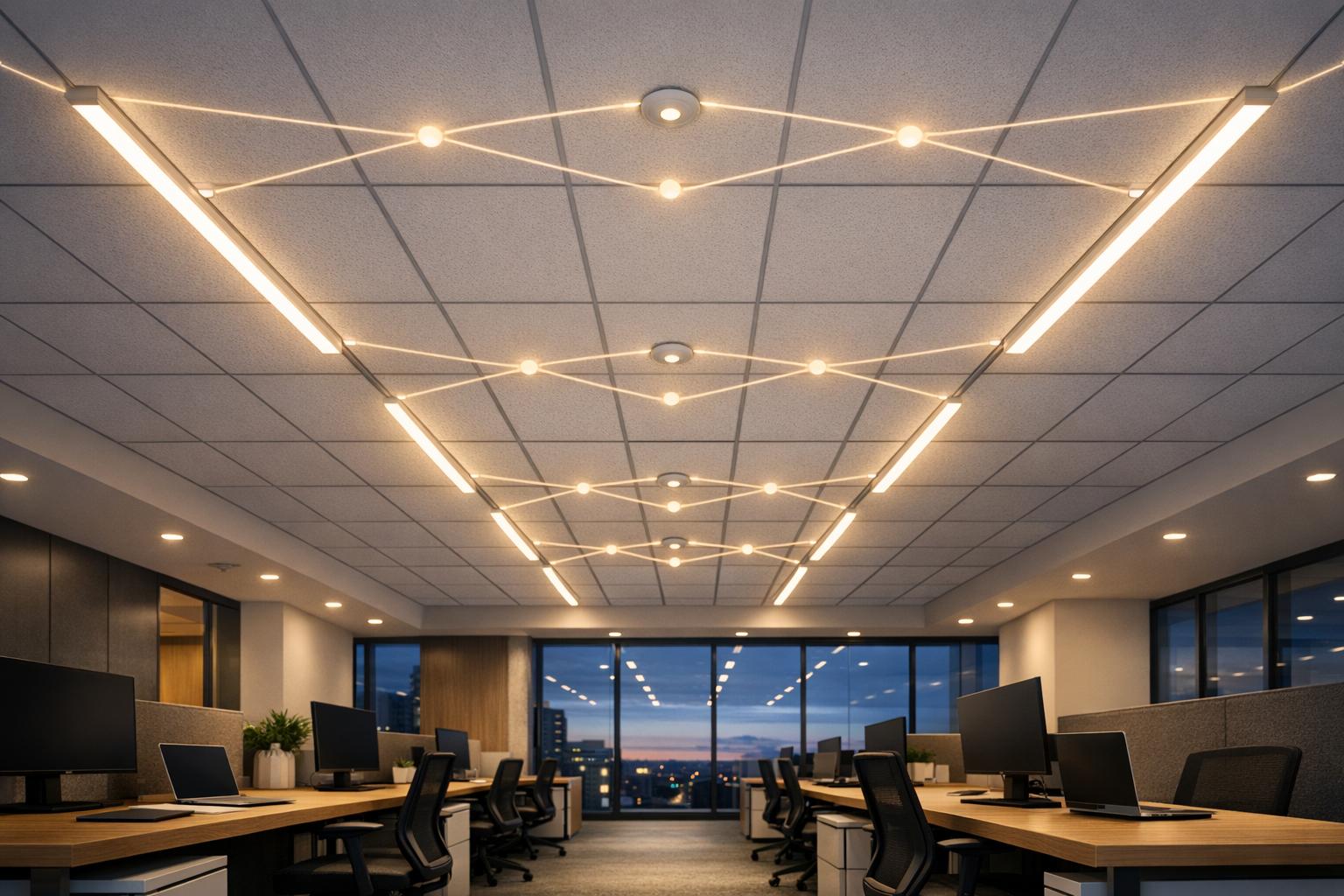
Smart lighting systems help reduce energy use by automatically adjusting to occupancy, daylight, and schedules. By integrating open protocols like DALI-2, Zigbee, and Bluetooth Mesh, these systems avoid vendor lock-in and work seamlessly across devices from different manufacturers. This ensures compliance with energy codes like ASHRAE 90.1 and boosts efficiency, cutting lighting energy use by 30–70% and total building energy by up to 20% when paired with HVAC systems.
To achieve this, following a proven lighting process is critical. Define goals, select protocols, and document requirements in an Owner's Project Requirements (OPR) document. Use tools like a requirements matrix to align business needs with system functions, ensuring flexibility and compatibility.
Key protocols include:
Proper commissioning, regular audits, and firmware management keep systems efficient and scalable over time. Smart lighting not only saves energy but also enhances operational efficiency when integrated with other building systems like HVAC. Start with clear goals and open standards to future-proof your system.
It's crucial to define system functions early on to avoid integration headaches later. This step lays the groundwork for selecting protocols and devices in the next phases.
Lighting goals should directly tie into operational priorities. For instance, a warehouse aiming to cut overhead costs will have very different needs compared to a municipal office building working toward LEED certification. Networked Lighting Controls (NLC) have the potential to cut lighting energy use by 40% to 50% beyond what LEDs alone can achieve. However, these savings only materialize when the system is tailored to the specific demands of the space.
Think about whether your facility needs software-defined zoning to allow reconfigurations without rewiring. Also, consider integrating HVAC systems for even greater energy efficiency. These considerations provide the foundation for selecting appropriate protocols and system architectures in the next steps.
"The ability to remotely access and manage building lighting allows the energy management team to rapidly respond to user needs." - Jake Wayne, America's East Geography Lighting Discipline Leader, Arup
Operational goals should be captured in an Owner's Project Requirements (OPR) document. This document should clearly outline system functions, performance targets, sustainability priorities, and maintenance expectations. It should also specify system interfaces.
Include details like communication protocols (e.g., BACnet, DALI, Zigbee), network segmentation strategies (such as VLAN), and Power over Ethernet (PoE) budgets. Regulatory compliance is another key factor - ensure the system aligns with standards like ASHRAE 90.1, the IECC, and local energy codes. For facilities participating in demand response programs, OpenADR compatibility should be non-negotiable.
Additionally, assign responsibility for integration tasks. This could fall to the electrical contractor, a manufacturer technician, or a dedicated multi-system integration (MSI) consultant. IT responsibilities, such as managing network security and addressing wireless interference, should also be clearly designated.
Once these requirements are documented, use a requirements matrix to tie each goal to a specific system function.
A requirements matrix helps connect business goals to the technical functions needed to achieve them. It links each goal to the protocols, standards, and integration points that support it, while also addressing any security or compliance needs:
| Business Goal | System Function | Protocol/Standard | Integration Point |
|---|---|---|---|
| Energy savings | Occupancy sensing, daylight harvesting, high-end trim | DALI-2, 0–10V | Standalone or BMS |
| Maintenance efficiency | Remote management, standardized attic stock, fault reporting | BACnet/IP, cloud API | Building Management System |
| Space flexibility | Zone reconfiguration | Bluetooth Mesh, Zigbee | Local network |
| Building integration | Occupancy data sharing with HVAC | BACnet/IP | BMS/BAS |
| Regulatory compliance | Automated demand response, code-compliant controls | OpenADR, ASHRAE 90.1 | Utility/grid signals |
Gary Meshberg, Chair of the Lighting Controls Association, emphasizes this approach:
"The designer should seek to define functional expectations (including monitoring and IoT applications), performance criteria, sustainability objectives, cost considerations, and maintenance expectations."

Smart Lighting Protocols Compared: DALI-2 vs Zigbee vs Bluetooth Mesh vs DALI+
Use your requirements matrix to guide the selection of protocols, certified devices, and a scalable system architecture. This step connects your interoperability needs with the practical implementation of connected devices.
The protocol you choose determines how devices communicate and how scalable your system can be. Here’s a practical summary of the most commonly used options:
| Protocol | Type | Best Use Case |
|---|---|---|
| DALI-2 | Wired | Precision control for drivers, sensors, and ballasts in commercial settings |
| D4i | Wired (intra-luminaire) | Standardized energy, diagnostics, and luminaire data from LED drivers |
| Bluetooth Mesh / NLC | Wireless | Decentralized control for spaces needing easy reconfiguration |
| Zigbee | Wireless | Popular mesh networking for medium to large commercial deployments |
| DALI+ | Wireless / IP-based | Native DALI commands over Thread, Ethernet, or Wi-Fi without translation |
For most commercial projects, DALI-2 is the go-to for wired control. If wireless flexibility is required, Bluetooth Mesh and Zigbee are excellent choices, though they depend on standardized gateways like DALI Part 341 for Bluetooth or Part 342 for Zigbee to ensure seamless communication with wired DALI components.
For larger facilities with plans for future expansion, DALI+ over Thread is an option worth exploring. Traditional wired DALI subnets are limited to 64 devices, but DALI+ introduces a system address that increases this limit by 255. When paired with IP-based carriers like Thread, the addressing capacity becomes nearly limitless.
"It opens up new possibilities for integrating DALI with wireless systems, creating a broader range of solutions for the industry." - Paul Drosihn, General Manager, DALI Alliance
Once protocols are selected, ensure all devices meet certification standards. Certification is critical - avoid relying on claims like "DALI-compatible", as these don’t guarantee multi-vendor interoperability.
Use the official DALI Alliance database (dali2.org/products) to verify DALI-2 and D4i certifications. Additionally, for energy efficiency compliance in the U.S., check products against the DesignLights Consortium (DLC) Qualified Products List at designlights.org.
When evaluating luminaires, confirm that internal components - such as LED drivers, sensors, and controllers - are individually certified. A luminaire can only carry the DALI-2 logo if all its components have passed certification. This ensures reliable multi-vendor compatibility across the system.
A strong system architecture relies on standardization at three levels: DALI for device-level control, Zhaga for physical sensor interfaces, and TALQ for network-level management software. This layered approach allows you to replace components at any level without overhauling the entire system.
A smart move: specify luminaires with Zhaga Book 18 or Book 20 sockets. This enables future integration of sensors like air quality monitors, occupancy detectors, or noise sensors at a modest upfront cost of $5–$15 per luminaire, compared to the high cost of replacing fixtures later.
On the network side, dedicate a VLAN for lighting traffic to keep it separate from general business data, enhancing both performance and security. For projects using Power over Ethernet (PoE), ensure switches support Perpetual PoE and Fast PoE. These features keep lighting operational during network reboots and allow for immediate recovery after power disruptions. These architectural choices establish a solid foundation for the next steps in system design and installation.
Once you've chosen protocols and defined the system architecture, the next challenge is turning those plans into a functional, physical setup. This step demands careful planning and execution.
Start by mapping out control zones for each room before any wiring begins. Opt for software-defined zoning whenever possible. This allows you to reconfigure fixtures or adjust behaviors without needing to rewire - a huge advantage for spaces like offices or retail stores that often change layouts.
For DALI-2 installations, a wired bus topology works best. Stick to the limit of 64 addresses per line to maintain system integrity. In contrast, retrofits often benefit from a wireless mesh topology, which ensures that if one node fails, the rest of the system remains operational. Generally, new construction projects lean toward wired bus layouts, while wireless mesh setups are more practical for retrofits in occupied spaces.
Be sure to document these decisions thoroughly. Clear records make future integrations and maintenance much easier.
Comprehensive documentation is key to ensuring the system's long-term reliability. Focus on three main documents throughout the project: the Owner's Project Requirements (OPR), the Control Intent Narrative (CIN), and the Sequence of Operations (SOO).
"Effective integration ensures a well-coordinated solution. It is essential for BAS projects and often required for lighting projects with open protocols." - Gary Meshberg, Chair of the Lighting Controls Council
The SOO is particularly important. It outlines how the lighting system interacts with other systems, such as HVAC or A/V setups, ensuring both sides understand their roles. Consistent labeling of circuits, addresses, and zones - combined with detailed digital drawings - will simplify troubleshooting later on.
Once the design is documented, commissioning ensures the system performs as expected. Unlike a simple startup, commissioning is a structured, quality-focused process often handled by a third-party expert. This process verifies that the system aligns with the OPR from start to finish.
Take a phased approach:
Before handing over the system, conduct failure mode tests. Simulate scenarios like network outages, power interruptions, or gateway resets to confirm the system defaults to safe settings.
"Commissioning requires a comprehensive third-party quality assurance process, whereas in the context of lighting controls, startup typically happens towards the end of the installation process." - C. Webster Marsh, Guest Author, Lighting Controls Academy
Keeping a system reliable means having a solid maintenance plan in place. One common issue in smart lighting is firmware drift - when devices run different software versions, causing integration problems over time. A 2024 audit revealed that 68% of smart lighting hardware suppliers fail to publish backward compatibility matrices for firmware updates. As a result, facility teams often bear the responsibility of ensuring compatibility.
To avoid these headaches, it’s crucial to maintain a live integration matrix. This document tracks every fixture, driver, sensor, and gateway alongside its tested firmware version. Anytime a device is replaced or updated, the matrix gets updated too. This simple practice can save time during troubleshooting and reduce service costs.
When rolling out firmware updates, limit them to batches of 20–30 devices. This approach helps manage network bandwidth and ensures updates are completed successfully. Additionally, negotiate contracts that include firmware version-pinning rights, which allow you to stick with a validated firmware version for at least 18 months. This single clause has been shown to cut field failures by 22% in smart lighting installations.
When evaluating suppliers, look closely at their firmware support policies. Here’s a quick comparison to guide your decision:
| Assessment Dimension | Minimum Acceptable Standard | High-Trust Benchmark |
|---|---|---|
| Firmware Support Window | ≥24 months from first shipment | ≥36 months + annual public roadmap |
| Breaking Change Disclosure | 7-day notice via email | 90-day public changelog + test environment |
| Protocol Compliance | One certified standard (e.g., DALI-2) | Dual-stack support (e.g., Matter + DALI-2) |
These practices lay the groundwork for scalable, reliable systems.
Expanding a lighting control system without disrupting existing integrations requires careful planning from the beginning. Choosing adaptable hardware and network designs ensures compatibility as the system grows. Mesh topologies, such as Bluetooth Mesh or Zigbee, are ideal for scalability. These networks become stronger and more reliable as fixtures are added, eliminating the need for additional control wiring. In contrast, centralized systems are limited by controller capacity and can fail entirely if the main controller goes down.
For long-term flexibility, consider specifying Zhaga Book 18-compliant fixtures. These fixtures feature a standardized socket that can accommodate snap-on sensor modules, BLE beacons, or IoT gateways even years after installation - no rewiring required. To enhance security as the system grows, isolate lighting IoT devices on a dedicated VLAN with firewall rules restricting traffic to the Central Management System (CMS). Combining lighting controllers with corporate IT networks increases security risks unnecessarily.
When expanding a wireless mesh network, keep an eye on mesh depth. Most gateways can handle a maximum of 5–7 hops; exceeding this limit can result in "orphaned" nodes that unpredictably drop off the network.
Regular audits ensure these scalability measures stay effective as the system evolves.
Even the best-commissioned systems can drift from their original setup over time. Changes like furniture rearrangements, occupancy shifts, or outdated sensor thresholds can impact performance. Periodic audits help address these issues. During a review, walk-test occupancy sensors, recalibrate lux levels, and verify that zone logic aligns with current space layouts.
Audits are also a chance to evaluate energy performance and rebate eligibility. Pairing networked lighting controls with LED upgrades can boost utility rebate values by 20–30% or more, but many incentives require proof of ongoing system performance. Companies like Luminate Lighting Group offer energy audit services to confirm interoperability, flag compliance gaps, and identify opportunities for rebates or 179D tax deductions. Reviewing the system every 12–18 months ensures it meets operational needs and complies with updated energy codes.
"A useful handover file for smart lighting integration should explain how the system is actually configured in the building, not just what equipment was delivered." - Commercial Tech Editor
Properly maintained intelligent controls can cut maintenance costs by 40% through remote monitoring and predictive scheduling. However, these savings only materialize if the system is actively managed and not left on default settings from day one.
Creating an interoperable smart lighting control system involves a clear, step-by-step process. It begins with defining your requirements before purchasing any hardware, selecting open and widely supported protocols (like DALI-2, Zigbee, or BACnet), and designing a system architecture that allows for future growth without disrupting existing operations. After installation, thorough commissioning and detailed documentation are essential to keeping the system dependable over the long term. These practices ensure the system remains flexible and efficient as needs evolve.
Smart lighting controls can reduce energy use by 30–60% compared to static LED setups, with a return on investment typically achieved within 3–7 years. Combining networked controls with LED upgrades can further boost utility rebate values by 20–30% or more.
Industry experts emphasize the importance of a cohesive approach:
"Smart lighting integration works best when it is managed as a whole system, not a collection of separate products." - Commercial Tech Editor
To ensure long-term success, treat your system as a dynamic asset rather than a one-time project. This means selecting standard protocols early, keeping firmware updated, and conducting regular system audits as the building's needs change. Jake Wayne, America's East Geography Lighting Discipline Leader at Arup, highlights this point: "Standardization is beneficial for ongoing maintenance, allowing for an attic stock of components that can be used for many buildings."
For a seamless experience, Luminate Lighting Group offers end-to-end services, including energy audits, design, and installation, to ensure full interoperability and compliance. By partnering with them, facilities can establish clear requirements, document control plans, and maintain system performance through periodic audits. This not only unlocks utility rebates and 179D tax deductions but also builds a sustainable and efficient system for the future.
Choosing between DALI-2, Zigbee, and Bluetooth Mesh comes down to your setup and how much reliability you need.
In environments like hospitals, where avoiding wireless interference is crucial, DALI-2 is often the go-to solution.
Before buying lighting controls, it's crucial to gather the right documents to ensure the system aligns with your needs. Begin with an Owner’s Project Requirements (OPR) document, which outlines your goals and expectations. Additionally, ask for a controls narrative, a Sequence of Operations (SOO) document, equipment specifications, wiring diagrams, one-line diagrams, and relay panel schedules. For expert guidance, Luminate Lighting Group can assist in making sure your upgrades meet both performance and energy standards.
To prevent firmware updates from causing compatibility issues, ask your suppliers for documented firmware versions and lock these versions before installation. Simplify integration by reducing the number of control platforms in use and choosing systems that offer supported integration pathways. For critical environments, ensure over-the-air (OTA) updates are reliable - look for at least a 99.2% success rate. If updates disrupt local integration, you might also consider blocking problematic update servers directly at the router level.


