.svg)
Sync lighting and HVAC with networked controls and occupancy data to cut energy use, improve comfort, and simplify facility management.

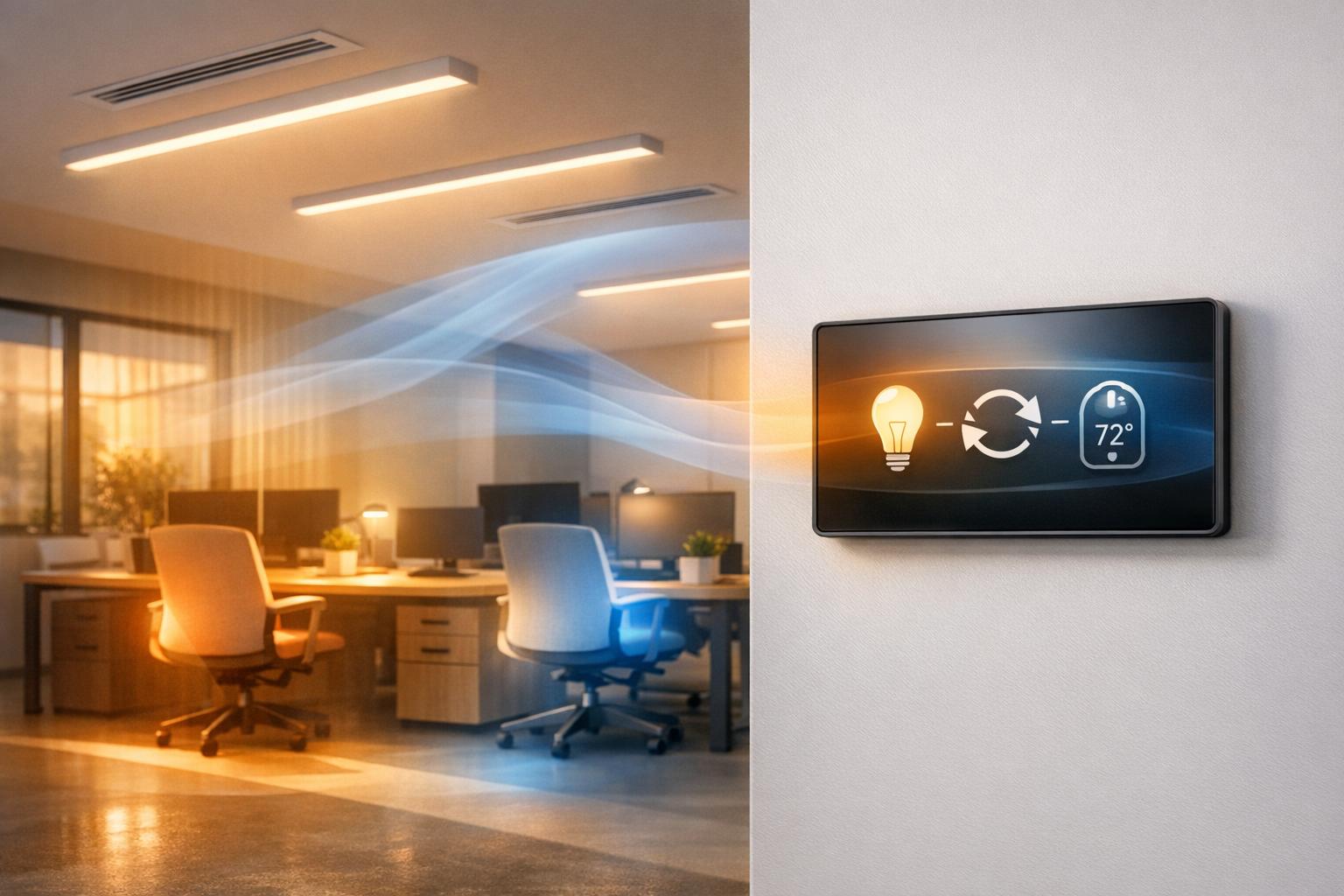
Integrated smart controls for lighting and HVAC systems can reduce energy costs, improve comfort, and simplify building management. By linking these systems on a shared platform, facilities can use real-time occupancy data to adjust lighting, temperature, and ventilation dynamically.
This approach is especially effective in buildings with variable occupancy, like offices, schools, and healthcare facilities. Using technologies like Networked Lighting Controls (NLC), occupancy sensors, and Building Management Systems (BMS), facilities can achieve measurable energy savings while maintaining comfort. Proper planning and coordination between lighting and HVAC teams are essential for success.

Integration Strategies for Lighting and HVAC Energy Savings
When lighting and HVAC systems operate on a unified platform, commercial buildings gain three key perks: lower energy costs, enhanced comfort for occupants, and easier day-to-day management. These benefits are measurable, allowing facility managers to track performance improvements with clear data.
When a lighting sensor detects an unoccupied conference room, the system doesn’t just turn off the lights - it also adjusts HVAC settings, reducing temperature and airflow. This coordinated response ensures that air conditioning doesn’t waste energy in empty spaces.
According to the DesignLights Consortium, integrating lighting and HVAC systems can reduce HVAC energy use by 12% to 17%, thanks to shared occupancy sensors. Instead of running on separate schedules, both systems respond to the same real-time data.
Here’s a breakdown of integration strategies and their energy-saving effects:
| Integration Strategy | Energy Impact | Primary Mechanism |
|---|---|---|
| Occupancy Setback | High | Adjusts temperature settings when no occupants are detected |
| VAV Turndown | Medium-High | Reduces airflow in unoccupied zones |
| Shared Scheduling | Medium | Synchronizes "Off" and "Unoccupied" cycles across systems |
| Demand Control Ventilation | High | Modulates fresh air intake based on real-time occupancy |
Buildings with variable occupancy patterns - like schools, government offices, and healthcare facilities - see the greatest savings. For instance, a classroom empty during lunch or a clinic exam room between appointments can quickly switch to energy-saving mode and return to comfortable settings within 5 to 10 minutes when reoccupied.
This approach doesn’t just save energy - it also enhances comfort for occupants.
Integrated systems deliver immediate comfort by automatically adjusting lighting, temperature, and even shading. As Lutron puts it, they create a "human-centric" environment.
"Integrated lighting and HVAC controls create an optimum indoor environment. They can share the same sensors to determine whether a room is occupied and automatically adjust the lighting and temperature to ideal settings".
This coordination of thermal and visual comfort is especially valuable in spaces where intuitive controls are essential.
Some advanced systems even feature tunable white lighting, which shifts color temperature throughout the day to align with natural circadian rhythms, promoting focus and well-being. Combine this with demand-control ventilation that adjusts fresh air based on room usage, and you get an environment that feels both responsive and comfortable.
These comfort benefits also tie into simpler management, making integrated systems even more appealing.
Beyond energy savings and comfort, integration makes facility management easier. For teams working with limited budgets or staff, this means achieving more with less effort.
"The most advanced platforms offer organizations one system simplicity. Facility teams can manage the integrated system from a single dashboard rather than making manual adjustments on multiple platforms".
Instead of maintaining separate occupancy sensors for lighting and HVAC, integrated systems use one set of sensors. This reduces installation time - wireless lighting controls are 70% faster to install than wired systems - and cuts down on maintenance.
Remote access adds another layer of convenience. Facility managers can monitor and adjust both lighting and HVAC from any computer or mobile device, addressing issues without needing to visit each zone. Plus, the data from these systems helps verify that all building components are operating as intended, catching potential issues before they turn into costly repairs.
Bringing lighting and HVAC systems together relies on three main technologies: networked lighting controls (NLC), occupancy sensors paired with daylight harvesting, and building management system (BMS) integration. Each contributes to creating a more efficient and responsive building environment.
Networked Lighting Controls form a smart system where luminaires and sensors communicate digitally to manage building lighting. Unlike older systems, NLC uses digital communication to share real-time data, particularly occupancy information.
This data-sharing capability is where NLC really shines. By transmitting real-time occupancy data, these systems can trigger HVAC adjustments. For example, when a room is empty, the HVAC system can switch to energy-saving settings, cutting airflow and increasing temperature setpoints to conserve energy.
Luminaire-Level Lighting Controls (LLLC) take it a step further. With sensors embedded in each fixture, these systems provide highly detailed occupancy data. This allows HVAC systems to make adjustments specific to each zone, rather than relying on simple "occupied/unoccupied" signals. Levin Nock, Senior Technical Manager at DesignLights Consortium, highlights this synergy:
"NLC-HVAC integration offers a powerful justification for NLC in buildings where it can save substantial whole-building energy using existing BAS and HVAC systems".
The energy savings are impressive. On average, NLC systems reduce lighting energy use by 48% and, when paired with HVAC, can cut HVAC energy consumption by up to 30%. Plus, these integrated solutions are far more cost-effective than replacing an entire HVAC system.
The next layer of efficiency comes from combining occupancy sensors with daylight harvesting.
Occupancy sensors play a dual role, detecting when spaces are vacant and signaling both lighting and HVAC systems to adjust accordingly, leading to significant energy savings.
Daylight harvesting adds another layer of optimization. Sensors measure natural light levels and reduce or turn off electric lighting when daylight is sufficient. When paired with automated window shades, these systems also reduce solar heat gain, easing the cooling load on HVAC systems. A Focus on Energy Pilot Project (2022–2025) demonstrated this in action at a public library and health clinic, achieving 12% to 17% HVAC energy savings while maintaining occupant comfort.
In specialized settings like operating rooms or labs, occupancy sensors can lower air-change rates from 20 ACH to 6 ACH during unoccupied times, all while maintaining necessary pressure levels.
BMS serves as the nerve center, integrating data from all systems to fine-tune operations. Using open protocols like BACnet and LonWorks, the BMS simplifies programming and installation, ensuring smooth communication between components.
When paired with LLLC, the BMS can process detailed occupancy data from individual fixtures, enabling precise control over HVAC zones. Instead of relying on binary signals, the system adjusts ventilation and temperature based on real-time occupancy data.
Paul Kondrat, Engineering Leader at CannonDesign, explains the potential:
"As programming, hardware, and protocols continue to mature and become more reliable, this type of approach will become easier and lead to greater benefits from a networked solution".
To maximize these benefits, it's essential to align lighting and HVAC control zones and appoint a coordination lead to ensure smooth collaboration between electrical and mechanical teams.
Putting integrated smart controls into action involves thoughtful planning, clear data-sharing strategies, and ongoing adjustments. These steps ensure that the theoretical advantages of these systems translate into practical results. The main focus is on creating seamless communication between lighting and HVAC systems, with both teams working toward a unified goal.
One straightforward method involves using room-occupancy sensors equipped with auxiliary low-voltage contacts (dry contact closures). These are directly wired to HVAC controllers, such as VAV boxes or heat pumps. This setup works well for smaller buildings or simpler applications.
For larger commercial projects, digital networked integration provides more adaptability. Modern systems often rely on open protocols like BACnet or LonWorks to handle occupancy signals as virtual control points. Craig DiLouie, Education Director at the Lighting Controls Association, explains:
"By sharing occupancy signals with the HVAC system, the occupancy sensors can trigger occupied-standby mode in properly aligned HVAC zones."
The key here is zone alignment - your lighting control zones must match your HVAC zones both physically and logically to ensure smooth operation.
An example from a Focus on Energy pilot project (November 2022–December 2025) involving a public library and health clinic highlights a common issue: BACnet functionality on Networked Lighting Control systems isn't always enabled by default. This oversight led to higher implementation costs when discovered late in the process. To avoid such problems, enable BACnet communication during the initial installation phase, saving time and money.
Once occupancy data-sharing is in place, refining operations with scheduling enhances efficiency even further.
Scheduling is a crucial step in aligning system operations with actual building usage. By understanding how a building physically responds, you can balance energy savings with comfort. For example, implementing nighttime setback schedules requires accounting for building mass. The warmup period must be long enough to allow the building envelope and furniture to recover, not just the air temperature. While air heats up quickly, the building structure takes longer to reach a comfortable temperature.
Astronomical scheduling takes this a step further by adjusting lighting based on local sunrise and sunset times throughout the year. This ensures that lights aren’t running unnecessarily during daylight hours while still providing adequate illumination as natural light fades.
Data analytics plays a pivotal role in turning sensor inputs into actionable commands. For instance, Luminaire-Level Lighting Controls (LLLC) collect highly detailed data from sensors embedded in each fixture. This allows systems to estimate actual occupancy levels rather than relying on simple binary signals. With this level of detail, HVAC adjustments can be more precise, targeting specific zones instead of conditioning entire floors.
However, managing this data requires careful programming to consolidate individual luminaire signals into unified commands for HVAC zones. Assigning an integration lead - someone dedicated to coordinating between the lighting and HVAC teams - can help navigate the complexities. Paul Kondrat, Engineering Leader at CannonDesign, underscores this point:
"Successful integration projects need commitment from design and installation teams to follow the original vision through to a final, reliable solution."
In addition to energy savings, analytics can uncover usage patterns that improve building services across the board.

Integrated smart controls require a high level of expertise to achieve measurable results. Luminate Lighting Group specializes in helping commercial clients coordinate lighting and HVAC systems through a process that includes assessment, installation, and ensuring compliance.
Before any equipment is installed, Luminate conducts thorough energy audits to determine whether a building is suitable for smart control integration. These audits use tools like the DesignLights Consortium (DLC) NLC-HVAC Integration Decision Tree to evaluate sites and avoid projects where technical challenges may prevent success. The focus is on energy-intensive buildings with variable occupancy, as these offer the greatest potential for energy savings.
The audits also identify potential technical obstacles related to BACnet, a key communication protocol, which helps streamline integration. They assess the building's BAS (Building Automation System) and NLC (Networked Lighting Controls) BACnet compatibility and explore HVAC strategies like temperature setback, VAV turndown, and demand control ventilation - measures that can save 12–17% on energy costs. Additionally, the audits produce detailed zone maps and cost estimates for lighting and HVAC control systems.
These findings lay the groundwork for creating tailored solutions in the next phase.
Following the audit, Luminate crafts custom specifications designed to match each building's unique layout and energy goals. These specifications emphasize the use of Networked Lighting Controls or Luminaire Level Lighting Controls (LLLC), which provide real-time occupancy data that can inform HVAC operations. From the start, the designs ensure seamless communication between lighting systems and Building Automation Systems via BACnet protocols.
The specifications align with CSI Division 25 standards, addressing critical aspects like control points, communication protocols, and latency requirements for integrated systems. They also include detailed sequences that dictate how occupancy signals trigger energy-saving HVAC strategies such as temperature adjustments and ventilation control. Luminate prioritizes full lighting retrofits alongside HVAC integration, as retrofitting older systems often leads to technical challenges and higher expenses.
Additional features like tunable white lighting and daylight harvesting are integrated to enhance the building's overall efficiency. Wireless lighting control systems are another key component, offering installation times up to 70% faster than traditional wired systems, which helps minimize disruptions to building operations.
These custom designs ensure a smooth transition to the installation phase.
With detailed audits and designs in place, Luminate oversees the entire installation process to ensure everything runs smoothly. Their turnkey services are led by an integration expert who coordinates between lighting and HVAC teams, troubleshooting communication issues and ensuring proper system sequencing. Given the technical complexity of these projects, this role is crucial, especially when retrofitting onto existing NLC systems, which can present unexpected challenges.
The installation process includes rigorous verification using standardized checklists to confirm that all systems are configured correctly and functioning as intended. For instance, Focus on Energy's demonstration projects at a public library and a health clinic highlighted the importance of proper implementation, achieving HVAC energy savings of 12–17%.
Beyond installation, Luminate helps clients navigate energy code compliance and identify financial incentives. This includes utility rebates, federal tax credits like the 179D deduction, and performance-based incentives tied to verified energy savings. These services ensure that systems meet local energy codes and support state initiatives aimed at achieving zero net energy in commercial buildings by 2030.
Bringing lighting and HVAC systems together through smart controls is a powerful way to cut energy costs in commercial buildings. By leveraging real-time occupancy data from networked lighting sensors, facilities can automate HVAC adjustments like setbacks, VAV turndown, and demand control ventilation, leading to 12% to 17% energy savings in HVAC operations. In this setup, lighting systems double as a key data source, driving efficiency across the entire building.
However, these projects aren’t plug-and-play. Success hinges on careful planning, starting with choosing the right buildings - typically large, energy-intensive spaces with fluctuating occupancy. Seamless communication between systems is also essential. As Paul Kondrat of CannonDesign points out, design professionals play a crucial role by fully utilizing the potential of these advanced systems.
To tackle these challenges, Luminate Lighting Group offers a streamlined approach led by experts. Their services include energy audits, custom control specifications, and full-service installation. These systems not only comply with energy codes but also qualify for utility rebates and federal tax incentives, such as the 179D deduction.
Many current HVAC systems can be improved or linked with smart lighting controls to boost energy efficiency and better synchronize operations. This approach enables smooth integration without requiring a complete system overhaul.
Aligning lighting zones with HVAC zones means developing a coordinated system that uses occupancy data and integrated controls to work efficiently together. This approach often relies on networked lighting controls and occupancy sensors to balance energy savings with maintaining comfort for the people in the space.
Energy-efficient upgrades like this integration could potentially qualify for utility rebates and 179D tax deductions, offering both financial incentives and tax savings. These programs are designed to encourage improvements in areas like lighting and HVAC systems. By taking advantage of them, you can lower energy costs while aligning with performance and environmental goals.


