.svg)
Smart exterior lighting controls ensure code compliance and cut energy use up to 70% with sensors, timers, photocells, or wireless systems.

If you manage commercial property, complying with updated energy codes like IECC 2024 and ASHRAE 90.1 now requires exterior lighting to include automatic shutoff controls. This isn't optional - it’s mandatory. Smart lighting controls not only meet these regulations but also cut energy use by 40–70% when paired with efficient LED systems. Here’s a breakdown of the key technologies that help you stay compliant and save on costs:
Each option offers specific benefits for energy savings, maintenance, and compliance. For example, occupancy sensors are ideal for parking lots or pathways, while astronomical timers suit municipal or roadway lighting. Smart wireless systems provide advanced control, combining multiple features into a single network.
Key Takeaway: Matching the right control technology to your property’s needs ensures compliance, lowers energy bills, and simplifies operations. Read on to learn how these solutions work and which might be best for your setup.
Occupancy sensors adjust lighting based on motion detection, cutting power usage by 50% to 90% in unoccupied areas. They also dim lights to 10–30% to maintain baseline safety and security levels. This immediate response not only satisfies code requirements but also leads to noticeable energy savings.
The effectiveness of these sensors depends on their mounting height. Passive Infrared (PIR) sensors are affordable and work well at heights up to 12–15 feet. However, their ability to detect minor movements decreases significantly at greater heights. For applications like exterior wall packs or high-bay lighting (15 to 40 feet), microwave or dual-tech sensors are necessary to ensure reliable motion detection and compliance with efficiency standards.
When combined with LED fixtures, occupancy sensors can reduce lighting energy use by 40% to 70% compared to older HID or fluorescent systems. To maximize these savings, it's important to set realistic timeout periods - typically between 5 and 15 minutes for active exterior spaces. Extremely short timeout settings can frustrate staff, leading them to disable the sensors altogether. These energy savings also align with regulatory requirements, further enhancing their practicality.
California Title 24 mandates motion sensors for outdoor luminaires mounted 24 feet or lower above grade. The code limits each sensor zone to a maximum of 1,500 watts and requires lights to dim or turn off within 15 minutes of an area being vacated. To streamline inspections and utility rebate applications, keep an "auto shutoff packet" ready. This should include room-by-room control schedules, sensor cut sheets with coverage details, and a lighting layout showing shaded control zones. Proper documentation can make plan reviews and rebate processing much faster.
PIR sensors are the most affordable option but are only suitable for lower mounting heights. For most exterior applications, where mounting heights are higher, microwave and dual-tech sensors are required to meet compliance standards. In California, installation costs may also include our proven installation process and acceptance testing by a California Licensed Controls Acceptance Test Technician (CLCATT).
Microwave sensors, while effective, can sometimes detect movement through certain materials, leading to false triggers. To avoid this, start with the manufacturer's default sensitivity settings and gradually adjust them to prevent unwanted switching caused by nearby zones. Although these sensors have a higher upfront cost, they provide long-term benefits through consistent energy savings and reliable compliance with regulations.
Timers, much like occupancy sensors, play a key role in smart lighting control systems, especially as required by current energy codes. These devices automatically dim or turn off exterior lights based on preset schedules, helping to cut energy use during daylight hours or periods of low demand. For example, California Title 24 mandates automatic scheduling controls for outdoor lighting in nonresidential and hotel settings. These controls must reduce lighting power by 50% to 90% during unoccupied periods or even switch the lights off entirely. Below, we’ll explore how timers contribute to energy efficiency, meet compliance standards, and impact installation costs.
Astronomical time clocks stand out as they adjust automatically for seasonal changes using geographic data. They predict sunrise and sunset times with an accuracy of ±15 minutes and account for daylight savings time without requiring manual input.
Timers are an effective way to save energy by ensuring lights operate only when necessary. By programming schedules that reduce power usage by 50–90% during low-activity periods, you can significantly lower energy consumption while still maintaining enough light for safety. Additionally, energy codes require at least two distinct nighttime periods with separate lighting levels to enhance efficiency.
Timers are also designed to meet stringent energy code requirements. For instance, California Title 24 Section 130.2 mandates automatic scheduling for all nonresidential outdoor lighting. To comply, timers must include a manual override feature, but this override can only last up to 2 hours before the preset schedule resumes automatically. For residential setups, overrides must reset within 6 hours.
Timers also need to have backup capabilities. They must preserve schedules for at least seven days and maintain date and time settings for up to 72 hours during power outages. Keeping detailed records of your schedules, dimming levels, and timeout settings can streamline plan reviews and make it easier to qualify for rebates.
Basic time-switch controls are relatively inexpensive, while advanced astronomical models come with higher costs due to their ability to predict seasonal changes and adjust automatically. On the other hand, modern smart Wi-Fi bulbs often include built-in timer functions, which can lower hardware and installation expenses. However, Wi-Fi timers depend on continuous router connectivity, so a power cut via a wall switch could disrupt their schedules. For commercial projects requiring long-term reliability, hardwired astronomical time clocks remain a solid, if pricier, option.
Photocells simplify dusk-to-dawn lighting by automatically switching circuits based on the surrounding light levels. They adapt naturally to seasonal changes in daylight, making them a smart choice for areas like security lighting, parking lots, and building perimeters where lights need to turn on as it gets dark. While they work well on their own, photocells also complement timer-based systems, adjusting lighting based on real-time ambient conditions.
Using photocell-controlled LED wall packs can cut energy use by 50–80%, with a payback period of about 1.8 years compared to 3.5 years for manual systems. To boost savings even more, many facilities pair photocells with timers in hybrid setups. For instance, wiring a timer in series with a photocell ensures lights only operate when it's dark and within set hours. In a modeled scenario involving 50 fixtures, this hybrid approach saved an extra $1,205 annually. These energy savings highlight how photocells can provide both environmental and financial benefits, making their installation a worthwhile investment.
Photocells are often seen as a "high-impact, low-cost upgrade". Most commercial LED wall packs come equipped with a ½″ threaded knockout for button-style photocells, while industrial poles typically use ANSI C136.10 twist-lock (NEMA) receptacles. It's crucial to match the sensor to the circuit voltage - whether 120V, 208V, 240V, or 277V - to avoid fire hazards or component failures. Additionally, ensure the photocell is rated for electronic ballasts to handle the high inrush current of LED drivers, which can be 100–400 times the steady-state current. To prevent contact welding caused by LED inrush, limit the load to 60% of the photocell's capacity. Many utility rebates can offset 30–50% of the project cost when automated controls like photocells are included.
After installation, regular maintenance is key to keeping photocells working efficiently. Dirt, bird droppings, or oxidation can cause the sensor to "fail on", leading to wasted energy. Performing bi-annual "Control Walks" to clean lenses, check terminals, and inspect connections can prevent this. During installation, using dielectric grease on wire nut connections and silicone-filled connectors can help guard against corrosion, a common cause of flickering or ghosting in outdoor sensors. Proper mounting is equally important - avoid placing photocells on north-facing walls, under deep eaves, or near reflective surfaces or the fixture's own light output to prevent optical feedback. These steps ensure long-term reliability and consistent performance.
Photocells help meet energy codes like IECC 2024 and California Title 24 by enhancing energy efficiency and ensuring compliance. They fulfill "Daylight Availability" requirements by automatically turning off outdoor lighting when there's enough natural light. For residential settings, lighting attached to buildings often needs to be controlled by a combination of a motion sensor and either a photocell or an astronomical time clock to meet standards. Most professional-grade photocells include a built-in time delay of 30–120 seconds to prevent flickering caused by temporary light sources. Additionally, they are designed to "fail-on", keeping security lighting active if the sensor malfunctions.
Astronomical timers use built-in calculations based on your facility's GPS coordinates or ZIP code to automatically predict sunrise and sunset times throughout the year. This means they adjust themselves without needing manual input. Unlike photocells, which can be affected by shadows, dirt, or nearby artificial lights, astronomical timers avoid false triggers by not relying on physical light sensors. Instead, they use precise solar data for more consistent performance.
Astronomical timers excel in energy management thanks to their automated scheduling. These timers can be programmed to reduce outdoor lighting power by 50% to 90% during unoccupied periods instead of simply switching lights between full power and off. Pairing them with motion sensors can further improve efficiency by dimming lights during low-activity times. Many models also offer a programmable offset feature (ranging from 0 to 99 minutes), allowing lights to turn on slightly after sunset or off just before sunrise, fine-tuning energy use even more.
The cost of astronomical timer switches typically ranges from $20 to $150, with professional installation adding $85 to $200 for labor. For instance, the Deako Simple Astronomical Timer Switch is priced at $59.99. Installation is straightforward, taking about 15 to 30 minutes, but it’s important to ensure your system has a neutral wire, as most modern astronomical timers require one. To save on costs, consider bundling the installation with other electrical work, which can help offset minimum labor charges.
Compared to photocells, astronomical timers require minimal upkeep. Since they don’t rely on external sensors, there’s no need for regular cleaning. Most models include battery backups that preserve programming for up to 7 days and maintain date/time settings for 72 hours, meeting code requirements. The main maintenance task is ensuring the timer is correctly set with your location’s geographical coordinates during installation to align with your local solar cycle.
Astronomical timers make it easier to meet energy codes like California Title 24 by offering a comprehensive solution to multiple requirements. They eliminate the need for separate photocells by internally calculating sunrise and sunset times, meeting "Daylight Availability" mandates automatically. For outdoor sign lighting, these timers are approved as standalone controls, unlike standard time switches, which must be paired with photocells to comply. To meet code standards, devices need to predict sunrise and sunset within ±15 minutes and maintain time accuracy within 5 minutes annually. They should also support at least two programmable steps per zone to handle the multi-level dimming schedules required by modern energy standards. These features make them a seamless fit for today’s energy codes and smart control systems.
Smart wireless controls take traditional lighting control methods to the next level by combining multiple features into one cohesive system. These advanced systems integrate scheduling, occupancy sensors, and daylight harvesting into a single network, all of which can be managed remotely through a mobile app.
Pairing high-efficiency LED fixtures with smart wireless controls can slash lighting energy use by 40% to 70% compared to older, unmanaged systems. Features like "task tuning" allow you to fine-tune light levels based on actual needs rather than keeping lights at full brightness all the time. For example, in storage areas, occupancy sensors integrated into these systems can cut energy use by up to 62.5%. A case study in a 120×80 ft industrial warehouse showed that upgrading from 400W Metal Halide fixtures to 150W LEDs with smart controls saved approximately $1,764 annually, with a payback period of 2.4 years and an additional $432 saved in maintenance costs.
One of the perks of wireless controls is that they don’t require changes to the existing electrical infrastructure, which helps reduce installation costs. For instance, WiFi controllers are priced at about $89.48, while multi-zone landscape controllers cost around $399.99 for a 3-zone, 200W unit. To ensure optimal performance, limit each wireless controller to 70%-80% of its rated wattage and restrict a single sensor or zone to a maximum of 1,500 watts.
Smart wireless systems are designed to simplify maintenance. Features like visible status signals and automatic schedule restoration after power outages reduce the need for manual intervention. Adjusting sensor sensitivity - such as lowering the default settings on microwave sensors - can help avoid "ghost switching" caused by movement in neighboring areas. These systems also make inspections easier by integrating seamlessly with energy codes and offering centralized control.
Smart wireless controls make meeting energy codes like IECC 2024, ASHRAE 90.1, and California Title 24 more straightforward by consolidating required strategies into a single network. For example, Title 24 mandates that outdoor motion sensors dim or turn off lights within 15 minutes of an area being vacated, a feature these systems handle with precision. Bi-level dimming, which reduces power use by 50% to 90% during unoccupied times, ensures compliance with both energy efficiency and safety standards. Additionally, daylight sensors can be calibrated remotely, eliminating the need for on-site technician adjustments. To simplify inspections, prepare a control packet that includes room-specific schedules, sensor coverage details, and a lighting layout with marked control zones.
Luminate Lighting Group exemplifies the use of these cutting-edge systems, providing energy-efficient and regulation-ready exterior lighting solutions.
"Future-proofing your facility means moving beyond standalone sensors to Networked Lighting Controls (NLC)." - Richard Miller
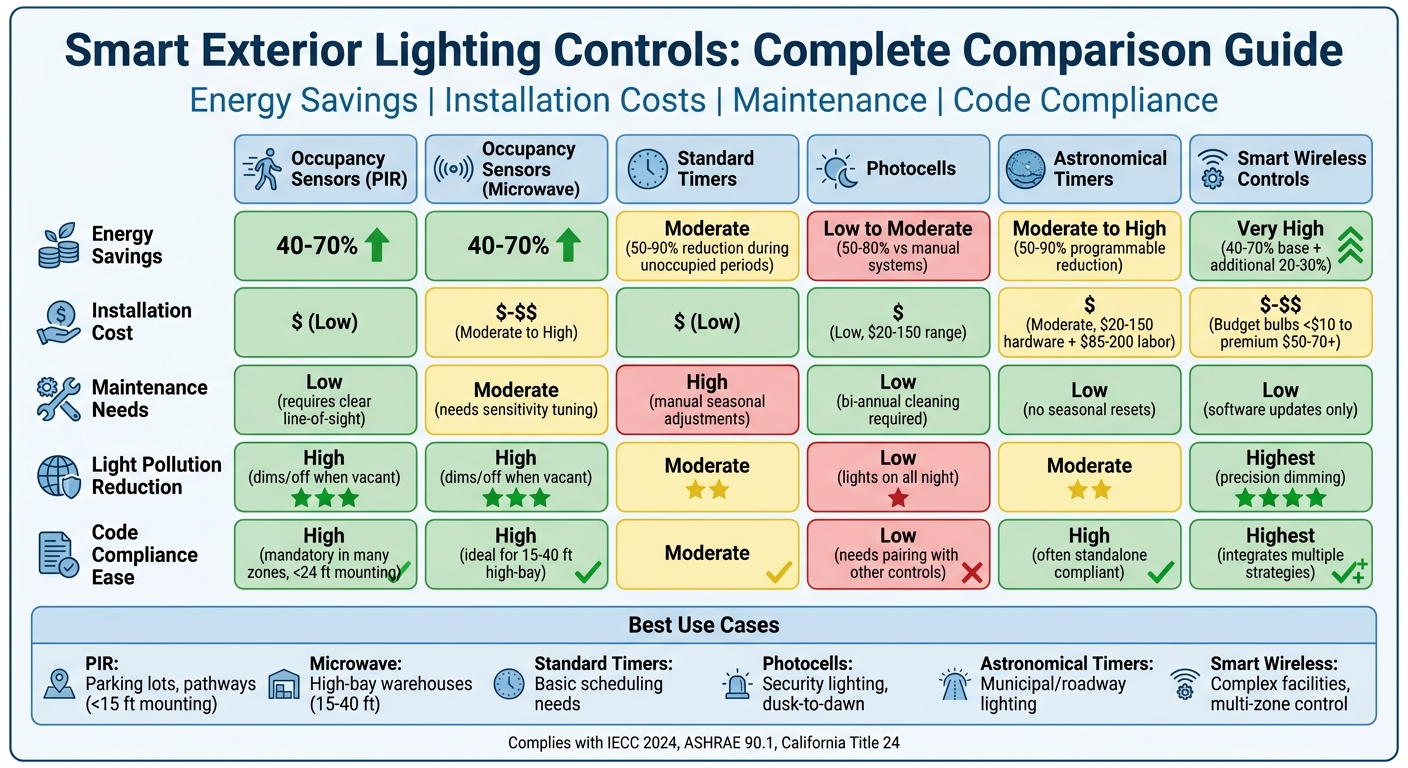
Smart Exterior Lighting Controls Comparison: Energy Savings, Costs & Compliance
Here's a summary of the key strengths and limitations of each control type, factoring in energy efficiency, costs, upkeep, and compliance.
| Control Type | Energy Savings | Installation Cost | Maintenance Needs | Light Pollution Reduction | Code Compliance Ease |
|---|---|---|---|---|---|
| Occupancy Sensors (PIR) | High (40–70%) | Low | Low; requires clear line-of-sight | High – dims or turns off when the area is vacant | High; mandatory in many zones |
| Occupancy Sensors (Microwave) | High (40–70%) | Moderate to High | Moderate; needs tuning to avoid false triggers | High – dims or turns off when the area is vacant | High; ideal for high-bay/warehouse setups |
| Timers (Standard) | Moderate | Low | High; needs manual seasonal adjustments | Moderate | Moderate |
| Photocells | Low to Moderate | Low | Low; regular cleaning required | Low (lights stay on all night) | Low; often needs pairing with other controls |
| Astronomical Timers | Moderate to High | Moderate | Low; no seasonal manual resets needed | Moderate | High; often compliant as standalone |
| Smart Wireless Controls | Very High (additional 20–30%) | Low (budget bulbs under $10) to High (premium systems $50–$70+) | Low; mainly software updates | Highest (precision dimming) | Highest; integrates multiple strategies |
The choice of control often boils down to balancing simplicity with performance. For instance, while photocells and standard timers are cost-effective initially, they offer limited energy savings and demand more manual maintenance. PIR sensors are excellent for areas with mounting heights under 15 feet, but for high-bay applications (15–40 feet), microwave sensors are more suitable, though they come with higher installation complexity.
Smart wireless controls, especially when paired with high-efficiency LED systems, can achieve up to 70% energy savings. They provide an additional 20–30% efficiency boost but require more intensive setup and detailed documentation to meet code requirements. Using a moderate timeout setting (10–20 minutes) combined with bi-level dimming (dropping to 10–30% output) strikes a balance between energy efficiency and occupant comfort.
"In high-bay and warehouse environments, occupancy/vacancy sensors plus 0–10 V dimming are usually the most cost-effective route to compliance and rebates." - hi-hyperlite.com
For reducing light pollution, smart wireless controls and occupancy sensors paired with photocells are the top performers. They ensure lights activate only when needed and dim or turn off within 15 minutes of an area being vacated. On the other hand, photocells alone often keep lights on throughout the night, leading to unnecessary energy use and light trespass.
These comparisons highlight the importance of selecting controls that align with both energy code requirements and operational goals.
Selecting the best control technology hinges on the specific needs of your application. Each type of control offers distinct benefits, from energy savings to regulatory compliance. For instance, astronomical timers automatically calculate sunrise and sunset times, eliminating the hassle of seasonal adjustments. This feature makes them particularly useful for municipal and roadway lighting, as they meet both daylight shutoff and scheduling requirements. Motion sensors, on the other hand, are essential for luminaires mounted 24 feet or lower. These sensors must reduce power usage by 50% to 90% within 15 minutes of an area being vacated, as required by energy codes.
For more specialized applications, tailored solutions are crucial. In parking lots, combining motion sensors with bi-level dimming (10–30% output) balances energy efficiency with security. Industrial facilities with high-wattage loads - those exceeding 1,500 W - can rely on intermediate relays or contactors triggered by sensors to maintain compliance and ensure durability. Meanwhile, municipal lighting installations benefit from twist-lock photocells rated for specific circuit voltages (like 277V or 120V), which help prevent relay failures and reduce fire risks.
Advanced systems, like smart wireless controls, take compliance to the next level by integrating photocell, timer, and motion data into a cohesive network. These systems support 0–10V dimming protocols and enable remote overrides across multiple zones. However, standard photocells lack dimming capabilities, meaning LED drivers with 0–10V inputs require dimming-capable photocells or smart controllers to meet the 50–90% reduction required by energy codes.
Luminate Lighting Group specializes in LED retrofits and smart control installations that meet Title 24 and other energy code standards. By partnering with us, you can ensure your outdoor lighting system not only complies with regulations but also qualifies for utility rebates and 179D tax deductions. We provide tailored solutions for warehouses, offices, municipal spaces, and industrial facilities, all designed to lower energy costs and enhance lighting performance.
Whether you're upgrading a parking garage or retrofitting an industrial campus, aligning the right control technology with your mounting height, wattage needs, and operational goals is essential. These strategies guarantee compliance with energy codes while maximizing long-term savings and lighting efficiency.
Exterior lighting standards in the IECC 2024 and ASHRAE 90.1 emphasize the use of automatic controls, such as occupancy sensors. These systems are designed to switch off lights in unoccupied spaces, helping reduce unnecessary energy use. Additionally, they must follow strict guidelines for control zones and set time limits to ensure lights don’t remain on longer than necessary. This approach not only aligns with energy code requirements but also promotes better energy efficiency.
Choosing between a photocell and an astronomical timer comes down to your environment and what you need. A photocell works by detecting ambient light, turning lights on at dusk and off at dawn - perfect for effortless, automatic operation. On the other hand, an astronomical timer uses your location to calculate sunrise and sunset times, allowing for precise scheduling. This makes it especially useful in places where daylight hours change a lot throughout the year. Photocells are straightforward, while timers offer more control over timing.
To successfully pass inspections and qualify for utility rebates, you’ll need to have the right documentation in place. This typically includes compliance forms, detailed control system records, and proof of automatic shutoff and sensor installation. Make sure all these documents align with energy code requirements for exterior lighting controls. Having thorough and accurate paperwork not only demonstrates compliance but also makes the rebate process smoother and more efficient.


