.svg)
How Washington tightens lighting power, advanced controls, and documentation compared with ASHRAE/IECC national codes.

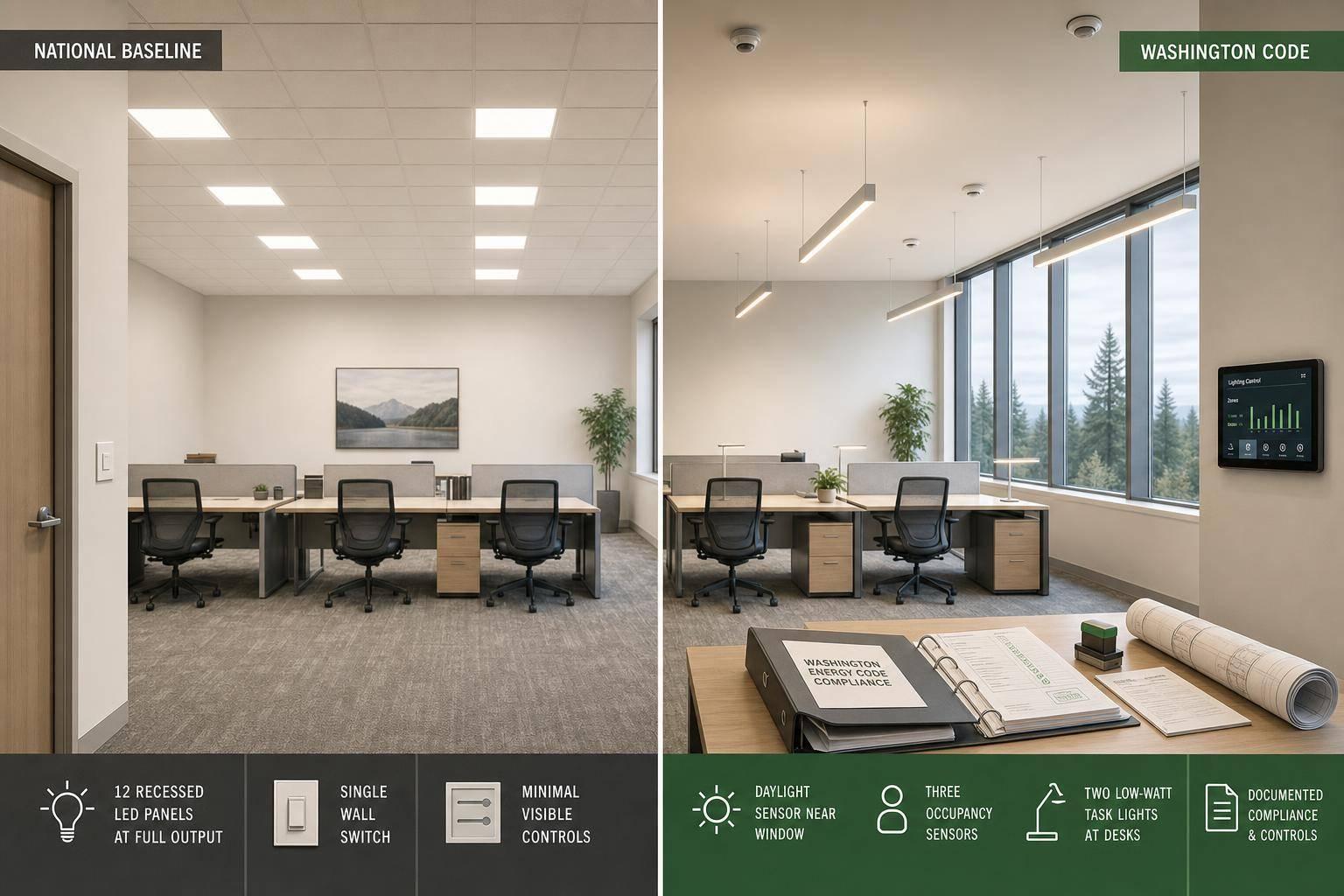
If you build in Washington, you usually have less room on lighting power, more control rules, and more paperwork than under national model codes alone.
I’d sum it up like this: ASHRAE 90.1 and the IECC set the base, but Washington goes further with a credit system, lower lighting power targets, and added control and closeout rules. In practice, that can mean designing to 90% or even 80% of standard interior lighting power allowances, using luminaire-level or networked controls on 50%+ of floor area for credits, and documenting trim settings, control sequences, and testing.
If you’re comparing Pacific Northwest rules to national codes, these are the main points:
Quick comparison
| Criteria | National Codes (ASHRAE 90.1 / IECC) | Washington |
|---|---|---|
| Interior lighting power | Standard LPD allowance | Credit path at 90% or 80% of standard |
| Core controls | Shutoff, occupancy, daylighting, dimming by space | Same base, plus more focus on LLLC/networked controls |
| Advanced controls | Often required by space type | Credit tied to controls on 50%+ of gross floor area |
| Receptacle control | Baseline code rules | Added R-1/R-2 master-off and receptacle placement rules |
| Documentation | SOO, plans, worksheets | More records for credit items and testing |
| Compliance path | Prescriptive or performance | Prescriptive plus C406 credit structure |
So if I’m looking at this from a project standpoint, the gap is simple: Washington does not just adopt the national baseline - it tightens it. That changes design, controls, closeout, and scheduling from the start.
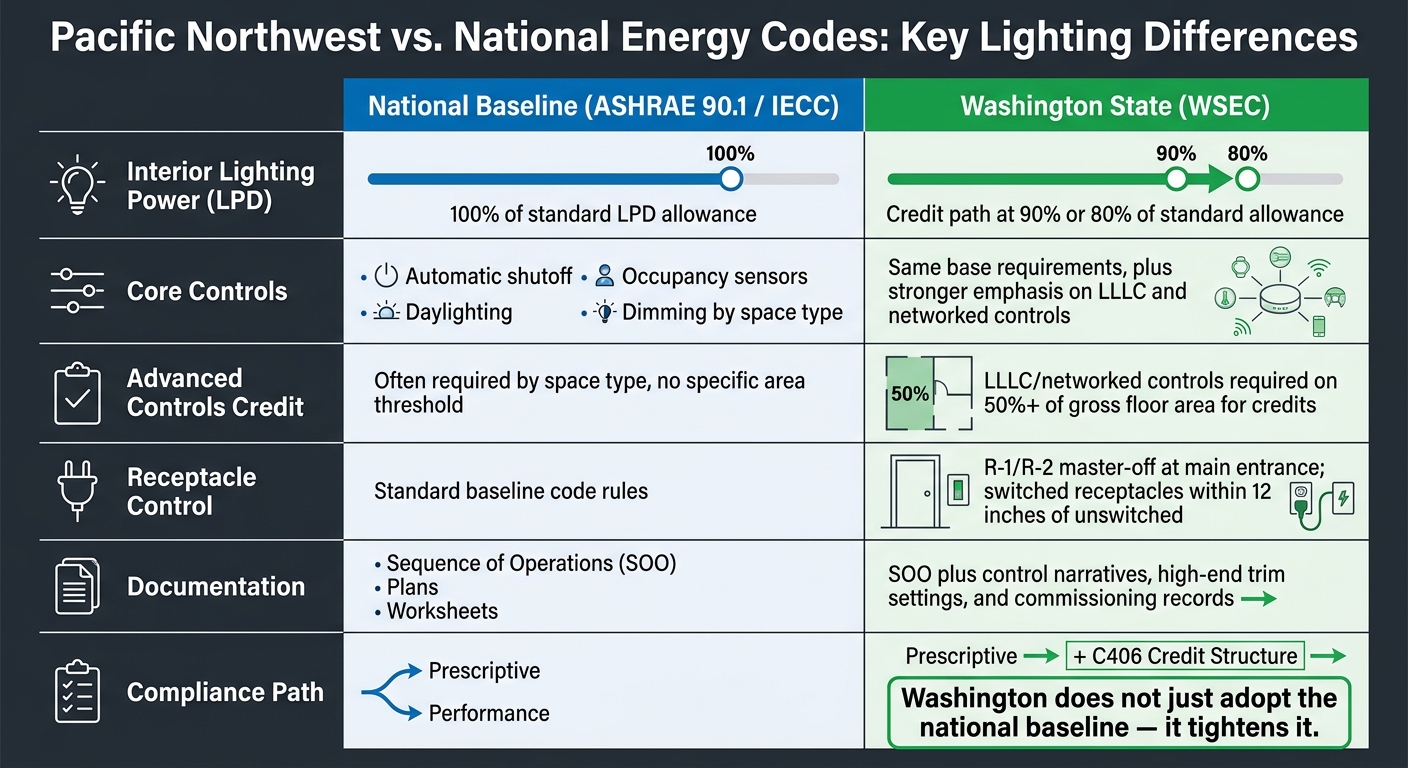
Pacific Northwest vs. National Energy Codes: Lighting Requirements at a Glance
Before looking at regional differences, it helps to start with the national baseline. For commercial lighting, that usually means ASHRAE 90.1 or the IECC. Most commercial projects follow one of those two paths, based on the code a state has adopted and any state-level changes layered on top.
For most lighting designers, the first big checkpoint is the lighting power density (LPD) limit. LPD sets the maximum watts per square foot allowed for a given space or building type. Teams can apply it through the space-by-space method or the building area method.
Exterior lighting works in a similar way. Power allowances depend on the application, such as parking lots, building entrances, and canopies, along with the lighting zone tied to the amount of nearby development.
Controls are where things get more detailed. Both code paths require automatic shutoff, manual controls, and daylight-responsive controls. Newer editions also push harder on dimming, especially in daylit areas and spaces with heavier use. Each control zone must also include a Sequence of Operations, zoning diagrams, and, under IECC 2024, code-specific worksheets. In plain English, compliance is no longer just a fixture schedule and a wattage count.
These rules are the national starting point. Pacific Northwest codes build from there, often with tighter limits and more detailed control rules.
| Control Requirement | ASHRAE 90.1-2022 | IECC 2024 (Commercial) |
|---|---|---|
| Automatic Shutoff | Required via occupancy sensors or time scheduling | Required; applies to more space types |
| Occupancy Sensors | Mandatory in many spaces, including offices and classrooms | Broader mandatory coverage with partial-off rules |
| Daylight Controls | Required in primary zones above power thresholds | More detailed daylight-zone definitions |
| Dimming | Multi-level required in many spaces | Push toward continuous dimming in high-use areas |
| Documentation | Sequence of Operations (SOO) required | SOO plus code-specific worksheets |
States turn these model codes into enforceable rules by adopting them. Then they often amend them by tightening some sections, loosening others, or swapping out entire chapters for locally written rules. That extra layer is why two neighboring states can start from the same national model and still end up with meaningfully different requirements. That’s where Washington, Oregon, and Idaho start to split apart.
Washington, Oregon, and Idaho differ most in lighting power limits, controls, and paperwork. Washington and Oregon are usually stricter than Idaho, which often stays closer to the national baseline. In day-to-day project work, those gaps show up in lighting power, control requirements, and compliance documentation.
Washington uses ASHRAE 90.1 Appendix G for performance compliance, but state rules override parts of ASHRAE 90.1. As the Washington State Legislature states:
"The mandatory requirements of the Washington State Energy Code are required to be met, instead of those of Section G1.2.1a of ANSI/ASHRAE/IESNA 90.1."
Washington's lighting measures in Section C406.2.3 give credits to projects that cut interior lighting power to 90% or 80% of the standard allowance. The region also puts more weight on Luminaire-Level Lighting Controls (LLLC) and networked lighting controls. That goes past the basic occupancy and daylight controls found in national model codes.
The biggest differences show up in lighting power limits, advanced controls, and compliance paths.
| Feature | Washington WSEC (C406) | Typical National Baseline (IECC/ASHRAE) |
|---|---|---|
| Reduced LPD - Option 1 | 90% of standard allowance | 100% of standard allowance |
| Reduced LPD - Option 2 | 80% of standard allowance | Not applicable |
| LLLC/networked controls credit | LLLC/networked controls on at least 50% of gross floor area | Basic occupancy/daylight sensors |
Those stricter rules are driven by state policy and utility efficiency programs.
That stricter policy shows up in three places right away: lighting power, control requirements, and paperwork.
The biggest difference starts with lighting power. National codes rely on standard LPD limits, while Washington may require a project to cut connected interior lighting to 90% or even 80% of those standard limits to earn credits.
That tighter cap changes design choices early. Professional lighting assessment services can help identify these efficiency opportunities before the design is finalized. Teams usually need higher-efficacy LED fixtures and a tighter layout to make the numbers work.
| Space / Application | National Baseline (IECC/ASHRAE) | Pacific Northwest (WA) | Stricter? |
|---|---|---|---|
| Open office, warehouse, retail | Standard LPD limits | Credits for 90% or 80% of standard values | Yes |
Once lighting power gets tighter, controls and project records tend to get tighter too.
Washington also gives credits for high-end trim used with LLLC or networked lighting controls across at least 50% of gross floor area. That matters because high-end trim limits output below full power. So this is more than basic on/off control.
In plain terms, fixture choice can't be an afterthought. The design team has to think about efficacy and dimming from day one.
Washington also sets out specific receptacle control rules for Group R-1 and R-2 occupancies. A master off control at the main entrance must deactivate all lighting and switched receptacles. Switched receptacles also need to be clearly identified and placed within 12 inches of an unswitched receptacle.
That sounds simple on paper, but it adds wiring work and coordination. If the team waits too long to deal with it, things can get messy fast.
| Control Category | National Baseline | Pacific Northwest (WA) | Project Impact |
|---|---|---|---|
| Enhanced digital controls | Standard code requirements | High-end trim with LLLC or networked lighting controls in at least 50% of gross floor area for credits | Drives smart fixture selection |
| Receptacle control | Standard code requirements | Master off at the main entrance for R-1/R-2, plus clearly identified switched receptacles within 12 inches of an unswitched receptacle | Requires specific entry-point wiring |
| Control documentation | Standard documentation | Control narratives, high-end trim settings, and commissioning records for credits | Adds documentation at project closeout |
The compliance path matters just as much as the wattage cap.
In Washington, the prescriptive path connects to the C406 credit system. If a project goes after lighting credits - whether by lowering LPD or using enhanced digital controls - it also needs control narratives, trim settings, and commissioning records. Put simply, the credit is not just about what gets installed. It's also about proving how the system was set up and tested.
| Compliance Path | National Use | Pacific Northwest Use | Documentation Burden |
|---|---|---|---|
| Prescriptive (LPD) | Standard LPD calculations | Stricter LPD, with 80% to 90% of the standard values for credits | High - detailed fixture schedules and wattage counts |
| Performance | Used for complex designs | Used to trade off lighting vs. envelope/HVAC | High - full building energy modeling required |
| Enhanced digital controls | Optional | Specific credit path for LLLC/networked systems | Moderate - control narratives and commissioning records |
These code differences don't just change compliance. They also affect project timing, rebate approval, and tax planning.
Tighter LPD limits push fixture selection, dimming choices, and zoning decisions earlier in the design process. Washington's 80% LPD option is already below the ASHRAE 90.1 baseline, which can help support 179D planning.
That same early coordination matters for utility incentives too. Most utility rebate programs require DLC-listed fixtures and controls. When fixture specs and control zones are lined up early, it's much easier to protect rebate eligibility. Many utility programs also cap controllable zones, so matching the circuit layout to those limits can make rebate applications simpler.
For retrofits, specifying 0–10 V or 1–10 V dimming drivers from the start is often the simplest route. In warehouses, zone-based control with dimming drivers can cut lighting energy use in a meaningful way compared with basic on/off switching.
This is where coordinated design and documentation support starts to matter. Luminate Lighting Group supports energy audits, photometric layouts, fixture and control specifications, and compliance documentation for code-compliant commercial lighting projects.
For owners and design teams, the takeaway is pretty simple. Pacific Northwest codes often go beyond national baselines, and those differences can affect both cost and schedule. Design decisions need to happen early, and documentation should be treated as part of the project scope - not something left for closeout.
In Washington, projects with residential buildings need to meet the stricter lighting rules in the Washington State Energy Code. That includes buildings with Group R sleeping units and assisted living facilities.
The same rule applies to new multifamily residential buildings and to projects going through major retrofit work.
Washington lighting credits can push up upfront project costs and stretch timelines because they call for more energy-efficiency work. WSEC increased required credits by about 16% to 33%, depending on occupancy and project scope.
To hit those credit targets, teams often need advanced lighting controls along with extra documentation, testing, and verification. That adds more moving parts to design, installation, and commissioning. The work can get more complex, and the schedule can get tighter. Over time, though, some of those added costs may be offset through utility rebates and lower energy bills.
Teams should prepare construction documents and supporting data that clearly show compliance with Washington code review requirements.
This usually includes the energy compliance path, insulation R-values, fenestration U-factors and SHGCs, mechanical system details, lighting fixture schedules, and lighting control details.


