.svg)
Proper office lighting is safety-critical — learn OSHA minimums, emergency lighting rules, fixture safety, penalties, and LED upgrade tips.

OSHA’s office lighting standards are more than just guidelines - they’re requirements aimed at ensuring workplace safety and comfort. Here’s what you need to know:
While OSHA sets the baseline, aiming for 46 foot-candles (500 lux) as recommended by ANSI/IES can improve productivity and reduce eye strain. Upgrading to LED systems with smart controls not only meets these standards but also cuts energy costs by up to 60%.
For compliance, conduct regular lighting surveys, maintain detailed records, and ensure emergency systems are tested monthly. Proper lighting isn’t just about meeting regulations - it’s about creating a safe, efficient, and comfortable workplace.
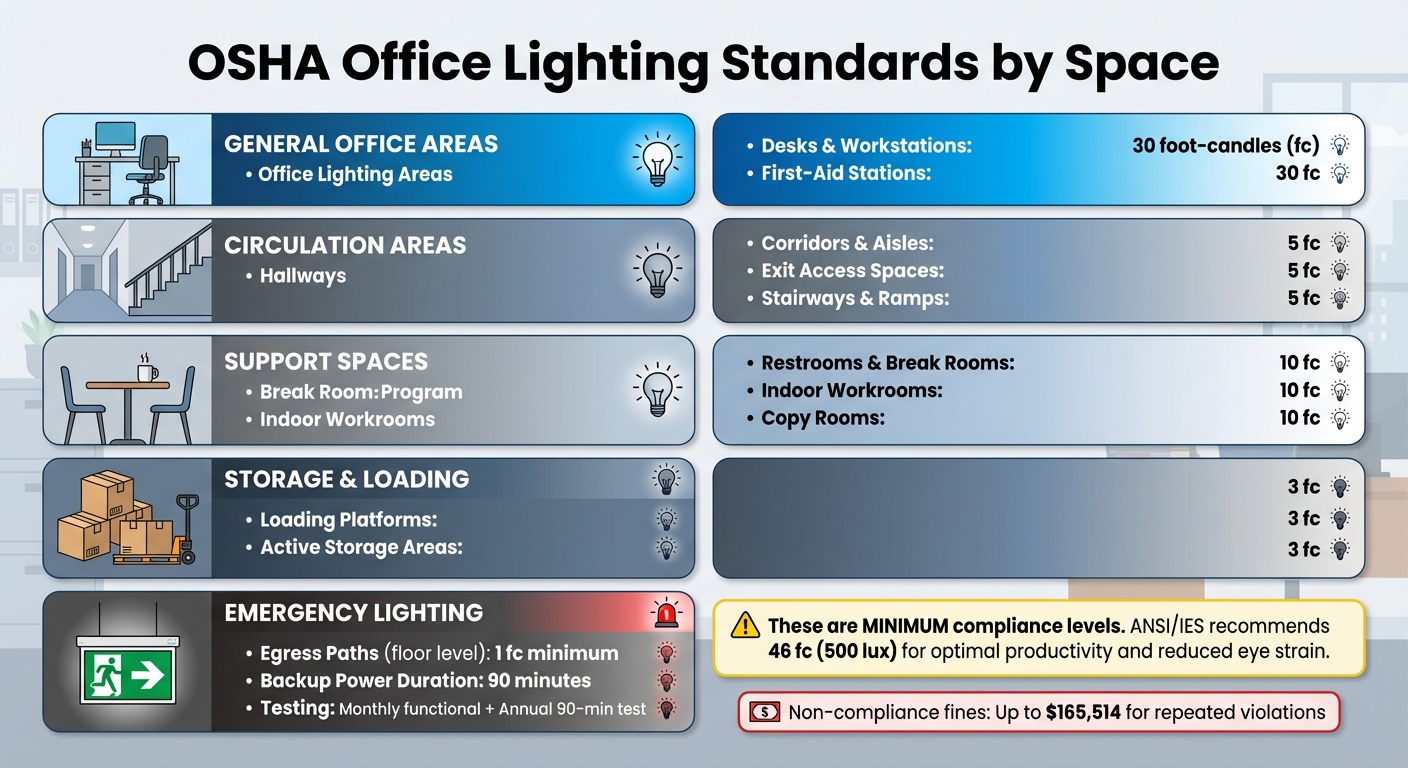
OSHA Office Lighting Requirements by Space Type
OSHA sets clear standards for office lighting to ensure safety and compliance. These guidelines focus on three key areas: providing adequate illumination for safe work, ensuring emergency and exit lighting for evacuations, and maintaining fixture safety to prevent electrical or physical hazards. These requirements, outlined in 29 CFR 1910 and 1926.56, not only help avoid fines - ranging from $16,550 per violation to $165,514 for willful or repeated offenses - but also protect employees from accidents, eye strain, and evacuation delays. Below, we break down each requirement to help you stay compliant and promote a safer workplace.
In general office areas like desks, workstations, and first-aid stations, OSHA mandates a minimum of 30 foot-candles (fc) of illumination at the working surface. This level helps employees perform tasks like reading, writing, and computer work without unnecessary strain. For areas like corridors, aisles, and exit access spaces, the minimum requirement drops to 5 fc, which is sufficient for safe navigation but may feel dim compared to task-oriented spaces. Similarly, stairways and ramps require at least 5 fc to reduce the risk of trips and falls.
Other spaces have their own minimum requirements:
It’s important to note that these are minimum compliance levels, not ideal lighting standards. For better visual comfort and reduced eye strain, the Illuminating Engineering Society suggests aiming for around 46 fc (500 lux) in offices. Think of OSHA's 30 fc as the baseline, not the goal, when designing your lighting plan.
Emergency lighting plays a vital role during power outages, ensuring safe evacuation. OSHA requires that emergency egress lighting activates automatically when the power fails, providing at least 1 fc (≈10 lux) at floor level along the entire egress path. This lighting must operate on backup power for at least 90 minutes and ensure consistent illumination without dark spots. Exit signs should be clearly visible, with placement ensuring no point in a corridor is more than 100 feet from a sign.
To maintain compliance, monthly functional tests and annual 90-minute tests are required. In multi-story buildings, emergency lights should be installed every 30–50 feet in corridors and at each stair landing. Using self-testing or monitored LED emergency fixtures can simplify maintenance and reduce the risk of unnoticed failures. These requirements align with 29 CFR 1910.37 and 1910.34 and are often supported by fire codes like NFPA 101.
Lighting fixtures in offices must be installed securely to prevent accidents caused by falling or damaged equipment. Fixtures positioned below 7 feet must include shatterproof or impact-resistant guards to protect against breakage. Additionally, all fixtures must enclose live electrical parts to prevent accidental contact, with openings no larger than 0.5 inches. In areas prone to impact, protective plates or guards are required.
To simplify compliance, consider retrofitting fixtures with built-in guards and conduct regular inspections to check for damage, loose mounting, or exposed wiring. These rules are part of OSHA's general electrical standards under 29 CFR 1910.305 and apply to both permanent and temporary lighting installations.
OSHA sets the baseline for office lighting at 30 foot-candles (fc), but achieving a truly productive and comfortable workspace often requires going beyond these minimums. The ANSI/IES standards, particularly the ANSI/IES RP-1 (Practice for Office Lighting), provide a more comprehensive approach to office lighting design. These guidelines serve as a bridge between OSHA's basic requirements and strategies that enhance both performance and comfort, ensuring employees can work without unnecessary strain, glare, or fatigue.
While OSHA's minimum standards provide a starting point, the ANSI/IES recommendations aim to create a more comfortable and efficient environment.
A layered lighting approach works best. Use low-glare ambient fixtures to provide 50–70% of the target illuminance and supplement with task lighting as needed. For example, ambient ceiling fixtures might deliver 20–30 foot-candles across an open office, while desk lamps add another 10–20 foot-candles for focused tasks. This method not only improves energy efficiency but also allows employees to adjust lighting to their preferences, minimizing harsh contrasts between bright and dark areas.
Hitting the right light levels is important, but the overall quality of the lighting determines whether employees feel comfortable or frustrated. Here are key factors to consider:
LED lighting systems are an excellent choice for meeting ANSI/IES guidelines while significantly cutting energy costs - typically by 30–60%. High-efficacy LED luminaires provide the required light levels with less power, and when paired with advanced controls, they become even more efficient.
Consider integrating zoned or networked controls, such as occupancy sensors, vacancy sensors, and time-based scheduling. These features ensure lights dim or turn off in unoccupied areas, saving energy. Daylight harvesting is another smart option, using photosensors to adjust electric lighting near windows while maintaining the right brightness on desks. Additionally, multi-level or continuous dimming allows spaces to be fine-tuned during setup, avoiding excessive lighting and enabling "task tuning" for further savings.
For instance, replacing outdated 2×4 fluorescent troffers - which often deliver over 60 fc and cause glare - with dimmable, low-glare LED panels set to 35–40 fc can enhance employee comfort and reduce energy consumption by 40–50%. Companies like Luminate Lighting Group specialize in designing and implementing these LED systems, ensuring compliance with energy codes and helping businesses take advantage of rebate programs.
Meeting OSHA lighting standards involves installing proper fixtures and keeping detailed records. Although OSHA doesn't specify a required format for documentation, maintaining thorough records can safeguard your organization during inspections and help spot potential issues before they turn into safety risks or costly violations.
A lighting survey is a critical step to ensure compliance. Start by dividing your office into zones - such as workstations, offices, meeting rooms, hallways, stairs, copy rooms, break areas, restrooms, and first-aid stations. Use a calibrated light meter (capable of measuring in foot-candles or lux) to take readings at desk height, typically about 30 inches above the floor. For larger spaces, take multiple measurements; for example, a large open office might require 5–10 readings to account for differences between areas near windows and interior zones.
Compare your readings to OSHA's general guidelines: 30 foot-candles for offices and first-aid stations, 5 foot-candles for exits and stairs, and 10 foot-candles for break areas and restrooms. You may also want to consult ANSI/IES RP-1 recommendations, which suggest around 300–500 lux (30–50 foot-candles) for general office work. Document your findings on a floor plan or spreadsheet, noting the measurement points, values, dates, times, meter calibration details, and the surveyor’s name. Highlight any areas with low lighting, glare, flickering fixtures, or uneven light distribution. These records will form part of your compliance documentation and can guide necessary improvements.
Keeping accurate records is key to maintaining safety standards. Your documentation should include:
For emergency lighting, conduct monthly visual inspections to confirm that lights are working and backup power engages for at least 30 seconds. Perform an annual test lasting at least 90 minutes to ensure the system functions during an actual emergency. Record each test, including the date, areas inspected, condition of signs and fixtures, any failures, and corrective actions taken. Retain these records for at least 3–5 years, organizing them by floor or department for easy access.
Many office lighting issues are easy to address with proactive maintenance. For example, flickering lights can be resolved by replacing old lamps with long-life LED tubes. If a space like a back copy room measures only 18 foot-candles when 30 are required, adding LED troffers or under-cabinet lighting can bring it up to standard. Exit signs should always remain visible, consistently lit, and regularly tested. Upgrading outdated incandescent exit signs to LED models with battery backups can improve reliability.
Glare on computer screens, while not governed by a specific OSHA standard, can cause eye strain and lower productivity. Reduce glare by using indirect or diffused lighting, positioning fixtures parallel to workstations, installing window blinds, and placing monitors perpendicular to windows. Any fixtures mounted below 7 feet should have OSHA-compliant shatterproof guards or be relocated to prevent hazards.
For a more comprehensive approach, consider working with experts like Luminate Lighting Group. They offer professional lighting surveys, custom LED retrofit designs, and turnkey installation services. Their solutions not only help you meet OSHA standards but may also qualify your office for utility rebates and 179D tax deductions.
The first step in improving office lighting is conducting a thorough needs assessment. Start by walking through the facility to spot problem areas - dimly lit corners, glare on computer screens, outdated fixtures, and emergency or exit lights that don’t meet automatic activation standards. Collect utility data to understand your current energy usage and set clear goals, such as achieving OSHA’s required foot-candle levels at desk height, reducing energy consumption by 30–50%, and modernizing emergency lighting systems.
To avoid issues like over- or under-lighting, create a photometric layout. This computer-generated model predicts how light will spread across your workspace, highlighting areas that might fall below required illumination or cause glare. A qualified lighting designer or a company like Luminate Lighting Group can perform an audit, generate the layout, and review compliance with codes. This step ensures accurate ROI projections and helps position new fixtures at least 7 feet above work surfaces or equip them with shatterproof shields, as required by OSHA. This planning phase sets the foundation for the retrofit process and ongoing maintenance.
Once the planning phase is complete, turn your attention to upgrading the lighting system. LED retrofits are an excellent choice, as they can reduce energy consumption by 40–60% compared to older fluorescent or HID systems, all while maintaining or improving light quality. To ensure compliance with OSHA standards, confirm that new LED fixtures provide adequate illumination in workspaces, exits, and stairwells. Look for high-efficacy fixtures with 120 to 150 lumens per watt and good optical control to distribute light evenly and minimize glare. Also, verify that the fixtures are compatible with your existing wiring. With utility rebates and federal incentives, such as Section 179D tax deductions, the investment often pays for itself in 2 to 5 years.
Adding smart controls can further enhance efficiency. Occupancy sensors, daylight harvesting systems, time-based scheduling, and networked dimming technology are particularly effective in areas with fluctuating occupancy, like conference rooms and break areas. However, it’s crucial to program these controls to maintain OSHA-compliant illumination levels in occupied spaces and along exit routes. For instance, sensors can dim lights in stairwells and corridors but should never turn them off while the building is in use. Emergency lighting systems must bypass control failures entirely, ensuring they activate automatically during power outages or system malfunctions. Regular commissioning and re-verification of these controls help prevent settings from drifting into energy-saving modes that compromise safety.
After your upgrade, a strong maintenance program is essential. Start by creating an inventory of all fixtures, lamps, drivers, emergency units, and controls, along with their locations and maintenance histories. Schedule regular inspections, typically quarterly for general lighting and monthly for emergency and exit lights. These checks should confirm that luminaires are clean, lenses are not yellowed or cracked, fixtures are securely mounted with proper guards, and no live parts are exposed. Cleaning lenses, reflectors, and diffusers can restore up to 30% of lost brightness.
For ongoing compliance, conduct regular lighting surveys with a light meter to ensure levels meet OSHA standards. Perform these surveys after layout changes, significant shifts in occupancy, or major maintenance work. Keep detailed records of photometric layouts, fixture schedules, and emergency lighting tests. When deficiencies are identified - such as illumination below required levels or malfunctioning emergency lights - log the corrective actions, including dates and responsible personnel. Many organizations partner with firms like Luminate Lighting Group for recurring audits and compliance reviews, integrating these with broader safety management systems to demonstrate adherence to OSHA’s General Duty Clause.
OSHA's office lighting standards establish a minimum of 30 foot-candles for general work areas, with 30–50 foot-candles being more suitable for tasks like computer work to help reduce eye strain. These standards not only ensure compliance but also contribute to a safer and more comfortable workplace.
Proper lighting plays a crucial role in reducing risks like trips, falls, and other hazards. It also improves visibility for identifying potential dangers and ensures that emergency and exit lighting functions effectively during power outages. Going beyond basic compliance, switching to well-planned LED lighting systems offers clear advantages - such as 30–60% energy savings, reduced maintenance costs, better employee comfort, and eligibility for utility rebates and federal tax deductions like Section 179D. Incorporating smart controls into these systems further ensures cost-efficient, code-compliant lighting throughout the day.
Conducting regular lighting assessments and promptly addressing issues is essential for maintaining both compliance and safety. Emergency lighting should automatically activate during power outages, providing at least 1 foot-candle of illumination along exit paths for at least 90 minutes.
Exceeding OSHA's basic lighting requirements can do more than just meet compliance - it can improve safety, productivity, and employee comfort in the workplace. Better lighting reduces eye strain, sharpens visibility, and helps cut down on mistakes and accidents.
Switching to modern lighting options, like energy-efficient LEDs, offers additional benefits. These lights can help lower electricity bills while aligning with environmentally conscious goals. Plus, a well-lit workspace creates a more welcoming atmosphere, which can lift employee morale and increase job satisfaction.
Ensuring your emergency lighting systems are in line with OSHA regulations means conducting regular inspections and tests to verify their functionality during power outages. Schedule monthly and annual tests as recommended, and promptly replace any batteries or bulbs to keep the system dependable.
It’s also critical that your emergency lighting offers enough illumination to allow for safe evacuation and meets OSHA's minimum lighting standards. For expert guidance, consider working with a professional lighting provider like Luminate Lighting Group. They can assist in designing and maintaining systems that not only comply with OSHA but also enhance energy efficiency and overall performance.
Switching to LED lighting in offices comes with a range of practical benefits. For starters, LEDs are incredibly energy-efficient, which means they can help cut down on energy bills while using less power. They also deliver high-quality light, creating a more comfortable and focused atmosphere for employees.
Another big perk? LEDs last much longer than traditional lighting, which means fewer replacements and less maintenance hassle. This durability helps avoid interruptions and reduces overall upkeep costs. Plus, they enhance workplace safety by offering steady, glare-free lighting that’s easy on the eyes.
Making the switch to LED lighting isn’t just about saving money - it's about creating a better, more efficient work environment.


