.svg)
Office lighting certifications define safety, performance, and energy rules—key UL, OSHA, IES and ENERGY STAR essentials for compliant LED retrofits.
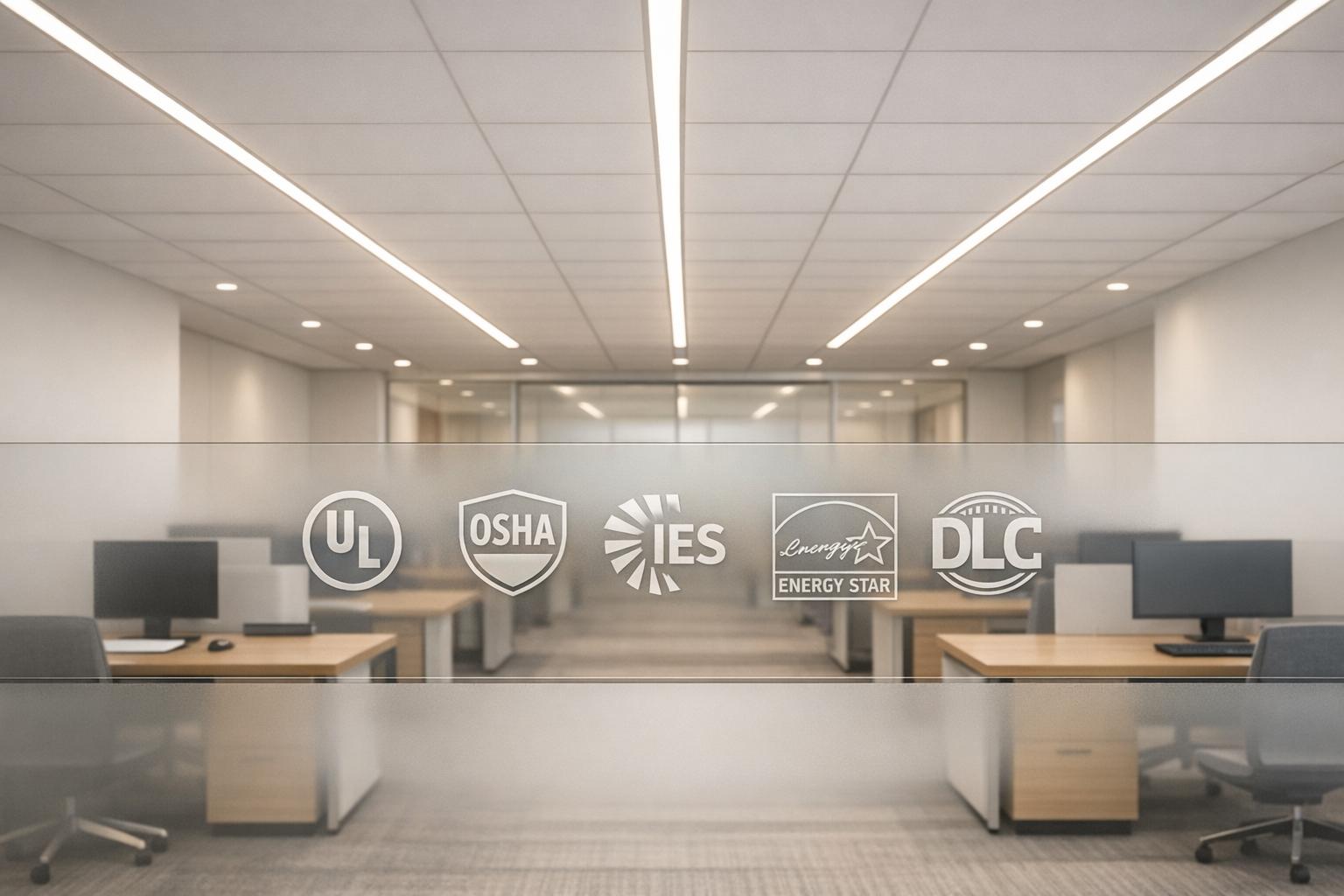
Office lighting certifications ensure safety, compliance, and energy efficiency. They help businesses avoid legal penalties, reduce energy costs, and improve workplace conditions. Here’s a quick breakdown of the top standards:
These certifications address safety, performance, and energy savings, making them crucial for modern office lighting systems.
UL 1598 serves as the cornerstone safety standard for luminaires across North America. It evaluates every aspect of a luminaire - housing, wiring, driver, light source, and heat management - ensuring they meet stringent safety measures to prevent fire hazards, electric shocks, and mechanical failures. The standard also outlines precise requirements for construction, materials, and electrical connections, ensuring office lighting systems adhere to critical safety protocols.
Using non-UL Listed fixtures in commercial settings can lead to failed electrical inspections and may even void insurance claims in the event of a fire. It's important to note that incorporating a UL Recognized component into an untested fixture does not automatically ensure safety or compliance. Full system testing is essential to achieve UL Listing.
"Putting a certified component into an untested fixture does not make the fixture safe or compliant." - Richard Miller, Lighting Professional
This comprehensive standard also applies to modern LED retrofits, ensuring they meet updated safety benchmarks.
UL 1598 goes beyond traditional luminaires by addressing LED retrofit practices. In 2016, the standard added Section 9A, which introduced LED-specific requirements, such as the use of Class P LED drivers. When choosing LED retrofit kits, look for the circular "UL Listed" mark. Avoid products with the backward "RU" symbol, as it only signifies a UL Recognized component, not a fully tested system. To confirm a product's certification, you can consult the UL Solutions Product iQ database using the manufacturer's file number.
UL 8750 zeroes in on the internal LED components that power lighting systems, complementing the broader scope of UL 1598, which certifies entire luminaires. This standard ensures that critical LED parts - like drivers, power supplies, controllers, arrays, modules, and packages - meet strict safety and performance criteria. It addresses key electrical characteristics of LEDs, such as their sensitivity to heat and the importance of accurate driver power conversion. To prevent overheating, rigorous thermal testing is conducted, particularly for enclosed fixtures. Additionally, the use of flame-resistant materials and proper insulation helps safeguard against potential electrical hazards.
This standard applies to equipment operating on branch circuits with a nominal voltage of 600 V or less. It also covers the visible light spectrum (400 to 700 nm) and extends to LED equipment powered by alternative sources, including batteries, fuel cells, and solar cells.
While UL 1598 focuses on the safety of the entire fixture, UL 8750 ensures compliance for the internal LED components used in retrofits. This is especially critical for retrofit kits, which often include drivers and light engines. These components must meet UL 8750 standards to ensure they integrate safely with existing luminaires. By doing so, the standard supports the safe and seamless adaptation of legacy lighting systems to modern LED technology. It also works in tandem with other certifications, like UL 1993 for self-ballasted lamps, ensuring the entire lighting system remains safe and compliant with local codes and insurance requirements.
At Luminate Lighting Group, we prioritize using UL 8750-certified components in our LED retrofit projects. This commitment ensures that upgraded fixtures meet rigorous safety standards while adhering to local regulations.
OSHA has specific lighting requirements to ensure worker safety and productivity. According to 29 CFR 1926.56, office spaces must maintain at least 30 foot-candles of illumination during work hours. This standard applies whether the light comes from natural sources or artificial fixtures. For reference, 1 foot-candle equals 1 lumen per square foot, which is approximately 10.76 lux.
When OSHA’s tables don’t specify lighting levels for certain areas, they rely on the American National Standard A11.1-1965 for guidance.
These requirements serve as a foundation for designing safe and efficient LED lighting systems.
OSHA also emphasizes the importance of properly installed and maintained lighting fixtures. Fixtures must include protective plates, be securely mounted, and avoid any openings large enough for a finger to fit through. Additionally, lights should be installed at least 7 feet above work surfaces or equipped with shatterproof shields to prevent injuries from broken glass.
The consequences of non-compliance are steep. Starting January 2025, a single serious OSHA violation can result in fines of $16,550 per violation, while willful or repeated violations can lead to penalties as high as $165,514 per violation. Jason Isaacs, Director of Product Marketing at Milwaukee Tool, highlights:
"I think if you were to go to most manufacturing facilities, you'll find they're illuminated well in excess of the OSHA safety requirements".
Combining OSHA-compliant lighting with UL and ENERGY STAR standards creates a safer and more efficient work environment.
Modern LED lighting makes meeting OSHA’s illumination standards easier than ever. Most LED commercial systems already exceed the minimum 30 foot-candle requirement, making them an excellent choice for compliance. Use a light meter to confirm that your lighting meets this threshold at workstation height. To calculate the necessary lumen output, remember that 1 foot-candle equals 1 lumen per square foot. This will help ensure the lighting covers your office’s entire area adequately.
For optimal results, arrange lights parallel to workers’ lines of sight to reduce glare on screens. Adding diffusers or "egg crate" louvers to overhead fixtures can also help minimize eye strain. These adjustments make LED retrofits both practical and effective for maintaining OSHA compliance.
The Illuminating Engineering Society (IES) provides specific lighting guidelines tailored to the complexity of tasks. For general office work, the recommended illumination is between 30 and 50 foot-candles, striking a balance between clear visibility and energy efficiency. More detailed tasks demand 50 to 75 foot-candles (approximately 750 lux) to ensure precision and minimize errors.
For areas like corridors and stairwells, where safety is the primary concern, lower lighting levels of 5 to 10 foot-candles are sufficient to help prevent accidents such as slips or falls.
"The more detailed the task, the greater the light requirement".
IES standards go beyond illumination levels to address overall safety by emphasizing light quality. For example, a Color Rendering Index (CRI) of 80 or higher and high Visual Comfort Probability (VCP) ratings are recommended to ensure clear visuals and reduce eye strain. Additionally, maintaining consistent light levels across spaces is critical to avoid temporary vision issues caused by sudden brightness changes.
Energy efficiency is another key focus, with standards like ASHRAE 90.1-2022 setting Lighting Power Density (LPD) limits. For instance:
Modern LED lighting systems not only meet these limits but also deliver up to 50% energy savings compared to older technologies. This makes them an excellent choice for energy-conscious office environments.
LED retrofits simplify the process of meeting IES standards. Tools like the Room Cavity Ratio (RCR) help optimize light distribution, while the Coefficient of Utilization (CU) measures how effectively lumens are delivered to the workspace. As Liam Buckley from Integrated Environmental Solutions points out:
"seemingly identical fixtures can vary by approximately 20% in actual applied lumens".
A recent LED retrofit project highlighted the benefits of these upgrades, showing both significant energy savings and improved visual comfort. To ensure a successful retrofit, follow these steps:
At Luminate Lighting Group, we offer LED retrofit services designed to align with IES recommendations, ensuring your office spaces are safer, more productive, and energy-efficient. By adhering to these standards, you'll not only save on energy but also enhance workplace safety and comfort, aligning with broader certification goals.
ENERGY STAR certification focuses on energy efficiency and durability, aligning with UL, OSHA, and IES standards. To meet these requirements, commercial downlights must deliver ≥82 lumens per watt (lm/W). Additionally, LED light sources must retain at least 70% of their initial brightness (L70) for a minimum of 25,000 hours, ensuring reliable long-term performance.
For products with sensors or connectivity features, strict standby power limits between 0.5 and 1.0 watt are mandated. Certified downlights must also direct ≥75% of their lumens within the 0–60° zone, ensuring effective light distribution. To maintain accurate color representation, the Color Rendering Index (CRI) must meet or exceed Ra 80, with R9 values above 0.
"Third-party certification ensures products are properly tested and reviewed prior to being labeled. It also eliminates the competitive advantage associated with possible cheating and preserves the label's value in the marketplace." - ENERGY STAR
ENERGY STAR certification covers specific categories of commercial LED retrofits, such as recessed, pendant, and surface-mounted downlights, accent lights, under-cabinet task lighting, and portable desk task lights. However, it does not include fixtures like recessed troffers, linear fluorescent pendants, and high bay fixtures. The program is set to phase out under a sunset plan, effective December 31, 2024.
For LED retrofits, ensure dimmable products offer continuous dimming from 100% down to at least 20% and operate quietly, below 24 dBA at minimum output. Certified products must include a warranty - 3 years for replaceable drivers and 5 years for non-replaceable drivers. For fixtures outside ENERGY STAR's scope, building operators can use the ENERGY STAR Portfolio Manager to monitor and optimize the energy performance of their entire lighting system.
At Luminate Lighting Group, we assist office clients in navigating these certification requirements during LED retrofit projects. By ensuring compliance and focusing on energy-efficient solutions, we help maximize performance and operational savings.

Office Lighting Certification Standards Comparison Chart
Each standard addresses a distinct aspect of office lighting, from safety to energy efficiency. OSHA mandates a minimum of 30 foot-candles in office environments to maintain a safe workspace, ensuring compliance with workplace safety regulations. On the other hand, the IES offers performance-based recommendations of 300–500 lux (approximately 28–46 foot-candles), focusing on enhancing visual comfort and productivity.
When it comes to hardware safety, UL 1598 and UL 8750 are key. These certifications ensure protection against risks like electrical shock, fire, and mechanical issues but do not specify illumination levels. Meanwhile, ENERGY STAR emphasizes energy savings, with its certified LED products using 75% less energy than traditional incandescent bulbs and lasting up to 15 times longer.
The table below provides a clear comparison of these standards, focusing on their primary objectives, illumination requirements, energy efficiency benchmarks, and relevance to LED retrofit projects:
| Standard/Certification | Primary Focus | Illumination Requirement (Office) | Energy Efficiency Benchmark | LED Retrofit Application |
|---|---|---|---|---|
| OSHA (29 CFR 1910/1926) | Workplace Safety & Legal Compliance | Minimum 30 foot-candles | Not specified | Mandatory baseline for all installations |
| IES Recommended Levels | Visual Performance & Comfort | 300–500 lux | Not specified | Design guideline for optimal lighting quality |
| UL 1598 | Electrical & Fire Safety (Fixture) | Not specified | Not specified | Essential for fixture installation safety |
| UL 8750 | LED Component Safety (Drivers/Modules) | Not specified | Not specified | Critical for LED driver and module safety |
| ENERGY STAR | Energy Efficiency & Longevity | Not specified | 75% less energy than incandescent | High relevance for cost savings and rebates |
For LED retrofits, safety and efficiency go hand in hand. UL certifications ensure the hardware is up to safety standards, while ENERGY STAR validates energy-efficient performance. It's worth noting that OSHA's 30 foot-candle requirement translates to about 322 lux, aligning closely with the lower end of IES recommendations. This overlap underscores the importance of balancing safety, comfort, and efficiency in office lighting design.
Certification standards play a crucial role in protecting employees, cutting costs, and ensuring compliance with regulations. For example, UL certifications help prevent electrical fires and mechanical malfunctions, while OSHA ensures workplace safety by requiring at least 30 foot-candles of illumination, helping businesses avoid costly penalties. ENERGY STAR certification goes a step further, offering long-term savings with energy-efficient LED lighting.
Beyond safety and compliance, these standards contribute to better employee well-being and productivity. Maintaining a Unified Glare Rating below 19 helps reduce eye strain, keeping employees comfortable and focused.
The financial advantages are equally compelling. Certified energy-efficient solutions, like ENERGY STAR LEDs, use 75% less energy than traditional bulbs and last 15 times longer. Meeting ASHRAE 90.1 or Title 24 standards not only ensures compliance but also prepares facilities for future energy regulations. By adopting these certified solutions, offices can create safer, more efficient, and forward-thinking environments.
At Luminate Lighting Group, we specialize in providing tailored lighting solutions that align with these standards. From energy audits to turnkey LED retrofits, our offerings include UL-certified fixtures, DLC-qualified products, and smart controls. These solutions ensure safety, optimize energy use, and maximize rebate opportunities, including 179D tax deductions.
Choosing the right lighting partner means going beyond basic compliance. It’s about creating a workspace that’s safer, more efficient, and supports long-term sustainability goals. Let us help you achieve that vision.
Yes, compliance with both UL 1598 and UL 8750 is necessary for an LED retrofit to guarantee safety and adherence to regulations. UL 1598 focuses on luminaires, while UL 8750 applies to LED light engines and drivers, ensuring that every component meets the required standards.
To measure lighting levels and ensure they meet OSHA standards, use a calibrated light meter. OSHA typically recommends at least 30 foot-candles for general office tasks. Here's how to take accurate readings:
Compare the readings to OSHA's guidelines. If the levels fall short, adjust the lighting setup to create a safe and well-lit environment for employees.
If ENERGY STAR doesn’t apply to your specific fixture type, you might want to explore other certification options like UL or UL Solutions. These organizations focus on safety and performance testing for lighting products in the U.S., ensuring they meet important regulatory standards.


