.svg)
Real-time occupancy sensors cut lighting and HVAC waste, lower energy costs, extend equipment life, and improve space utilization and analytics.

Buildings waste energy on empty spaces. Lights and HVAC systems often run when no one is around, leading to unnecessary costs. Occupancy data changes this by tracking when and where spaces are used, allowing systems to adjust in real-time.
By installing sensors and integrating data with building management systems, businesses can make smarter energy decisions while cutting costs and improving efficiency.
Imagine walking through an office building after hours - corridors are brightly lit, conference rooms glow with no one inside, and restrooms hum with unnecessary energy use. This is the reality for many commercial spaces like office buildings, warehouses, and municipal facilities. Traditional systems keep lights and equipment running regardless of whether anyone is actually there, leading to massive energy waste. In fact, the U.S. Environmental Protection Agency estimates that about 30% of the energy used in commercial buildings is wasted.
Lighting alone makes up 17%–20% of total energy consumption, but in spaces like restrooms, storage areas, and hallways, up to 90% of that energy is wasted. And it doesn’t stop there - between 26% and 65% of a building’s energy use happens during non-operational hours, with general equipment accounting for as much as 16% of that usage.
Even during peak hours, most commercial buildings only reach about one-third of their maximum occupancy. Yet, intermittently used spaces - like conference rooms, breakrooms, and warehouse aisles - often remain fully lit. This waste highlights the inefficiency of relying on fixed schedules or manual controls to manage energy use.
Traditional approaches to energy management, like scheduled timers or manual switches, often fail to meet the demands of modern, flexible workplaces. Fixed schedules assume predictable occupancy patterns, but with the rise of hybrid work and flexible office arrangements, this assumption no longer holds true. For instance, lights might be set to turn off at a specific time but remain on in empty conference rooms or private offices left vacant by remote workers.
Manual controls aren’t much better. Studies show that fewer than 50% of lighting systems in U.S. commercial buildings are turned off after hours. People forget, are in a rush, or assume someone else will handle it, leaving lights and equipment running unnecessarily.
Adding to the problem, standardized assumptions about building occupancy often miss the mark. For example, ASHRAE 90.1 occupancy estimates can be off by as much as 46% compared to actual usage. These assumptions often predict near-full occupancy during work hours, but real-world data shows much lower usage. As of 2015, only 16% of all lit commercial buildings had occupancy sensors installed, though larger buildings over 50,000 square feet had a higher adoption rate of 55%.
This mismatch between outdated control methods and modern building usage patterns is a major contributor to unnecessary energy waste.
Occupancy data refers to real-time information gathered by sensors to track how spaces are being used. Instead of assuming a conference room is occupied all day from 9:00 AM to 5:00 PM, occupancy data provides precise details, such as when the room is actually in use, how many people are present, and for how long. This level of accuracy is made possible by sensors like passive infrared (PIR) detectors that detect body heat, ultrasonic sensors that monitor motion around obstacles, and IoT-enabled devices that capture everything from movement to temperature changes and energy usage.
Today's systems go beyond basic detection. They deliver detailed insights, such as the number of occupants in a space, their movement patterns, and how efficiently the space is being utilized. For instance, a conference room designed for 20 people might show as "occupied", but occupancy data could reveal that only 5 people are using it. This means the room is operating at just 25% capacity while consuming energy as though it were full.
Occupancy data plays a central role in addressing inefficiencies by enabling precise, data-driven energy management. This data is processed through advanced analytics to turn raw sensor readings into actionable insights. The process typically involves three steps: cluster analysis to identify usage patterns, decision tree algorithms to establish operational rules, and predictive modeling to forecast occupancy trends. These insights make it possible to adjust HVAC and lighting systems proactively.
To improve accuracy in complex environments, systems use sensor fusion - a method that combines data from PIR sensors, CO2 monitors, plug power meters, and IoT devices. This approach achieves accuracy rates of 75% to 88%. By analyzing real data, these systems uncover variations in occupancy and adjust energy consumption to match actual usage.
"In the majority of cases, this assumption [fixed schedules] differs significantly from the actual occupants' presence. As a consequence, considerable energy savings could be achieved by adapting operation systems... to achieve more efficient occupancy-based schedules." - Alfonso Capozzoli, Ilaria Ballarini, Vincenzo Corrado
This method has proven effective. For example, between 2013 and 2016, Zaanstad Town Hall in the Netherlands implemented this analytics process as part of the EU OPTIMUS project. By grouping employees with similar arrival and departure patterns into specific thermal zones, the facility managed to save 14% on HVAC energy consumption and reduced system operation by about 27 hours per week.
Occupancy-based controls are a game-changer when it comes to cutting energy usage. By activating lights and HVAC systems only when needed, these systems can deliver impressive savings. For instance, energy consumption can drop by 30%–90% in restrooms, 45%–80% in storage areas, 35%–54% in warehouses, and around 10% in open office spaces.
The financial benefits are equally compelling. Take the University of Illinois as an example: in 2007, they installed wired sensors in over 200 rooms across 10 buildings. The result? $14,000 in annual savings and a payback period of just 4.2 years. Adjusting sensor time delays can also maximize savings. A 1-minute delay can save up to 46% of energy, compared to 32% for a 10-minute delay and 22% for a 30-minute delay. These cost reductions not only shrink energy bills but also pave the way for smarter, more efficient use of space.
Beyond saving money, occupancy data offers valuable insights into space utilization. For example, a conference room that’s frequently booked but rarely used can be identified and repurposed. This helps facility managers optimize underused areas, cutting down on unnecessary overhead costs.
Occupancy monitoring also boosts operational security. It can detect activity in restricted areas, such as labs or data centers, during off-hours and trigger automatic alarms. Plus, when integrated with workplace management systems, it can automatically release unused bookings, ensuring resources are available for those who need them.
Reducing the operating hours of lighting fixtures doesn’t just save energy - it also extends their lifespan. LEDs, for instance, are well-suited to frequent on-off cycles, and properly set sensor delays can help fluorescent lamps last up to 20,000 hours.
Financial incentives make these systems even more appealing. Marriott International’s headquarters provides a great example. After a lighting retrofit in February 2013, the company cut annual energy consumption by 860,000 kWh (66%), saving $120,000 annually in energy and maintenance costs. They achieved a payback period of just over two years, thanks to $130,000 in EPAct tax savings. Similarly, Ernst & Young’s New York City headquarters used utility rebates to lower upfront costs by over 13%, with projected annual savings nearing $1 million. Utility companies often cover up to 50% of installation costs through rebates, and the EPAct 179D tax deduction offers $0.30 to $0.60 per square foot for lighting systems that reduce wattage by 25% to 40% compared to ASHRAE standards.

Luminate Lighting Group takes energy efficiency to the next level by combining LED retrofits with occupancy sensors. By upgrading commercial and industrial facilities with LED systems equipped with these sensors, the company helps turn occupancy data into real energy savings. These retrofits are particularly effective in spaces like warehouses, offices, municipal buildings, and industrial facilities - places where energy waste often goes unnoticed. LED fixtures work perfectly with occupancy-based controls because they provide instant restrike times and aren’t affected by frequent on-and-off cycles, ensuring a long operational life.
Clients can choose between wireless and wired sensor options. Wireless sensors, which use radio frequency communication, eliminate the need for extensive electrical wiring, significantly reducing installation labor costs. While wireless sensors are priced between $170 and $260 per unit, wired sensors cost less, ranging from $110 to $115. Despite the higher upfront cost - 55% to 130% more - wireless sensors often prove to be a smarter choice due to their lower installation expenses and adaptability for future upgrades.
Luminate Lighting Group also offers tailored sensor solutions. For smaller spaces requiring clear line-of-sight detection, they recommend Passive Infrared (PIR) sensors. For areas with partitions or irregular layouts, ultrasonic sensors are the go-to option. In spaces like stairwells or corridors, where a minimum level of light is always needed, the company installs bi-level switching systems. These systems dim lights to 50% output instead of turning them off completely, ensuring safety and comfort while still saving energy. Beyond sensor installation, the company enhances efficiency further with thorough audits and custom lighting designs.
To maximize energy savings, Luminate Lighting Group begins with detailed energy audits. These audits identify where occupancy sensors and other upgrades can have the greatest impact, turning occupancy data into actionable cost reductions. The audits also ensure compliance with energy standards like ASHRAE 90.1, helping clients meet regulatory requirements while improving efficiency.
The audit process focuses on areas with the highest potential for savings, such as high-density zones where multiple lamps are used per fixture. This approach ensures the fastest return on investment. Placement is key, too - PIR sensors are typically mounted within 15 feet of their target area and positioned away from HVAC registers to avoid performance issues. With these improvements, businesses can see operating cost reductions of up to $25,000 annually for every 10,000 square feet. These audits lay the groundwork for long-term savings and efficient energy use.
After completing audits and custom designs, Luminate Lighting Group handles the full installation of IoT-enabled lighting systems. These advanced systems integrate real-time occupancy analytics into your building's infrastructure, ensuring continuous energy optimization. By leveraging APIs, the system provides detailed data on occupancy patterns, motion detection, and even desk-level usage. Wireless sensors used in these systems boast a battery life of 6 to 12 years, depending on usage and settings.
To ensure seamless integration, the company employs mesh networks and 128-bit Advanced Encryption Security (AES), safeguarding your building’s network from potential breaches. For larger facilities, signal repeaters are installed to maintain connectivity when sensors and controllers are more than 50 feet apart. Before connecting to your production network, all hardware and cloud-based platforms undergo IT security reviews, ensuring compatibility with existing systems like Wi-Fi and building management tools.
These IoT systems don’t stop at lighting - they can also integrate with HVAC controls. By adjusting temperature set points and airflow in unoccupied spaces, they often deliver even greater energy savings than lighting solutions alone. With Luminate Lighting Group’s IoT-enabled systems, businesses gain not only energy efficiency but also smarter, data-driven building management.
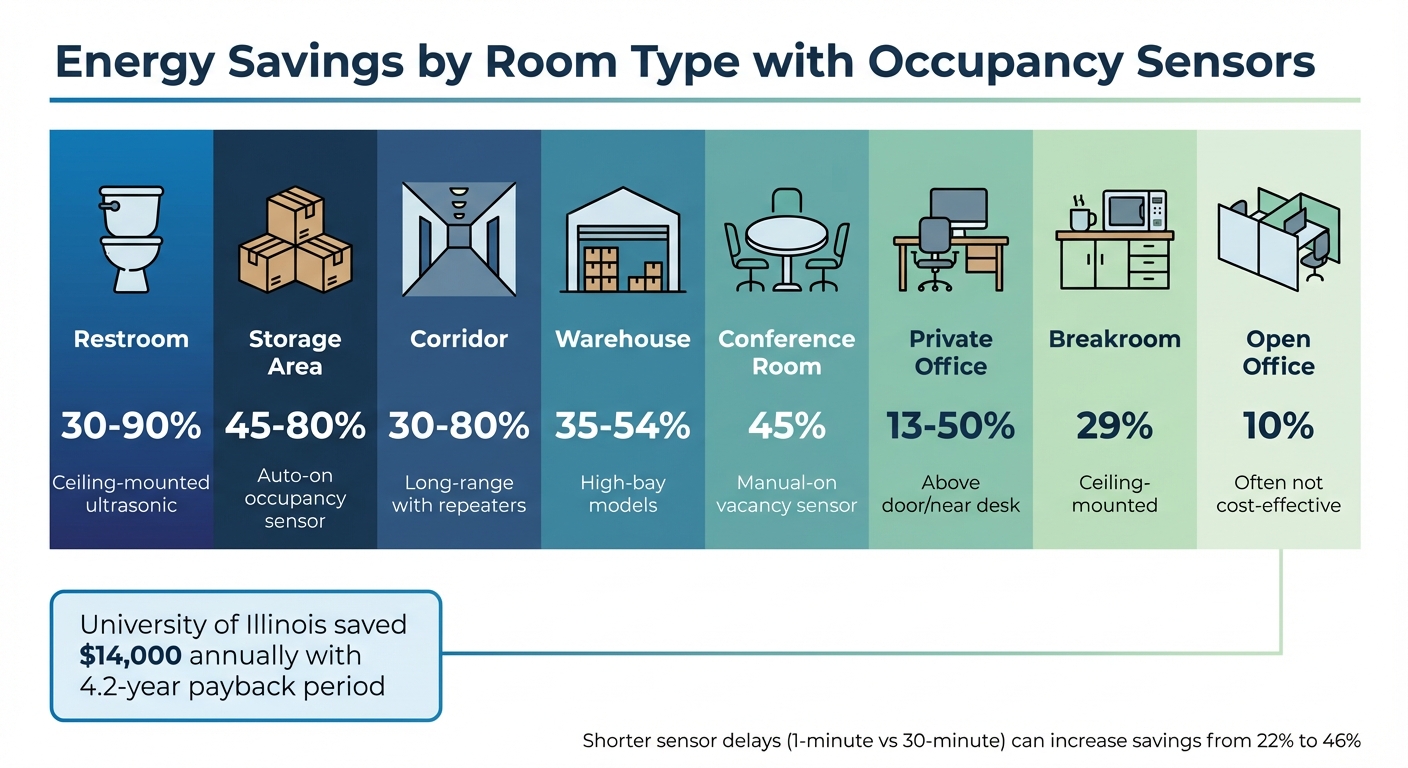
Energy Savings by Room Type with Occupancy Sensors
The placement of sensors plays a crucial role in maximizing energy savings. Focus on spaces that are used sporadically - like restrooms, breakrooms, conference rooms, stairwells, and storage areas - as these areas offer the most potential for savings. On the other hand, placing sensors in spaces that are continuously occupied, such as busy lobbies or open offices, tends to be less cost-effective.
For restrooms, ceiling-mounted sensors positioned over stalls work best, with additional units for areas with irregular layouts. In private offices, sensors can be installed above entry doors or near desks to effectively monitor occupancy. In warehouses, high-bay sensors designed for ceilings over 15 feet are ideal and should be protected from potential impacts, such as those caused by forklifts. In naturally lit spaces, using vacancy sensors (manual-on/auto-off) allows occupants to take advantage of daylight, minimizing unnecessary artificial lighting.
To avoid false triggers, keep sensors at least 4 feet away from HVAC registers. In large spaces like corridors, wireless sensors may require signal repeaters if they are located more than 50 feet from their controllers to ensure consistent communication.
These placement strategies are designed to optimize energy savings, as highlighted in the table below.
Energy savings vary depending on the type of space and its usage patterns. The table below outlines potential savings and the most effective sensor strategies for different areas:
| Room Type | Potential Energy Savings | Best Sensor Strategy |
|---|---|---|
| Restroom | 30–90% | Ceiling-mounted (ultrasonic preferred for stalls) |
| Storage Area | 45–80% | Occupancy sensor (auto-on) |
| Corridor | 30–80% | Long-range sensors; use signal repeaters for wireless |
| Warehouse | 35–54% | High-bay specific models; protect from forklifts |
| Conference Room | 45% | Vacancy sensor (manual-on) |
| Private Office | 13–50% | Above the door or near the desk for minor motion detection |
| Breakroom | 29% | Ceiling-mounted to avoid obstructions |
| Open Office | 10% | Often not cost-effective unless cubicle walls are low |
Source:
In a 2007 study conducted by the University of Illinois, wired occupancy sensors were installed in over 200 rooms across 10 buildings. The results showed annual cost savings of approximately $14,000, with a simple payback period of 4.2 years.
When sensors are installed correctly and integrated into broader systems, the reduction in energy consumption becomes strikingly clear. Occupancy-based lighting controls, when implemented effectively, can lower lighting energy use by 30% to 50% in commercial buildings. For instance, one study revealed that shortening a sensor's time delay from 30 minutes to 1 minute boosted energy savings from 22% to 46%. Starting with a 10-minute delay is often a good balance, with adjustments toward the 15-minute NEMA recommendation made only if feedback from occupants suggests it.
Reducing lighting use by 30% to 50% translates to an overall energy reduction of 6% to 10%. These savings not only align with corporate sustainability goals but can also contribute to ENERGY STAR certification. For some businesses, this certification can lower operating costs by as much as $25,000 per year for every 10,000 square feet of office space. Additionally, integrating occupancy data with HVAC systems - adjusting temperature settings and airflow in unoccupied areas - can lead to even greater energy reductions than lighting controls alone.
Occupancy data transforms energy management from an educated guess into a precise science. With real-time sensor data, building systems can adapt to actual usage patterns, cutting down on wasted energy. Picture this: lights dim automatically in empty meeting rooms, HVAC systems fine-tune airflow based on the number of people present, and maintenance schedules are adjusted according to real usage needs - all of this, thanks to occupancy data.
The financial benefits are hard to ignore. Occupancy-based solutions reduce energy consumption and carbon emissions by an average of 22%, often paying for themselves within two to five years. Beyond cost savings, this approach extends the life of equipment, streamlines cleaning schedules, and provides the detailed data needed for ESG reporting and certifications. These advantages make it clear why this method is gaining traction among forward-thinking organizations.
Luminate Lighting Group has been at the forefront of this movement, bringing over 35 years of experience to the table. With more than 25,000 locations served, they specialize in delivering tailored solutions that ensure optimal sensor placement and seamless system integration. Their expertise highlights the broader trend toward smarter, occupancy-driven energy management.
As hybrid work models continue to reshape how we use commercial spaces, real-time occupancy monitoring is becoming indispensable. Whether you're managing an office, warehouse, or municipal facility, occupancy data equips you with the insights needed to make smarter decisions about energy use, space planning, and sustainability goals. This isn't just about cutting costs - it's about operating more intelligently and preparing for the future.
Occupancy sensors are a smart way to reduce energy waste. They work by automatically turning off or dimming lights when a room is empty. When paired with HVAC systems, these sensors can also fine-tune heating and cooling based on whether a space is being used, ensuring energy is consumed only when necessary.
The impact of these systems can be impressive. Lighting energy usage can drop by 30% to 60%, and in some instances, even up to 90%. Combined, occupancy sensors can cut a building's total energy consumption by 10% to 15%, making them a practical choice for boosting energy efficiency in commercial properties.
Choosing the right occupancy sensor for each area in a building can make a big difference in cutting energy costs while keeping spaces comfortable for occupants. For large, open areas like warehouses or manufacturing floors, high-bay or wide-angle ceiling-mounted sensors are the go-to choice. These sensors are designed to cover expansive spaces and handle the challenges of high ceilings effectively. In contrast, passive infrared (PIR) sensors work perfectly in standard office spaces. Mounted on walls or ceilings, they detect body heat and offer a budget-friendly solution.
When it comes to spaces like conference rooms, breakrooms, or restrooms, dual-technology sensors (which combine PIR and ultrasonic detection) are worth considering. They’re excellent at reducing false triggers caused by minor movements or air circulation. For corridors and stairwells, low-height wall-mounted or fixture-mounted sensors with a narrow detection range are ideal, as they focus on detecting people passing through. Outdoor or semi-exposed areas require weatherproof sensors, and wireless options can make retrofitting simpler by eliminating the need for extra wiring.
The benefits of integrating the right sensors into your building’s lighting system are substantial. Energy savings can range from 10% in storage rooms to as much as 90% in warehouses. Companies like Luminate Lighting Group specialize in pairing these sensor solutions with energy-efficient LED retrofits and services like energy audits. They also help businesses across the U.S. take advantage of cost-saving opportunities, including utility rebates and 179D tax deductions.
Businesses often see a return on investment (ROI) from occupancy-based energy systems within 2 to 4 years. In some cases, the payback can happen in as little as two years, depending on factors like the size of the facility, energy consumption habits, and the system's design.
These systems help cut down on energy waste while improving lighting efficiency. As a result, they not only reduce utility expenses but also align with sustainability efforts and meet energy code requirements. For companies aiming to lower costs and boost efficiency, the savings generated make this investment a smart move.


