.svg)
Five practical steps—audit, calculate lighting power allowances, retrofit to LEDs, install controls, and document—to meet ASHRAE 90.1 and cut energy use.

Need to meet ASHRAE 90.1 lighting compliance? Here’s how you can do it in five clear steps as part of our proven process:
Why it matters: The 2022 ASHRAE 90.1 update introduced stricter LPD limits and expanded requirements for lighting controls. Following these steps can cut energy costs by 20–50%, improve efficiency, and help you qualify for tax deductions and utility rebates.
Let’s break down each step in more detail to simplify the process and save you time and money.
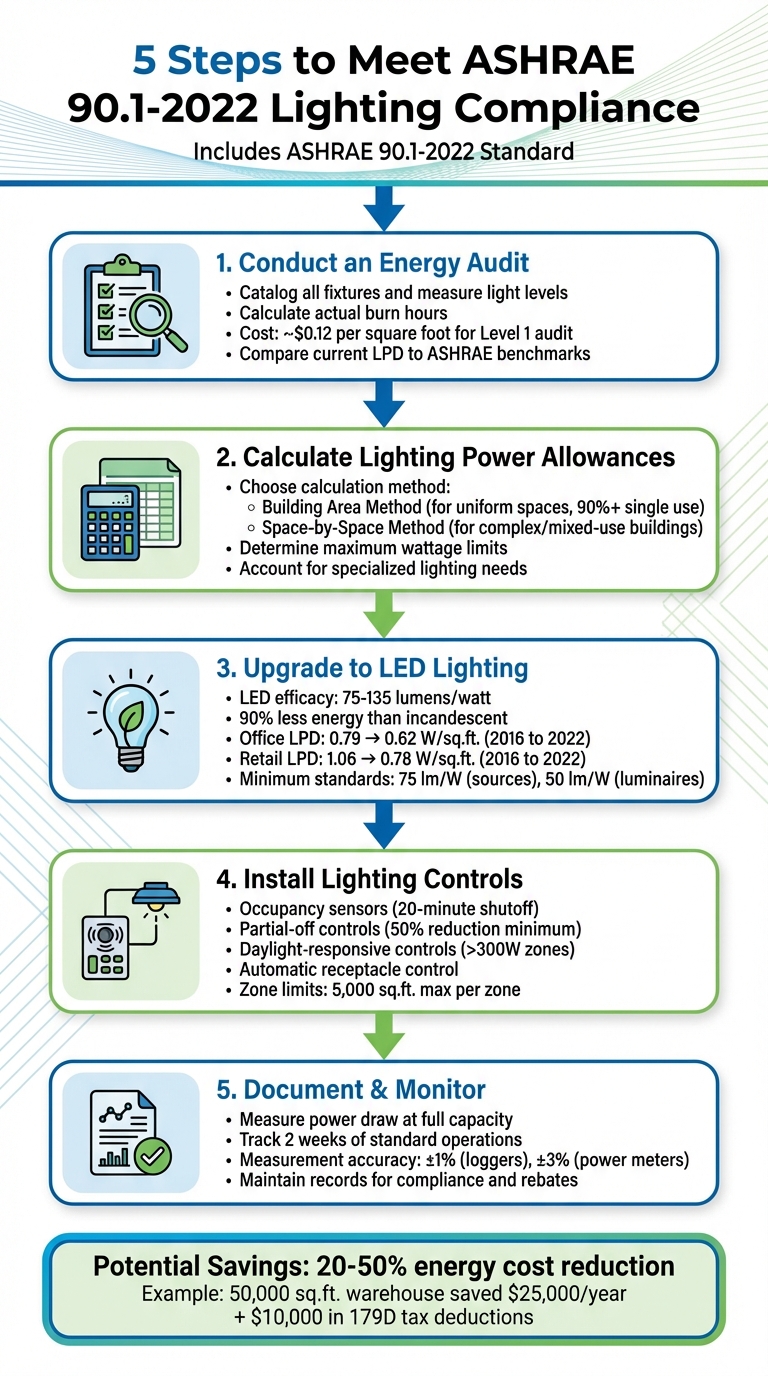
5 Steps to Achieve ASHRAE 90.1 Lighting Compliance

To kick off your lighting upgrade journey, start by evaluating your current system's performance. This step, known as an energy audit, helps you figure out where you stand in terms of compliance and energy efficiency. It’s the foundation for calculating ROI and setting a realistic budget for updates. Essentially, this audit ensures your upgrades are precise and targeted.
Begin by taking stock of every fixture in your facility. Catalog all lighting - both indoors and outdoors. Record details like lamp types, wattages, ballast specs, and mounting heights. Use a light meter to measure how much light (in foot-candles) reaches task height. For example, this could be desk height in an office or workbench level in a warehouse. These measurements will reveal if your system is underperforming or wasting energy by over-lighting spaces.
Next, calculate your actual burn hours. Many facilities underestimate how long their lights are on by forgetting about cleaning crews, security lighting, or outdoor fixtures that run from dusk to dawn. Bobby Graham, Chief Growth Officer at FSG, emphasizes the value of on-site inspections for accuracy:
High-level data can shape budgets and ROI, but precise costing requires an on-site inspection.
Gather a full year’s worth of utility bills to get a clear picture of seasonal variations and the financial impact of your current lighting system.
While collecting performance data, also note physical factors that influence light distribution. This includes details like floor plans, ceiling heights, surface colors, and obstacles such as furniture or storage racks. Check for aging lamps, dirt buildup, or multifunctional spaces that might affect performance. For most commercial spaces, a basic ASHRAE Level 1 walk-through audit costs about $0.12 per square foot and provides enough data to identify potential savings and necessary upgrades.
Once all the data is in, compare your lighting power density to ASHRAE benchmarks for your building type. This analysis highlights where upgrades are needed most urgently and helps prioritize which areas to address first versus those that can wait.
Once you've established your baseline, the next step is to calculate the maximum lighting power your facility can use under ASHRAE 90.1 guidelines. This sets your wattage limit. ASHRAE offers two calculation methods: the Building Area Method and the Space-by-Space Method. The Building Area Method works well for straightforward spaces with uniform use, while the Space-by-Space Method is better suited for buildings with varied or complex layouts. Your choice will depend on the design and function of your facility.
This method calculates a single lighting power density (LPD) limit by multiplying the total building area by the LPD value assigned to your building type in ASHRAE 90.1. To qualify, at least 90% of the building must serve a single primary function. For example, in a 200,000 sq. ft. warehouse where 185,000 sq. ft. is used for storage, the facility meets the requirement.
While this method simplifies calculations, it comes with limitations. It doesn’t allow extra power for decorative or specialized lighting, like chandeliers in a lobby or custom lighting for displays. If your building requires these features, this method may not provide enough flexibility.
This approach involves calculating the LPD for each individual space by multiplying its area by the specific LPD value from ASHRAE tables. The results are then summed to determine the total allowance. One key advantage is that unused power from one space can be allocated to another, provided all spaces fall under the same permit category. However, allowances for specialized uses are "use-it-or-lose-it" - meaning if you don’t install the intended lighting, you can’t transfer that power elsewhere.
The Space-by-Space Method also offers additional allowances for specific needs. For instance, videoconferencing studios can use up to 1.5 watts per sq. ft. if proper controls are installed. Similarly, retail displays and decorative lighting are given extra wattage. For multi-tenant buildings, unleased spaces are typically allowed up to 0.6 watts per sq. ft., according to ASHRAE guidelines.
This method provides more flexibility for facilities with diverse lighting needs, making it a better fit for complex or mixed-use buildings. However, it requires careful planning to ensure compliance with the intended purposes of each allowance.
Once you've set power allowances, the next step is to replace outdated fixtures with efficient LED systems. This upgrade not only brings significant energy savings but also ensures compliance with modern standards like ASHRAE 90.1-2022.
A key factor to consider here is luminous efficacy - essentially, how well a light source converts electricity into visible light, measured in lumens per watt. LEDs today deliver 75–135 lumens per watt, a massive leap compared to older technologies. For instance, an 800-lumen LED bulb uses just 9 watts, while an incandescent bulb requires 60 watts to achieve the same brightness. That’s a 7:1 efficiency ratio, meaning LEDs consume about 90% less energy than incandescent bulbs and 85% less than halogen options.
These efficiency improvements are why ASHRAE has tightened lighting power density (LPD) limits. For example, office LPD thresholds have dropped from 0.79 W/sq.ft. in 2016 to 0.62 W/sq.ft. in 2022. Retail spaces saw a similar reduction, going from 1.06 W/sq.ft. to 0.78 W/sq.ft.. These stricter targets are attainable because LED systems now meet minimum efficacy standards of 75 lumens/W for light sources and 50 lumens/W for luminaires in residential units.
When selecting LED replacements, focus on lumen output, not wattage. Check the "Lighting Facts" label on LED packaging to ensure the lumens and efficacy align with your needs. This approach helps maintain proper light levels while significantly cutting energy use. Also, verify that the LED's wattage doesn’t exceed the fixture’s maximum rating.
Another advantage of LEDs is their minimal heat output. Unlike incandescent bulbs, which waste nearly 90% of their energy as heat, LEDs reduce the cooling load on your building. This, in turn, decreases HVAC energy consumption. By addressing both lighting and climate control efficiency, LED retrofits are among the most cost-effective ways to meet compliance standards and lower energy bills.
After upgrading to LED fixtures, the next step is installing the necessary lighting controls. According to ASHRAE 90.1, these controls are mandatory for compliance and play a key role in cutting down energy waste. They're not just another feature - they're essential for meeting standards and ensuring your LED upgrade delivers on energy efficiency and cost savings.
Occupancy sensors are a must-have for automatic lighting control. These sensors are required to dim or turn off lights within 20 minutes of detecting vacancy. However, in areas like stairwells, corridors, lobbies, or warehouses, where complete darkness isn't practical, partial-off controls come into play. These controls must reduce lighting power by at least 50% within the same 20-minute window.
In spaces near windows or skylights, daylight-responsive controls are required. If the total lighting power in these primary and secondary sidelighted zones exceeds 300 watts, you need to install controls that adjust lighting levels based on available daylight. The code also mandates that these zones be controlled independently, even if their combined wattage exceeds the threshold.
Another requirement is automatic receptacle control, which helps manage plug loads. This applies to private offices, conference rooms, breakrooms, classrooms, and individual workstations. These outlets must automatically turn off within 20 minutes of vacancy to save energy from devices like monitors, chargers, and task lights. Controlled receptacles should be clearly marked with permanent labels or distinct colors for easy identification.
Proper zoning is also critical. Each floor must have its own automatic shutoff controls, and every room needs independent control. For larger spaces, zones must be limited to 5,000 square feet or less. In specific areas like warehouses, sensors should be arranged by aisle, and in parking garages, each zone should control no more than 500 watts. These zoning and control measures work hand-in-hand with your LED upgrade to reduce energy waste and ensure compliance with ASHRAE standards.
After installing your LED lighting and controls, the next step is all about ensuring your system continues to meet ASHRAE standards over time. This involves documenting your setup and actively monitoring performance. By keeping compliance checklists, performing power calculations, and maintaining detailed records, you can verify that your lighting system remains efficient and aligned with regulatory standards. This step builds on your earlier audit and retrofit work, ensuring long-term success.
Start by establishing a solid operational baseline. Measure the power draw at full capacity with all controls turned off. This isolates energy savings and provides a clear "before-and-after" picture. To ensure accuracy, track two weeks of standard operations to account for normal business fluctuations.
Selecting the right measurement method is crucial. If your project involves a specific building or area, total circuit measurement is ideal. It monitors the circuits serving your project area and validates total energy savings. For facilities with varied layouts, sampling measurement can be effective. This method involves monitoring a representative sample of fixtures and extrapolating the data for the entire facility. Make sure your energy loggers and Current Transformer (CT) systems have a measurement uncertainty of ±1% of the reading, while power meters used for baseline measurements should have an uncertainty of ±3%.
Keep meticulous records of your setup and measurements. Use photos or sketches to document measurement points, note equipment specifications, and log any changes like renovations. These records not only help with compliance but also make future optimizations easier, tying back to your initial energy audit. Be sure to allow at least one hour for your system to warm up before taking measurements.
For systems with daylighting controls, consider environmental factors. Use solar radiation ratios to estimate annual energy use from short-term measurements. If your system includes multiple control layers, such as occupancy sensors and daylighting controls, monitor each layer separately for two weeks to identify specific savings. Detailed documentation like this not only ensures compliance but also helps you maximize energy savings and may even assist in securing utility rebates or tax deductions.
Navigating ASHRAE compliance isn’t easy. It involves energy audits, lighting calculations, and detailed documentation. That’s where Luminate Lighting Group steps in. We simplify every stage, from initial assessments to final paperwork, so you can focus on your business.
First, we conduct thorough audits to identify inefficiencies and pinpoint where your building falls short of ASHRAE standards. This benchmarking process lays the groundwork for determining compliance, giving you a clear picture of your building's performance. From there, we provide customized lighting fixture recommendations that meet your specific Lighting Power Allowances (LPA) and Lighting Power Density (LPD) needs. These tailored solutions ensure your building aligns with the calculations and standards outlined earlier.
But it’s not just about meeting technical requirements. We also handle the paperwork for 179D tax deductions and utility rebates, streamlining the process outlined in Step 5. By incorporating smart lighting controls and high-efficiency systems, we can help reduce energy consumption by up to 30%, which can significantly offset the cost of upgrades.
For existing buildings, we guide you through the updated ASHRAE Standard 100-2024 requirements. This now includes decarbonization assessments alongside energy audits for buildings that fall short of performance targets. With existing structures expected to make up about 90% of buildings over the next decade, this service is more relevant than ever.
Whether you manage warehouses, offices, or other facilities, our comprehensive approach ensures your journey to ASHRAE compliance is seamless. By addressing each step with precision, we not only help you meet compliance standards but also improve energy efficiency for long-term savings.
Achieving ASHRAE lighting compliance doesn’t have to be complicated. By sticking to five straightforward steps - conducting an energy audit, calculating lighting power allowances, upgrading to LED lighting, installing required controls, and keeping thorough documentation - you can simplify the process while cutting energy costs by 20–50%. These steps not only deliver immediate savings but also set you up for long-term compliance.
Take this example: a 50,000 sq. ft. warehouse retrofit aligned with ASHRAE 90.1 standards saved around $25,000 annually. This was achieved by upgrading to LED lighting with a minimum efficacy of 55 lm/W and using occupancy sensors that reduced power use by 30% after 20 minutes of vacancy. On top of that, the project earned $10,000 in 179D tax deductions.
The 2022 update to ASHRAE 90.1 introduced stricter lighting power density limits and expanded control requirements, including automatic shutoff, daylight-responsive dimming, and bilevel exterior controls. These changes impact both interior and exterior lighting applications. For instance, new categories like horticultural lighting and exterior spaces such as parking lots now fall under its scope. To meet these updated standards, precision is key - whether calculating power allowances or commissioning controls correctly.
Navigating these updates without expert help can lead to costly errors. Proper guidance ensures accurate calculations, effective control commissioning, and solid documentation, helping you avoid penalties and secure rebates. Companies like Luminate Lighting Group specialize in managing every step of ASHRAE compliance. From energy audits and LED upgrades to control installations and documentation, they make the process seamless. Whether you’re overseeing warehouses, offices, or municipal buildings, expert support ensures you stay compliant, save money, and qualify for incentives. By following these steps, you can confidently tackle ASHRAE compliance while maximizing energy efficiency and cost savings.
The ECB Method Compliance Forms found in the ASHRAE 90.1-2010 User's Manual are a popular tool for verifying lighting compliance. These forms are frequently used to align with ASHRAE 90.1 standards, providing the necessary documentation to confirm compliance requirements.
You don't necessarily have to invest in new lighting controls when upgrading to LEDs. That said, incorporating features like occupancy sensors or daylight-responsive systems can take your energy savings to the next level. Plus, these additions can help you meet ASHRAE standards with ease. By integrating these controls, you maximize efficiency and get the full benefits of your LED upgrade.
To stay compliant over time, it's important to maintain thorough records. This includes energy audit reports, compliance forms, and lighting system specifications. You should also keep invoices, photos, and certifications for any installed products, like those with DLC or ENERGY STAR ratings. By organizing and preserving this documentation, you can demonstrate adherence to ASHRAE standards and ensure ongoing compliance.


