.svg)
Maximize utility rebates for LED retrofits by choosing prescriptive or custom incentives, meeting DLC/ENERGY STAR rules, and timing bonus offers.

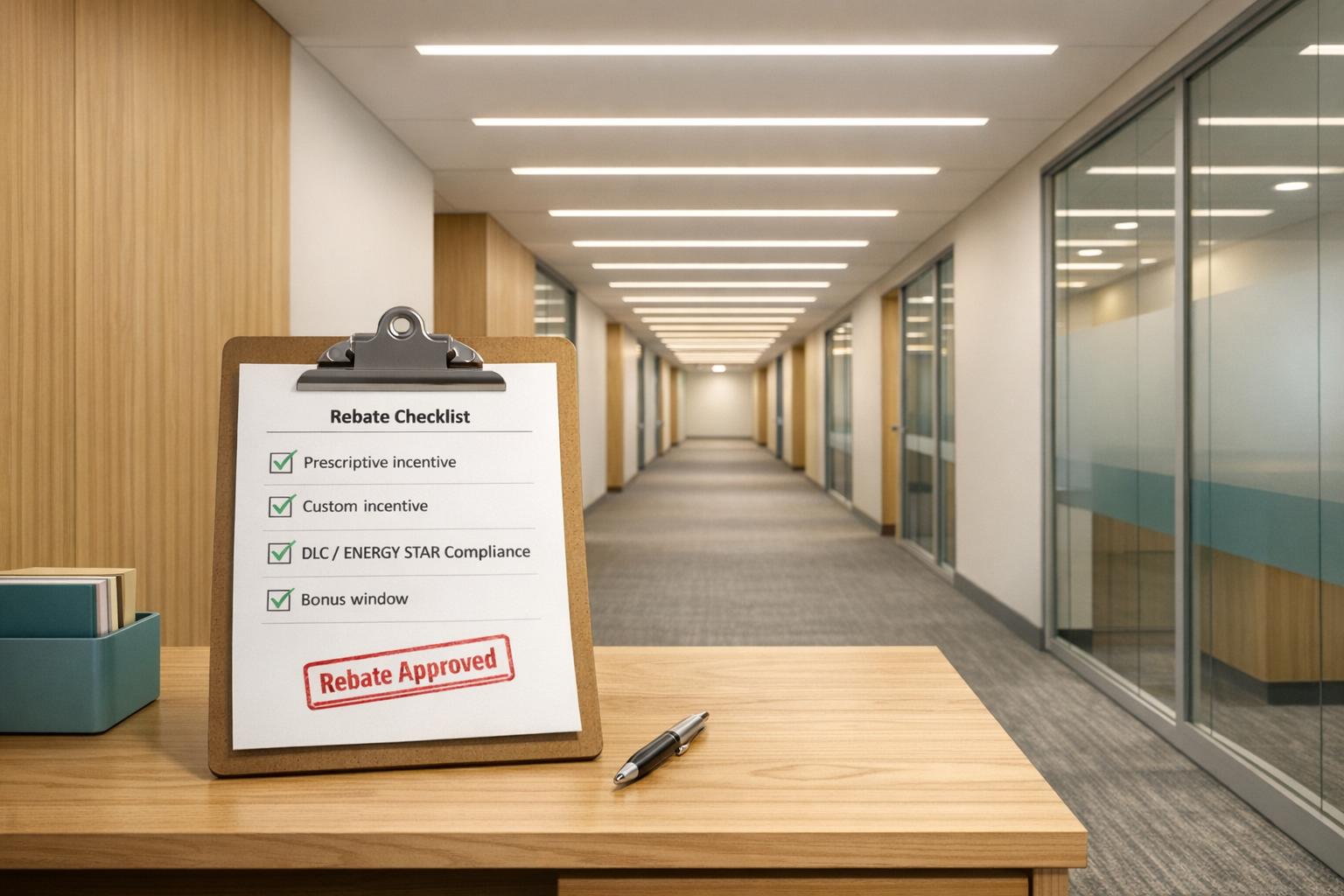
LED retrofits can save energy and reduce costs, but upfront expenses often deter businesses. Utility rebate programs help offset these costs, making energy-efficient upgrades more affordable. These rebates come in two types: midstream rebates, which provide immediate discounts at purchase, and downstream rebates, which require applications and post-installation inspections but can offer higher payouts.
Key takeaways:
To maximize rebates, businesses should:
With rising electricity rates and evolving rebate programs, now is an ideal time to upgrade to energy-efficient lighting systems while taking advantage of available incentives.

LED Retrofit Utility Rebate Statistics and Trends 2025-2026
Understanding how utility rebate programs operate is essential for businesses looking to maximize savings from LED retrofits. As of February 2026, 75% of the U.S. is covered by active commercial lighting rebate programs, spanning 47 states and Washington, D.C.. These programs are designed to help utilities manage grid demand more efficiently, avoiding the need for costly new power plants. By encouraging businesses to adopt energy-saving solutions like LED lighting, utilities can meet demand while keeping costs in check. This framework not only supports energy efficiency but also highlights the evolving nature of rebate structures across the country.
Rebate programs generally fall into two categories:
An emerging trend is LED-to-LED incentives, which encourage replacing older LEDs with newer, more efficient models. This category grew by 22% in 2026, reflecting the aging of early LED installations. Additionally, Networked Lighting Controls (NLC) are gaining traction, with 63% of prescriptive programs now including them.
Rebate programs and incentive levels vary widely by region. For instance, New York State ended its Commercial and Industrial (C&I) lighting incentives in late 2025, leaving it as one of the few major markets without traditional rebates. On the other hand, states like Tennessee, North Carolina, and Maryland saw increases in outdoor lighting incentives - up by 15% in 2025 - through utilities such as TVA, Duke North Carolina, and Baltimore Gas & Electric.
Budget constraints also influence regional programs. In Pennsylvania, utilities like PECO and First Energy reduced prescriptive rates in 2025 as they approached the final stages of their five-year program cycles. Meanwhile, ComEd in Illinois expanded its midstream program by significantly increasing rebates for specific fixtures, driving growth in that region.
State policies also play a role in shaping rebate structures. For example, Massachusetts reduced midstream rebates by 45% on average and eliminated incentives for non-controlled lighting, redirecting funds toward advanced energy efficiency measures aligned with state objectives. In contrast, Maine and Colorado continue to offer fluorescent-to-LED incentives despite having bans on fluorescent lamps. Oregon and Hawaii have tied their rebate programs to similar bans, phasing out incentives for those products. These variations highlight the dynamic nature of rebate programs and their alignment with local priorities.
The rebate landscape has seen significant changes heading into 2026. Average prescriptive lighting incentives increased by 17% across all categories, far outpacing inflation. Some categories experienced even sharper rises - rebates for replacing legacy HID lighting in parking garages, wall packs, and pole lights jumped by 30% or more, with screw-in HID replacements seeing increases as high as 38%.
Lighting controls have also become a focus. Rebates for Networked Lighting Controls (NLC) and Luminaire Level Lighting Controls (LLLC) increased by 7% in 2026, while standard sensors (like wall-mounted or fixture-mounted options) saw boosts ranging from 12% to 20%. Additionally, 7% of programs began the year with bonus incentives in place, which can double standard rebate amounts.
Utilities are increasingly prioritizing full fixture replacements and advanced technologies. This shift encourages comprehensive retrofits over simple bulb replacements, directly reducing costs and accelerating energy savings. Rising commercial electricity rates - up an average of 7% in 2025, with some regions seeing spikes as high as 29% - have only amplified the demand for energy-efficient upgrades.
Getting rebates for LED retrofits requires meeting specific eligibility criteria and following a set application process. These rebates can significantly lower the cost of retrofits, making it easier to upgrade to energy-efficient lighting. Knowing the requirements ahead of time can help you avoid delays and ensure your project qualifies for the highest possible incentives.
Utility programs usually require businesses to have an active commercial or industrial account in good standing with their utility provider. Additionally, facilities must participate in energy efficiency fees as part of their utility bills.
Product compliance is a must. Fixtures need to be listed on the DesignLights Consortium (DLC) Qualified Product List or hold an ENERGY STAR certification. They also need to meet minimum lifetime standards and include a 5-year warranty. Keep in mind that utilities often update their requirements to align with new DLC versions, so using outdated or non-compliant products could disqualify your project entirely.
Some rebate programs also require that installations are done by an approved Trade Ally or certified contractor. Certain utilities, like NV Energy, may not offer rebates for retrofit kits in specific applications, emphasizing the importance of reviewing technical requirements before making purchases.
Once you confirm eligibility, you can move forward with the application process to secure your rebates.
After confirming you meet the qualification criteria, follow these steps to navigate the application process:
"Make sure you install those lights within the time frame (usually 60 days) you agreed to at the time of purchase. Otherwise, you risk being charged the full cost of the lighting."
- Zoe Wells, ELEDLights
Following these steps carefully can help you secure the maximum available rebates, making your LED retrofit project even more cost-effective while boosting energy savings.
Careful planning can significantly increase the rebates you receive for LED retrofits. By aligning your project with the right rebate structure and timing your installation to take advantage of bonus incentives, you can secure thousands of dollars in additional savings. Two key factors influence your rebate potential: selecting the most suitable rebate type for your project and ensuring the timing aligns with bonus opportunities.
When it comes to rebates, the structure you choose matters. Prescriptive rebates provide a fixed amount per unit, making them ideal for straightforward, one-to-one replacements. The process is simpler, often requiring just invoices and product specs, which means faster approval and payment timelines.
On the other hand, custom rebates are calculated based on actual energy savings, typically offering between $0.05 and $0.15 per kilowatt-hour (kWh) saved in the first year. Although custom rebates demand more detailed documentation, they can yield higher payouts for complex projects. For instance, facilities that operate continuously or incorporate advanced lighting controls often benefit more from the custom approach.
"Prescriptive rebates are quick, predictable, and ideal for common equipment replacements. Custom rebates require more effort but provide flexibility and higher payouts for innovative or complex projects." - Kaitlyn Dambrosio, Incentive Rebate 360
The best choice depends on the specifics of your project. For example, a warehouse upgrading to standard high-bay LED fixtures might find prescriptive rebates sufficient. However, a manufacturing plant adding features like daylight harvesting and occupancy sensors could justify the extra effort involved in applying for custom rebates.
Rebate structures are just one piece of the puzzle - timing can also play a big role in maximizing your savings. Rebate programs often adjust their values throughout the year, and utilities frequently introduce time-sensitive bonus incentives. These bonuses, which can range from a 10% increase to even doubling the standard rebate, are often introduced toward the end of the year to help utilities meet their energy-saving goals. In fact, 7% of rebate programs launched 2026 with bonus incentives already in place.
Timing is also critical due to technology phase-outs. Some states are eliminating rebates for fluorescent-to-LED upgrades as they phase out fluorescent lamps. For instance, Hawaii plans to end such incentives after March 31, 2026, while New York and Oregon have already discontinued most commercial and industrial lighting rebate programs. If your facility still uses fluorescent systems, acting quickly is essential.
Meanwhile, opportunities are expanding for LED-to-LED replacements. With first-generation LEDs nearing the end of their lifespan, 22% more programs now offer rebates for upgrading older LEDs to newer, more efficient models. If your facility’s existing LED systems are aging, this could be an excellent time to upgrade and take advantage of incentives that weren’t available during the initial installation.
For tailored LED retrofit solutions that help you secure every available incentive, Luminate Lighting Group provides expert services to maximize your savings.
A wide range of commercial and industrial LED products qualify for rebates, though the specific items and rebate amounts depend on the program. Indoor fixtures - like high bays, low bays, LED panels, troffers, downlights, and track lights - are commonly eligible across the 78% of the U.S. covered by active commercial lighting rebate programs. Similarly, outdoor lighting products such as shoebox area lights, wall packs, flood lights, canopy lights, and cobra head street lights also qualify.
Replacement lamps are another category eligible for rebates in most areas. This includes LED fluorescent tube replacements (T8/T5), CFL replacements, corn lights, and standard bulbs like A-shaped, PAR, and MR types. Lighting controls, however, can significantly increase rebate values. Products like Networked Lighting Controls (NLC), occupancy sensors, and daylight-responsive systems can boost rebates by more than 3.5 times compared to standard fixtures. For instance, in Connecticut's Energize program, a basic 2x4 LED fixture qualifies for $25, but the same fixture equipped with Luminaire Level Lighting Controls (LLLC) earns a rebate of $90. This illustrates how integrating advanced controls can dramatically increase rebate potential.
Specialty lighting applications - such as exit signs, emergency lights, vapor-tight fixtures, and hazardous area lighting - also qualify under specific rebate categories. The key is aligning your project needs with products that deliver the highest rebate opportunities while meeting performance standards.
Knowing which products qualify is the first step in selecting certified equipment that maximizes your rebate returns.
Certification plays a critical role in determining rebate eligibility and payout. Ensure the products you purchase are listed on the DesignLights Consortium (DLC) Qualified Products List (QPL) or carry an ENERGY STAR certification. These certifications confirm that the products meet efficiency standards, such as minimum lumens per watt (lm/W), a warranty period of at least 5 years, and specific technical criteria.
The DLC maintains separate lists for various product categories, including standard Solid-State Lighting (SSL) and Networked Lighting Controls. It’s crucial to install products according to their Primary Use Designation (PUD). For example, a fixture classified as a "High-Bay Aisle Luminaire" cannot be installed as an "Outdoor Wall-Mounted" light and still qualify for rebates. Some programs even offer higher incentives for DLC Premium products, which exceed standard efficiency benchmarks.
Double-check that the model number on your product matches the certified listing to avoid rebate application rejections. Additionally, take "before and after" photos during installation, as these are often required to verify the work for prescriptive rebate payouts. If you need expert assistance with product selection or ensuring compliance with certification requirements, Luminate Lighting Group can guide you through the process to help secure the maximum rebate for your project.
Utility rebate programs play a key role in reducing upfront expenses and shortening payback periods for LED retrofit projects. By focusing on applications with higher incentives and incorporating advanced controls, businesses can further lower costs and boost savings.
However, timing is everything. Rebate structures are constantly evolving, with many programs requiring pre-approval before equipment purchases and operating on a first-come, first-served basis until funds are exhausted. Waiting for equipment prices to drop can backfire - if rebate values decrease at the same time, payback periods may actually stretch longer.
With commercial electricity rates climbing and rebate opportunities expanding, now is an opportune moment to act. Businesses that move quickly can secure time-sensitive bonus incentives, as seen with 7% of programs already offering increased payouts by early 2026.
Luminate Lighting Group is here to help you navigate these opportunities, ensuring you maximize every available incentive while achieving your energy efficiency goals.
Midstream rebates offer a more immediate financial advantage since they’re applied directly at the point of sale through distributors. This approach lowers upfront costs and streamlines the purchasing process. On the other hand, downstream rebates require customers to complete the project and go through an approval process before receiving payment. This often involves extra administrative work, which can delay the financial benefit.
When deciding on a rebate for your LED retrofit project, you’ll typically choose between prescriptive rebates and custom rebates.
The best choice depends on the complexity of your project and the energy savings it can deliver.
To make sure your rebate application goes through without a hitch, gather all the necessary documents, such as invoices, spec sheets, project details, and energy savings calculations. Carefully review everything for accuracy before submitting it. Also, be mindful of the deadline - missing it or providing incomplete or incorrect information could lead to delays or even rejection.


