.svg)
Real-time energy analytics cuts energy costs 10–20%, delivers payback in 6–11 months, and uncovers inefficiencies for faster savings and incentives.


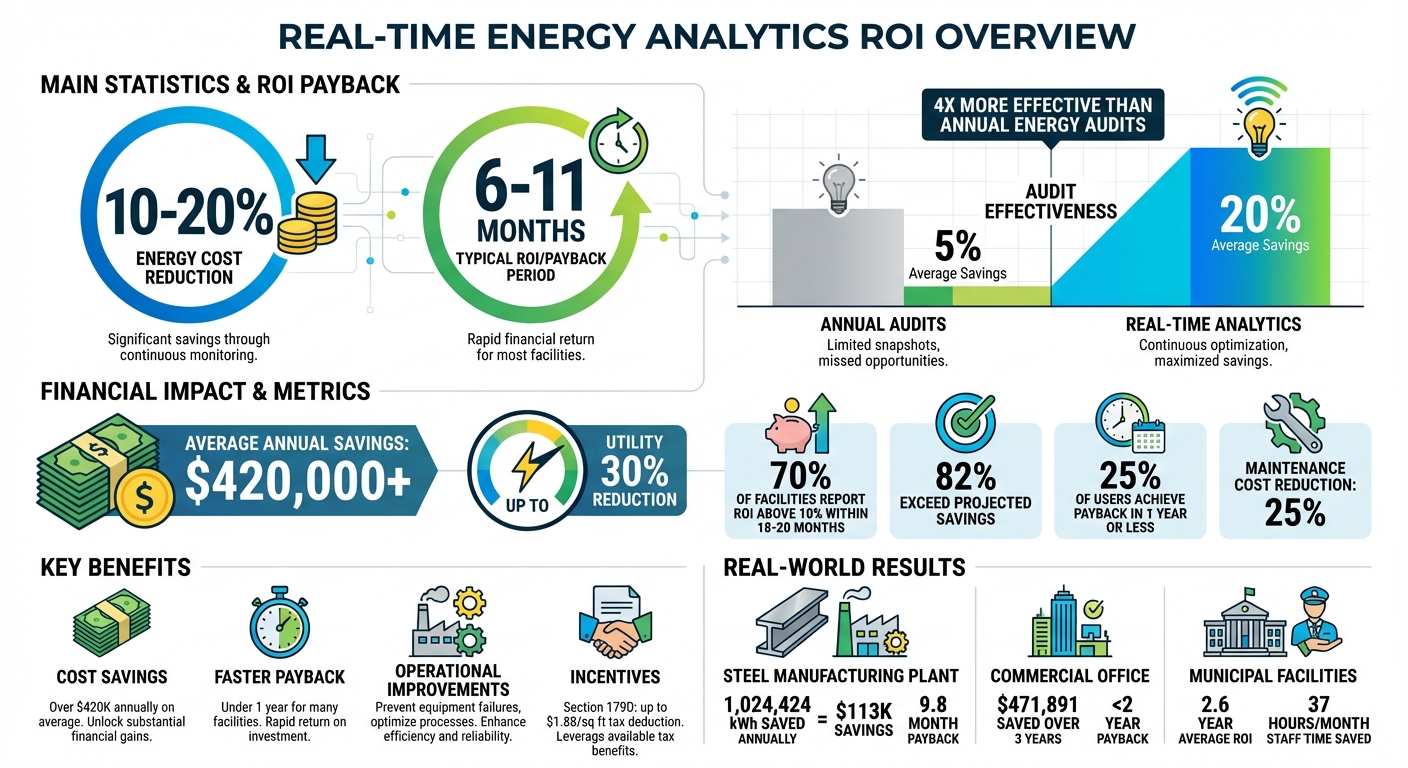
Real-time energy analytics helps facilities cut energy costs by 10–20% and achieve ROI within 6–11 months. By using data from meters and sensors, it identifies inefficiencies like equipment running after hours or demand spikes, enabling immediate action. This approach is four times more effective than annual energy audits, which typically only save 5%. Key benefits include:
Facilities using this technology report reduced maintenance costs, better energy tracking, and easier qualification for rebates. To get started, install IoT sensors, integrate with existing systems, and conduct an energy audit to prioritize improvements. Results can often be seen within weeks.
Real-Time Energy Analytics ROI: Cost Savings and Payback Statistics
Real-time energy analytics involves the continuous gathering, processing, and analysis of high-frequency energy data from equipment, circuits, and building meters. The goal? To spot inefficiencies and identify opportunities for improvement as they happen - not weeks or months down the line. Instead of relying on monthly utility bills or annual audits, facility teams gain live, on-the-spot insights into how, when, and where energy is being consumed.
While traditional monitoring offers a look back at past performance, real-time analytics works like a health monitor, constantly assessing energy use and turning raw data into actionable insights. For example, it can trigger immediate actions, like adjusting schedules or shutting down nonessential systems the moment an issue arises. This proactive approach helps facilities address problems right away, avoiding the waste and costs that come with delayed responses.
In large U.S. facilities, implementing real-time energy analytics often means combining interval meter data, equipment-level sensors, and building automation systems into a single platform. This setup tracks real-time power (kW) and energy usage (kWh) across meters, panels, and major equipment. It also translates energy consumption into dollar amounts - such as $/kWh, $/kW, and total daily costs - so facilities can monitor expenses per square foot and verify savings from specific energy-saving measures. Next, let’s break down the key components that enable these real-time insights.
A reliable real-time energy analytics system typically has three main layers:
Real-time energy analytics helps slash utility bills by pinpointing waste as it happens. IoT sensors are the key players here, detecting issues like compressed air leaks, phantom loads, or equipment running unnecessarily - problems that traditional yearly audits often miss. The moment inefficiencies are flagged, they can be addressed, preventing prolonged waste and unnecessary costs.
For example, real-time analytics can cut energy use by 10–20% and reduce utility expenses by as much as 30%. A steel manufacturing plant demonstrated this by monitoring furnace schedules and idle loads in real-time, saving an impressive 648,000 kWh annually - a major win for their bottom line.
Load-shifting strategies take these savings even further. Using AI-driven forecasting, businesses can predict energy demand by analyzing historical data, production schedules, and even weather patterns. This allows them to shift non-critical operations to off-peak hours, avoiding steep demand charges and power factor penalties. Facilities leveraging these strategies have seen utility costs drop by up to 30%. Real-time systems are four times more effective than annual audits, which typically only save 5%, compared to the 20% savings real-time analytics can deliver.
But the benefits go beyond just cutting costs - real-time analytics also makes entire operations run more efficiently.
With real-time data, facilities can fine-tune systems like HVAC to respond to temperature changes instantly. Lighting systems also benefit, as analytics can identify irregularities and optimize usage by dimming lights or scheduling them based on occupancy. For those upgrading to LED systems, integrating networked controls not only boosts monitoring capabilities but also opens doors to utility rebates and tax deductions through providers like Luminate Lighting Group.
Real-time systems also excel at predicting equipment failures. By tracking anomalies such as unusual vibrations or temperature spikes, they can forecast breakdowns weeks in advance, reducing maintenance costs by 25%. McKinsey reports that advanced energy analytics can lower facility costs by up to 15% through improved reliability and uptime.
Sustainability reporting becomes easier as well. Real-time monitoring tracks Scope 2 emissions and energy usage across business units, providing clear dashboards that break down daily costs, energy consumption per unit, and progress toward sustainability goals. This visibility not only boosts employee awareness but also ensures compliance with ESG standards by providing accurate measurement and verification of efficiency projects. EnergyCAP users, for instance, save 37 hours per month on energy management tasks while achieving 2.5 times the annual savings of average systems, with ROI in 2.6 years - and 25% of users see returns in a year or less.
This enhanced efficiency also helps businesses stay compliant and maximize financial incentives.
Once costs and operations are optimized, real-time analytics becomes a valuable tool for meeting energy codes and securing financial incentives. By tracking energy consumption down to the circuit level, facilities can document the exact savings from specific improvements. This verifiable data is critical for claiming utility rebates and adhering to energy codes.
Federal tax incentives, like Section 179D, offer even more financial rewards. This program provides deductions of up to $1.88 per square foot (adjusted for 2025) for energy-efficient upgrades in commercial buildings, such as lighting and HVAC improvements [context]. Real-time analytics simplifies the process by generating detailed measurement and verification reports required for IRS documentation, ensuring savings are accurately recorded. When combined with utility rebates for code-compliant retrofits, these incentives can significantly boost project ROI. In fact, 70% of facilities report ROI above 10% within 18–20 months, and 82% exceed their projected savings.
To set up real-time energy analytics, you’ll need the right combination of hardware and software. Start with IoT sensors to measure key parameters and sub-meters to capture detailed kilowatt-hour consumption for specific zones or loads. These devices feed data into cloud-based platforms for analysis and visualization.
The best cloud platforms provide features like real-time dashboards, instant mobile alerts for anomalies, historical trend analysis, and AI-driven load forecasting. Look for systems capable of handling data at sub-second intervals, and ensure they integrate smoothly with existing building management systems (BMS) or enterprise resource planning (ERP) software via APIs. Tools like single line diagram (SLD) visualization software are also valuable - they map out your electrical system in real time, helping pinpoint bottlenecks and inefficiencies. Mobile accessibility is another must-have, enabling plant managers to receive alerts on their smartphones and respond to issues immediately.
By combining these tools, you’ll create a robust framework for real-time energy analytics that can drive actionable insights.
Once your hardware and software are in place, the next step is conducting an energy audit to establish a baseline. This involves reviewing utility bills, inspecting equipment, measuring current loads, and benchmarking against Energy Star standards. The audit helps identify high-impact zones where sensors can provide the most value. For example, if lighting upgrades are part of your strategy, companies like Luminate Lighting Group offer comprehensive energy audits, documenting current fixtures and projecting potential savings.
After the audit, set key performance indicators (KPIs) based on your findings. Common metrics include cost per kilowatt-hour, peak demand reduction, energy consumption per production unit, and maintenance cost avoidance. Define clear goals, such as reducing facility costs by 15% or achieving 10–20% overall energy savings. Additionally, establish metrics required to qualify for utility rebates and tax incentives.
The deployment process typically unfolds over a 90-day phased rollout:
For example, a steel manufacturing facility following this approach optimized furnace schedules and reduced idle loads, saving 1,024,424 kWh annually - equivalent to approximately $113,000 USD. They achieved a payback period of 9.8 months and cut maintenance costs by 25%. Pilot deployments are an excellent way to demonstrate ROI before scaling up. In fact, 70% of facilities report ROI exceeding 10% within 18–20 months, and 82% surpass their projected savings when the system is deployed effectively.
Real-world examples show how real-time energy analytics can deliver measurable financial benefits.
A steel production plant used real-time energy monitoring across its furnaces, rolling mills, and auxiliary systems to keep a close eye on energy usage. By fine-tuning furnace schedules, shifting hot mill operations to avoid peak demand times, and shutting down idle equipment when production lines were inactive, the facility saved 1,024,424 kWh annually. This translated to $113,000 in yearly savings and a payback period of just 9.8 months. On top of that, using real-time data for predictive maintenance cut maintenance costs by 25%, as repairs could be planned during scheduled downtime instead of costly emergency fixes. Other facilities have seen similar benefits from these strategies.
A multi-site commercial office building adopted real-time energy monitoring to track electricity and gas usage across its offices, conference rooms, and shared spaces. With continuous analytics, the engineering and sustainability teams optimized HVAC schedules based on when spaces were occupied, reduced overnight energy use, and pinpointed underperforming equipment for targeted repairs and adjustments. Over three years, these efforts led to $471,891 in cumulative energy cost savings, with a payback period of less than two years. The system’s dashboard reports also provided ongoing insights to keep operations running efficiently. These results demonstrate how such measures can help facilities align with broader sustainability goals.
A nationwide survey of municipal and institutional users highlighted that, on average, customers achieved ROI within 2.6 years. Impressively, nearly 25% of users recouped their investment in just one year or less after implementing real-time analytics, automated reporting, and bill tracking. These tools helped users catch anomalies in 4.7% of their monthly utility bills, addressing billing errors and operational inefficiencies early. Automation also saved more than 37 hours of staff time per month. Energy managers used this verified data to support sustainability initiatives, confirm savings from efficiency projects, and strengthen applications for utility incentives and performance-based funding.
Real-time energy analytics consistently delivers impressive results, cutting energy costs by 10–20% with payback periods of just 6–11 months - outperforming traditional audits by up to four times. Facilities in manufacturing, commercial, and municipal sectors report annual savings that often surpass $420,000 for larger operations.
Beyond energy savings, these systems reduce maintenance expenses by preventing costly downtime. They also provide verified energy data crucial for meeting ESG goals, complying with benchmarking standards, and qualifying for utility rebates and tax incentives. Around 70% of facilities report a return on investment above 10% within 18–20 months, with many experiencing equal or greater savings in subsequent years compared to their first year.
To get started, consider conducting an energy audit and piloting real-time monitoring on high-impact systems. Many facilities begin seeing savings within weeks and achieve full payback in less than a year. For operations with significant lighting demands - such as warehouses, industrial plants, and offices - combining analytics with targeted LED retrofits through providers like Luminate Lighting Group can unlock additional financial benefits. This approach strengthens an overall energy strategy.
Energy optimization doesn’t stop after the initial improvements. As production schedules evolve and equipment ages, real-time analytics continue to identify new ways to reduce waste and improve efficiency. The insights gained today help shape smarter budgeting, better capital planning, and more effective sustainability reporting for the future. Real-time analytics turns energy management into a powerful tool for long-term profitability and sustainability.
Real-time energy analytics bring a fresh approach to managing energy use compared to traditional energy audits. With continuous monitoring, these tools provide ongoing insights into how energy is consumed, making it easier to spot inefficiencies and take action right away. This real-time feedback can lead to consistent cost savings over time.
Traditional energy audits, on the other hand, are usually done at set intervals. This approach can miss problems that crop up between audits, leaving inefficiencies unaddressed for extended periods. By tapping into real-time data, businesses can stay ahead with proactive energy management, improving efficiency and boosting their ROI in the process.
To implement real-time energy analytics, you'll need a few key components. Start with advanced sensors and meters to monitor energy consumption. Pair these with a data acquisition system that collects and transmits the information seamlessly.
A centralized software platform is crucial for analyzing and visualizing the data in real time. Also, make sure your facility has a stable internet connection and hardware that integrates smoothly with your current building systems. Together, these elements provide insights that can help cut energy costs and streamline operations.
Most facilities typically see a return on investment (ROI) from real-time energy analytics within 6 to 12 months. The specific timeline can vary based on factors such as the scope of energy upgrades, changes in operations, and whether utility rebates or tax incentives are available.
By lowering energy expenses and streamlining operations, these analytics deliver tangible savings that quickly cover the initial costs. For larger facilities looking to enhance efficiency and reduce overhead, they’re a practical and effective solution.


