.svg)
Venue LED retrofits reduce energy and maintenance costs, unlock rebates/179D tax benefits, and often pay back in 1–4 years.

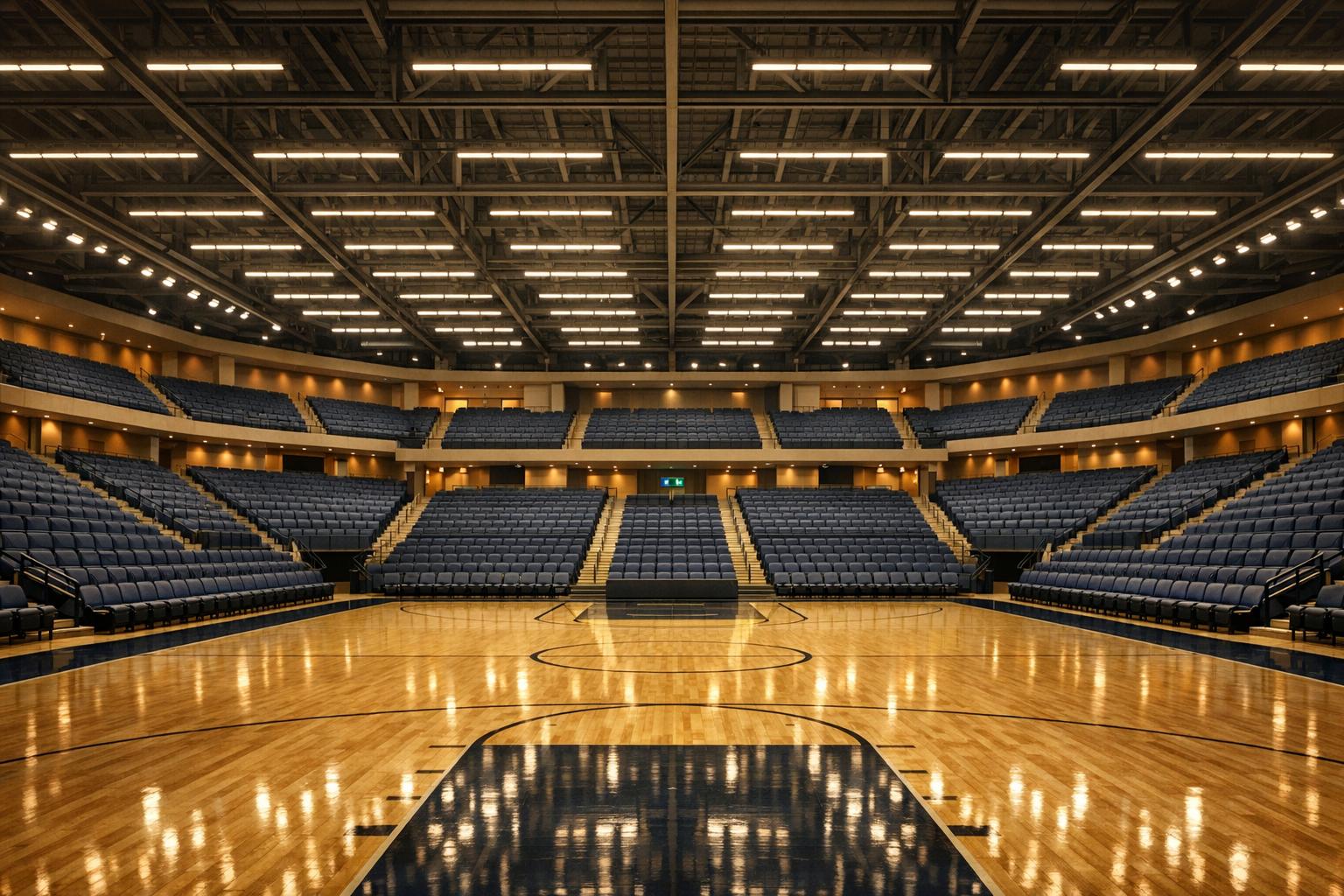
Switching to LED lighting in venues can significantly reduce costs and improve efficiency. LED retrofits slash energy bills by up to 75%, reduce maintenance needs due to longer lifespans (50,000+ hours), and eliminate delays caused by traditional lighting's warm-up times. Venues can also benefit from utility rebates covering 20–50% of project costs and federal tax deductions like Section 179D, which expires June 30, 2026. Proper planning, including energy audits, prioritizing high-use areas, and adding smart controls, ensures faster payback periods (1–4 years) and lasting savings.
Key Benefits of LED Retrofits for Venues:
To maximize returns, venues should audit current systems, select efficient fixtures, and schedule installations during downtime. Proper commissioning and ongoing monitoring ensure the system delivers on its savings potential.
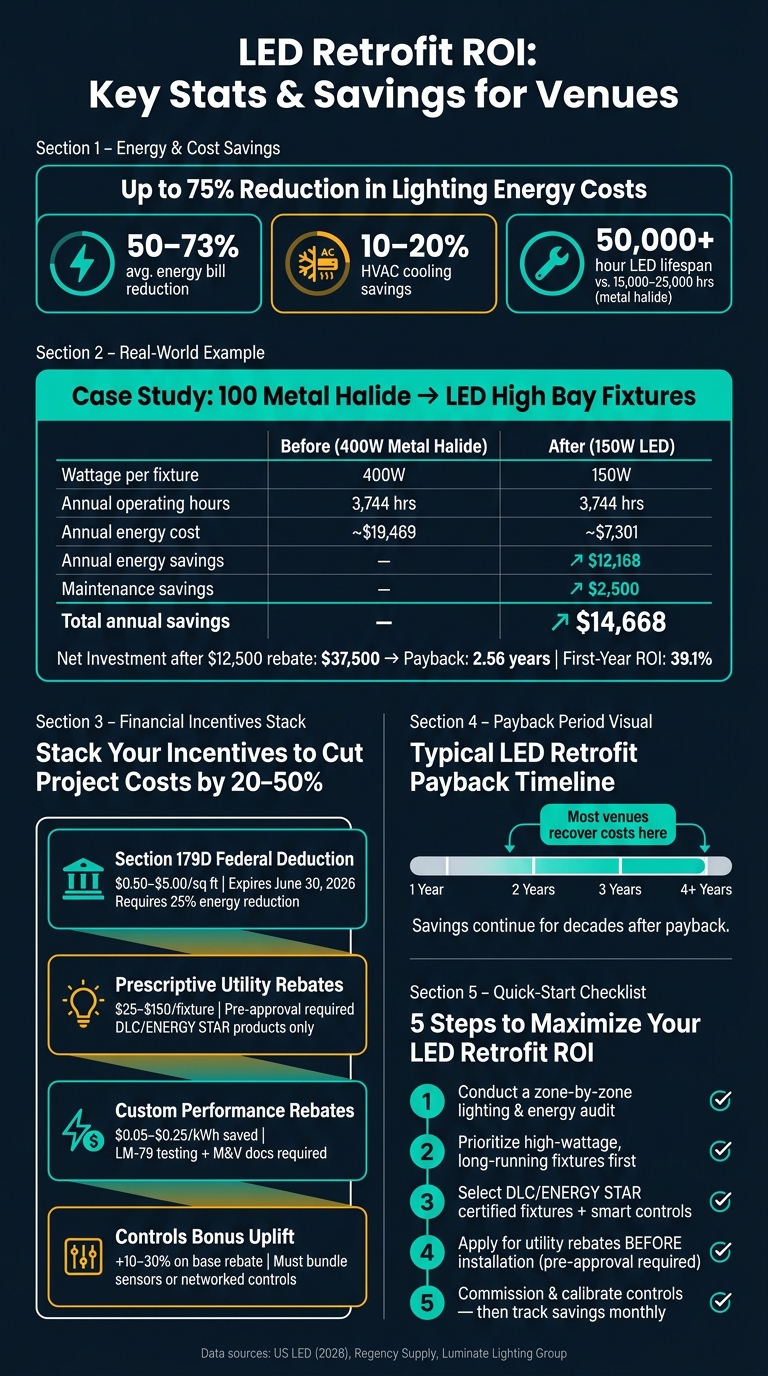
LED Retrofit ROI: Key Stats & Savings for Venues
Before diving into a retrofit or calculating potential savings, it’s essential to follow a proven process for lighting solutions to understand your current setup. This means documenting all fixtures, analyzing utility bills, and identifying the main cost drivers.
Start by breaking your venue into specific zones - think arena bowl, concourses, locker rooms, back-of-house areas, offices, and any cold storage or mechanical spaces. Each zone has unique lighting needs, operating hours, and savings opportunities, so analyzing them separately provides a more accurate picture.
For each zone, record details like fixture type (metal halide, high-pressure sodium, fluorescent, etc.), wattage, quantity, and daily operating hours. Then, review the past year’s utility bills. Pay close attention to peak demand charges in addition to overall kilowatt-hour consumption. These charges can add up, and LED retrofits often help reduce them significantly.
Don’t forget to assess whether your electrical panels can handle upgraded lighting controls or smart systems. Factors like conduit layouts or panel locations might limit your options and influence installation costs. A thorough audit not only sets a baseline for energy use but also points out key areas for improvement.
Once you’ve gathered the data, it’s time to pinpoint operational challenges. Some of the biggest cost factors in venue lighting might not be immediately obvious from your utility bills.
One major issue is maintenance access. Fixtures installed 50 to 100 feet above the ground require specialized equipment, like aerial lifts, for servicing. In venues with premium flooring, such as hardwood courts or high-end turf, bringing in this equipment can risk damage to the surface. Quantifying these risks in terms of cost is a vital part of the audit.
"LED longevity minimizes the frequency of costly high-altitude maintenance." - Jules Tompkins, Regency Supply
Another common challenge is instant-on capability. Certain zones, like those using HID lighting, may have warm-up delays that disrupt operations. Identifying these areas helps prioritize them in your retrofit plan.
After collecting all zone-specific data, calculate your annual energy costs and account for all maintenance expenses. For energy, use this formula: multiply fixture wattage by daily operating hours, then by 365, and divide by 1,000 to get kilowatt-hours. Multiply that by your utility’s blended rate to estimate annual costs.
For maintenance, include expenses like lift rentals, labor for high-altitude servicing, and lamp replacement frequency. In venues with hard-to-reach fixtures, maintenance savings can often rival energy savings. Labor alone typically makes up 35% to 45% of total retrofit costs, so underestimating this can lead to inaccurate ROI projections.
After conducting an audit, the next step is creating a retrofit plan that maximizes energy savings and reduces maintenance costs.
Once the audit is complete, it’s time to decide which areas to tackle first. Not all zones offer the same return, so prioritization is key.
Start with zones that have older, high-wattage fixtures running for long hours. For instance, replacing a 400W metal halide high-bay in an arena or stage area with a 150W LED unit can slash energy use by 63% right away. Similarly, spaces like lobbies, parking garages, and concourses that operate continuously should be high on the list. The longer these fixtures run, the quicker the payback.
"The longer you burn it, the faster the payback." - Regency Supply
This prioritization also helps guide fixture selection. Keep in mind that the Section 179D deduction, which offers $0.50–$5.00 per square foot in tax relief, is only available for projects documented before June 30, 2026.
After identifying priority zones, the next step is selecting the right fixtures and controls. Retrofit kits are great for quick upgrades, while full replacements often provide better performance and greater long-term value. Adding sensors and dimming systems can further increase savings and make your project eligible for extra rebates.
For large, high-ceiling spaces like arenas, UFO high-bays delivering 20,000–50,000 lumens are a solid choice. Cold storage or outdoor areas benefit from vapor-tight LEDs rated for temperatures as low as -40°F. In performance spaces, LED PAR/wash fixtures and mini moving heads use significantly less power - just 10–50 watts compared to the 300–1,000 watts consumed by older units.
Smart controls can amplify your savings. Occupancy sensors, dimming systems, and daylight harvesting can increase base rebate amounts by 10–30%. For venues hosting live events, DMX control systems are essential for synchronized lighting effects, while sound-activated modes are a good fit for DJ-driven or casual setups.
"In 2026, small venues that pair modest rigs with smart control have a real edge, delivering cinematic looks while keeping heat and power draw under control." - Lily Evans, Lighting Design Consultant
Make sure your chosen fixtures and controls align with rebate and regulatory requirements to maximize financial benefits.
Your choices in fixtures and controls directly affect the incentives you can claim, so compliance is non-negotiable. Fixtures must be either DLC Qualified or ENERGY STAR certified to qualify for rebates or the Section 179D deduction. Before purchasing, verify that your selections are listed on the DesignLights Consortium Qualified Products List.
Utility rebate programs typically require pre-approval before installation. Applications submitted after the work is done are almost always rejected, especially as deadlines approach in 2026. Rebates can cover 20–50% of project costs, with prescriptive incentives expected to increase by 17% in 2026. Outdoor fixtures, in particular, may see rebate enhancements of 30% or more.
Additionally, many areas are enforcing Building Performance Standards (BPS), which set energy efficiency benchmarks. LED retrofits can contribute 15–25% of the energy reductions needed to meet these standards for 2026–2030. Meeting these requirements not only secures incentives but also strengthens your ROI projections. Companies like Luminate Lighting Group can assist with navigating compliance and rebate processes, ensuring your specifications and documentation are ready before work begins.
| Incentive Layer | Potential Value | Key Requirement |
|---|---|---|
| Section 179D (Federal) | $0.50–$5.00 / sq ft | DLC/ENERGY STAR products; expires June 30, 2026 |
| Prescriptive Rebates | $25–$150 / fixture | Pre-approval required; DLC catalog products only |
| Custom Performance | $0.05–$0.25 / kWh saved | LM-79 testing data and M&V documentation |
| Controls Bonus | +10–30% uplift | Must bundle sensors or networked management |
Accurate savings calculations and identifying financial incentives are key to justifying your investment in an LED retrofit.
Estimating energy savings is straightforward when you know the wattage of your fixtures and their operating hours. Here's the formula:
Annual kWh Savings = [(Existing Watts − LED Watts) × Number of Fixtures × Annual Hours] ÷ 1,000
To calculate the dollar amount, multiply the result by your local electricity rate.
For example, in February 2026, US LED analyzed a retrofit project for a business replacing 100 metal halide fixtures (400W each) with LED high bays (150W each). These fixtures operated 3,744 hours annually at a rate of $0.13/kWh. The energy savings alone reached $12,168 per year, with an additional $2,500 in maintenance savings, resulting in total annual savings of $14,668.
Modern LEDs last between 50,000 and 200,000 hours, compared to the 15,000–25,000 hours typical of metal halide or fluorescent fixtures. This extended lifespan significantly reduces costs for lamp replacements, labor, and equipment rentals. When calculating maintenance savings, use the L70 lifetime - the point where LED brightness drops to 70% of its original level - for the most reliable comparison to older technologies.
Once you've calculated these savings, you can use them to qualify for rebates and tax deductions.
After estimating your savings, the next step is securing financial incentives to further lower your project costs.
Utility rebates often require pre-approval before purchasing or installing fixtures. Prescriptive rebates in 2026 typically range from $25 to $150 per fixture, while custom performance rebates can add $0.05–$0.25 per kWh saved annually.
On a federal level, the Section 179D tax deduction offers building owners deductions ranging from $0.50 to $5.00 per square foot for qualifying energy-efficient upgrades. To qualify, you must achieve at least a 25% energy reduction, verified by third-party certification. Note that this deduction is set to expire on June 30, 2026.
In the US LED example, a $12,500 utility rebate reduced the $50,000 project cost to a net investment of $37,500, even before applying any 179D benefits. Organizations like Luminate Lighting Group can assist with navigating rebate applications and ensuring all relevant documentation is completed.
Once you've calculated your savings and net costs, you can evaluate the financial performance of your retrofit using key ROI metrics:
| Metric | Formula | What It Tells You |
|---|---|---|
| Payback Period | Net Investment ÷ Annual Savings | How long it takes to recover your investment |
| First-Year ROI | (Annual Savings ÷ Net Investment) × 100 | How the investment compares to other uses of capital |
| Net Investment | Gross Cost − (Rebates + Tax Deductions) | Your actual out-of-pocket cost |
In the US LED example, the $37,500 net investment divided by $14,668 in annual savings results in a 2.56-year payback period and a 39.1% first-year ROI. These metrics highlight a strong return, even before factoring in additional benefits like reduced HVAC cooling costs. In warmer climates, LEDs' lower heat output can deliver 10–20% extra savings by reducing cooling loads.
For larger venues or projects requiring board approval, advanced metrics like Net Present Value (NPV) and Internal Rate of Return (IRR) can offer a broader perspective. These metrics show how the retrofit performs over the LED system's full lifespan, relative to your cost of capital. On average, commercial LED retrofits in 2026 achieve payback within 1–4 years, with savings continuing for decades.
Once you’ve got your ROI calculations and retrofit plans sorted, the next step is making sure installation and verification are done right. This is where you lock in those projected savings.
Timing matters - a lot. If you don’t plan the installation carefully, you could disrupt rehearsals, ticketed events, or even broadcasts. That’s a headache no one wants.
The best approach? Schedule retrofits during quieter periods, like dark weeks, breaks between touring productions, or seasonal closures. If shutting down entirely isn’t an option, consider phasing the work. This way, each zone can be tested individually without throwing the whole venue into chaos.
Keep in mind that brightness needs vary depending on the type of venue. Here’s a quick reference to help you plan:
| Venue Type | Recommended Brightness (lux) | Scheduling/Operational Priority |
|---|---|---|
| Church | 600–1,000 | Prioritize comfort and warmth for speakers |
| Concert | 1,000–2,000 | Focus on high-contrast layers for performers |
| Theater | 800–1,200 | Test scene-by-scene for emotional impact |
| Outdoor Stage | 1,500–3,000 | Calibrate at dusk to manage ambient light |
| Broadcast | 1,200–2,000 | Increase intensity by 30–50% for camera clarity |
Source:
For venues that host live-streamed events, don’t skip a separate "camera-ready" calibration session. Cameras need more light - 30–50% more than what works for the human eye - to ensure clear, sharp video.
Once the fixtures are installed, commissioning is the next step. This is where everything gets fine-tuned to ensure the system performs as expected.
"Commissioning finalizes adjustments and calibrations after installation and occupancy." - Whole Building Design Guide
During this phase, you’ll handle tasks like calibrating ambient light sensors, setting trim levels, grouping zones, and programming preset scenes for various activities (performances, presentations, cleaning cycles, etc.). Automation is also key - using time-of-day or astronomical clock controls ensures that exterior and security lighting adjusts automatically.
Here’s a critical warning from the Whole Building Design Guide:
"If a lighting control system is not commissioned, it may result in greater energy consumption than a building without any controls at all."
Skipping commissioning is one of the most common reasons LED retrofits fail to deliver the expected energy savings. Once this process is complete, back up all programming documentation and administrative QR codes immediately. Losing these could make future adjustments a nightmare. It’s also essential to train your operations staff on manual overrides and scene controllers to prevent disruptions to automated settings.
After commissioning, it’s time to verify that the system is delivering on its promises. Start by monitoring utility bills, maintenance calls, and replacement costs over the first three months. If the retrofit was sized correctly, you should notice a clear drop in maintenance needs and replacement expenses within the first year.
Don’t rely solely on data, though. Gather feedback from users about issues like glare, shadows, and color accuracy - these can reveal problems that numbers alone won’t catch. If you find any issues, adjust beam angles or trim settings through the control system.
For extra assurance, organizations like Luminate Lighting Group can assist with post-installation verification. They’ll help confirm that the system’s actual performance matches the projections you used to qualify for rebates and tax breaks.
LED retrofits offer a triple advantage by cutting costs on energy, maintenance, and incentives. They can slash energy bills by 50% to 73%, reduce HVAC cooling expenses by 10% to 20%, and provide access to rebates and tax incentives that offset 20% to 50% of the total investment. These combined savings often lead to payback periods between 12 and 24 months.
To achieve the best outcomes, venues should follow a structured retrofit process. This includes auditing current systems, focusing on high-access areas, verifying rebate eligibility, and commissioning advanced controls for optimal performance.
It's also wise to engage with utility providers early to secure custom rebates and avoid potential delays during installation.
For large facilities, the 179D federal tax deduction can be a game-changer. By obtaining third-party certification, venues can qualify for deductions of up to $1.80 per square foot on lighting upgrades that reduce energy usage by at least 25%. This can translate into major savings for larger properties. A methodical approach like this ensures both immediate and sustained benefits.
To help venues navigate this process, Luminate Lighting Group offers services such as energy audits, tailored retrofit designs, and post-installation verification. Their expertise ensures venues can move from initial assessment to confirmed savings with ease. By following this comprehensive strategy, venues can secure quick payback periods and long-term returns on their investment.
To get a quick idea of your LED retrofit payback, start by calculating the total project cost and then compare it to your energy savings, accounting for any rebates. For instance, high-bay LED fixtures usually cost between $250 and $400 each and offer a payback period of 12 to 20 months after rebates. On the other hand, troffers are priced at $75 to $130 each, with a payback period of 18 to 30 months. This straightforward approach gives you a practical estimate based on the type of fixtures and the size of your facility.
Start by focusing on high-traffic locations such as stadiums, arenas, and main event spaces. These areas often deliver the highest return on investment because they generate substantial energy savings, reduce maintenance expenses, and may qualify for utility rebates. Targeting these spaces first ensures you achieve the greatest impact in terms of both efficiency and cost savings.
To take advantage of rebates and the 179D deduction, it's essential to complete energy-efficient LED lighting upgrades before the specified deadlines. For the 179D deduction, construction on qualifying projects must start no later than June 30, 2026. Additionally, your upgrades need to meet certain energy savings and performance standards to ensure you qualify for the maximum tax benefits and incentives.


