.svg)
High-bay LED retrofits can cut energy use 50–70%, lower maintenance, improve safety, and typically pay back in 1–3 years with available rebates.

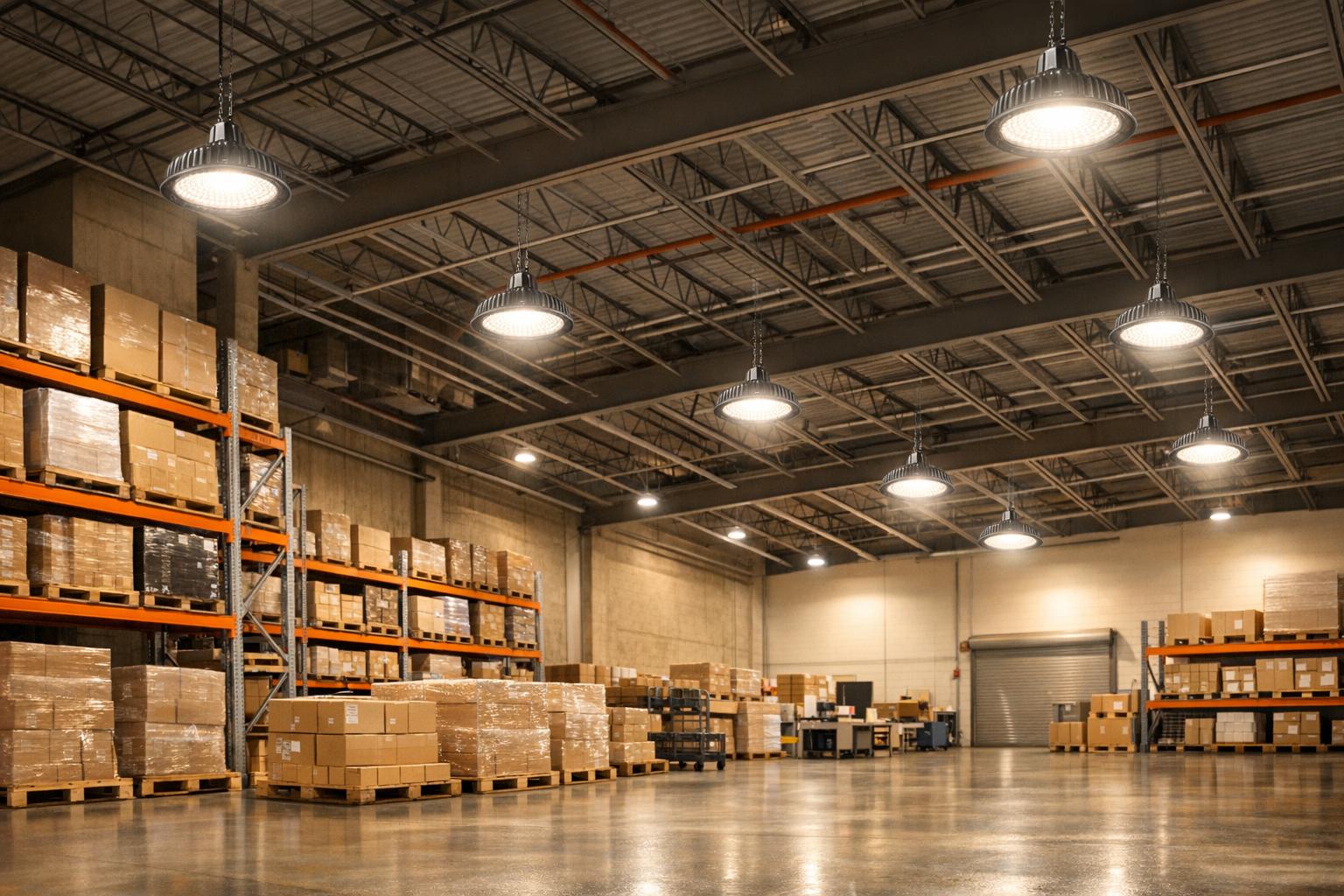
Retrofitting high-bay lighting with LEDs can drastically cut costs while improving workplace efficiency. Here's why it makes sense:
Switching to LEDs not only saves money but also creates a safer and more efficient work environment.
Outdated warehouse lighting systems bring a host of challenges, including high energy costs, frequent maintenance, and safety concerns. For years, fixtures like metal halide, HID, and T5 fluorescent lights were the go-to choice. However, these older technologies are now proving to be far more expensive and inefficient than many facility managers realize. Let’s break down the key issues.
Older high-bay fixtures are energy hogs. Take a 400W metal halide fixture, for instance - it uses double the wattage of a 200W LED fixture to achieve the same level of brightness. Factor in ballast draw, and the actual energy consumption climbs even higher. In a warehouse running 10 hours a day for 250 days a year, each outdated fixture wastes about $60 annually when compared to an LED equivalent, assuming an energy cost of $0.12 per kWh. This inefficiency eats into operational budgets.
And it doesn’t stop there. These older fixtures also generate significant heat, which forces HVAC systems to work overtime, especially during warmer months. This added strain on cooling systems drives up energy costs further, creating a double financial hit - higher lighting expenses and elevated cooling bills.
Maintenance is another costly headache. Metal halide lamps typically last only 10,000 hours, meaning they need to be replaced about six times during the lifespan of a single LED fixture. While the lamp itself might cost just $11, the real expense lies in the labor. Replacing high-bay bulbs often requires specialized equipment, like lifts, and around 30 minutes of labor per replacement, adding up to approximately $21 in labor costs for each instance. These frequent replacements quickly add up, making the case for LED retrofits even stronger.
Outdated lighting doesn’t just cost more - it can also be dangerous. Metal halide and HID systems often provide uneven light coverage, leaving dark spots that can increase the risk of accidents, especially in areas where forklifts and heavy machinery are in use. In 2021 alone, 52 fatalities were recorded in the U.S. related to industrial truck and tractor operations, with proper lighting identified as a key factor in preventing such incidents.
Beyond safety, poor lighting impacts productivity and quality control. Workers often struggle with glare and insufficient illumination, which can lead to eye strain and make it harder to identify errors during manufacturing or inventory checks.
"Proper LED lighting makes employees more comfortable - no more glare, no more inadequate illumination, no more straining their eyes to see their work."
Flickering, dimming, and inconsistent light from older systems also create an unpleasant work environment, negatively affecting employee morale and operational efficiency. LED lighting solves these issues by providing steady, high-quality illumination that boosts both safety and productivity - topics that will be explored further in the next section.

LED vs Metal Halide High-Bay Lighting: Cost and Performance Comparison
Switching to LED retrofits can dramatically cut energy costs, lower maintenance expenses, and improve overall operational efficiency. These benefits often lead to payback periods of just 1 to 3 years. The key driver of this return on investment (ROI) lies in energy savings, as outlined below.
A 200W LED fixture delivers the same brightness as a 400W metal halide lamp while using only half the energy - even before factoring in the additional energy draw from ballasts. After retrofitting, many facilities see lighting energy costs drop by 50% to 70%. Considering that lighting typically accounts for 20% to 30% of a commercial building's electricity bill, an LED retrofit can shrink that share to just 4% to 6%.
LEDs also emit far less heat than traditional HID lamps, which reduces the workload on HVAC systems during warmer months and leads to further cooling cost savings. Adding occupancy sensors and dimming controls can push savings even further by adjusting light levels based on actual usage.
LED fixtures are built to last, with lifespans ranging from 50,000 to 100,000 hours - equivalent to about 5 to 11 years of continuous use. In contrast, metal halide lamps typically last only around 10,000 hours. Over the lifespan of a single LED fixture, a metal halide lamp may need to be replaced five or six times. For a facility with 300 high-bay fixtures, this translates to an estimated $20,000 in annual maintenance savings, with each LED fixture saving about $126 in product and labor costs over its lifetime.
Additionally, LED retrofits eliminate the recurring costs of equipment rentals - like bucket trucks or lifts - often required for replacing high-bay bulbs. They also simplify inventory management by reducing the need to stock replacement parts. For example, one facility with 500 fixtures reported annual energy savings of $120,000 and a 65% reduction in total energy usage after switching to LED technology. Combined with energy savings, the extended lifespan of LEDs significantly enhances operational efficiency.
LEDs provide brighter, more consistent illumination, which improves safety and quality control in work environments. Bill Stoots, Director of Operations at Exal Corporation, highlighted this in his statement:
"The improvement to our quality and level of light was phenomenal. The improved lighting will benefit our productivity, quality control and employee morale."
In fact, 74% of employees working in facilities with upgraded energy-efficient lighting reported greater happiness and morale. Better lighting conditions not only enhance employee satisfaction but also reduce disruptions in operations - an essential factor for facilities running 24/7. For instance, one manufacturing plant that replaced 300 high-bay lights reported annual energy savings of $80,000 and reduced maintenance costs by $20,000.
| Feature | 400W Metal Halide | 200W LED High-Bay |
|---|---|---|
| Energy Consumption | 400 Watts | 200 Watts |
| Annual Energy Cost | ~$120 (2,500 hrs/year) | ~$60 (2,500 hrs/year) |
| Lifespan | 10,000 Hours | 50,000–100,000 Hours |
| Replacements Needed | 5–6 times (over 50,000 hrs) | 0 times |
| Light Quality | Degrades, flickers | Consistent, uniform |
For businesses considering an LED retrofit, these tangible benefits highlight the value of upgrading to modern lighting solutions. At Luminate Lighting Group, we offer tailored LED retrofit solutions that help maximize ROI, improve operational performance, and align with your sustainability goals.
Switching to LED lighting offers clear financial benefits, yet many warehouse operators hesitate to make the leap. Concerns about upfront costs, potential disruptions, and navigating rebate programs often hold them back. Tackling these challenges head-on can make the transition smoother and more cost-effective.
While the initial cost of LED retrofits can seem steep, utility rebates and financing options significantly reduce the financial burden. Many utility companies provide rebates tailored for warehouses adopting energy-efficient lighting. For instance, Pacific Gas & Electric (PG&E) has offered custom rebates of $0.08 per kWh saved and prescriptive rebates of up to $250 for replacing a 750-watt metal halide fixture with an LED high-bay. Similarly, PECO in Pennsylvania has provided incentives of $0.30 per watt of reduction, capped at $200 per fixture.
To qualify for these rebates, fixtures generally need to be DesignLights Consortium (DLC) or ENERGY STAR certified. A helpful resource for finding local and federal incentives is the Database of State Incentives for Renewables & Efficiency (DSIRE). Since rebate funds are often distributed on a first-come, first-served basis, it’s wise to reach out to your utility provider during the planning stage, well before installation begins. Keeping detailed records, such as purchase receipts and product specifications, will simplify the application process and help you secure the maximum rebate.
One of the biggest concerns for warehouses is minimizing downtime during the retrofit process. Professional installers can work during off-peak hours, ensuring operations remain largely unaffected. For small to mid-sized warehouses, retrofits are typically completed within one to three days, with work scheduled during evenings or weekends to avoid interfering with daily operations.
Take Enru Logistics in Grapevine, Texas, as an example. Luminate Lighting Group managed their lighting upgrade while adapting to frequent project scope changes and coordinating around the facility’s logistics schedule. Pete Hernandez from Enru Logistics shared:
"Luminate remained engaged and ready to move forward whenever we were. They quickly delivered quotes, adapted to changes in scope, and streamlined the entire process for our AP team."
Choosing a provider that offers turnkey project management - handling everything from audits and photometric layouts to rebate paperwork and installation - can significantly ease the process. Experienced electricians ensure materials are procured and installations scheduled only when your facility is ready. Additionally, post-installation training on new sensors and dimming controls helps employees adjust quickly, enabling immediate energy savings and operational efficiency.
Once cost and operational concerns are addressed, the next step is ensuring compliance with energy codes and securing rebates. Many rebate programs differentiate between "Prescriptive" rebates (a fixed amount per fixture) and "Custom" rebates (based on actual energy savings in kWh or kW). Pre-approval is often required before purchasing or installing any equipment - skipping this step could disqualify your project entirely.
Energy codes like California’s Title 24 or ASHRAE 90.1 are often prerequisites for rebate eligibility. At Luminate Lighting Group, comprehensive energy audits ensure all fixtures meet certification requirements, helping projects qualify for the highest rebates while adhering to local codes. By managing the documentation and application process, they allow you to focus on your core business instead of dealing with bureaucratic hurdles.
Switching to LED high-bay lighting can slash energy costs by 50%–60% in actual applications. For a facility with 50 fixtures, this can mean saving around $500 annually on maintenance costs alone.
Take, for example, a warehouse that replaced 50 fixtures - swapping out 300-watt metal halide lights for 150-watt LEDs. This upgrade delivered an impressive 757% return on investment (ROI) over a decade. What’s more, utility rebates from providers like Oncor, CenterPoint, PSO, and Entergy Arkansas often offset a large portion of the upfront costs, significantly reducing the payback period.
LED retrofits don’t just save energy - they triple light levels while cutting energy usage. At Enru Logistics in Grapevine, Texas, Luminate Lighting Group completed a retrofit that completely revamped the facility. Pete Hernandez from Enru Logistics shared:
"The results have been outstanding - the warehouse is significantly brighter and more functional."
Adding occupancy sensors and smart controls takes these upgrades even further by eliminating unnecessary energy use and boosting ROI. Beyond the financial and operational perks, these changes also deliver meaningful environmental benefits.
LED retrofits aren't just about cost savings - they also make a measurable impact on sustainability. By cutting energy use and reducing CO2 emissions, these upgrades help businesses meet ESG (Environmental, Social, and Governance) goals. For instance, a 200-watt LED fixture uses half the energy of a 400-watt metal halide while providing the same brightness.
The benefits extend beyond energy savings. LEDs, with a lifespan of up to 70,000 hours, last over three times longer than the typical 20,000-hour lifespan of metal halide lamps. This durability eliminates two re-lamping cycles, reducing labor costs and material waste.
Luminate Lighting Group also includes occupancy sensors and daylight controls as part of its standard installations, ensuring lights are only on when needed. For facilities looking to quantify these advantages, a professional lighting audit can provide clear metrics to support sustainability reports and ESG compliance goals.
Switching to high-bay LED lighting can reduce energy use by 50%–70%, extend fixture lifespans to an impressive 50,000–100,000 hours, and achieve a full return on investment (ROI) within just 1 to 3 years. Beyond the financial benefits, these upgrades contribute to safer and more efficient warehouse operations, minimizing accidents around heavy machinery and improving employee productivity.
Utility incentives make these savings even more appealing. Many rebate programs significantly cut upfront costs, with some reducing fixture prices to as low as $1 for qualifying cases. Over a 10-year period, LED systems prove to be about 43% more cost-effective than traditional lighting when factoring in energy, maintenance, and replacement expenses. Facilities that have transitioned to LED lighting consistently report these advantages.
LED retrofits also bring environmental benefits by reducing energy consumption and lowering carbon emissions. This supports ESG goals, strengthens sustainability metrics, and enhances ROI by delivering both financial and environmental value.
At Luminate Lighting Group, we specialize in tailored LED solutions for warehouses and industrial spaces. Our comprehensive services include detailed lighting audits, utility rebate assistance, code compliance, photometric layouts, fixture selection, smart controls integration, and professional installation.
Ready to see the difference? Contact Luminate Lighting Group for an energy audit and a customized proposal that outlines your potential savings, payback period, and eligible incentives. Let’s make your lighting smarter and more efficient.
Switching high-bay lighting to LEDs can lead to big savings. With energy usage dropping by 50–80%, you’ll notice an immediate reduction in utility bills. Plus, LED fixtures have a much longer lifespan compared to traditional lighting, which means you’ll spend less on maintenance over time.
On top of that, many LED upgrade projects are eligible for utility rebates and federal tax incentives. These can cover as much as 50% of the project’s cost, making the initial investment far more manageable. Thanks to these combined savings, most businesses see a return on their investment in under 2–3 years. It’s a smart move for warehouses and industrial facilities looking to cut costs and improve efficiency.
LED retrofits contribute to a safer workplace by offering brighter and more uniform lighting. This improved visibility helps reduce accidents tied to poor lighting conditions, such as slips, trips, or errors when handling equipment. Employees can work with greater precision and confidence thanks to the enhanced clarity these lights provide.
On top of that, LED lighting is easier on the eyes, reducing strain and fatigue, which makes the work environment more comfortable. Their long-lasting design and minimal maintenance needs also mean fewer interruptions from bulb replacements, allowing teams to stay on task and maintain productivity.
Switching to high-bay LED lighting in warehouses comes with its own set of challenges. These include the upfront cost of the fixtures, navigating complex rebate programs and regulations, and managing the installation process. While the initial price tag for LED fixtures might seem steep, the long-term benefits - like lower energy bills and reduced maintenance - usually make the investment worthwhile. However, understanding how to leverage utility rebates, tax deductions such as the 179D incentive, and local energy codes is crucial to maximizing these savings.
To tackle these challenges, begin with a professional lighting audit. This helps evaluate current energy usage and pinpoints the best retrofit options for your space. Working with a knowledgeable provider can simplify the process, ensuring compliance with regulations, proper documentation for rebates, and the selection of certified products. When it comes to installation, timing is key - schedule it during periods of low activity to minimize disruptions. Additionally, use surge protectors and appropriate wiring to safeguard equipment and avoid unnecessary downtime. By addressing these considerations upfront, businesses can unlock substantial energy savings and often see a return on investment in as little as three years.


