.svg)
Case studies show LED retrofits cut energy 50–90%, reduce maintenance, and deliver fast paybacks with rebates.

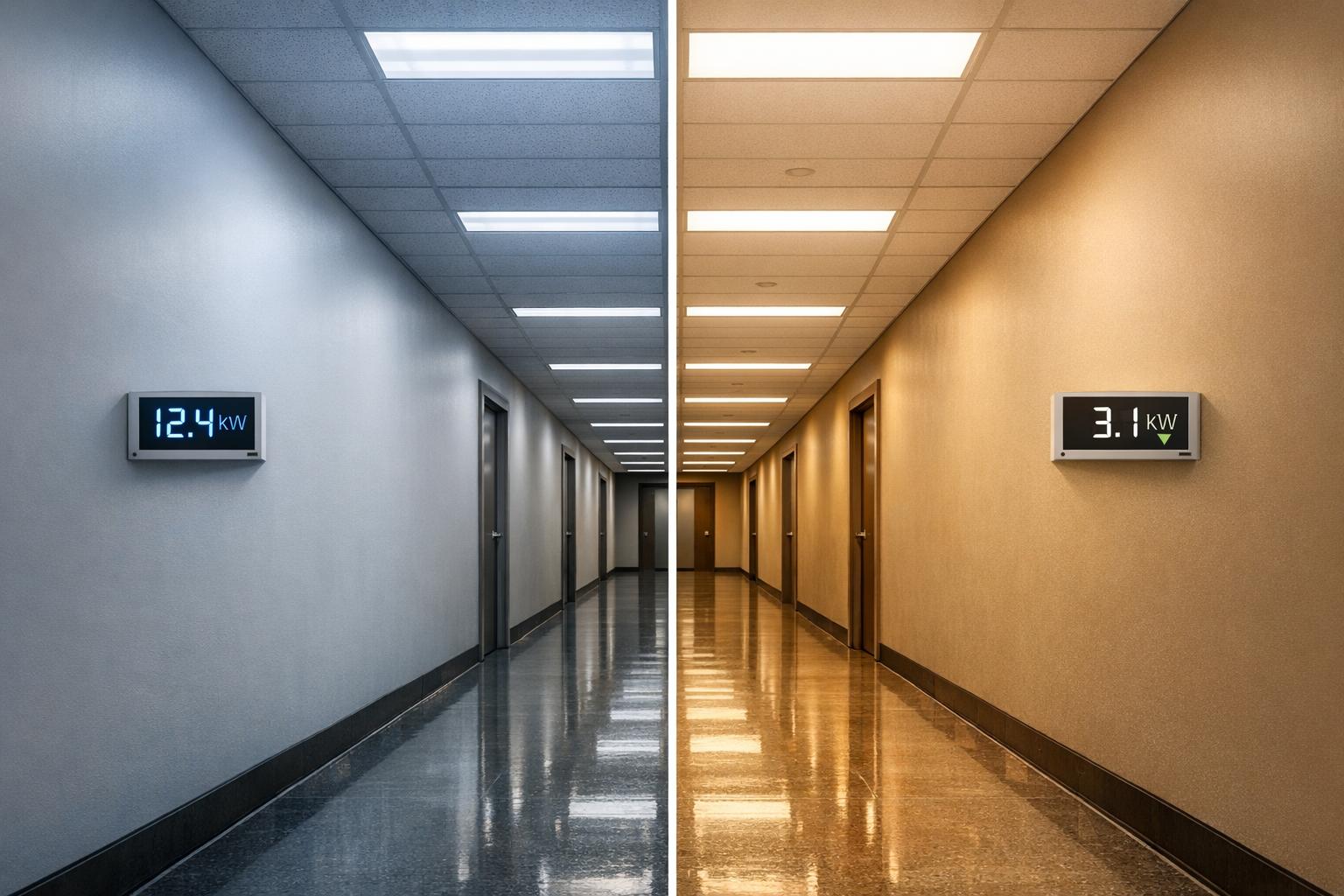
Switching to LED lighting can save businesses 50% to 90% on energy costs, with payback periods often under two years. LEDs last significantly longer than traditional lighting, reducing maintenance costs by up to 80%. Plus, utility rebates and tax incentives can offset upfront costs, making the transition even more affordable.
Here’s what you’ll learn:
LED retrofits aren’t just about cutting costs - they improve lighting quality and reduce carbon footprints. Whether you manage a warehouse, office, or city infrastructure, upgrading to LEDs is a proven way to save money and energy.
When evaluating the impact of LED retrofits, it's essential to focus on the numbers that reveal both immediate and long-term benefits. These metrics go beyond just cutting down the electricity bill - they highlight efficiency, cost savings, and overall performance improvements.
One of the most telling metrics is the percentage reduction in annual kWh usage. In warehouse and distribution facilities, LED retrofits often slash energy consumption by 54% to 70%. For instance, a distribution center in the northeastern U.S. replaced 943 interior T12 fixtures and 33 exterior HID fixtures, achieving a 68% energy reduction and saving over $40,000 annually on energy costs.
But energy efficiency isn't just about using less power. Lighting quality also matters. Metrics like foot-candle levels, uniformity, and color rendering ensure the retrofit doesn't just save money but also improves the facility's functionality. A well-executed retrofit delivers better lighting performance alongside lower energy bills.
These efficiency improvements also lead to another significant benefit: reduced maintenance costs.
Maintenance savings are often overlooked but can account for 15% to 25% of total project savings, especially in high-bay environments. LEDs have a lifespan of up to 100,000 hours compared to just 20,000 hours for traditional systems, reducing replacement needs by about 80%.
Fewer replacements mean lower costs for labor, equipment rentals like scissor lifts, and fewer ballast failures. On average, this translates to savings of $53–$85 per fixture annually.
"A 200-fixture warehouse saves $3,750/yr in maintenance labor from eliminated relamping alone." - Jhon Polus, Oxmaint
Rebates, tax deductions, and financing programs can significantly reduce the upfront costs of LED retrofits. Utility rebates often cover 20% to 50% of total project expenses. When paired with the federal Section 179D tax deduction - which provides $0.60 to $1.20 per square foot for qualifying lighting upgrades - the net cost of the project drops even further. Adding occupancy sensors can unlock additional rebate tiers while delivering an extra 20% to 30% in energy savings on top of the LED baseline.
The table below outlines typical post-rebate payback periods for various facility types, offering a helpful reference point:
| Facility Type | Typical Payback (Post-Rebate) | 10-Year Net ROI |
|---|---|---|
| Warehouse / Distribution | 12–18 months | Very High (300–600%+) |
| Manufacturing / Industrial | 12–20 months | Very High |
| Parking / Exterior | 18–28 months | High |
| Commercial Office | 20–30 months | Moderate–High |
(Source: Echelon Cost & ROI Guide 2026)
One important note: most utility rebate programs require pre-approval before installation begins. Retroactive applications are almost always denied.
These metrics provide a foundation for understanding the financial and operational benefits of LED retrofits. They set the stage for the case studies that follow, where we’ll dive into real-world examples of savings and performance improvements.
Warehouses are prime candidates for LED retrofits. With their high ceilings, extended operating hours, and energy-intensive fixtures, they offer substantial opportunities for cutting waste and improving efficiency.
A regional distribution company in the Southeast undertook a retrofit of its 750,000 sq. ft. facility, replacing outdated 400W metal halide high-bay fixtures with 150W LED high bays equipped with integrated occupancy sensors. This upgrade involved over 2,800 fixtures and was completed in just 6 weeks, with work scheduled overnight to avoid disrupting operations.
The project had three main objectives: lower energy costs, reduce maintenance demands, and enhance overall light quality. These goals provided a clear framework for achieving significant financial and energy savings.
The results of this retrofit were impressive. The facility achieved $387,000 in annual savings and secured $142,000 in utility incentives, which reduced the payback period to just 1.8 years. Post-installation metering confirmed these savings.
One standout feature was the use of occupancy sensors, which dimmed lights to 20–30% in less-trafficked areas. This approach went beyond simply swapping fixtures, embracing managed lighting to optimize energy use based on real-time activity. It’s a perfect example of how advanced technologies can amplify savings.
Here's how this project compares to similar retrofits:
| Facility | Size (sq. ft.) | Energy Savings | Annual Savings | Payback Period |
|---|---|---|---|---|
| SE Distribution Co. | 750,000 | N/A | $387,000 | 1.8 years |
| SanMar Distribution | 3.3M+ | 5.5M kWh/yr | $1,086,000* | 3.2 years |
| Kenwal Steel | 110,000 | 93% | N/A | < 1 year |
| TransPak Logistics | Multiple | 64% | $171,058 | 4.17 years |
*Includes combined energy and maintenance savings.
The Kenwal Steel project is particularly noteworthy. At their 110,000 sq. ft. facility in Dearborn, MI, IT Manager Kevin Stoops led a retrofit replacing 369 aging 1,000W metal halide fixtures with a Digital Lumens Intelligent LED Lighting System. This upgrade slashed lighting energy costs by 93%, achieving a payback period of less than one year.
"Our steel mill is a very active, high-performance facility, so I questioned how much additional savings sensing and dimming technologies could deliver... With the Digital Lumens system, the answer is a lot, and we now have the data to prove it." - Kevin Stoops, IT Manager, Kenwal Steel Corp.
The team used LightRules management software to track data, providing insights into occupancy patterns. This helped them fine-tune the system over time, delivering benefits that extended beyond the initial energy savings.
Industrial facilities, much like warehouses, highlight how switching to LED lighting brings measurable, long-term cost benefits. These facilities often face unique lighting issues, such as high energy consumption, excessive heat, poor visibility, and the need to meet strict regulations. Upgrading outdated fluorescent systems to LEDs addresses these challenges effectively.
At Siemens Energy's Norwood, OH facility, T5 fluorescent fixtures caused excessive heat buildup, overtaxing the HVAC system. Additionally, uneven lighting on the production floor compromised worker visibility and safety. To solve these issues, the facility replaced the old fixtures with 200W LED UFO high bays, resulting in a 54% energy reduction.
Similarly, Boise Cascade's veneer mill in Willamina, OR, faced pressure to comply with Oregon's upcoming 2025 fluorescent lighting restrictions. The mill opted for a full LED upgrade, cutting annual energy use by 172,065 kWh and securing $60,000 in utility rebates. This upgrade achieved a 55% energy reduction, driven largely by regulatory compliance needs.
"I recognized some of the incentives were going away… it seemed like the time was right to get those incentives, save energy, and reduce our carbon footprint." - Jake Abbott, Plant Manager, Boise Cascade
The benefits of these upgrades extend far beyond energy savings. Siemens Energy anticipates saving over $125,000 within five years, while Boise Cascade reports $23,604 in combined annual energy and maintenance savings, with a payback period of just 3.81 years.
| Facility | Previous System | Energy Reduction | Annual Savings | Payback Period |
|---|---|---|---|---|
| Siemens Energy (Norwood, OH) | T5 Fluorescent | 54% | $27,300 | ~3.8 Years |
| Boise Cascade (Willamina, OR) | Fluorescent | 55% | $23,604 | 3.81 Years |
In addition to lower energy bills, these retrofits reduce operational costs by minimizing the need for frequent re-lamping and the associated expenses of high-ceiling maintenance. This combination of energy and maintenance savings makes LED upgrades a smart choice for industrial facilities looking to improve efficiency and reduce costs.
Office buildings often encounter challenges like outdated fluorescent systems, inconsistent lighting, and high maintenance expenses. Similar to the industrial and warehouse retrofits discussed earlier, LED upgrades in office spaces provide measurable energy savings and reduced costs, showcasing the adaptability of LED technology across various facility types.
Customizing lighting solutions for specific areas ensures both efficiency and cost-effectiveness.
At 3601 Hempstead Turnpike in Levittown, NY, EN-POWER GROUP revamped a 92,000-square-foot, five-story office building constructed in 1972. The project involved replacing over 800 old fixtures with modern LED units across offices, hallways, and stairwells. This upgrade resulted in annual savings of 359,000 kWh and $72,000 in energy costs.
Meanwhile, at Smiths Medical World Headquarters in Minnesota, Premier Lighting replaced around 5,000 fluorescent T8 lamps with 17W LED T8 alternatives on a one-to-one basis. This change not only improved energy efficiency but also enhanced illumination levels significantly - from 67% to 84% in foot-candles.
"The documented results demonstrated a significant illumination improvement from 67% to 84% higher foot-candles throughout." - Premier Lighting
These targeted retrofits highlight the importance of tailored solutions, enabling precise budgeting and a clear path to strong returns on investment.
When utility rebates are factored in, LED retrofits offer impressive financial benefits. Across various office projects, from expansive multi-story buildings to smaller spaces, these upgrades demonstrate long-term savings potential.
For example, the Levittown project received a $31,000 rebate from PSE&G, reducing the payback period to just 1.01 years. On a smaller scale, Cushman & Wakefield retrofitted their 5,932-square-foot office on the 45th floor of One World Trade Center in July 2015. A $5,000 investment led to $4,212 in annual electricity savings, achieving a payback period of approximately 1.2 years. Over a 10-year lease term, this project is projected to save $87,862 in electricity costs, delivering a 359% ROI.
| Project | Building Size | Annual Energy Savings | Annual Cost Savings | Payback Period |
|---|---|---|---|---|
| 3601 Hempstead Turnpike (Levittown, NY) | 92,000 sq. ft. | 359,000 kWh | $72,000 | 1.01 years |
| Cushman & Wakefield (New York, NY) | 5,932 sq. ft. | 47.5% reduction* | $4,212 (lighting only) | 1.2 years |
| SVS Office Building (Golden, CO) | 20,000 sq. ft. | 68,000 kWh | $16,000 | ~2 years |
*Based on the percentage reduction in energy usage.
In some cases, reusing existing fixture housings with LED modules can further cut costs. For the SVS Office Building in Golden, CO, SES Lighting's President James McKinney used this approach across more than 1,000 fixtures, including 2x2 u-bend troffers and 2x4 troffers in private offices. This retrofit saved 68,000 kWh and $16,000 annually, achieving a payback period of about two years. This method reduces labor and material costs while maintaining high performance.
Municipal lighting upgrades come with their own set of challenges. Cities must juggle limited public budgets, aging infrastructure, and the need to meet environmental goals.
The City of Hillsboro, OR offers a standout example of a successful municipal LED retrofit. From 2019 to 2021, the city collaborated with McKinstry to replace 8,100 streetlight fixtures, transitioning from high-pressure sodium (HPS) to LED technology. This upgrade also included the installation of a wireless control system that dims lights during low-traffic hours, cutting energy use by up to 70% during those times.
To ease the financial burden of the project, Hillsboro secured $245,550 in incentives from the Energy Trust of Oregon. The benefits? An impressive $500,000 in annual savings, a 2.1 million kWh reduction in energy consumption, and 1.8 million pounds of carbon emissions avoided annually. These outcomes not only reduce costs but also support long-term fiscal stability.
Municipal retrofits stand out because the energy savings directly benefit the public. Hillsboro's project aligned perfectly with the city's broader sustainability objectives.
"Our infrastructure improvement project... is helping us make substantial progress in meeting our City's Sustainability Plan's goal of an 80% reduction in GHG emissions by 2030." - Steve Callaway, Mayor, City of Hillsboro
These upgrades demonstrate how technical improvements can align with both environmental and budgetary goals. Other cities have experienced similar successes, further emphasizing the value of LED retrofits.
In Gresham, OR, rising power costs had left the city's streetlight fund on the brink of depletion by 2018. To address this, Gresham replaced 8,000 HPS streetlights with energy-efficient LEDs equipped with field-switchable wattage selectors. The result? $500,000 in annual energy savings and a 50% reduction in energy use. This achievement earned the city the 2015 Sustainability Practices Award from the American Public Works Association.
"With the LED conversion, the imbalance between revenue and expenses is going to turn around. So not only are we saving money and helping the environment, the streetlight fund will be financially sustainable." - John Dorst, Deputy Director, Department of Environmental Services (Retired), City of Gresham
These examples highlight a recurring trend: when cities align LED upgrades with their financial and environmental goals, the benefits are undeniable. The savings help stabilize budgets, extend the lifespan of infrastructure from 5–7 years (HPS) to 20 years (LED), and prepare cities for smarter, more connected systems. These municipal projects echo the long-term savings and returns seen in warehouses, industrial spaces, and office buildings.
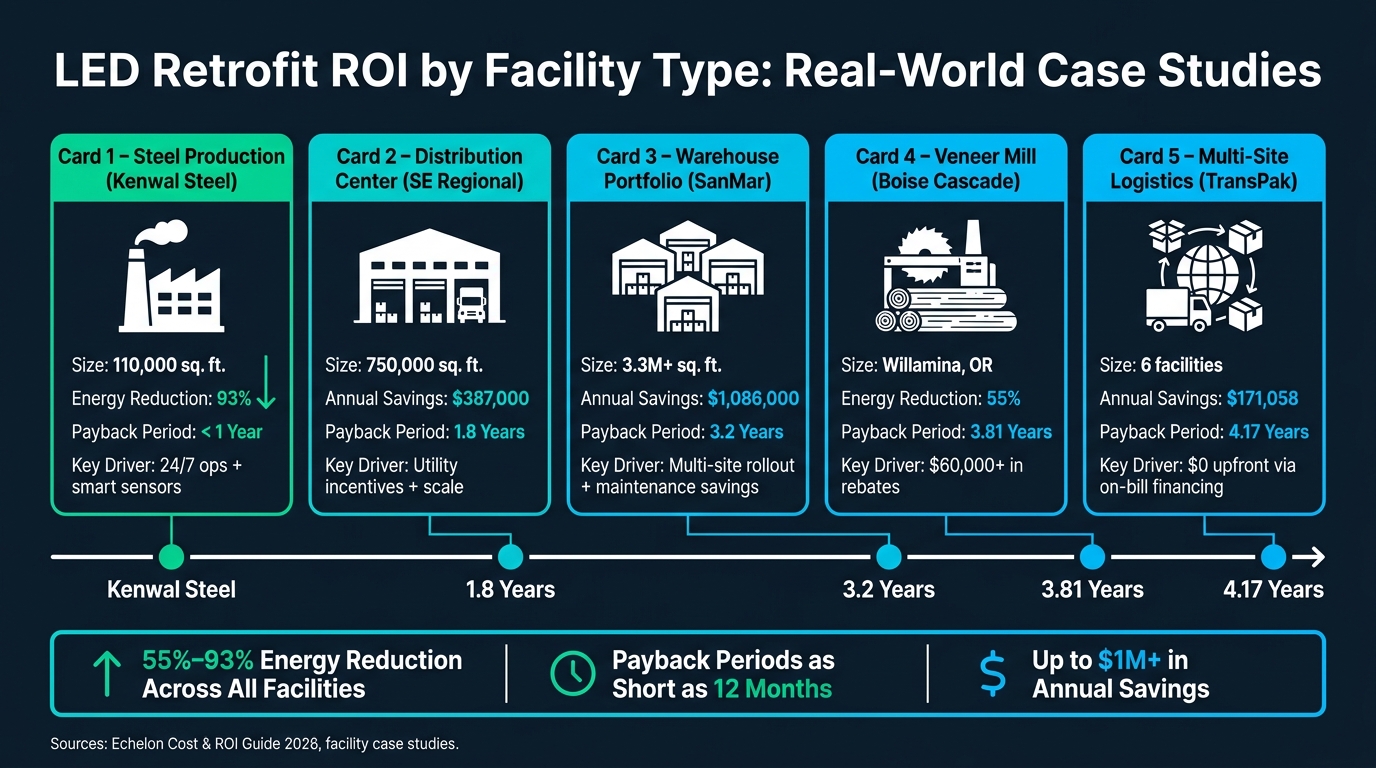
LED Retrofit ROI by Facility Type: Real-World Case Studies
LED retrofits consistently show strong financial returns across various facility types, offering rapid payback periods and long-term savings. Here's a breakdown of the financial outcomes across several case studies:
| Facility Type | Annual Savings | Payback Period | Key Driver |
|---|---|---|---|
| Steel Production (Kenwal Steel, 110,000‑sq. ft.) | 93% energy reduction | < 1 year | 24/7 operation + smart sensors |
| Distribution Center (Southeast Regional, 750,000‑sq. ft.) | $387,000 | 1.8 years | Utility incentives + scale |
| Warehouse Portfolio (SanMar, 3.3M‑sq. ft.) | $1,086,000/year | 3.2 years | Multi-site rollout + maintenance savings |
| Veneer Mill (Boise Cascade, Willamina, OR) | 55% energy reduction | 3.81 years | $60,000+ in rebates |
| Multi-Site Logistics (TransPak, 6 facilities) | $171,058/year | 4.17 years | $0 upfront via on-bill financing |
These examples illustrate how operational intensity and tailored financing options contribute to financial success.
For facilities with around-the-clock operations, like Kenwal Steel’s 110,000‑sq. ft. plant, the payback period was less than a year. This was achieved through continuous production paired with smart dimming technology. Similarly, the Southeast Regional Distribution Center saw a 1.8‑year payback, thanks in part to $142,000 in utility incentives.
TransPak adopted a different approach, using on-bill financing to cover upfront costs across six facilities. This method resulted in a 4.17‑year payback period. As Alex Kummer, EVP of Western US at TransPak, explained:
"On-bill Financing has been a great opportunity for us to conserve our cash flow. A big success for us is not only are we reducing costs, but we're significantly reducing our energy consumption."
SanMar’s multi-site rollout highlights the dual benefits of LED retrofits. Over 10 years, their efforts are projected to deliver over $10 million in combined energy and maintenance savings. Across all these cases, LED upgrades demonstrate their value by cutting energy costs by 55–93% while also reducing maintenance expenses. These results showcase why LED retrofits are a key part of effective energy strategies.
The success stories outlined earlier highlight one thing: achieving solid financial returns from LED retrofits isn’t just about swapping out lightbulbs. It takes careful planning, the right products, and expert project management. That’s where Luminate Lighting Group steps in, turning those success stories into real, measurable results for your facility.
Luminate handles every step of their retrofit process, starting with a free on-site energy audit and continuing through installation and post-project support. They begin by documenting key details like fixture types, wattage, operating hours, and mounting heights to establish an accurate baseline. From there, they use photometric analysis to design a lighting plan tailored to your space, ensuring optimal light levels without wasting energy or over-lighting. This thorough approach sets Luminate apart from more basic retrofit services.
Another advantage? Luminate operates independently of any single manufacturer. This means their recommendations focus entirely on performance and long-term return on investment (ROI), rather than being influenced by inventory needs. This independence is key when you’re looking to maximize savings over the next 10 to 15 years.
Luminate is also an approved contractor for utility rebate programs like Oncor, taking care of all the paperwork and pre-qualification steps. This ensures clients can take full advantage of available financial incentives. Their licensed electricians work during off-hours - nights and weekends - so businesses with multiple shifts can keep operations running smoothly during the retrofit.
Here’s what one client had to say about their experience:
"The Luminate team retrofitted the lighting in a few of our commercial properties and I couldn't be more pleased with the quality of the work, the value they provided and the level of service that they provided." - C. Bennett, Building Owner
If you’re considering an LED retrofit for your facility, Luminate offers a no-cost lighting assessment. This assessment outlines potential savings, payback periods, and available incentives, giving you a clear picture of what to expect before moving forward.
LED retrofits deliver measurable savings across various types of facilities. Energy reductions can range from 55% to 93%, depending on the scale of the project and the controls implemented. For instance, Kenwal Steel's 110,000 sq. ft. production facility in Dearborn, MI, replaced 369 metal halide fixtures, slashing lighting energy costs by 93% and achieving payback in under 12 months. Meanwhile, a 750,000 sq. ft. distribution center saved $387,000 annually after a full LED conversion, with a payback period of just 1.8 years.
But the benefits go beyond just energy savings. Utility rebates, tax incentives, and reduced maintenance costs add to the financial appeal. Facilities with high-ceiling fixtures, for example, no longer need to schedule costly scissor lift crews for re-lamping. On top of that, utility programs often cover 20% to 40% of project costs, and financing options like On-Bill Financing can eliminate upfront expenses entirely.
The environmental impact is another big win. Boise Cascade's veneer mill in Willamina, OR, cut CO2 emissions by 125 metric tons annually - comparable to removing 27 cars from the road - while also securing over $60,000 in rebates. These outcomes highlight what’s possible with a carefully planned retrofit.
Whether you oversee a warehouse, manufacturing plant, office building, or municipal facility, the message is clear: outdated lighting technology is costing you more than you think. With efficient fixtures, advanced controls, rebates, and expert guidance readily available, the real question isn’t whether an LED retrofit makes financial sense - it’s how soon you’ll make the switch.
To figure out your payback period, take the net project cost - which is the total cost after subtracting any rebates or incentives - and divide it by your total annual savings. These savings typically include reductions in energy costs and avoided maintenance expenses.
For calculating energy savings, use this formula:
(Current Power Consumption − LED Power Consumption) × Electricity Rate × Annual Operating Hours.
For a more complete picture of long-term value, think about the Total Cost of Ownership (TCO). This includes not only the LED lifespan but also potential savings on HVAC systems due to reduced heat output from LEDs.
You might be eligible for utility rebates and the Section 179D tax deduction when making energy-efficient upgrades. Utility rebates typically range from $20 to $100 per fixture, depending on your provider. Meanwhile, the Section 179D tax deduction offers up to $5.94 per square foot for qualifying upgrades, provided specific criteria are met. Since many programs require pre-approval, working with Luminate Lighting Group early in the process can help you take full advantage of these incentives and lower your project costs.
Yes, occupancy sensors and controls play a big role in cutting down energy use and costs. They work by automatically dimming or turning off lights in areas where no one is present, ensuring that lighting is only used when necessary. Luminate Lighting Group incorporates these controls into customized LED retrofits, allowing you to get the most out of your energy savings. To make this system effective, proper setup is crucial - this includes fine-tuning time delays and defining zones to maintain both safety and productivity.


