.svg)
Targeted lighting—assess layout, choose proper high bays, optimize placement, match lumens and add smart controls to eliminate dark spots and safety risks.

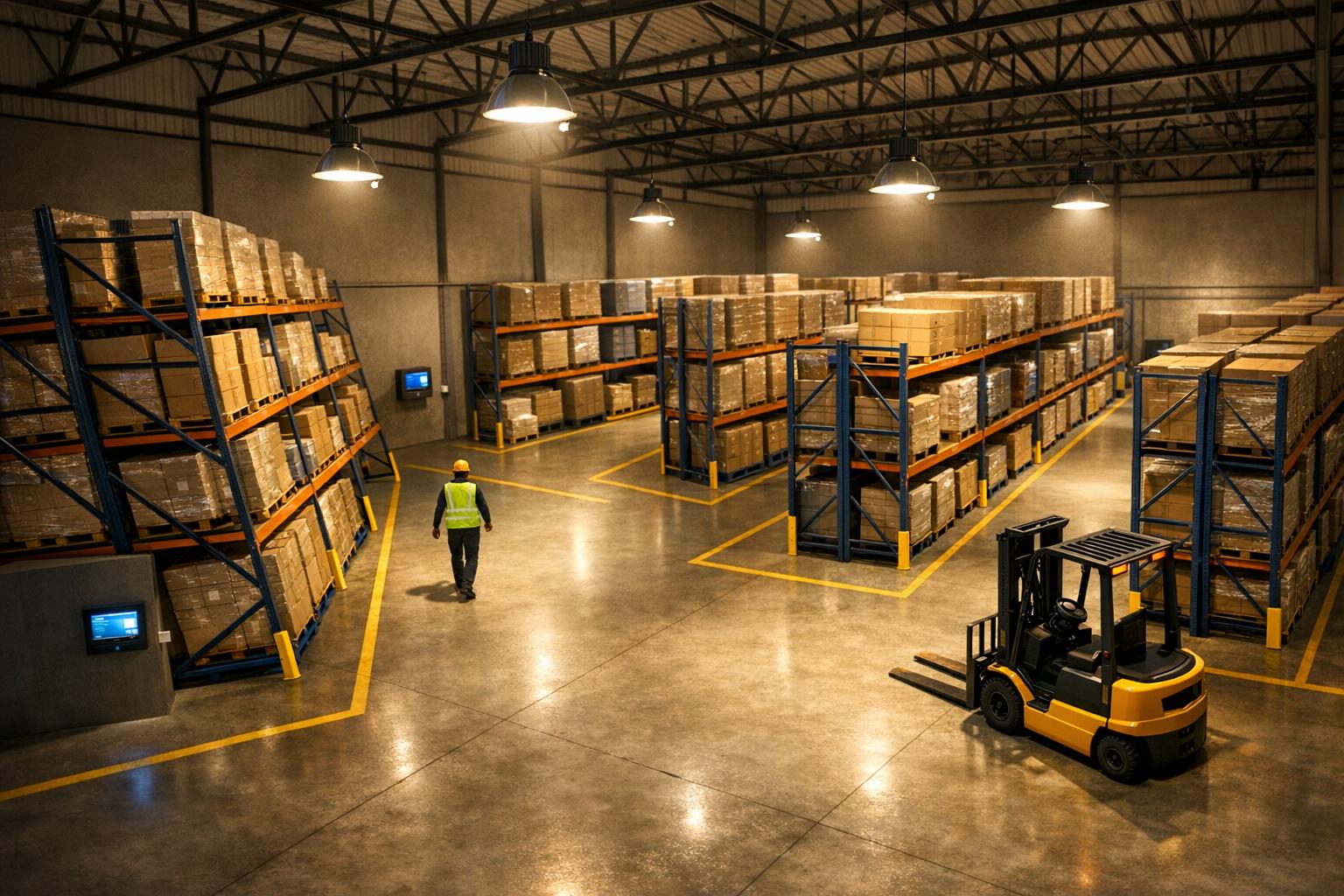
Irregular warehouse layouts can make lighting tricky. Shadows from obstructions, uneven light distribution, and glare in narrow aisles can slow workers down and create safety risks. Here’s how you can fix it:
Efficient lighting design reduces energy costs, improves visibility, and boosts productivity. Start with a detailed assessment and tailor your approach to your warehouse’s layout and needs.

Warehouse Lighting Requirements by Zone: Recommended Foot-Candles and Uniformity Ratios
Before diving into fixture placement, start with a detailed warehouse assessment. This step ensures your lighting strategy aligns with the layout, workflow, and environmental conditions of the space. Skipping it or relying on assumptions can lead to illuminance errors of up to 15% in critical work areas.
Begin by documenting the mounting height - the distance from the floor to the bottom of the light fixture. This measurement determines the spacing-to-mounting-height (S/MH) ratio, which directly impacts how evenly light spreads across the warehouse. For older facilities, account for any floor slopes or mezzanines that might alter the effective mounting height, as these can cause uneven lighting.
Next, identify structural obstructions over 24 inches, such as HVAC ducts, sprinkler systems, columns, or cranes, which can create unwanted shadows. If available, provide CAD files (.dwg or .dxf format) to gain a clearer picture of the structural layout.
Surface reflectance also plays a big role in lighting efficiency. For example, polished concrete reflects more light than oil-stained asphalt, and lighter walls and ceilings (with 50–70% reflectance) can boost illuminance by 10–20% compared to darker surfaces. Don’t forget to record ambient temperatures and dust levels - high heat can reduce usable lumens by 10–25%, while heavy dust can lower the Light Loss Factor (LLF) below 0.6, resulting in a 25–30% loss in brightness.
Getting these physical details right lays the groundwork for accurate task-specific lighting assessments.
Once you’ve documented the physical layout, divide the warehouse into specific task zones. Many warehouses combine multiple activities - like bulk storage, picking, packing, and assembly - each with unique lighting needs. For instance, bulk storage might need 5–10 fc, while fine assembly or quality control areas require 50–100 fc.
| Zone Type | Recommended Illuminance (fc) | Target Uniformity (Max:Avg) |
|---|---|---|
| Bulk Storage (Inactive) | 5–10 fc | 4:1 |
| Loading Docks | 20–30 fc | 3:1 |
| Picking/Packing (Active) | 30–50 fc | 3:1 |
| Fine Assembly/QC | 50–100 fc | 2:1 |
Source: IES RP-7 industrial lighting recommendations.
For racked areas, note aisle widths, rack heights, and any overhangs. In high-rack spaces over 30 feet, vertical uniformity on rack faces becomes more important than floor-level illuminance. Workers need to clearly see labels and scan barcodes from the ground to the top pallet, requiring specialized optics for these areas.
Leverage professional lighting design software like AGi32 to create heat maps that visualize light distribution before installation. These tools account for structural obstacles, racking setups, and surface reflectance, showing exactly where light will - and won’t - reach.
To ensure accurate simulations, request IES LM-63 photometric files (.ies files) for the fixtures and optics you’re considering. For picking zones, target 10–15 fc at the 2-foot level, and design for 15–25% higher uniformity (U0 ≥ 0.5) to offset "dynamic shadows" caused by varying inventory heights. Adjust the manufacturer’s published S/MH ratio by a 0.8–0.9 factor to account for real-world conditions like pallet variations and dust buildup.
By incorporating photometric analysis, you can cut energy consumption by 50–70% compared to outdated systems while avoiding over-lighting. Many industrial lighting providers offer this service for free, making it accessible even for projects with tight budgets.
With these steps, you’ll create a lighting plan tailored to your warehouse’s unique challenges and needs.
Once you've assessed your warehouse, the next step is to match LED fixtures to your specific layout using our proven lighting design process. Picking the wrong fixtures can lead to wasted energy, poorly lit work areas, and dark spots - even if your calculations were spot on. Here's a breakdown to help you choose the best option for your space.
Each of these fixture types serves a distinct purpose. UFO high bays (circular in shape) are ideal for open floor plans, staging zones, and receiving areas because they produce a cone-shaped light pattern. They’re also the go-to replacement for older metal halide or high-pressure sodium fixtures. On the other hand, linear high bays create a rectangular "curtain" of light, making them perfect for narrow aisles and racking systems where reducing shadows between tall shelves is critical.
Here’s how these fixtures perform in real-world examples:
While UFO fixtures excel in horizontal coverage, they might fall short when it comes to illuminating high rack levels. That’s where linear fixtures shine - they provide better vertical illumination, which is essential for tasks like scanning barcodes and reading labels from the floor to the top pallet. In one simulation, linear fixtures equipped with 90° optics achieved recommended light levels in forklift aisles while requiring 20% fewer fixtures than a circular layout.
"The choice between circular... and linear high bays is not merely aesthetic. It is a decision rooted in photometric distribution, maintenance of foot-candles (fc) at the work plane, and long-term energy compliance." - Richard Miller, Lighting Designer
The beam angle, which measures the cone of light where intensity drops to 50% of its maximum, determines how well a fixture covers an area. The higher the mounting height, the narrower the beam angle needed to direct light effectively to the floor.
| Mounting Height | Recommended Beam Angle | Best Use Case |
|---|---|---|
| 15–20 ft | 90° to 120° | Workshops, Garages, Low-Rack Warehouses |
| 21–30 ft | 60° to 90° | Standard Warehouses, Factories, Gyms |
| 31–40+ ft | 40° to 60° | High-Rack Distribution Centers, Atriums |
Source: shop.app.
For instance, using a 90° lens instead of a 120° lens at a 25-foot mounting height can boost floor illumination by nearly 40% without increasing energy use. When reviewing fixture specs, check the candela distribution at 60–75 degrees in the IES file. Low intensity at these angles often signals poor vertical illumination, which can be a problem for racked environments.
"Without controlled distribution, lumens fail to deliver effective illumination. Imagine trying to light the bottom of a 35-foot-tall silo. A 30,000-lumen fixture with a 120° beam would hit the walls halfway down, leaving the floor dim." - Thach Nguyen Ngoc
Warehouses often require lighting tailored to different tasks. A hybrid lighting approach - using a mix of fixture types - can provide better results than relying on a single solution. For example, UFO high bays work well for open areas, while linear high bays are better suited for narrow aisles.
Consider this: if your facility includes a 20-foot open receiving area and 30-foot racked aisles, you could install UFO fixtures with 90° optics in the open area and linear fixtures with 60° x 90° aisle optics in the racked sections. This setup avoids "zebra striping" (alternating bright and dark zones) and ensures efficient energy use. Before finalizing, conduct a photometric check to confirm the design meets safety and uniformity standards.
For added flexibility, choose wattage-selectable or CCT-selectable fixtures. These allow you to adjust brightness and color temperature after installation, which is handy if your warehouse layout or operations change over time.
Getting your fixture placement right is crucial to avoid dark spots, shadows, and uneven lighting, especially in warehouses with irregular layouts. A one-size-fits-all grid approach rarely works. Instead, design your lighting plan to match the unique layout and workflow of your space.
Rather than spacing fixtures evenly across the ceiling, align them with the layout of your aisles, shelving, and work zones. For racked environments, place fixtures along the longitudinal center of aisles. This ensures that light reaches both the floor and the vertical faces of the racks. Not only does this improve visibility for tasks like scanning barcodes and reading labels, but it also prevents wasting light on the tops of racks.
Before finalizing your fixture layout, identify potential obstructions such as HVAC ducts, fire suppression systems, machinery, or columns. These can create "shadow zones" that leave key areas poorly lit. To address this, add extra fixtures in areas with high shelving or bulky equipment, such as row ends or transition zones, to ensure no gaps in coverage.
In active picking zones, lighting success isn’t just about floor illumination - it’s about vertical uniformity along the rack faces. A vertical uniformity ratio (average-to-minimum) of 3:1 or better is ideal, as it reduces eye strain and minimizes errors. Poor vertical uniformity can lead to "visual lag", where forklift operators take longer to adjust their eyes between bright upper racks and dimmer lower levels. This lag can add 3 seconds per pick, and in a warehouse with 1,000 picks per day, that’s nearly 50 minutes of lost productivity daily.
"The primary indicator of lighting success is not the average illuminance on the floor, but the vertical uniformity ratio on the rack faces." - Richard Miller, Hi-Hyperlite
Dark spots often occur when the light cones from fixtures don’t overlap enough. To avoid this, use the S/MH (Spacing-to-Mounting Height) ratio discussed earlier. Fixture spacing should generally be equal to or less than the mounting height.
To adjust for real-world conditions like rack overhangs, dust, or inventory changes, apply a reduction factor of 0.8–0.9 to the published S/MH ratio. For example, a fixture with a published S/MH ratio of 1.8 should be spaced at about 1.44 times the mounting height (1.8 × 0.8 = 1.44) for proper overlap.
| Parameter | Published S/MH | Applied Heuristic (0.8x) | Rationale |
|---|---|---|---|
| Narrow Aisle Fixture | 1.4 | 1.12 | Prevents "scalloping" on rack faces |
| Medium Beam Fixture | 1.8 | 1.44 | Compensates for inventory height changes |
| Wide Beam (Open Area) | 2.2 | 1.76 | Accounts for structural obstructions |
To avoid dark spots near walls, position the first row of fixtures at half the standard spacing from the wall. In narrow or irregular spaces, use fixtures with asymmetric lenses (e.g., 60° × 90° beam spread) to focus light along the aisle rather than wasting it on top of racks. Additionally, maintaining a 3:1 average-to-minimum illumination ratio is recommended to reduce visual fatigue.
Before installation, use professional photometric software like AGi32 or DIALux to simulate and validate your lighting plan. These tools allow you to model your unique warehouse layout in 3D and predict light distribution with high accuracy.
For warehouses with complex racking systems, software simulations provide far better accuracy compared to basic estimation methods. When running simulations, input the mounting height (distance from the floor to the fixture) instead of the ceiling height for precise calculations. Don’t forget to include surface reflectance values - light reflects differently off polished concrete versus dark asphalt, which affects the number of fixtures needed.
For layouts with high racking, simulate the use of asymmetric lenses to evaluate their performance compared to standard wide-beam fixtures. Designers often aim for 15–25% higher uniformity in simulations to account for "dynamic shadows" caused by varying inventory heights. By modeling actual mounting heights and surface conditions, you can ensure optimal light distribution throughout your space.
Lighting isn't just about brightness - it's about making a space function efficiently. Matching the lumen output to the specific tasks in each zone ensures your lighting setup supports productivity without wasting energy.
Once you've decided on fixture placement and type, the next step is calculating the exact lumens needed for each zone. The formula is straightforward: Total Lumens = (Target Lux × Area) ÷ (Utilization Factor × Maintenance Factor).
Here’s a quick example: If you're lighting a 10,000-square-foot picking area requiring 30 foot-candles (about 320 lux), with a utilization factor of 0.70 and a maintenance factor of 0.75, you’ll need approximately 6,048,000 total lumens spread across your fixtures.
The lumen output per fixture depends on the mounting height:
For industrial settings, account for lumen depreciation over time by using a maintenance factor of 0.70–0.80. Each warehouse zone has unique lighting needs:
When lighting is tailored to these needs, it can cut order picking and inventory errors by 20–30%.
Too much light can cause glare and energy waste, while too little light leads to shadows and safety risks.
"Good lighting is not about making a space brighter, it is about making a space work better." - Dara Greaney, Founder and CEO of LED Light Expert
To strike the right balance, maintain a 3:1 average-to-minimum illumination ratio. This ensures even lighting without creating "puddles" of brightness surrounded by dark areas.
Choose fixtures with additional lumen capacity and incorporate 0–10V dimming. This lets you adjust brightness over time, compensating for dirt buildup and lumen depreciation while keeping light levels comfortable during the early years of use.
In warehouses with varying layouts, a one-size-fits-all approach won't work. Instead, assign foot-candle targets by zone:
Beam angles also matter. For ceilings between 15–25 feet, use 90°–120° beam angles. For higher ceilings (25–45 feet), switch to 60° optics to focus light downward effectively. In racking areas, prioritize vertical illumination to highlight pallet faces and labels, not just the floor.
For complex layouts or spaces with obstructions, professional photometric modeling can take the guesswork out of planning. This ensures the light is distributed effectively throughout the warehouse.
"The 'cost of guessing' in industrial lighting is high. An under-lit warehouse creates OSHA hazards, while an over-lit space wastes energy and capital." - Richard Miller, Hi-Hyperlite
Lighting upgrades in warehouses aren’t just about the fixtures you choose. For spaces with unconventional layouts, incorporating smart controls and planning for ongoing maintenance can ensure consistent performance and energy efficiency across all zones.
Automated lighting controls can dramatically cut energy usage. Motion and occupancy sensors are particularly useful in areas with sporadic traffic, like certain aisles or storage zones. These sensors help eliminate wasted energy in spaces that aren’t constantly in use.
Another effective strategy is daylight harvesting. By using sensors to detect natural light from skylights or open dock doors, artificial lighting can automatically adjust to complement the available daylight. This is especially helpful in warehouses with uneven access to natural light.
"Integrating these automated features into your lighting upgrade can drastically cut energy costs - sometimes by as much as 50% or more." – Dara Greaney, Founder and CEO of LED Light Expert
For more precise control, consider DALI (Digital Addressable Lighting Interface) dimming. This system lets you manage individual fixtures or zones, making it ideal for layouts where different areas have unique lighting needs. Many modern LED high bays are also compatible with plug-in sensors, which can be added or relocated as your warehouse configuration evolves.
Another option is networked lighting controls (NLC), which allow for real-time monitoring and remote adjustments across the facility. For simpler setups, step dimming provides a cost-effective alternative, letting lights switch between preset levels (e.g., 20% and 100%) instead of offering full-range dimming.
These smart controls not only save energy but also lay the groundwork for a maintenance plan that adapts to your warehouse's changing needs.
Unlike traditional lighting systems that fail suddenly, LED systems degrade over time, making a proactive maintenance plan essential. Regular inspection and cleaning of sensors and reflectors should be part of this plan. Dust buildup can interfere with sensors, leading to reduced sensitivity or "false offs", which can undermine energy savings.
In warehouses with unconditioned spaces where ceiling temperatures can exceed 100°F, motion sensors can help prevent unnecessary heat exposure, which can shorten the lifespan of LEDs.
Flexibility is another key consideration. Choose modular LED fixtures and adaptable controls that can be repositioned as your warehouse expands or reconfigures. Ensure compatibility between LED drivers and dimming switches to avoid issues like flickering or fixture failure.
For warehouses with changing workflows, it’s important to periodically reassess sensor zoning to ensure lights remain responsive to new movement patterns. This prevents scenarios where lights unexpectedly turn off while forklift drivers navigate complex aisles. In high-density storage areas, include checks for vertical illuminance to ensure rack labels remain readable, not just the floor.
Smart systems equipped with real-time monitoring provide actionable data that can enhance performance and streamline maintenance. These systems send instant alerts for issues like burned-out fixtures, helping minimize downtime and speed up repairs.
Remote management features allow for adjustments to settings like occupancy timeouts or brightness levels without the need for an on-site visit.
"The fee for connectivity service often pays off through the additional savings recognized through a service plan (adjusting occupancy timeouts or brightness levels after initial install, adjusting holiday schedules and business hours, implementing schedule override requests for one-off events like inspections and inventory events, etc.)." – Acuity Brands
For example, in November 2025, Americold replaced metal halide fixtures with an intelligent LED system featuring occupancy sensors and network controls. This upgrade reduced energy consumption by over 2.3 million kWh annually, achieving more than 90% energy savings. Similarly, March Foods replaced 84 high-pressure sodium lamps with 150-watt LEDs, boosting energy efficiency by 66% and achieving an additional 72% savings with smart controls. This resulted in cutting annual carbon emissions by about 98 tons.
Monitoring also helps identify issues like unintended cycling (frequent on-off switching) or gaps in sensor coverage that might not be obvious during installation. By reviewing occupancy data from smart sensors, you can pinpoint underutilized areas and further optimize lighting levels. To simplify future troubleshooting, document sensor addresses, zone layouts, and final settings in as-built drawings.
Lighting an irregular warehouse layout requires thoughtful planning at every step. From the initial evaluation to ongoing system monitoring, the five tips shared here work together to create a lighting setup that’s both efficient and practical.
Start with a detailed warehouse assessment. This means identifying mounting heights, spotting obstructions, and addressing task-specific needs to avoid costly mistakes. Then, choose fixtures and beam angles that suit your layout’s quirks. This careful selection ensures optimal placement, eliminating dark spots and uneven lighting.
Align your lighting with racking systems and workflow patterns to avoid dead zones. Pair this with zone-specific lumen outputs tailored to the needs of each area. For example, inactive storage areas may only need 5–10 foot-candles, while maintenance zones might require up to 50 foot-candles. This approach prevents energy waste from over-lighting.
Incorporate smart controls and a solid maintenance plan to keep your system dynamic and efficient. Networked controls can cut energy costs by as much as 68%, and real-time monitoring can help address issues before they affect productivity. These steps offer a clear roadmap to ensure every corner of your warehouse is well-lit and functional.
"The cost of guessing in industrial lighting is high. An under-lit warehouse creates OSHA hazards, while an over-lit space wastes energy and capital." - Richard Miller, Hi-Hyperlite
These strategies do more than just lower energy bills - they create a safer, more efficient workspace that adapts to your changing needs. By following this checklist, you can design a lighting system that supports precision and productivity.
At Luminate Lighting Group, we specialize in tackling the challenges of irregular warehouse layouts. Our tailored LED solutions are built to enhance energy efficiency, improve safety, and drive productivity.
A photometric study is a smart move for warehouses. It helps design a lighting setup that ensures even light distribution, improves energy use, and meets safety and regulatory requirements. With a photometric plan, you can pinpoint the best spots for fixtures and evaluate light levels. This is crucial for keeping the workspace safe, enhancing productivity, and staying compliant with industry standards.
Linear high bay LEDs outperform UFO (round) fixtures when it comes to lighting warehouse aisles. Thanks to their specialized aisle optics - like 60°x90° or 90° beam distributions - these fixtures direct light precisely into narrow aisle spaces. This focused design minimizes wasted light, reduces energy costs, and enhances visibility where it’s needed most, ensuring better task-specific lighting.
On the other hand, UFO fixtures tend to scatter light more broadly. This can lead to unnecessary light spill, higher energy consumption, and less efficiency for applications that require targeted aisle illumination.
Smart controls like motion sensors and daylight-responsive systems are among the best tools for saving energy in warehouses. These technologies can reduce energy use by 30–80% by ensuring lights are only on when necessary. Motion sensors activate lighting when movement is detected, while daylight-responsive controls adjust brightness based on the amount of natural light available. Together, they help maintain effective lighting while cutting down on wasted energy.


