.svg)
A practical guide to lighting audits: inventory, light‑level measurements, controls review, LPD and code compliance, LED retrofit options and rebate documentation.

Lighting audits are detailed evaluations of a building's lighting systems to identify inefficiencies, reduce energy use, and ensure compliance with energy codes like IECC and ASHRAE 90.1. These audits catalog fixtures, measure light levels, assess energy usage, and recommend upgrades such as LED retrofits and advanced controls. By addressing lighting inefficiencies, audits can reduce energy consumption by 50–70%, lower utility costs, and improve safety and compliance with regulations.
Key Takeaways:
Lighting audits provide actionable data and a roadmap for upgrades, helping facilities reduce costs, improve lighting quality, and meet energy standards.
In the U.S., lighting audits follow specific codes and standards that outline the requirements for compliant lighting. Two primary energy codes, the International Energy Conservation Code (IECC) and ASHRAE/IES Standard 90.1, are widely adopted across jurisdictions, often with local modifications. For instance, ASHRAE 90.1-2022 sets limits for lighting power density (LPD), such as 0.75 W/ft² for enclosed offices and 0.50 W/ft² for corridors in office buildings.
To calculate LPD, auditors sum up the total wattage of fixtures and divide it by the floor area, comparing the result to the limits set by IECC or ASHRAE. This process highlights opportunities to replace outdated lighting systems with energy-efficient LED solutions.
Both IECC and ASHRAE 90.1 also require automatic lighting controls like occupancy sensors, time scheduling, daylight-responsive systems, and automatic shutoff features. For example, ASHRAE 90.1 specifies that occupancy sensors should be used in storage areas and daylight harvesting controls should be installed near skylights or windows. Auditors evaluate existing control systems and identify areas for improvement.
The National Electrical Code (NEC, NFPA 70) focuses on electrical safety in lighting installations, covering wiring methods, circuit loading, overcurrent protection, grounding, and emergency circuit labeling. Ensuring compliance with NEC is critical for safety and for passing inspections after retrofits.
State and local codes often build on these national standards. For example, California's Title 24 includes stricter LPD limits and more detailed control requirements than IECC or ASHRAE, while New York City's Local Law 88 requires lighting upgrades and energy audits for existing buildings by specific deadlines. Auditors must research the specific codes and amendments relevant to each project, ensuring that audit documentation reflects these local requirements.
As codes become more stringent, older lighting systems often fall out of compliance. Replacing fluorescent or HID systems with LED solutions and advanced controls can cut lighting energy use by 40–70%. This makes audits a crucial step for facilities aiming to meet updated energy requirements while significantly reducing energy costs. Additionally, audits must address emergency lighting standards to ensure compliance with life-safety codes.
Audits must also confirm that emergency and egress lighting systems meet strict safety regulations. These requirements are primarily outlined in NFPA 101 (Life Safety Code) and the International Building Code (IBC), with electrical details governed by the NEC. Auditors evaluate whether emergency lighting systems adhere to performance and testing standards.
Emergency lighting must provide an average illumination of 1.0 footcandle along egress paths when activated, with no point dropping below 0.1 footcandle. Over a 90-minute emergency period, lighting must maintain an average of at least 0.6 footcandle, with no point below 0.06 footcandle. Measurements are taken at floor level along exit routes, stairwells, and hallways.
Exit signs must remain continuously lit and clearly visible from the egress path. Codes require that exit sign characters be at least 6 inches tall with a minimum stroke width of 3/4 inch, and no point along the exit path should be more than 100 feet from a visible sign. Auditors document the location, condition, and visibility of all exit signs during their evaluations.
Emergency lighting systems must undergo regular functional testing, with monthly 30-second tests and annual 90-minute tests for both unit equipment and central battery systems. These records are reviewed during inspections for occupancy permits and routine checks. Missing or failed tests indicate compliance gaps that must be addressed.
Auditors also determine the power source for emergency lighting - whether from self-contained battery backups, central battery systems, or generators. NEC Article 700 mandates that emergency circuits be on dedicated, clearly labeled circuits with reliable power sources. By documenting the age and condition of emergency fixtures, auditors help facility managers plan timely upgrades to maintain compliance.
Comprehensive documentation is essential for meeting code requirements and qualifying for rebates or tax deductions. Inspectors and code officials rely on detailed reports to confirm compliance with energy, safety, and life-safety standards. Additionally, proper documentation supports utility rebate applications and federal tax incentives like Section 179D.
An audit report should include a lighting plan that maps fixture locations and types, a fixture schedule listing wattage, lamp type, driver specs, and mounting height, and LPD calculations comparing current and proposed lighting levels to IECC or ASHRAE 90.1 standards, broken down by space type.
Equally important is documentation for lighting controls. This includes a control schedule, a zoning diagram showing grouped fixtures, and a control narrative explaining how the system meets requirements for automatic shutoff, occupancy sensing, and daylight harvesting. For example, the narrative might detail how occupancy sensors deactivate lights after a set period of inactivity.
Emergency lighting requires a separate plan detailing the location of fixtures and exit signs, battery runtime specifications, and power sources. Testing records verifying compliance with 90-minute runtime and minimum illumination standards should also be included.
Photometric data, such as IES files or photometric calculations, may be required for new designs or major renovations to ensure adequate lighting levels. Jurisdictions often require photometric layouts for areas like parking garages and stairwells, where insufficient lighting could pose safety risks.
Utility rebate programs frequently require before-and-after LPD calculations, fixture schedules, and energy savings estimates. Some programs specify that upgrades must align with certain ASHRAE 90.1 editions to qualify for rebates ranging from $0.10 to $0.30 per watt saved. Additionally, the Section 179D tax deduction allows building owners to deduct up to $1.80 per square foot for lighting upgrades that reduce energy use by 50% compared to an ASHRAE 90.1-2001 baseline. This deduction requires an energy savings analysis supported by construction drawings and specifications.
Organizing this documentation into a structured report - with sections like an executive summary, existing conditions, proposed design, code compliance analysis, and supporting drawings - streamlines the inspection process and helps facility managers move efficiently from audit findings to implementation. Companies such as Luminate Lighting Group often assist facility owners by integrating code-driven audits with the necessary rebate and tax documentation, helping maximize financial benefits while meeting energy and safety standards.
A well-organized audit process, backed by solid planning, lays the groundwork for accurate data collection and meaningful results.
The work for a lighting audit starts well before setting foot on-site. Proper preparation ensures the data collected is accurate, savings estimates are reliable, and designs meet code requirements.
Begin by gathering existing building documentation. Request digital floor plans and reflected ceiling plans that show fixture locations, room dimensions, and ceiling heights. If formal plans aren't available, evacuation maps or maintenance sketches can serve as substitutes. These documents streamline the inventory process and minimize guesswork during the walkthrough.
Utility bills are another key resource. Collect at least 12 months of electric bills to establish a baseline for energy use and costs. Look for trends in monthly kilowatt-hour (kWh) usage, demand charges, and seasonal changes. For example, if your facility uses 50,000 kWh monthly for lighting at $0.12 per kWh, that equates to about $6,000 per month or $72,000 annually - helpful figures when assessing the financial impact of upgrades.
Operating schedules for each area are equally important. Office spaces might operate from 8:00 a.m. to 6:00 p.m. on weekdays, while warehouses could run 24/7, with cleaning crews adding extra hours. These "burn hours" play a major role in energy calculations. A fixture running 4,000 hours annually versus one running 8,760 hours will yield vastly different savings.
Set clear audit goals with facility managers, finance teams, and safety officers. Whether the focus is on cutting energy costs, improving lighting quality, reducing maintenance, or achieving code compliance, this step shapes the data collection process. For example, if energy savings are the priority, collect detailed utility data and tariff structures. If compliance is the goal, gather emergency lighting layouts, control sequences, and past inspection reports to compare against current codes like IECC or ASHRAE 90.1.
Understanding the building's use and problem areas also helps refine the audit plan. Identify the tasks performed in each space - computer work, assembly, storage, or circulation - and note areas where occupants have reported issues with lighting. Pay attention to zones with specific requirements, such as preferred color temperatures (commonly 3500K or 4000K in U.S. offices) or spaces where precise visual tasks are performed.
For larger buildings - over 50,000 square feet or those with many similar spaces - decide whether to conduct a full fixture inventory or use representative sampling. Smaller buildings often benefit from a full inventory for rebate accuracy, while sampling may be more practical for expansive warehouses or campus-style facilities. Critical or unique areas should always be fully documented.
Prepare a standardized audit form or use digital tools before visiting the site. Whether you use printed forms or mobile audit software, structure your data collection to include location, fixture quantity and type, lamp and ballast or driver details, wattage, input voltage, control mechanisms, fixture condition, and relevant notes. Consistent data fields reduce errors and simplify compiling information across multiple locations.
Lastly, review site safety protocols and logistics. Coordinate with the facility manager to confirm procedures for check-in, required personal protective equipment (PPE) like hard hats and safety glasses, escort policies, and lockout/tagout rules for accessing electrical panels. Clarify access to mechanical rooms, above-ceiling spaces, outdoor fixtures, and secured areas. A quick pre-visit review of logistics and equipment ensures you're ready to go.
With the groundwork laid, make sure you're equipped with the right tools for accurate on-site measurements.
Accurate data collection hinges on having the right tools. At a minimum, auditors should bring a camera or smartphone to document fixture details and room layouts. Capture both close-up and wide-angle photos for reference.
A tape measure and digital laser meter are essential for verifying measurements like room dimensions, ceiling heights, and fixture spacing. These details are crucial for accurate photometric calculations and fixture selection, especially in spaces with high ceilings.
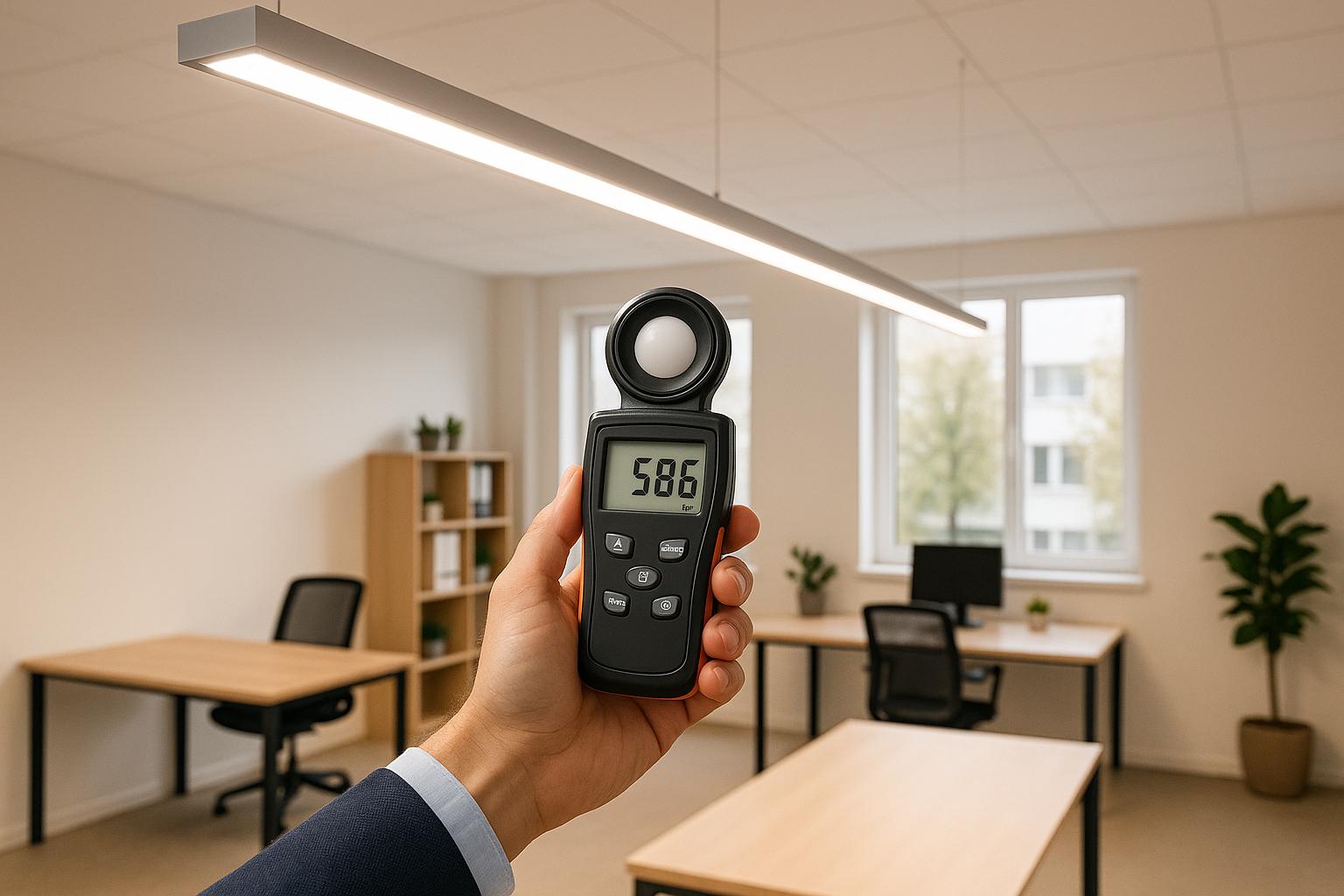
A light meter (or illuminance meter) is used to measure existing light levels at task height. Readings, typically in footcandles, are taken at work surfaces - around 30 inches above the floor in offices - to ensure retrofit designs meet or exceed current lighting standards.
A power or clamp meter verifies the actual wattage of fixtures and checks circuit loads. Relying solely on nameplate data can be misleading, particularly for older installations or systems with dimming features and sensors. Measuring real-time power usage is especially useful for exterior lighting, which often operates on high-voltage circuits.
Digital tools like mobile audit software or tablet apps can enhance efficiency and reduce errors. These tools allow you to standardize data entry, pre-load building information, and use drop-down menus to avoid transcription mistakes. They also let you attach photos, sketches, and voice memos to each record, making it easier to document complex conditions. For multi-site audits, digital tools simplify applying consistent templates and compiling energy and cost analyses across a portfolio.
Don't forget PPE. Alongside safety glasses, hard hats, and gloves, some sites may require high-visibility vests or arc-rated gear for accessing electrical panels. Always confirm site-specific requirements in advance.
| Tool | Purpose |
|---|---|
| Camera or smartphone | Document fixture details, nameplates, and room layouts |
| Tape measure & laser distance meter | Measure room dimensions, ceiling heights, and fixture spacing |
| Light meter (footcandle meter) | Measure illuminance at task height to meet standards |
| Power meter or clamp meter | Verify actual wattage and assess circuit loads |
| Mobile audit software or tablet | Streamline data entry and attach supporting documentation |
| Personal protective equipment (PPE) | Ensure safety compliance based on site requirements |
When auditing occupied buildings, careful planning is key to minimize disruptions while capturing accurate data. The goal is to observe lighting systems under typical operating conditions, with occupancy sensors, daylight harvesting, and other controls functioning as they normally would.
Schedule audits during regular operating hours to get a realistic snapshot of lighting performance. For offices, mid-morning or mid-afternoon on a workday often works well. In industrial settings, align audits with active production periods rather than downtime or maintenance windows. For buildings that rely on daylighting or skylights, take readings when daylight conditions are typical - usually around midday - and note the weather. Avoid unusual circumstances like storms or blackout blinds that could skew results.
An on-site lighting audit is your chance to gather critical data for retrofit designs, energy calculations, and compliance checks. Every step of this process helps ensure both regulatory adherence and energy efficiency. A methodical approach is key to covering all spaces and capturing the necessary details.
Start by checking in with your facility contact to confirm any last-minute access restrictions or safety protocols. Review your audit plan for efficient coverage. Many auditors begin with exterior lighting before moving inside, covering interior spaces either floor by floor or following a clear path, like a clockwise route. Establishing a workflow upfront will make measuring and documenting much smoother.
The fixture inventory is the foundation of your audit. Without accurate data on fixtures, lamp types, and wattages, energy calculations and savings estimates won't hold up.
Assign each space a unique identifier, such as a room number or zone name, that ties back to your floor plan. Record the room's function (e.g., office, warehouse, corridor), along with its approximate dimensions, ceiling height, and fixture mounting height. Mounting height is especially critical for high-bay areas where it affects light distribution and fixture choices.
For each fixture, document the manufacturer/model (if visible), type (e.g., fluorescent, HID, LED), and lamp details. Count the number of lamps per fixture and total the number of each fixture type in the space.
Ballast and driver details are equally important. Older fluorescent fixtures may use magnetic ballasts, while newer ones typically feature electronic ballasts. LED fixtures generally come with integrated drivers specifying input wattages. If labels are missing, use a clamp meter to measure input wattage and voltage (common values include 120 V, 277 V, or 480 V for exterior circuits).
Take note of the mounting method - whether recessed, surface-mounted, suspended, high-bay, wall pack, or pole-mounted - and assess the fixture's condition. Look for working fixtures, failed lamps, damaged housings, or dirt buildup. Include accessory details like wire guards, reflectors, or emergency ballasts.
Emergency and egress lighting require special attention. Identify all exit signs, emergency equipment, and luminaires on emergency circuits. Document their locations relative to exits and corridors, and verify that they are operational. Ask facility staff about how emergency lighting is tested (e.g., generator or inverter backup), the testing frequency, and any known issues. This ensures retrofits maintain safety standards while improving efficiency.
For exterior lighting, walk the perimeter and parking areas to note fixture types, lamp technology, pole heights, and coverage. Verify circuit voltages at electrical panels, as exterior circuits in U.S. commercial buildings often run at 480 V, while many LED fixtures operate between 120–277 V.
Using a standardized audit form or digital app can help ensure consistency. Include fields for location, quantity, fixture details, lamp and ballast specs, wattage, voltage, controls, condition, and notes. Digital tools also allow you to attach photos, voice memos, and sketches, which can streamline later analysis.
Once you've completed the inventory, move on to measuring light levels to evaluate performance.
After documenting the fixtures, assess lighting performance by measuring light levels. These measurements help determine if the current lighting meets design standards and identify areas for improvement. In the U.S., illuminance is measured in footcandles (fc), with readings taken at task height to compare against IES recommendations and code requirements.
Use a calibrated light meter set to footcandles. Take multiple readings in each area - at workstations, circulation zones, corners, and under or between fixtures. This will give you both the average illumination and the uniformity of light distribution.
For office and desk work, measure at about 30 inches above the floor (standard desk height). For industrial tasks, measure directly at the work surface, such as a workbench or assembly area. In corridors or storage spaces, take readings at the height where tasks are performed.
Record each measurement along with the space ID, time of day, and lighting state (e.g., all lights on, dimmed, or with daylight contribution). Note weather conditions when measuring areas with windows or skylights, as cloudy or sunny days can significantly impact readings. Measurements should reflect normal operating conditions, with occupancy sensors and daylight systems active.
Compare these readings to IES standards. For example, general office work typically requires 30–50 fc, detailed tasks may need 50–75 fc, and corridors or storage areas often require 10–20 fc. Highlight any areas that fall short of or exceed these targets, as these discrepancies can reveal opportunities for improvement or energy savings.
Beyond the numbers, assess the overall visual quality. Check for glare by observing common viewing positions - watch for direct views of bright lamps, highly reflective surfaces, or stark contrasts between fixtures and surrounding areas. Document any problematic fixtures or locations. Look for flicker, which could indicate aging ballasts or incompatible dimming systems, and evaluate color consistency. Whether the space feels warm (around 3,000 K), neutral (4,000 K), or cool (5,000 K or higher), inconsistencies might point to mixed lamp types or aging components. Photos of fixture types, room views, and specific issues can further support your design recommendations.
Energy codes today demand more than efficient fixtures - they require controls that adjust lighting based on actual needs. Documenting these systems is essential for ensuring compliance and identifying inefficiencies.
Start by identifying all control devices in each space. For manual switches, note the type (e.g., single-pole, three-way) and whether they are logically zoned (e.g., perimeter rows controlled separately from interior areas). Avoid setups where all lights are either fully on or off.
For occupancy and vacancy sensors, record the sensor type (e.g., passive infrared, ultrasonic, dual-technology), mounting location (wall or ceiling), and coverage area. Confirm that sensors activate when someone enters and deactivate when the space is vacant. Ask facility staff about timeout settings and note any complaints of lights turning off prematurely or staying on unnecessarily.
Daylight sensors and photocells are common in perimeter zones and outdoor areas. Check that these sensors have a clear view of natural light and aren’t obstructed by overhangs, trees, or interior objects. Ensure they aren’t mistakenly sensing artificial light from the fixtures they control, as this can cause erratic behavior. Observe how smoothly dimming or stepped systems respond to daylight changes.
Time switches and building automation systems (BMS or EMS) often manage lighting schedules. Identify whether the system uses a standalone timer, a networked panel, or an integrated BMS. Compare programmed schedules to actual occupancy patterns to spot inefficiencies.
For help navigating complex control systems and ensuring your audit findings lead to effective, compliant retrofits, consider consulting experts like Luminate Lighting Group.
After completing an on-site audit, you’ve gathered key details about fixtures, light levels, controls, and conditions. The next step is where the real impact happens: turning that raw data into actionable recommendations. This process demands thorough analysis, thoughtful design, and clear documentation that resonates with both technical teams and decision-makers.
Start by organizing your field data into a structured format, like a spreadsheet or a specialized audit tool. Each row should represent a fixture type or space, with columns for details like location, fixture type, lamp and ballast specifications, wattage, mounting height, quantity, operating hours, control type, and measured light levels (in footcandles). Standardize entries and double-check fixture counts and operating hours against plans or schedules. Summarize energy use by space and fixture category to pinpoint high-energy-consuming areas, which helps prioritize recommendations and model retrofit scenarios.
Once the data is organized, classify each space by its use - think open offices, warehouses, stairwells, or parking garages - and map these classifications to the applicable lighting power density (LPD) and control requirements outlined by energy codes like ASHRAE 90.1 or the IECC. Calculate the existing LPD by dividing the total lighting wattage (including ballast or driver losses) by the square footage of the space. Comparing this value to the code maximum reveals whether a space is over, at, or below the limit.
Next, evaluate control systems for compliance. Identify gaps by comparing existing controls to code requirements, noting issues like non-compliance, safety risks, or energy waste. Document these gaps with specific space identifiers, relevant code sections, and associated risks to help prioritize fixes.
Look for outdated, high-wattage technologies like T12 fluorescents, metal halides, halogens, or incandescent lamps, especially in areas with long operating hours. These are prime candidates for LED upgrades, which can significantly cut energy use. Also, check for spaces where light levels exceed recommended targets - this presents opportunities to reduce wattage or optimize fixture counts without sacrificing performance. Pay attention to fixtures with frequent maintenance needs, such as high-bay lamps requiring lifts, as these can benefit from the longer lifespan of LEDs.
Focus on areas with little to no existing controls but predictable occupancy patterns, such as warehouses, corridors, restrooms, or parking garages. Adding occupancy sensors, scheduling, or daylight harvesting systems in these spaces can reduce operating hours by 20–60%. Finally, prioritize locations with high utility rates or demand charges, as reducing the kilowatt load in these areas can deliver strong financial returns.
With these gaps identified, you’re ready to design retrofits that address these specific issues.
Start by setting clear design goals for each space. Define target light levels (in footcandles), uniformity, glare limits, color temperature (CCT), and color rendering (CRI) based on design guidelines and audit findings. Choose LED luminaires or retrofit kits that meet these goals while lowering wattage. Use photometric files to verify light levels and uniformity, especially in critical areas like task zones or safety paths. Ensure the total connected load for each space meets or stays below code limits, leaving room for future adjustments.
Develop a control strategy tailored to both code requirements and operational needs. For instance:
Consider networked or wireless controls for greater flexibility, energy monitoring, and easier setup. Verify compliance for emergency and egress lighting by ensuring circuits, battery packs, or inverters match the new fixtures and maintain required illumination levels.
Decide between one-for-one LED replacements or redesigned layouts. One-for-one replacements are quicker and less disruptive, using existing wiring and fixture placements. This approach works well when the current layout meets lighting quality and code standards but needs efficiency and maintenance improvements. Redesigned layouts are better for spaces with over-lighting, poor uniformity, or significant changes in use. In these cases, fewer, strategically placed LED fixtures can improve performance while lowering energy use. Use photometric modeling to confirm that reduced fixture counts still meet light level targets and emergency criteria. Also, consider installation costs against long-term energy and maintenance savings. For U.S. projects, factor in eligibility for utility rebates and federal incentives like the 179D tax deduction.
Tailor designs to the specific needs of different facility types:
Luminate Lighting Group uses audit data to create custom fixture schedules, control zoning diagrams, and rebate-ready documentation, aligning with U.S. energy codes while helping clients reduce costs and qualify for incentives like the 179D tax deduction.
These tailored designs serve as the foundation for the final audit report.
The audit report transforms technical findings into a compelling business case for building owners and facility managers. Begin with an executive summary that highlights the project’s objectives, key findings, total costs, annual energy and maintenance savings, payback period, and high-level recommendations - all written in straightforward, accessible language. This summary allows decision-makers to quickly see the value of the project.
The main report should include:
Follow this with proposed retrofit designs, including fixture schedules, control strategies, and code compliance notes. Include an energy and financial analysis that outlines projected energy and demand reductions, cost savings, available rebates, and financial metrics that translate these savings into dollar amounts.
Create a financial model that incorporates actual utility rates (e.g., $/kWh for energy and $/kW for demand), maintenance savings from longer-lasting LEDs, and all project costs - materials, labor, permits, controls, and commissioning. Account for utility rebates, tax incentives like the 179D deduction, and financing options to give stakeholders a clear picture of net costs. Present results in phases or bundles (e.g., "Phase 1: High-Bay and Exterior" and "Phase 2: Office and Conference Rooms") to prioritize high-return measures while planning for future upgrades.
Include appendices with detailed spreadsheets, photometric summaries, control zoning layouts, product cut sheets, and any required utility or code documentation for rebates and permits.
A lighting audit goes beyond simply counting fixtures - it's the cornerstone for achieving energy savings, meeting code requirements, and improving efficiency in commercial, industrial, office, and municipal buildings across the United States. By thoroughly documenting fixtures and their performance, you establish a reliable baseline that turns abstract energy goals into measurable cost savings. This process doesn't just save money - it delivers lasting benefits for operations and finances.
Audits also highlight code deficiencies, such as inadequate emergency or egress lighting and outdated control strategies, which can result in failed inspections, fines, or liability issues if ignored. By gathering detailed data on fixtures and operations, audits make it possible to accurately size utility rebates and federal incentives, significantly reducing upfront costs and boosting return on investment. Additionally, this documentation provides a valuable resource for maintenance teams, future upgrades, and sustainability reporting, helping track greenhouse gas reductions and progress toward ESG objectives over time.
The process ensures that retrofit designs are tailored to actual conditions. Designers can fine-tune light levels, improve consistency, adjust color temperatures, and add controls that align with how spaces are used. This transforms basic upgrades into complete lighting solutions that enhance comfort, safety, and productivity while maximizing energy and maintenance savings.
As outlined earlier, Luminate Lighting Group conducts detailed energy audits to create custom LED retrofit plans and lighting designs that meet client-specific goals for performance, compliance, and budget. By converting audit findings into rebate-ready documentation and connecting clients to U.S. utility rebates and 179D incentives, we help facilities cut energy costs, meet energy codes, and support sustainability efforts. Our approach ensures that projected energy savings and lighting performance are delivered over the long term, while also preparing clients for future energy strategies.
Lighting audits also serve as living tools for asset management, ready to adapt as occupancy patterns, regulations, and technologies evolve. Whether you're tackling a one-time retrofit or planning a multi-year improvement program, the insights gained from audits empower smarter decisions and sustained performance.
A lighting audit is a practical way to pinpoint where energy is being wasted and discover opportunities to make your lighting system more efficient. By examining your current setup, you can identify strategies to cut down on energy use and reduce operating expenses.
Switching to energy-efficient LED lighting can lead to 50–80% savings on energy costs, while also offering better light quality, reduced maintenance, and a safer work environment. Beyond these benefits, a lighting audit can help ensure your system meets energy code requirements, align with sustainability efforts, and even open the door to perks like utility rebates or tax deductions.
Lighting audits are essential for meeting energy codes like ASHRAE 90.1 and the IECC. These evaluations assess your existing lighting systems to pinpoint where upgrades are needed to align with energy efficiency standards and regulatory requirements.
By examining elements such as energy usage, fixture types, and lighting controls, audits deliver a detailed plan for achieving compliance. This approach not only helps you steer clear of penalties but also enhances energy efficiency, lowers utility bills, and aligns with broader sustainability objectives.
To carry out an effective lighting audit, begin by collecting comprehensive details about the current lighting setup. This involves noting down the types of fixtures, their wattages, quantities, and where they are installed. Additionally, gather energy usage data to help estimate potential cost and energy savings.
Equipping yourself with tools like a light meter, measuring tape, and either a notebook or a digital device for recording observations can make the process smoother. Being well-prepared not only ensures precise results but also helps pinpoint opportunities for energy-efficient improvements that match your objectives.


