.svg)
Compare LED and traditional municipal lighting: energy use, costs, lifespan, maintenance, and environmental impact.

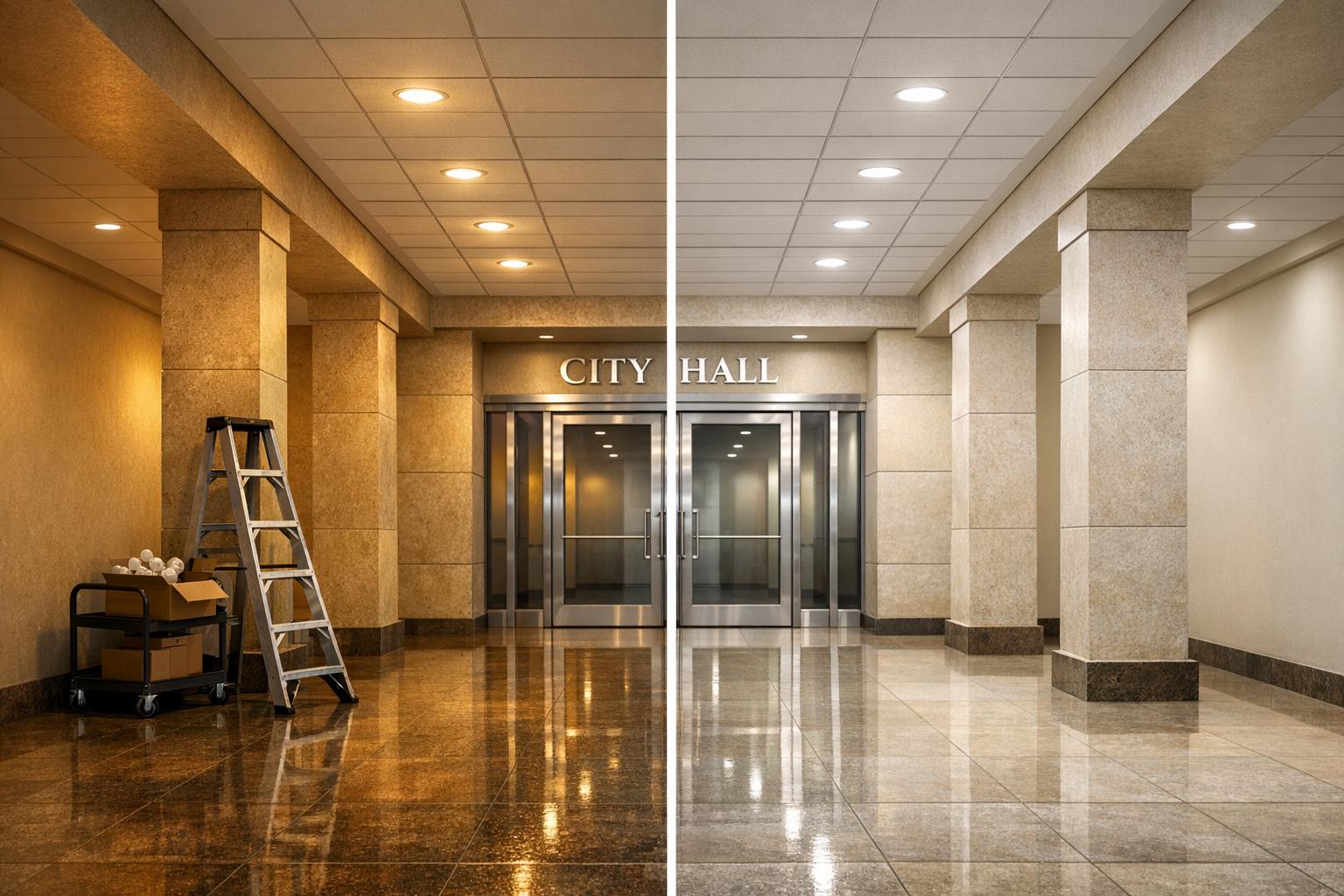
Switching to LED lighting for municipal buildings saves money, improves reliability, and reduces maintenance needs. LEDs use up to 80% less energy than older systems, last 10–15 years compared to 2–4 years for high-pressure sodium or metal halide lamps, and provide better visibility with a whiter, more natural light. They also cut maintenance costs by up to 90% and support modern features like smart controls for dimming and monitoring.
Key benefits of LEDs over older systems include:
For cities, the upfront cost of LEDs pays off quickly, with most projects recovering their investment within 14–22 months. Tax deductions (like the 179D program) and utility rebates further sweeten the deal. LEDs are a clear choice for cutting costs and improving municipal infrastructure.
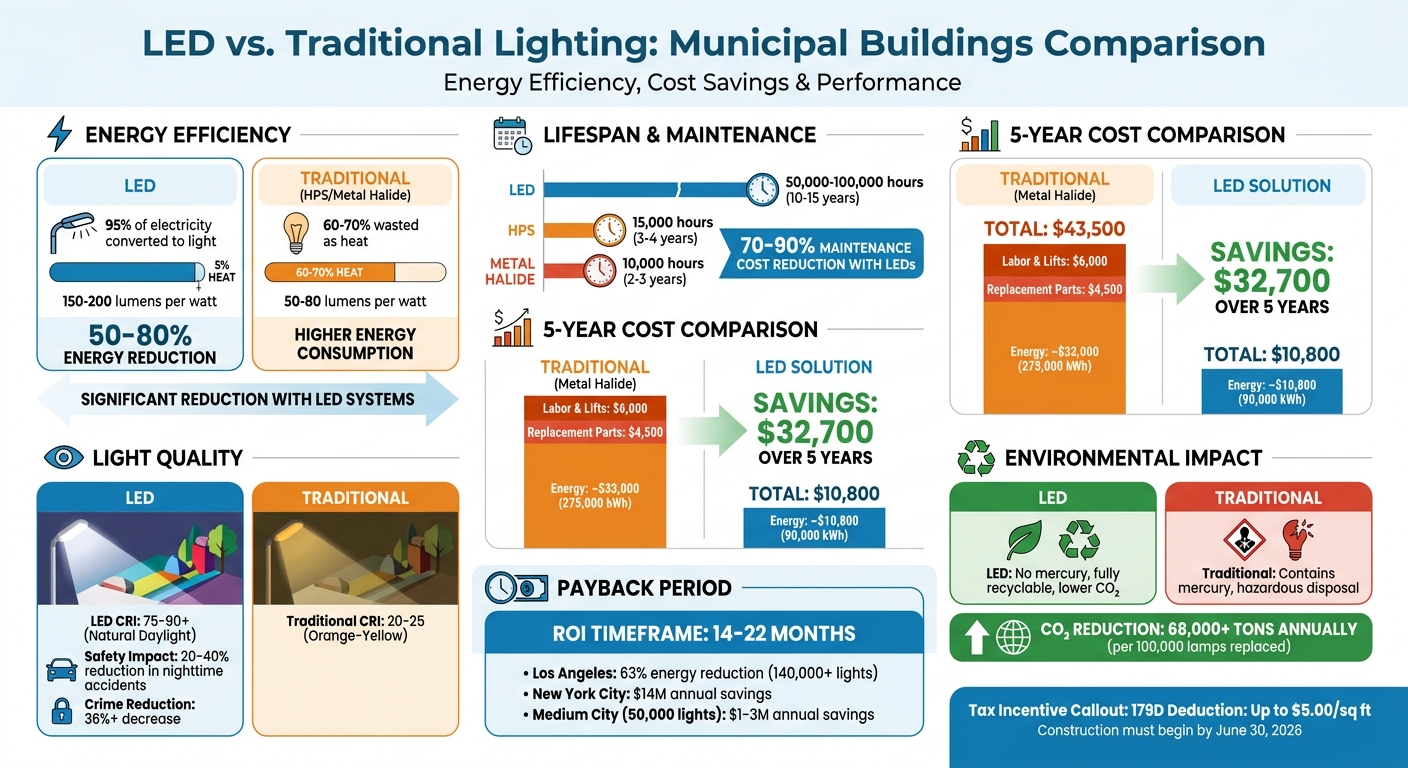
LED vs Traditional Lighting: Cost, Efficiency, and Lifespan Comparison for Municipal Buildings
LED lighting works by using electron movement in semiconductors to produce light, rather than relying on heated filaments or excited gases. This design results in significantly less wasted heat compared to traditional lighting options. According to the Department of Energy, "The light-emitting diode (LED) is today's most energy-efficient and rapidly developing lighting technology".
One of the standout features of LEDs is their ability to emit light directionally. Unlike traditional bulbs, which scatter light in all directions and require additional components like reflectors (which often trap light), LEDs focus their output. This makes them particularly effective for illuminating streets, parking lots, and municipal buildings. For example, modern LED streetlights provide between 150–200 lumens per watt, far surpassing the 50–80 lumens per watt typical of high-pressure sodium lamps.
Municipal buildings also benefit from the ruggedness of LED technology. Constructed as solid-state devices, LEDs lack fragile components like glass or moving parts, making them highly resistant to shocks, vibrations, and extreme temperatures. They can operate reliably in conditions ranging from -40°F to 140°F. This durability makes LEDs well-suited to the tough demands of public infrastructure, offering reliability in diverse and challenging environments.
LED lighting delivers substantial energy savings for municipalities, cutting energy use by 50–80% - a critical factor for budget-conscious operations. Their long lifespan, ranging from 50,000 to 100,000 hours (approximately 10–15 years), ensures that LEDs outlast traditional lamps by up to a decade. This longevity translates to maintenance cost reductions of 70–90%.
In addition to savings, LEDs provide exceptional light quality. With a high Color Rendering Index (CRI) of 75–90+, LEDs produce light that closely resembles natural daylight. This is a stark improvement over high-pressure sodium lamps, which emit a yellowish light with a CRI of just 20–25. Better lighting quality enhances visibility, which has been shown to decrease nighttime accidents by 20–40% and reduce criminal activity by over 36%.
Moreover, LEDs are designed to integrate seamlessly with modern smart city technologies. Features like remote dimming, motion detection, environmental monitoring, and support for 5G connectivity make them a forward-thinking choice for municipalities looking to enhance infrastructure efficiency and adaptability.
Traditional municipal lighting systems rely on fluorescent tubes, halogen bulbs, and high-intensity floodlights. These technologies have been the backbone of public lighting for decades. However, many municipalities still use line voltage systems, which come with higher safety risks in public areas compared to modern low-voltage options.
For street and outdoor lighting, high-pressure sodium (HPS) and metal halide lamps remain widely used. These systems produce a distinctive orange-yellow glow, which distorts colors and reduces visibility - an important drawback for safety and security. Another issue is their delayed illumination, as these lights take time to reach full brightness, making them unsuitable for situations requiring instant lighting.
The hardware itself poses challenges. Traditional installations often conflict with historic architecture and require frequent maintenance, driving up costs. Performance-wise, these systems fall short in durability. HPS and metal halide lamps typically last only 10,000 to 20,000 hours, far less than modern alternatives. This short lifespan means more frequent replacements, often requiring specialized crews to access fixtures on rooftops or high poles. These limitations make traditional systems less effective, especially in demanding municipal environments.
Beyond design limitations, traditional systems face several other critical issues. One major drawback is their inefficiency - these lights waste a lot of energy as heat instead of converting it into visible light. High-intensity floodlights, in particular, consume excessive power, leading to higher operational costs for municipalities that run these systems year-round. The heat output also increases air conditioning expenses during warmer months as buildings struggle to maintain comfortable indoor temperatures.
Another significant issue is maintenance. Traditional bulbs burn out more frequently, causing disruptions in busy public areas and requiring regular service calls. The labor and equipment costs for replacing bulbs - especially those mounted on tall poles or building exteriors - add up quickly.
Environmental concerns add another layer of complexity. Many traditional systems, such as fluorescent lamps, contain mercury and other hazardous materials. This makes disposal more complicated and raises environmental risks if not handled correctly. Additionally, their high energy consumption contributes to a larger carbon footprint due to increased CO2 emissions.
Safety concerns are also significant. Traditional line voltage systems pose higher electrical risks in public spaces, particularly in areas where children play or pedestrians walk. A comparison table highlights the key challenges:
| Feature | Traditional Systems | Impact |
|---|---|---|
| Lifespan | 10,000–20,000 hours | Frequent replacements needed |
| Energy Waste | High (lost as heat) | Increased utility bills and cooling costs |
| Hazardous Materials | Often contains mercury | Specialized disposal required |
| Light Quality | Orange-yellow, poor color rendering | Reduced visibility and safety |
| Start-up Time | Requires warm-up period | Delayed illumination |
Cities looking to cut costs and improve reliability can gain a lot by switching to energy-efficient lighting. LEDs convert more than 95% of electricity into light, while older systems waste 60–70% as heat. This stark difference explains why municipalities often see substantial savings after adopting LED technology.
Traditional High-Intensity Discharge (HID) bulbs emit a lot of heat, with temperatures inside the bulb reaching up to 1,000°F. This extra heat forces HVAC systems to work harder, increasing energy use. With LEDs, saving 3 watts in lighting energy also saves 1 watt in cooling energy. These efficiency gains make LEDs a clear choice for reducing costs and improving system performance.
The numbers paint a clear picture. A 400W Metal Halide lamp, including its ballast, uses 458W, while an equivalent LED fixture only requires 150W. For streetlights, LEDs needing just 30 to 50 watts can match the brightness of a 100-watt high-pressure sodium lamp. This stark contrast in power usage highlights why LEDs outperform traditional options.
Real-world examples back this up. Los Angeles replaced over 140,000 streetlights with LEDs, cutting energy use by 63%. New York City’s LED upgrade saves around $14 million annually in energy and maintenance costs. Even a medium-sized city with 50,000 streetlights can slash electricity costs by $1–3 million each year.
Switching 100 lights that run 12 hours a day can save over 130,000 kWh annually. Over five years, the financial impact becomes even clearer:
| Cost Factor | Traditional (Metal Halide) | LED Solution |
|---|---|---|
| Energy Consumption | ~275,000 kWh | ~90,000 kWh |
| Estimated Energy Cost | $33,000 | $10,800 |
| Replacement Parts | $4,500 | $0 |
| Labor & Lift Rentals | $6,000 | $0 |
| Total 5-Year Cost | $43,500 | $10,800 |
Beyond direct energy savings, smart LED systems offer additional perks like adaptive lighting and dimming based on real-time needs. These features can reduce output by 50% or more during low-traffic hours. Plus, since LEDs draw less power overall, reviewing utility bills for peak usage charges often reveals even more ways to save.
"Your current utility bill is essentially a 'hidden tax' on inefficiency. The longer you wait to make a decision, the more money you're essentially giving to the utility company." – Evan Carter, Bright LED TX
When weighing upfront costs against long-term savings, it's clear why LEDs are a smart financial move for municipal buildings.
While LED systems initially cost more than traditional HID or fluorescent fixtures, their total cost of ownership tells a different story. Over time, the savings become undeniable.
Traditional lighting systems come with unexpected expenses that add up quickly. For instance, when bulbs fail in high-ceiling facilities, the costs go beyond just the price of a new bulb. Municipalities often face scissor lift rentals (which can exceed $500 per day) and labor costs - making the bulb's price almost irrelevant.
On the other hand, LED retrofits typically break even within 14 to 22 months after installation. Beyond that point, they continue to deliver savings, while traditional fixtures keep draining budgets with frequent replacements and maintenance.
The upfront cost difference between LEDs and traditional systems shrinks significantly when you consider how quickly LEDs pay for themselves. According to the cost analysis referenced earlier, a typical municipal facility can save over $32,000 in energy, replacement parts, and labor within five years of switching to LED.
Traditional HID bulbs last between 15,000 and 20,000 hours, whereas industrial-grade LEDs operate for over 100,000 hours. Furthermore, most commercial LED upgrades come with 5- to 10-year warranties that cover the housing, LEDs, and drivers - something traditional fixtures rarely provide. These warranties add extra value and peace of mind.
These short payback periods pave the way for even greater financial benefits when paired with available incentives.
In addition to operational savings, municipalities can take advantage of financial incentives like the 179D Commercial Buildings Energy-Efficiency Tax Deduction, which further lowers the cost of LED retrofits. This program allows municipalities to claim up to $5.00 per square foot for qualifying interior lighting upgrades. For a 50,000-square-foot municipal building, that could mean a potential deduction of $250,000.
To qualify for the 179D deduction, projects must begin construction by June 30, 2026. Additionally, the upgraded lighting system must reduce energy costs by at least 50% compared to ASHRAE 90.1-2007 standards. LEDs, which typically cut energy use by around 67% compared to Metal Halide systems, easily meet this requirement. Even better, the tax deduction can often be claimed every three years for further improvements, creating ongoing financial benefits.
Luminate Lighting Group assists municipalities in navigating these incentives. By conducting thorough energy audits and assessing rebate eligibility, they help cities maximize their savings while modernizing their lighting infrastructure.
Municipal operations require lighting solutions that deliver high performance while minimizing environmental harm. LED technology excels in both areas, offering better light quality, advanced smart controls, and a smaller ecological footprint.
The type of lighting used in public spaces has a direct impact on safety and the quality of life for residents. LEDs emit a crisp, white light that significantly enhances color recognition compared to the yellowish glow of traditional high-pressure sodium (HPS) lamps. This improved visibility can make streets safer for both drivers and pedestrians.
"The white, crisp light emitted by LEDs improves color recognition, making it easier for drivers and pedestrians to identify objects at night." - Dara Greaney, Founder and CEO, LED Light Expert
LED streetlights have been shown to reduce nighttime accidents by as much as 50%. Their superior Color Rendering Index (CRI), which typically ranges from 75 to 90+, far surpasses the 20–25 CRI of HPS lamps. This makes them a clear choice for municipal lighting.
Modern LED systems also feature smart controls, such as daylight harvesting, occupancy sensors, and remote monitoring. These features allow cities to adjust brightness based on real-time conditions like traffic or pedestrian activity, cutting down on unnecessary energy use without compromising safety. Additionally, LED poles can double as hubs for technologies like environmental sensors, 5G microcells, and CCTV systems.
These advantages not only enhance public safety but also align with broader sustainability goals.
LED lighting offers a significant reduction in environmental impact compared to older technologies. By consuming 50% to 80% less energy than traditional systems, municipalities can dramatically lower their carbon emissions. For instance, replacing 100,000 HPS lamps with LEDs can cut over 68,000 tons of CO₂ emissions annually.
Unlike fluorescent and HID lamps, which contain hazardous mercury, LEDs are nearly free of toxic substances. This eliminates the risk of contamination during disposal and simplifies recycling efforts. LEDs are also much more efficient, generating minimal heat compared to traditional bulbs, which waste 60–70% of their energy as heat. This efficiency can even help reduce cooling demands in municipal buildings.
Another benefit is the directional lighting of LEDs, which minimizes light pollution. By focusing light where it’s needed rather than scattering it into the sky, LEDs help preserve dark skies and protect ecosystems. Combined with smart dimming during off-peak hours, these systems save energy while reducing their impact on wildlife and the environment. Companies like Luminate Lighting Group work with cities to design LED systems that balance high performance with eco-conscious goals.
LEDs have a much longer lifespan compared to traditional lighting, which significantly reduces maintenance costs for cities. LED street lights can last between 50,000 and 100,000 hours, equating to 11–22 years of use when operated for 12 hours daily. In contrast, High-Pressure Sodium (HPS) lamps typically last about 15,000 hours (3–4 years), while Metal Halide bulbs burn out even faster, lasting only about 10,000 hours (2–3 years).
This difference in longevity changes how municipalities approach lighting upkeep. Traditional lighting systems often require frequent replacements, creating ongoing maintenance challenges. LEDs, on the other hand, are built as solid-state devices without fragile filaments or glass, making them resistant to vibrations and impacts - an important feature for high-traffic areas.
The extended lifespan of LEDs directly reduces the frequency of replacements, which in turn lowers labor costs. Replacing a single streetlight can cost between $100 and $300 due to the need for aerial equipment, road closures, and crew time. When traditional lamps need replacing every 2–4 years across hundreds or thousands of fixtures, these expenses can escalate quickly. By switching to LEDs, municipalities can cut replacement labor costs by as much as 90%.
For instance, in a facility with 1,000 fixtures, transitioning from halogen to LED could save approximately $125,790 in labor costs over an eight-year period. Similarly, in a smaller installation with 100 fixtures, traditional systems might incur around $10,500 in maintenance costs over five years, whereas LED systems require minimal upkeep. This allows municipal teams to redirect their efforts to more pressing infrastructure projects instead of repetitive bulb replacements.
| Lighting Type | Average Lifespan (Hours) | Real-World Use (12 hrs/day) | Replacement Frequency |
|---|---|---|---|
| 2026 Long-Lifespan LED | 50,000–100,000 | 11–22 years | Once every 10+ years |
| High-Pressure Sodium (HPS) | 15,000 | 3–4 years | Every 2–4 years |
| Metal Halide | 10,000 | 2–3 years | Every 1–3 years |
The table highlights how LEDs outperform traditional lighting in lifespan and replacement frequency, offering clear advantages for municipal budgets. When selecting LED fixtures, it’s essential to look for the L70 rating, which ensures the light will maintain at least 70% of its original brightness for over 50,000 hours. Additionally, opting for fixtures with modular LED chips and drivers allows for cost-effective repairs by replacing only the faulty components. Most municipal LED upgrades pay for themselves within 2–3 years, making the transition a smart financial and operational decision.
Luminate Lighting Group specializes in designing LED systems with advanced thermal management and surge protection, helping drivers achieve their full rated lifespan. This further minimizes maintenance needs, reinforcing LEDs as the go-to solution for municipal lighting, offering both cost savings and reliable performance.
LED lighting isn't just about saving energy - it’s also about versatility and improving the functionality of municipal spaces. Whether indoors or outdoors, LEDs provide practical solutions that enhance productivity, reduce costs, and even promote public well-being.
Inside municipal buildings like department offices, libraries, animal shelters, water treatment facilities, and historic sites, LEDs are a game-changer. These spaces often struggle with poor lighting due to outdated fluorescent or incandescent systems or limited natural light. LED lighting not only boosts energy efficiency but also creates a better environment for workers and visitors alike.
Outdoor spaces also reap the rewards of LED upgrades. Strategically placed LED fixtures in streets, parking lots, walkways, and building facades cut down on wasted light while improving visibility. Parks and recreation areas can take it a step further by using International Dark-Sky Certified or wildlife-friendly LED systems to curb light pollution. For remote trails or sidewalks, solar-powered LED options offer an energy-efficient solution that could even contribute to earning LEED points.
Cities can make the most of LED lighting by incorporating smart controls that adjust brightness based on occupancy or time of day. This not only saves energy but also boosts the return on investment (ROI). For iconic buildings like city halls, bridges, or historic landmarks, color-changing LED fixtures add a modern touch while highlighting architectural details. Sports fields and community centers also benefit from LEDs, offering bright, efficient nighttime lighting with dimming options to save energy during off-peak hours - all without compromising safety. These adaptable features make LEDs a perfect fit for municipal lighting upgrades.
Municipalities can stretch their budgets further by tapping into professional assessments and incentive programs. Companies like Luminate Lighting Group provide energy audits, custom lighting designs, photometric layouts, and rebate assistance to help projects meet energy codes and maximize savings. By choosing dimmable LEDs with reduced blue light emissions for areas near nature preserves and integrating smart control systems, cities can protect local wildlife while achieving quicker payback on their investments. These tailored solutions not only improve lighting quality but also unlock financial benefits, making the transition to LEDs a smart move in more ways than one.
Switching to LED lighting offers a trifecta of benefits: energy savings, reduced maintenance costs, and better lighting quality. LEDs have a lifespan of 10–15 years, far outlasting the 2–3 years typical of high-pressure sodium lamps. This longevity allows cities to shift resources from constant repairs to addressing more pressing community needs.
The advantages go beyond cost savings. LED systems improve public safety and help meet environmental goals. Financially, most municipal LED projects recover their initial investment in just 14 to 22 months, with lifetime ownership costs typically 30–50% lower than traditional systems. Add in utility rebates and the 179D tax deduction - offering up to $5.00 per square foot for qualifying upgrades - and the financial case becomes even stronger. (Keep in mind, to claim the full tax benefits, construction must start before June 30, 2026.)
LEDs also enhance visibility, making streets safer for drivers and pedestrians. Their superior color rendering has been linked to a 20–40% drop in nighttime accidents. Plus, since LEDs are free of mercury and lead and are fully recyclable, they support sustainability goals and help cut carbon emissions.
However, achieving these benefits isn’t as simple as swapping out old bulbs. Collaborating with experts like Luminate Lighting Group ensures every aspect of the upgrade - energy audits, custom designs, rebate processing, and code compliance - is handled seamlessly. As a professional from Waypoint Lighting Solutions puts it:
"The difference between a result that is just acceptable and one that is spectacular comes only by partnering with an expert willing to design and install a lighting system customized for your facility".
To pick the best LED brightness and color temperature, think about how the space will be used and the atmosphere you want to create. Match the lumen levels to the activity and size of the area. For example, brighter lighting works well in places like parking lots or warehouses. For offices or conference rooms, aim for a neutral tone with 3500K–4000K. In environments like hospitals, where clear visibility and alertness are key, go for cooler, more vibrant lighting in the 4000K–5000K range.
The most effective approach to modernizing municipal lighting is by implementing IoT-enabled systems equipped with centralized control. Features like occupancy sensors and daylight harvesting allow these systems to adapt in real time, improving energy use while integrating smoothly with current infrastructure.
To streamline operations, choose platforms that offer remote management and automated scheduling. These tools reduce the need for constant manual oversight, making it easier to manage lighting systems while optimizing energy savings without adding unnecessary complications.
To qualify for utility rebates or the 179D deduction after an LED retrofit, having the right paperwork and meeting IRS guidelines is essential.
For rebates, you'll need energy modeling, third-party certification, and detailed documentation of the retrofit. If you're aiming for the 179D deduction, ensure you include energy savings models, inspection reports, and references to applicable IRS notices (such as 2008-40, 2006-52, and 2012-26) to confirm adherence to energy efficiency standards.


