.svg)
Compare LED and fluorescent warehouse lighting — energy use, lifespan, maintenance, light quality, cold performance and cost.

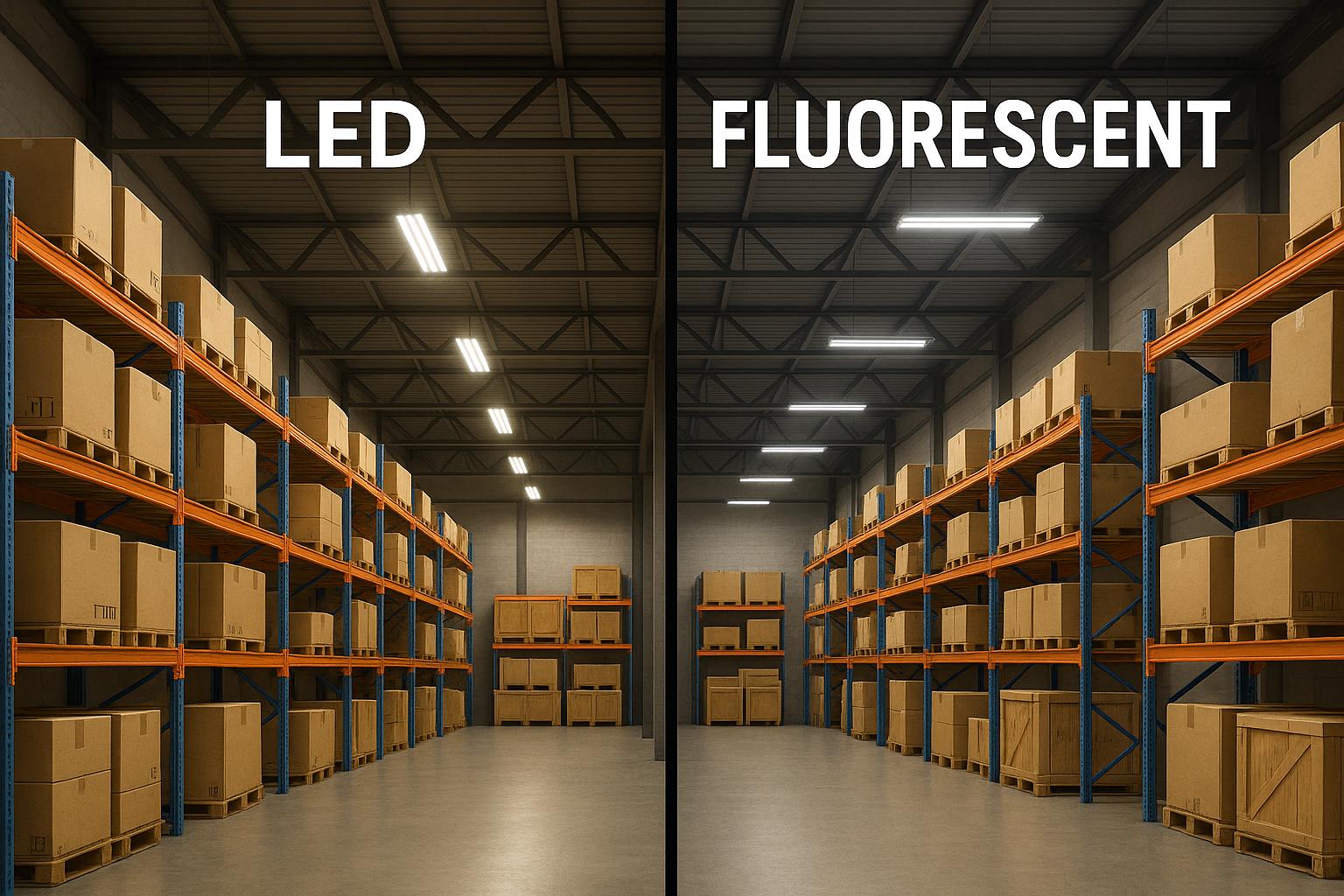
LED lighting is the better choice for warehouses. It lasts longer, uses less energy, and works better in tough conditions compared to fluorescent lighting. LEDs save 40–80% on energy costs, last 3–8 times longer, and reduce maintenance needs. They also provide better light quality, are mercury-free, and handle cold temperatures and frequent switching without issues.
| Feature | LED | Fluorescent |
|---|---|---|
| Energy Efficiency | 120–160+ lumens/W | 70–100 lumens/W |
| Lifespan | 50,000–100,000 hours | 7,000–15,000 hours |
| Annual Cost (10 fixtures) | ~$3,200 (100 fixtures) | ~$7,900 (100 fixtures) |
| Cold Temperature | Full brightness | Output drops by 49% |
| Maintenance | Minimal | Frequent replacements |
| Environmental Impact | No mercury | Contains mercury |
Switching to LEDs may have a higher upfront cost, but the savings on energy, maintenance, and rebates make it a smart investment for warehouses.
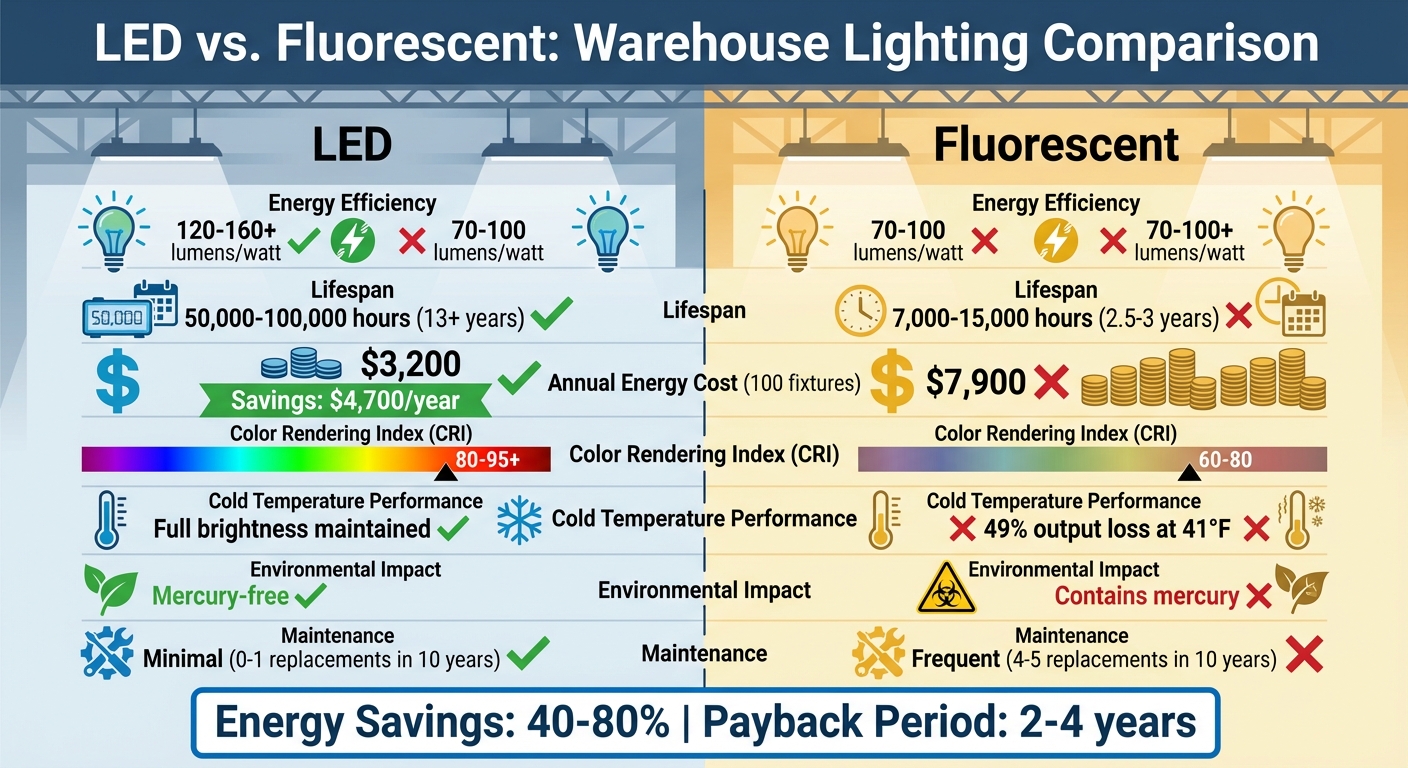
LED vs Fluorescent Warehouse Lighting Comparison: Energy, Cost & Performance
LED, short for Light Emitting Diode, operates on a completely different principle than older lighting technologies. When electricity passes through a semiconductor inside the LED, it excites electrons, which then emit light directly with very little heat. This solid-state design eliminates the need for fragile components like glass tubes, filaments, or gases. As a result, LEDs are far more durable - an essential feature for warehouses where vibrations, forklift movement, and accidental impacts are common.
The energy efficiency of LEDs is hard to ignore. For example, an 8-foot LED shop light uses just 72 watts compared to the 110+ watts required by fluorescent fixtures. In vapor-tight setups often found in warehouses, LEDs consume only 12–55 watts, while their fluorescent counterparts can easily exceed 160 watts. These differences add up to real savings - up to $81 per fixture annually in some applications like troffer lighting.
LEDs also shine when it comes to performance in challenging environments. They turn on instantly and maintain full brightness, even in cold storage or unheated spaces where fluorescents often struggle. With a typical lifespan of 50,000 hours (or 25,000–50,000 hours for most commercial-grade fixtures), LEDs last three to eight times longer than fluorescent lamps, which usually need replacing after just 6,000–15,000 hours. This extended lifespan means fewer replacements, reduced downtime, and lower labor costs, particularly in high-ceiling areas. These benefits make LEDs a smart choice for a wide range of warehouse needs.
Thanks to their technical strengths, LEDs are versatile enough to meet the unique demands of warehouse environments. For ceilings above 20 feet, high bay LED fixtures are the go-to choice. These fixtures focus light downward with precision, offering excellent visibility. Unlike fluorescent tubes, which scatter light in all directions and rely on reflectors, LEDs are naturally directional, making them much more efficient.
For areas exposed to dust, moisture, or regular washdowns - like woodworking shops or loading docks - vapor-tight LED fixtures are ideal. These fixtures replace 1–4 fluorescent lamps with integrated LED units that use significantly less power. Similarly, linear LED strip fixtures are a popular replacement for traditional fluorescent tube systems, delivering comparable or even better brightness while cutting energy use by about half.
LEDs also integrate seamlessly with modern controls like sensors, dimmers, and daylight harvesting systems. They can handle frequent on/off cycles without losing efficiency, making them perfect for spaces like aisles and storage zones where occupancy varies. Beyond their inherent energy savings, LED upgrades often qualify for utility rebates and federal 179D tax deductions. Companies like Luminate Lighting Group specialize in helping businesses design and document these retrofits, ensuring clients maximize both energy savings and financial incentives.
Fluorescent lighting operates using a discharge process that's quite different from LEDs. When switched on, the ballast sends an electric current through a glass tube filled with low-pressure mercury vapor and inert gas. This current creates an arc between the electrodes at each end of the tube, which primarily generates ultraviolet (UV) light - invisible to the human eye. To make this light visible, the tube's inner surface is coated with phosphors that absorb the UV radiation and re-emit it as the white light you see illuminating spaces like warehouse floors.
The ballast is a crucial component in this system. It regulates the current and provides the high voltage needed to ignite the lamp. Modern electronic ballasts have largely replaced older magnetic ones, reducing flicker and humming noises. However, the fundamental process - discharge and phosphor conversion - remains consistent across all fluorescent systems. Whether you're dealing with older T12 lamps, standard T8 tubes (which use 28–40 watts per 4-foot lamp), or the more efficient T5 lamps, the underlying technology hasn't changed much.
Fluorescent lighting became popular in warehouses due to its lower upfront cost. However, these fixtures typically consume 110–160 watts, depending on their configuration. In contrast, LEDs provide similar light output while using about 40–44% less energy. Beyond energy efficiency, fluorescent lighting comes with several drawbacks. For one, the tubes contain small amounts of mercury, which poses disposal challenges and requires careful handling if a tube breaks. The glass construction also makes them prone to damage from impacts or vibrations - common in warehouse settings. Additionally, cold temperatures can significantly reduce their performance. At 41°F, fluorescent tubes can lose up to 49% of their light output and may even fail to start, making them unreliable in unheated areas like loading docks or cold storage zones. Frequent on/off switching, often triggered by occupancy sensors in warehouses, also shortens their lifespan considerably.
These limitations set the stage for understanding how fluorescent lighting fits into warehouse environments and why alternatives like LEDs are gaining traction.
Throughout the mid-to-late 20th century, fluorescent lighting became the go-to choice for U.S. warehouses. High bay fixtures equipped with T12, T8, or T5 lamps were commonly used to light up wide aisles, racking areas, and open storage spaces. Their linear design provided broad, diffuse illumination, which seemed ideal for large warehouse floors at the time. Fluorescent strip lights and industrial channel fixtures were also widely installed over shipping and receiving areas, assembly lines, and production floors where consistent, uniform lighting was a priority.
In older facilities - those built or last updated before LEDs became affordable - fluorescent systems are often still in use. Many remain operational simply because they haven’t failed yet, and facility budgets have been allocated to other priorities. Smaller spaces like maintenance shops, mezzanines, back-of-house storage rooms, and staging areas also tend to still rely on fluorescent strip lights and channel fixtures. These setups often combine high-bay fluorescent lighting for the main warehouse floor with lower-mounted fluorescent troffers in support areas and offices.
However, fluorescent lamps have relatively short lifespans, typically lasting only 7,000–15,000 hours. In warehouses running long shifts, this means frequent replacements. Maintenance in high-bay areas requires lifts or specialized equipment, which increases labor costs and long-term expenses. These challenges are prompting many warehouse operators to rethink their lighting systems. As energy codes increasingly push for higher-efficiency lighting and advanced controls, fluorescent systems are often viewed as temporary solutions. Many facility managers are now planning retrofits to LEDs, aligning these upgrades with budget cycles and maintenance schedules. The operational headaches tied to fluorescent systems are a major reason why modern warehouses are exploring more efficient lighting options.
LED lighting outshines fluorescent systems when it comes to energy efficiency. Warehouse-grade LED fixtures typically deliver 120–160+ lumens per watt (lm/W), with many high-bay models achieving 130–150 lm/W. By comparison, fluorescent systems typically operate between 70–100 lm/W, with T8 tubes delivering around 80–95 lm/W and T5 lamps reaching up to 100 lm/W. This means LEDs can deliver the same light output while being up to 44% more efficient than standard 4-foot fluorescent tubes.
The wattage used by each system further highlights this difference. For example, a 2×4 fluorescent troffer with four lamps and a ballast can use up to 160 watts, whereas a comparable LED troffer requires only 22–50 watts. Similarly, an 8-foot LED shop light consumes about 72 watts, while its fluorescent counterpart uses over 110 watts. These differences translate into significant cost savings. Using the U.S. average electricity rate of $0.12 per kWh and assuming 12 hours of daily operation (approximately 4,380 hours per year), a 150-watt fluorescent high-bay fixture costs about $79 annually to operate. In contrast, a 60-watt LED fixture costs just $32 per year, saving $47 per fixture annually.
Now, scale this to a warehouse with 100 fixtures. LEDs operating at 140 lm/W would cost $3,200 annually in energy, while fluorescent fixtures at 90 lm/W would total $7,900 annually. That’s a $4,700 savings in the first year alone. Over an LED's lifespan of 50,000 hours, these savings add up dramatically, with energy reductions of up to 80% being documented.
| Metric | LED | Fluorescent | Savings |
|---|---|---|---|
| Lumens per Watt | 140 lm/W | 90 lm/W | up to 44% more efficient |
| Annual Cost per Fixture | $32 | $79 | $47/year |
| Annual Cost (100 fixtures) | $3,200 | $7,900 | $4,700/year |
Switching to LEDs doesn’t just save money - it also helps the environment. Lower energy use directly reduces indirect CO₂ emissions. A study by the University of Michigan found that LEDs are 25% more efficient than fluorescents overall, leading to meaningful carbon footprint reductions.
Additionally, LEDs eliminate a major environmental concern associated with fluorescents: mercury. Fluorescent lamps contain small amounts of mercury, which poses a hazard during disposal and requires careful handling if a lamp breaks. LEDs, on the other hand, are completely mercury-free, reducing toxic waste and making them easier to handle and dispose of responsibly.
For companies aiming to meet sustainability goals or comply with environmental standards, LED retrofits are a smart move. Partnering with energy-focused organizations like Luminate Lighting Group can help businesses perform detailed energy audits, qualify for utility rebates, and take advantage of Section 179D tax deductions. These measures not only offset retrofit costs but also align with broader environmental objectives, making the transition to LEDs a win-win for businesses and the planet.
LED and fluorescent lighting differ significantly when it comes to lifespan. LED high-bay and linear fixtures typically last between 50,000 and 100,000 hours, while fluorescent lamps only manage 7,000 to 15,000 hours. To put this into perspective, with an annual usage of 3,744 operating hours, a 50,000-hour LED fixture can last approximately 13 years before its brightness drops to 70% (known as L70). In contrast, a 10,000-hour fluorescent tube would need replacing every 2.5 to 3 years under the same conditions.
Over a 10-year period, this means an LED fixture might not require replacement at all, while a fluorescent lamp would need to be replaced 4 to 5 times. This difference becomes even more critical in high-bay warehouses, where replacing fixtures involves lifts or scaffolding, adding costs for rentals, safety measures, and downtime.
| Lighting Type | Lifespan | Replacements Needed (10 Years) | Years Between Replacements |
|---|---|---|---|
| LED | 50,000–100,000 hours | 0–1 | 13+ years |
| Fluorescent | 7,000–15,000 hours | 4–5 | 2.5–3 years |
Fluorescent lamps are also more vulnerable to environmental factors. In cold or unheated warehouses, their light output can drop by up to 49% at around 41°F, and frequent on/off switching - common with motion sensors - further shortens their lifespan. LEDs, on the other hand, maintain full brightness in cold conditions, handle frequent switching with ease, and are far more durable. This makes their rated lifespan far more dependable in demanding industrial environments.
These differences in longevity directly impact maintenance costs, making LEDs a more cost-effective choice over time.
Because LEDs last so much longer, their maintenance needs are significantly lower compared to fluorescents. Fluorescent fixtures require regular lamp and ballast replacements, along with frequent inspections. Since many fluorescent fixtures use multiple tubes, even a single tube failure can lead to repeated maintenance visits. Additionally, ballasts often fail years before the fixture itself is retired, further driving up labor and parts costs.
In high-bay warehouses, replacing fluorescent lamps is particularly costly. Each relamping project requires lifts or scaffolding and involves at least two workers for safety. In the U.S., service calls often include truck roll fees, lift rentals (which can cost hundreds of dollars per day), and hourly labor. Altogether, a single relamping project can run into the thousands. Repeating this process every few years makes fluorescent maintenance a recurring and expensive operating cost.
LED fixtures, by contrast, are designed to minimize maintenance. Thanks to integrated drivers and diodes, they typically only require occasional cleaning. Drivers are built to last as long as the LED modules, and failures are rare compared to fluorescent ballasts. Plus, since LEDs don’t have issues like glass breakage or mercury hazards, there’s little need for cleanup or safety-related maintenance.
When you factor in fewer replacements, lower labor costs, reduced lift rentals, and minimal component failures, LEDs can cut the total cost of ownership by 30–60% over 10 years - even if their upfront cost is higher. Many warehouses find that these maintenance savings significantly shorten the payback period for LEDs, often to just 2–5 years. And that’s before considering utility rebates or tax incentives. Organizations like Luminate Lighting Group help warehouse operators validate these savings through site-specific audits, while also capturing rebates and 179D tax deductions to offset upgrade costs.
LED fixtures boast a CRI (Color Rendering Index) of 80–95+, while fluorescents lag behind at 60–80. A higher CRI means LEDs display colors more accurately, which can make a big difference when reading labels or safety signs - helping reduce picking mistakes.
Both LED and fluorescent lights offer color temperatures in the 3,500K–5,000K range. But here’s the catch: LEDs keep their color temperature consistent throughout their lifespan, while fluorescents tend to shift toward a greenish tint as they age. This color drift can contribute to eye strain over time. For optimal clarity and comfort, a 4,000K setting is ideal, while 5,000K mimics daylight for high visibility.
| Lighting Type | CRI Range | Color Temperature | Light Distribution | Footcandle Target |
|---|---|---|---|---|
| LED | 80–95+ | 4,000K–5,000K (stable) | Uniform, directional | 20–50 fc |
| Fluorescent | 60–80 | 3,500K–5,000K (shifts over time) | Hot spots and dark zones | 20–50 fc |
LEDs are designed to provide uniform, directional light, ensuring consistent illumination across a space. Fluorescents, on the other hand, emit light in all directions and depend on reflectors, which often create bright spots directly below the fixtures and leave darker patches in between.
This difference in light quality lays the groundwork for understanding how each system impacts workplace safety.
When it comes to warehouse operations, lighting isn’t just about brightness - it’s about safety and reliability.
LEDs shine at full brightness the moment they’re turned on, even in cold environments. They’re also unaffected by frequent on/off cycles, making them perfect for motion-sensor setups. Fluorescents, however, can be sluggish to start, especially in low temperatures, and their lifespan shortens with repeated switching. This instant-on capability of LEDs is a game-changer for areas like dock doors, freezer warehouses, and low-traffic aisles, where immediate lighting can help prevent accidents like slips or collisions.
Fluorescent lights with older ballasts often flicker, which can strain the eyes and create a stroboscopic effect. This makes moving parts appear to slow down, posing risks in areas with conveyors or fast-moving machinery. In contrast, modern LED fixtures are flicker-free, even when dimmed, ensuring stable and reliable light output. This consistency is crucial for maintaining accurate perception of speed and motion - key for safety in active work zones.
LED systems also offer advanced features like 0–10V or digital dimming, daylight sensors, and motion controls. These allow warehouses to customize light levels based on specific zones or tasks. For instance, LEDs can maintain low ambient lighting for general orientation and instantly ramp up to full brightness when needed - something fluorescent systems can’t achieve without costly specialized ballasts.
Another safety concern with fluorescents is their construction. Made from fragile glass and containing mercury, broken fluorescent tubes pose risks of lacerations and hazardous-material cleanups. LEDs, on the other hand, are built with durable housings and are mercury-free, reducing both health and environmental hazards.
Companies like Luminate Lighting Group specialize in evaluating existing fluorescent setups and designing tailored LED solutions. By meeting precise CRI, color temperature, and footcandle requirements, they help warehouses improve visibility and safety.
When you combine their superior light quality, safety features, and lower maintenance needs, LEDs clearly stand out as the smarter choice for modern warehouses.
When weighing the financial aspects of LED lighting, the numbers speak for themselves: while the initial investment is higher, the long-term savings in energy and maintenance make LEDs a smart choice. Let’s break it down.
For a 10-fixture warehouse, installing fluorescent lights costs between $1,200 and $1,500, while LEDs range from $1,800 to $2,500. That’s an upfront difference of $600 to $1,000. But here’s where LEDs shine - over five years, they can cut energy use by 40–50% compared to fluorescents. Many facilities see their LED investment pay off in just 2 to 4 years, especially when factoring in utility rebates and federal incentives like the 179D tax deduction.
Let’s look at an example. Imagine your warehouse operates 12 hours a day, 6 days a week, totaling about 3,750–4,000 hours annually. At an average electricity rate of $0.12 per kWh, fluorescent high-bay fixtures (drawing 120–150 watts) cost about $648 per year in energy for 10 fixtures. LEDs, drawing 60–90 watts, cost only $432 per year - a yearly savings of $216. Over five years, that’s $1,080 saved on energy alone.
Maintenance is another area where LEDs outperform fluorescents. Fluorescent fixtures often need frequent replacements, adding costs for lamps, ballasts, and labor. In contrast, LEDs boast lifespans of 25,000 to 50,000+ hours, meaning they may not need replacing at all during the first five years, significantly reducing maintenance expenses.
Rebates and incentives further sweeten the deal. Many utilities in the U.S. offer rebates ranging from $10 to $100+ per LED fixture, which can dramatically improve your return on investment. Companies like Luminate Lighting Group specialize in navigating these programs, handling the paperwork for utility rebates and 179D tax deductions. For larger facilities, the 179D deduction offers additional per-square-foot benefits, making the financial case for LEDs even stronger.
Here’s a side-by-side comparison for a 10-fixture warehouse:
| 10-Fixture Warehouse Example | LED (90W/fixture) | Fluorescent (135W/fixture) |
|---|---|---|
| Initial Installed Cost | $1,800–$2,500 | $1,200–$1,500 |
| Annual Energy Use (4,000 hrs) | 3,600 kWh | 5,400 kWh |
| Annual Energy Cost ($0.12/kWh) | $432 | $648 |
| 5-Year Energy Cost | $2,160 | $3,240 |
| 5-Year Maintenance Cost | Minimal (~$100) | $500+ |
| Utility Rebates (LED only) | $100–$1,000 | $0 |
| Net 5-Year Cost of Ownership | ~$4,060–$4,760 | ~$5,440–$6,240 |
| Payback Period (LED) | 2–4 years | N/A |
This table highlights the clear financial advantages of LEDs. Over five years, they deliver lower overall costs and a faster payback period. To see how this applies to your facility, take stock of your current fixtures, operating hours, and electricity rates. Then, consult with a lighting expert to get an estimate tailored to your specific needs.
When it comes to warehouse operations, LED lighting outshines fluorescent lighting in several key areas. LEDs deliver 40–75% energy savings, last significantly longer, and offer better light quality. With a Color Rendering Index (CRI) of 90+ compared to the 60–80 range of fluorescents, LEDs ensure more accurate color representation - an essential feature for safer navigation and operational efficiency throughout your facility.
LEDs also outperform fluorescents in challenging conditions. For example, they maintain their full brightness even at 41°F, whereas fluorescents can lose up to 49% of their brightness in cold environments. LEDs are built to withstand frequent on/off cycles without compromising performance, and they don’t contain mercury, making them safer for workers and easier to dispose of responsibly. In warehouses with high ceilings, the reduced need for frequent bulb replacements also means far lower maintenance costs. These advantages combine to reduce operating expenses while improving workplace safety.
"Our solutions are designed not only to improve visibility and safety but also to reduce energy consumption, lower maintenance costs, and create sustainable spaces that enhance productivity and overall facility performance." - Luminate Lighting Group
From a financial perspective, LEDs are a smart long-term investment. While the initial costs might be higher, they quickly pay for themselves through rebates and 179D tax deductions. Many warehouse operators report energy savings of 50–80% after switching to LED lighting. Over time, the combination of reduced energy use and lower maintenance needs results in a much lower total cost of ownership compared to fluorescents.
Companies like Luminate Lighting Group specialize in designing LED retrofits tailored to meet the unique needs of warehouses. They handle everything from energy audits and photometric layouts to rebate optimization and 179D documentation, ensuring you get maximum performance improvements and financial benefits. LEDs aren’t just a lighting solution - they’re an investment in efficiency, safety, and sustainability.
LED lights perform exceptionally well in cold warehouse environments, maintaining consistent brightness and energy efficiency regardless of low temperatures. On the other hand, fluorescent lights often falter in the cold, leading to flickering or diminished performance. This reliability makes LEDs a smarter, more cost-effective option for these challenging conditions.
Switching to LED lighting in warehouses can lead to major savings over time. LEDs consume 50-80% less energy compared to traditional fluorescent lights, which directly translates to lower electricity bills. Plus, their extended lifespan means fewer replacements and reduced maintenance expenses.
But the advantages don’t stop at cost savings. LEDs provide brighter, more consistent lighting, improving visibility and enhancing workplace safety. While the upfront cost might be higher, the long-term benefits - both financial and practical - make LEDs a smart upgrade for warehouse lighting.
LED lights offer several eco-friendly advantages over fluorescent ones, making them a smarter choice for warehouse lighting. They consume far less energy, which helps cut down on greenhouse gas emissions linked to electricity production. Plus, unlike fluorescent bulbs, LEDs are free of harmful materials like mercury, so there's no risk of contamination when it's time to dispose of them. By switching to LEDs, you're not only boosting energy efficiency but also taking a step toward greener practices in your facility.


