.svg)
LED beats fluorescent at workstations—lower energy use, better light quality, and far less maintenance.

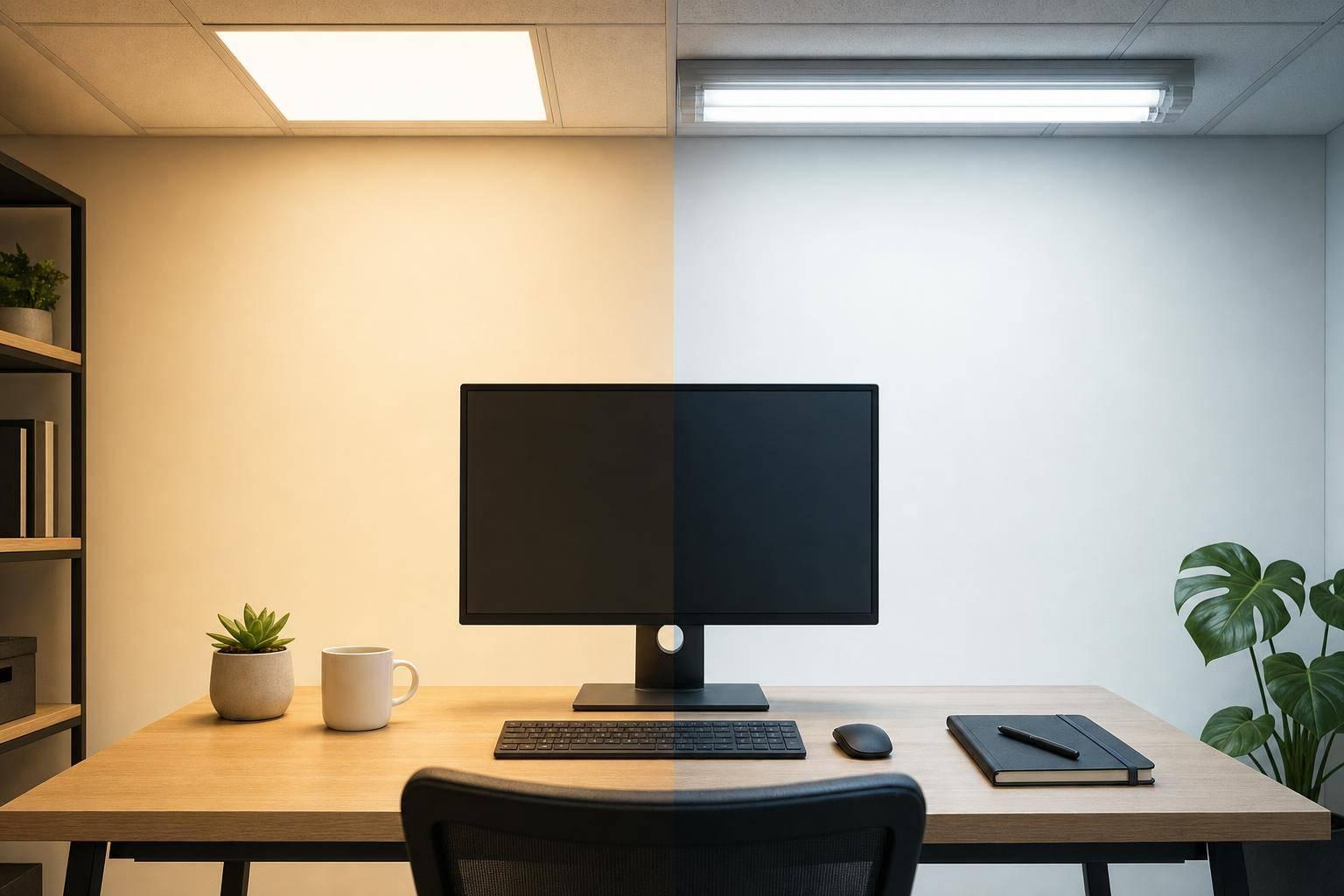
If I had to pick one for most workstations, I’d pick LED. It usually gives me lower power use, less maintenance, and better light at the bench than fluorescent. For task areas where people assemble, inspect, label, or pack parts, that can mean fewer missed defects, less eye strain, and a payback window of about 18 to 36 months.
Here’s the short version:
For workstation tasks, I’d focus on these checks first:
One of the clearest takeaways is this: fixture choice alone isn’t enough. I still need the right layout, beam spread, and target light levels for each workstation.
Quick Comparison
| Criteria | LED | Fluorescent |
|---|---|---|
| Energy use | Lower | Higher |
| Lifespan | 50,000–100,000 hrs | 15,000–30,000 hrs |
| Light spread at bench | More even | More hot spots and edge drop-off |
| Flicker/noise | Low with good driver, silent | More flicker, ballast buzz |
| Cold performance | Instant start to -40°F | Slow start, lower output in cold |
| Switching | Handles frequent on/off well | Lamp life drops with frequent cycling |
| Maintenance | Low for many years | More lamp and ballast service |
| Disposal | No mercury in lamp | Mercury handling required |
| Best fit | Most assembly, inspection, packing, and machine stations | Older systems still in place, but often a weaker long-term choice |
So if I’m comparing the two for workstations - not just general area lighting - the answer is pretty simple: LED is usually the better fit on cost, light quality, and upkeep.
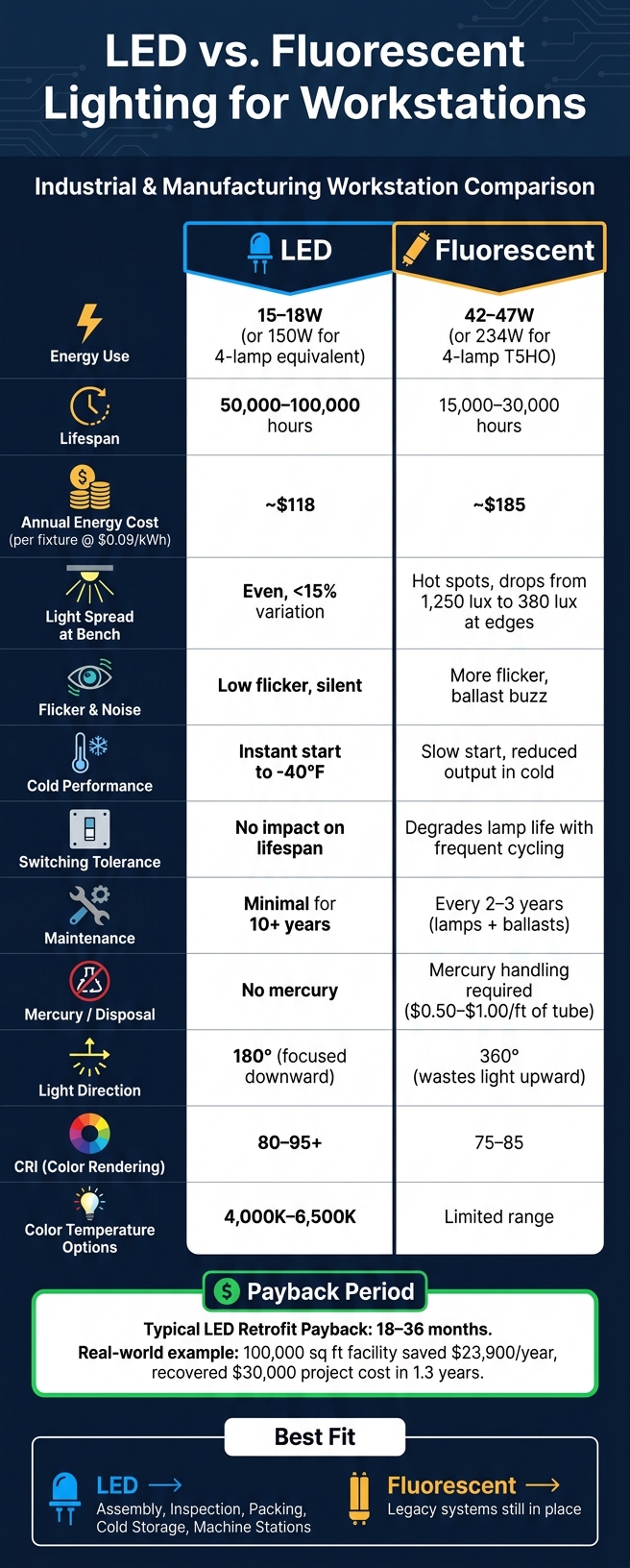
LED vs. Fluorescent Lighting for Workstations: Full Comparison
IES and ANSI/IES-RP-7-1991 set the baseline for industrial workstation lighting, and OSHA points to them for safety guidance. Those standards give us a clear way to judge LED and fluorescent lighting side by side.
The right light level depends on the job. Packaging and labeling lines may need 30 foot-candles (fc), difficult assembly often calls for 50–200 fc, and precision assembly or inspection can require as much as 600 fc.
But brightness alone doesn’t tell the whole story. Uniformity matters just as much. A work surface can look well lit at first glance, then fall off fast at the edges. With fluorescent tubes, light can drop from 1,250 lux directly under the fixture to just 380 lux at the bench edges, while LED fixtures usually keep variation to less than 15% across the same surface. That steadier spread is a big deal for assembly and inspection, where missed detail can lead to mistakes.
LEDs also send light more directly where it’s needed. That helps cut down on bright spots. For fixtures mounted at workstation height, 60° to 120° beam spreads help keep light on the task area without shining straight into a worker’s eyes.
CRI measures how accurately a light source shows color. For stations where workers handle wiring, color-coded parts, labeling, or finish inspection, a CRI of 80 to 90+ is the practical target. LEDs often land in the 80–95+ range, while standard T8 fluorescent lamps usually sit around 75–85.
CCT shapes how the workspace feels and how well details stand out. For bench work, 4,000K–5,000K tends to balance contrast and comfort. For inspection work, 5,600K–6,500K can make defects easier to spot and help workers stay alert during long shifts.
Flicker is another issue that’s easy to miss until people start feeling it. Fluorescent flicker can lead to eye strain, headaches, and a stroboscopic effect near rotating machinery. High-quality LED drivers remove visible flicker, which makes the workstation easier on the eyes over time. With those requirements on the table, the tradeoffs between LED and fluorescent lighting start to come into focus.
At the workstation, efficiency only matters when it cuts cost without making task lighting worse. That’s where LED usually pulls ahead.
A four-lamp T5HO fluorescent fixture draws 234 watts, while a similar LED fixture uses 150 watts. On top of that, many modern LED tubes deliver more than 130 lumens per watt, compared with roughly 50–100 lumens per watt for standard T8 fluorescent lamps.
| Factor | T5HO Fluorescent (4-Lamp) | Comparable LED Fixture |
|---|---|---|
| Power Draw | 234W | 150W |
| Est. Annual Energy Cost (@ $0.09/kWh) | $185 | $118 |
| Annual Maintenance Cost | $45–$60 | Minimal for 10+ years |
The cost gap gets more obvious at scale. In early 2026, a 100,000 sq ft distribution center in the Dallas-Fort Worth area replaced 200 fluorescent fixtures with LEDs and cut operating costs by $23,900 per year across energy, maintenance, and HVAC. The site recovered a $30,000 net project cost in 1.3 years.
Fluorescent systems also come with a disposal expense that’s easy to miss during planning. Mercury handling under hazardous waste rules can cost $0.50–$1.00 per foot of tube.
This is where the day-to-day difference shows up fast.
LED luminaires are usually rated for 50,000 to 100,000 hours, while fluorescent tubes tend to land in the 15,000 to 30,000 hour range. In plain terms, that means fewer service calls, fewer lift rentals, and fewer moments when someone has to stop work just to deal with lighting.
| Factor | T8/T5 Fluorescent | LED Luminaire |
|---|---|---|
| Lifespan | 15,000–30,000 hrs | 50,000–100,000 hrs |
| Maintenance Frequency | Every 2–3 years | Minimal for 10+ years |
| Operating Temp Range | 50°F to 104°F | -40°F to 113°F |
| Vibration Resistance | Low (fragile glass) | High (solid-state) |
| Switching Tolerance | Degrades lifespan | No impact |
| Ballast Failure Risk | Yes | No ballast to fail in direct-wire LED retrofits |
Cold spaces are especially hard on fluorescent. In unheated warehouses or cold storage rooms, fluorescent lamps can start slowly and may never hit full output. LED fixtures keep working down to -40°F, with no warm-up, no flicker, and no dim first few minutes at the start of a shift.
Frequent switching is another weak spot for fluorescent. Every on/off cycle chips away at lamp life. LEDs don’t have that problem, which makes them a much better match for occupancy sensors and motion-based control zones.
Not all light produced by a fixture ends up where workers need it.
Fluorescent tubes throw light in 360 degrees, so part of that output goes upward into the fixture and never helps the task below. LEDs are directional at 180 degrees, which puts more light on the work surface.
| Feature | T8 Fluorescent | LED Tube / Fixture |
|---|---|---|
| Light Direction | 360° (wastes light upward) | 180° (focused downward) |
| Warm-up Time | 30 seconds to 3 minutes | Instant (<1 second) |
| Audible Noise | Buzzing as ballasts age | Silent |
| UV Emission | Small amounts (can fade materials) | Virtually none |
LEDs also pair well with dimming and occupancy controls, and they do it without the wear that frequent switching causes in fluorescent systems. At the workstation, that leads to steadier task lighting, less noise, and no UV exposure to materials or finishes. Those aren’t small details. They shape worker comfort and can affect output quality.
That’s why this comparison points to more than a simple lamp replacement. It sets up the case for a retrofit plan.
Once LED comes out ahead on performance, the next step is getting the retrofit spec right.
Before you order a single LED fixture, document the basics by workstation zone: lamp type, fixture count, ballast age, and wattage. Also track how often lamps and ballasts fail, what those replacements cost in labor, and whether any areas need lift rentals. In high-ceiling spaces, lamp changes can run $45–$60 when labor and lift rental are included.
During the audit, flag flicker, dark spots, and glare hotspots. Don’t just note them in passing - measure them, then set targets based on what each workstation task needs.
Check the current system against the target light levels, uniformity, glare, CRI, and CCT already defined for each area. Prioritize T12 systems. U.S. production has ended, which makes replacement lamps harder to find.
Set performance targets for:
Those targets feed straight into the photometric layout.
A photometric layout turns performance targets into a fixture map. It shows where luminaires should go and what output each area needs before any hardware is bought. That matters more than it may seem. Too much light wastes money. Too little light can create compliance and safety problems.
On the cost side, utility rebates from providers such as Dominion Energy or Oncor can range from $25 to $100 per fixture. In many cases, fixtures need DLC qualification to qualify. Section 179D tax deductions can also help offset installation costs for lighting upgrades that meet the rules.
That cost model helps define the scope for fixture selection and installation.
Luminate Lighting Group supports workstation retrofits with energy audits, photometric layouts, fixture specification, rebate coordination, and 179D documentation.
For most industrial workstations, LED is the better pick. It uses much less energy, lasts far longer, and contains no mercury, which makes disposal simpler. On top of that, rules around fluorescent lighting are getting tighter, and new efficiency standards are leaning toward LED.
That said, the right LED setup still depends on the job. Required foot-candles, glare sensitivity, ceiling height, cold conditions, and controls integration all affect which fixture and color temperature fit best.
The case for LED is pretty straightforward: lower lifecycle cost, near-zero maintenance for 10+ years, better light quality for precision tasks, and a fluorescent supply chain that keeps shrinking. Rebates and 179D can also cut upfront cost and shorten payback.
It comes down to your budget, how much upkeep you want to deal with, and what you expect from the system over time.
A retrofit often makes sense for lower-budget projects or phased renovations where you want to keep the existing setup in place. A full fixture replacement is usually the better long-term move if you want stronger optical performance, the highest energy savings, and better durability. It also removes ballast-related maintenance from the equation.
Luminate Lighting Group can help you figure out which option makes the most sense for your facility and your costs.
It depends on the task.
Linear fixtures are a good fit for broad coverage across general bench areas. But inspection stations usually do better with adjustable, directional lighting.
Fixtures with pivoting heads or optics can aim light where it’s needed and keep coverage even across the work surface. That helps cut down on hot spots and eye strain.
And because LED lighting is directional by nature, it sends more light to the work surface than fluorescent systems do.
Estimate LED payback by comparing your annual savings with your net upfront cost.
Your annual savings come from two main places. First, LEDs use less electricity, based on fixture wattage, operating hours, and your local utility rate per kWh. Second, you cut many of the maintenance costs tied to fluorescent lighting, like lamp replacements, ballast repairs, labor, and equipment rental.
Your net cost is your initial project cost minus utility rebates and federal 179D tax deductions.
If you want a more exact number, Luminate Lighting Group can help with facility-specific energy audits.


