.svg)
Compare LED retrofits and new LED systems for offices — costs, energy savings, installation impact, lifespan, and when to choose each option.

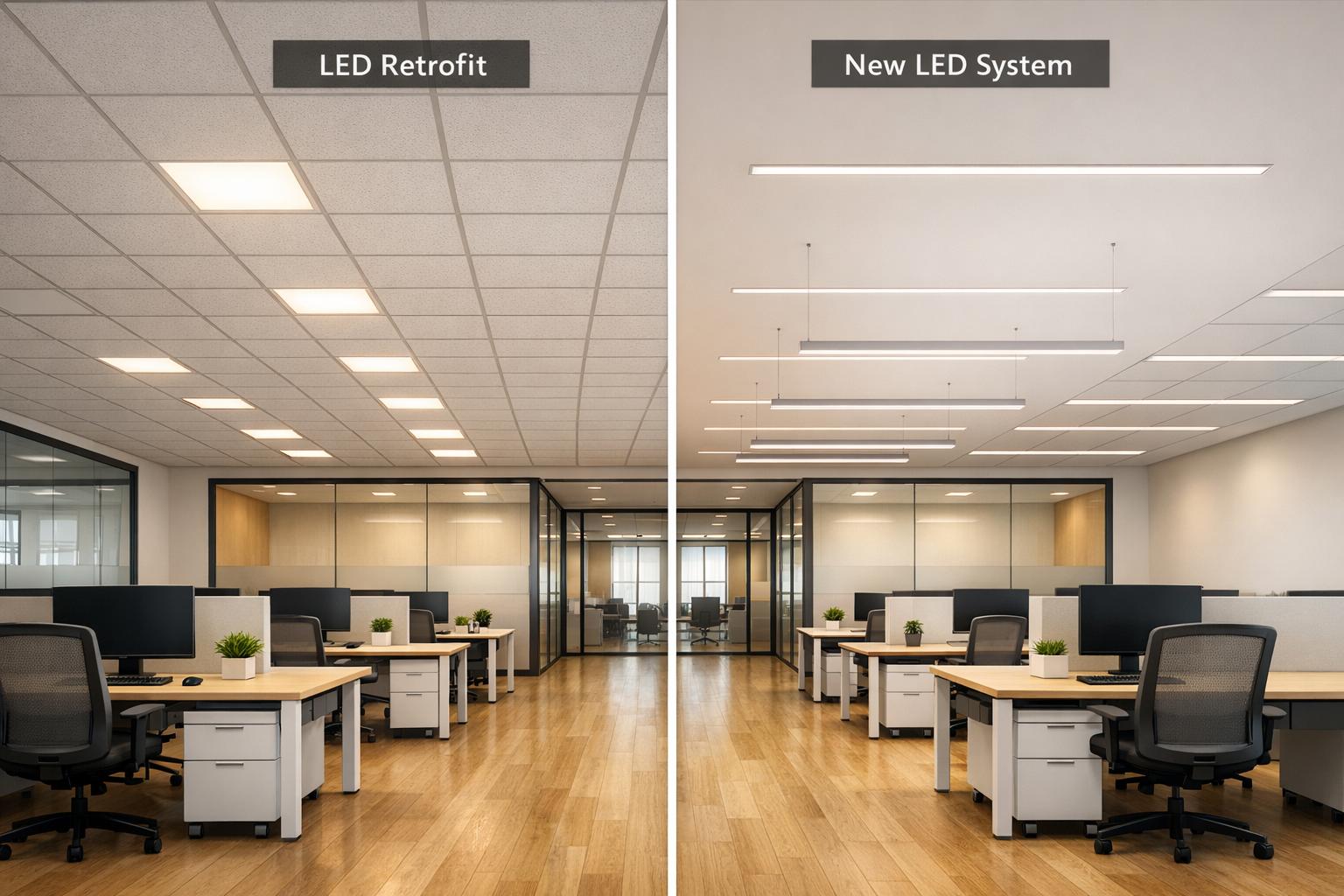
Upgrading office lighting can save energy, reduce costs, and improve productivity. But should you choose LED retrofits or install entirely new LED systems? Here’s a quick breakdown:
Key Takeaway: Retrofits are cost-effective for quick upgrades, while new systems offer better long-term value and advanced capabilities.
Quick Comparison:
| Feature | LED Retrofits | New LED Systems |
|---|---|---|
| Cost per Fixture | $40–$60 | $50–$200 |
| Installation Time | ~15 minutes per fixture | ~30 minutes per fixture |
| Energy Savings | 40–70% | 50–70% |
| Lifespan | 50,000–75,000 hours | 70,000–100,000 hours |
| Disruption | Minimal | Higher |
| Advanced Features | Limited | Built-in (e.g., sensors) |
Each option has its strengths - choose based on your budget, goals, and office needs. Our team follows a proven lighting process to help you determine the best fit for your facility.
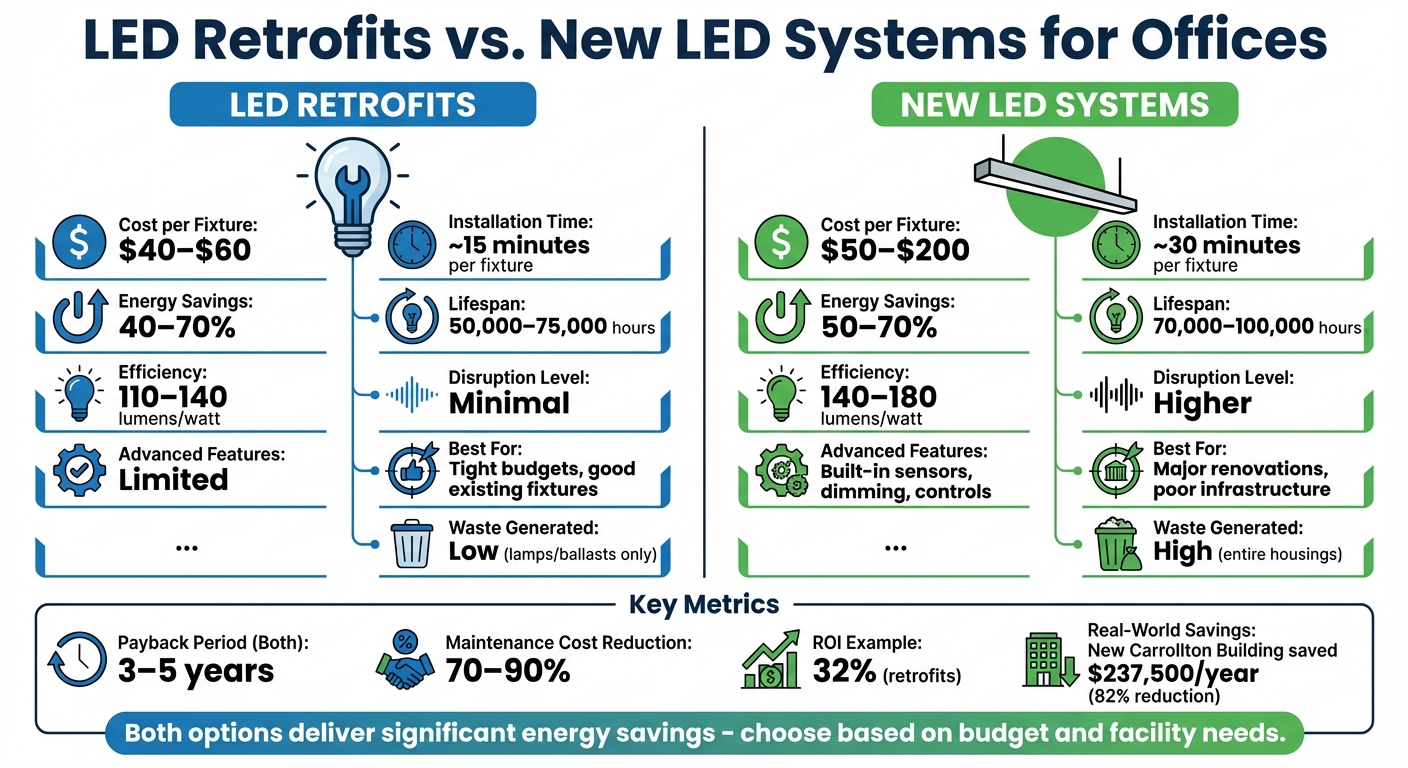
LED Retrofits vs New LED Systems: Cost, Performance & Savings Comparison
LED retrofits involve upgrading existing light fixtures by replacing internal components - like lamps, ballasts, and sockets - while keeping the original metal housing intact. This approach modernizes office troffers by installing updated LED technology inside, all while reusing the existing framework. The result? Less waste and lower disposal costs.
When it comes to retrofitting office troffers, there are three primary methods to consider. Each method replaces outdated parts with LED components that fit into the current housings:
This retrofit approach is particularly useful in buildings with challenges like asbestos-containing ceilings or specialized housings that are costly or difficult to replace. It also minimizes disruptions, as there’s no need to remove large sections of the ceiling.
One major benefit of retrofits is their lower upfront cost. LED tubes range from $6 to $12 each, while retrofit kits typically cost $40 to $60 per fixture - much less than the $50 to $200 price tag for new fixtures. Installation is also quicker and less intrusive, avoiding extensive removal of fixtures or ceiling tiles. Depending on the type of retrofit, energy savings can range from 40% to 70%.
However, retrofits do have limitations. The existing fixture’s design and optics may not be ideal for LED light distribution, potentially resulting in lower light quality compared to brand-new LED fixtures. Damaged or poorly positioned housings also remain an issue, as retrofits don’t address these structural problems. Additionally, basic lamp-only swaps may lack advanced features like dimming or occupancy sensors unless further modifications are made.
"An LED retrofit kit replaces all the components of the existing troffer except the 'shell' above the ceiling. The new components fit inside the shell of the old troffer and make it look like a brand new fixture." – Energy Performance Lighting
Next, we’ll dive into new LED systems for offices to see how they compare to retrofits.
New LED lighting systems are a complete upgrade, offering a fresh start in design and performance compared to LED retrofits. While retrofits reuse existing housings, new systems replace old fluorescent troffers entirely with fixtures specifically designed for LED technology. These fixtures integrate light engines - LED chips mounted on circuit boards - eliminating the need for traditional lamps.
This approach lets you reimagine your lighting layout from the ground up. Modern LEDs provide brighter, more even illumination, often requiring fewer fixtures and enabling a more efficient lighting design. With this foundation, it’s easier to dive into the features and performance benefits of these systems.
New LED fixtures come packed with built-in technology that retrofits can’t match. Features like integrated 0-10V or DALI drivers, occupancy sensors, and daylight harvesting capabilities are standard in these systems. The optical design is also a major upgrade, reducing glare and eliminating the uneven lighting issues - like hot spots or dark patches - that can occur when retrofitting LEDs into older fluorescent housings.
These fixtures also excel in thermal management. With advanced heat sinking and lens designs, they achieve 140–180 lumens per watt, significantly outperforming retrofit kits. Their robust design translates to durability, with lifespans ranging from 70,000 to 100,000 hours, compared to the 50,000–75,000 hours typical of retrofits.
"Fully replacing a fluorescent fixture with a new LED fixture is as easy as - or often easier than - retrofitting one. This is because there's actually more wiring involved when doing a retrofit project." – Emmalee Gagnon, ELEDLights
The main advantage of new LED systems is their long-term efficiency and reliability. These fixtures can cut maintenance and operating costs by 70% to 90% since they virtually eliminate the need for re-lamping. They also maintain 90% of their brightness at 50,000 hours, while retrofits tend to lose brightness more quickly. Energy savings are significant too, with reductions of 50% to 70% compared to traditional fluorescent systems.
However, the initial costs are higher. New LED fixtures typically cost between $50 and $200 per unit, compared to $40 to $60 for retrofit kits. Installation can also be more disruptive, as it involves removing old fixtures and disposing of bulky metal housings. On the bright side, new fixtures often qualify for larger utility rebates, which can help offset some of the upfront investment.
Next, we’ll explore the financial impact of these systems in more detail.
When comparing LED retrofits to entirely new systems, the upfront costs vary quite a bit. For retrofits, you’re looking at $40–$60 per fixture (with individual 4-foot LED tubes priced between $6 and $12 each). On the other hand, new LED fixtures come in at $50–$200 per unit. A typical retrofit project, including components, installation, and waste removal, averages about $70 per fixture.
The process for retrofitting involves bypassing ballasts and rewiring sockets, which can add some complexity. New systems simplify things in some ways by replacing the entire unit, but they also require the removal of metal housings and cleaning up ceiling debris.
| Cost Factor | LED Retrofit | New LED System |
|---|---|---|
| Hardware Cost per Unit | $6–$60 | $50–$200 |
| Total Installation Cost | ~$70 per fixture | Higher (varies by project) |
| Labor Complexity | Moderate to high (rewiring) | Moderate (full removal) |
| Disposal Costs | Minimal (lamps only) | Significant (metal housings) |
| Typical Payback Period | 3–5 years | 3–5 years |
A retrofit can save around $22.50 per fixture annually by reducing energy use from 175W to 100W, based on an electricity rate of $0.10 per kWh. That translates to a payback period of 3.1 years and a 32% ROI. Meanwhile, new LED systems can achieve even greater energy savings - 50% to 70% compared to traditional fluorescent lighting. Both options generally offer a payback period of three to five years.
These initial costs set the stage for understanding the broader benefits, like long-term savings and available financial incentives.
The financial benefits of LED systems go well beyond the initial payback period. LEDs can slash operating costs by 50% compared to fluorescent lighting. Add advanced controls like occupancy sensors or daylight harvesting, and energy savings can climb above 70%. Maintenance costs also drop significantly, as LEDs last between 25,000 and 100,000 hours - saving an estimated $50 per fixture annually in labor costs.
In addition to these savings, financial incentives can make the investment even more appealing. Utility rebates, which vary by location, can dramatically lower costs. In some cases, they bring the price of retrofit kits down to just $1 per kit. Federal tax benefits, like the 179D tax deduction, allow building owners to deduct the cost of energy-efficient lighting installations. However, utility incentives are often distributed on a first-come, first-served basis at the start of the fiscal year, so applying early is key to securing funding.
"Replacement of outdated lighting systems allows for the fastest ROI for facility managers - paying for themselves within an average of three to five years or less." – Jeff Gatzow, Vice President, Optec LED Lighting
When comparing LED retrofits to entirely new LED systems, the differences in efficiency and performance are clear. New LED systems typically achieve 140–180 lumens per watt (lm/W), outshining retrofit kits, which deliver 110–140 lm/W. This translates to a 10%–25% boost in efficiency, which can lead to considerable energy savings, especially in larger office environments.
The lifespan of these systems also varies. While LED retrofit kits generally last 50,000–75,000 hours, new LED systems extend their operational life to 70,000–100,000 hours. Additionally, new systems maintain 90% or more of their initial brightness at 50,000 hours, whereas retrofits may begin to show noticeable lumen depreciation as early as 35,000–40,000 hours. This earlier decline in brightness is often tied to less effective heat dissipation in retrofits.
Real-world examples highlight these differences. In March 2022, the GSA upgraded 11,800 fluorescent troffers in the New Carrollton Federal Building, achieving an 82% reduction in energy use. This change slashed the annual lighting bill from $291,000 to $53,500. Similarly, a Hamilton office installed 40W LED retrofit kits, saving 20,100 kWh annually and recouping their investment in just 18 months.
| Criteria | LED Retrofit | New LED System |
|---|---|---|
| Energy Efficiency | 110–140 lm/W | 140–180 lm/W |
| Expected Lifespan | 50,000–75,000 hours | 70,000–100,000 hours |
| Lumen Maintenance | ≥90% at 35,000–40,000 hours | ≥90% at 50,000 hours |
| Typical Energy Savings | 20%–60% | 60%+ (with controls) |
These figures underscore how performance differences directly impact energy savings and system reliability over time.
Heat management plays a critical role in maintaining LED performance. New LED systems are designed with dedicated heat sinks that effectively dissipate heat, ensuring the diodes stay cool. This helps protect brightness levels and extends the system's lifespan. On the other hand, retrofit kits often reuse housings originally designed for fluorescent tubes. These older designs can trap heat, leading to higher operating temperatures and faster degradation of the LEDs.
"Old parabolic troffers, HID high bays, or fixtures that use magnetic ballasts were never engineered for today's LED thermals and optics." – LumaEnergy
Compatibility is another area where retrofits can fall short. Older components, such as ballasts, sockets, and reflectors, may not match the needs of modern LEDs. For instance, outdated reflectors and sockets can block 25%–35% of the light output, reducing overall efficiency. In contrast, new LED systems replace these legacy components with hardware specifically built for LED technology. They also integrate effortlessly with advanced controls, like occupancy sensors and daylight harvesting, enabling energy savings to exceed 70%.
LED retrofits are designed to be installed quickly and efficiently. Most fixtures can be updated in just 15 minutes, as the existing metal housing and wiring remain intact. The process focuses on replacing internal parts - such as lamps, ballasts, or drivers - without needing to disturb the ceiling infrastructure.
In contrast, installing new LED systems takes about 30 minutes per fixture and involves more intensive labor. This process requires fully disconnecting and removing old hardware, including large metal housings. Installers often need to move ceiling tiles, which can stir up dust and debris.
The waste generated also varies significantly. Retrofits produce minimal waste, typically limited to old lamps and ballasts. On the other hand, new installations result in larger volumes of waste, including entire metal housings that may require dumpsters or off-site disposal. Both methods must follow strict disposal protocols for fluorescent tubes due to their mercury content.
| Feature | LED Retrofit | New LED Fixture |
|---|---|---|
| Installation Time | ~15 minutes per fixture | ~30 minutes per fixture |
| Labor Complexity | High internal wiring (ballast bypass) | High physical labor (housing removal) |
| Ceiling Disturbance | Minimal to none | Significant; requires moving tiles |
| Waste Volume | Low (lamps/ballasts only) | High (entire metal housings) |
These differences in installation affect both costs and downtime, making it essential to plan carefully for the specific needs of your project.
The installation process has a direct effect on office productivity. LED retrofits cause minimal disruption since the work can be done through existing ceiling cut-outs. This makes it easy to schedule installations after hours or in phases, such as completing one floor or area at a time. As a result, employees can continue working with little to no interruption.
New system installations, however, require more coordination. Gaining ceiling access, removing old hardware, and cleaning up work areas can temporarily disrupt operations. While both retrofits and new systems can be installed on weekends or in phases, retrofits are particularly advantageous for buildings with infrastructure concerns, like asbestos in ceilings. In such cases, avoiding ceiling disturbances helps sidestep the additional costs and complexities of handling hazardous materials.
LED retrofits make maintenance simpler by allowing easy replacement of components without altering the existing housing. However, Type A retrofits come with a drawback: if the ballasts are older than five years, they may fail prematurely, leading to unexpected maintenance and higher labor costs.
On the other hand, new LED systems eliminate these issues entirely. By replacing all legacy components - like ballasts, outdated wiring, and worn sockets - these systems are built specifically for LED technology. They’re designed with advanced heat dissipation, which protects the LED chips and drivers, significantly extending their lifespan. These systems often last between 50,000 and 100,000 hours, meaning that in facilities operating 24/7, replacements are only needed every 5–10 years. This is a huge improvement compared to the frequent lamp changes required with older lighting technology. Maintenance costs can drop by as much as 80% to 90% after upgrading to LED. Additionally, the improved light distribution of new systems often allows for a reduction in the total number of fixtures, cutting down on future maintenance needs.
These durability and maintenance benefits pair well with the environmental gains offered by both strategies.
Both LED retrofits and new systems contribute to environmental goals, but in different ways. Retrofits shine when it comes to reducing material waste. By reusing existing metal housings, they help keep these materials out of landfills. This aligns closely with principles of material conservation and the circular economy.
New LED systems, however, focus on achieving maximum energy efficiency. While they do involve the disposal of old housings and the production of new ones, they deliver substantial energy savings - often 60% or more. They also integrate easily with advanced controls like occupancy sensors and daylight harvesting systems. Since LEDs emit almost no heat, they can also reduce HVAC energy use. Over decades, the energy savings from these systems can offset the environmental costs associated with manufacturing new fixtures.
Both options provide meaningful sustainability benefits, reinforcing the long-term value of investing in LED upgrades.
When balancing cost and performance, LED retrofits can be a smart choice for certain office setups. They’re particularly effective when the existing housings, like fluorescent troffers, are still in good condition. By retrofitting, you can achieve energy savings between 20% and 60% without needing to replace the entire fixture. Plus, retrofits are budget-friendly, with costs ranging from $0.50 to $1.50 per square foot, compared to the $2.00 to $5.00 per square foot price tag for complete replacements.
In offices where infrastructure constraints make major changes difficult - like spaces where ceiling disruption isn’t an option - retrofits become the practical solution. They’re also ideal for projects with tight budgets, as they involve lower upfront expenses and often pay for themselves in energy savings within two years or less. For offices looking to prioritize energy efficiency without a large initial investment, retrofits strike the right balance.
On the other hand, completely new LED systems shine in scenarios involving major renovations or office redesigns. If your office is undergoing a transformation - like reconfigured layouts, changes in ceiling height, or a fresh aesthetic overhaul - new fixtures allow you to rethink the entire lighting design. Modern LED panels and troffers not only improve light quality but can also reduce the total number of fixtures needed for proper illumination.
New systems are also the go-to option for offices that need advanced lighting controls. Integrated fixtures are built to support features like occupancy sensors, daylight harvesting, and networked controls, pushing energy savings past 70%. Retrofitted fixtures, which often rely on older wiring, can’t easily accommodate these smart technologies.
A great example of the benefits of new systems comes from the New Carrollton Federal Building in Lanham, Maryland. Here, 11,800 fluorescent troffers were replaced with LED fixtures equipped with advanced controls. The result? The annual lighting bill dropped from $291,000 to $53,500, an impressive 82% reduction. While new systems involve higher upfront costs, the long-term savings and advanced capabilities make them worthwhile for offices prioritizing efficiency and modern features.
In November 2015, Princeton University undertook a lighting upgrade at the Carl Icahn Laboratory, a 98,000-square-foot research facility. The building was equipped with 815 recessed 2x2 troffers, 550 linear T8 fixtures, and 245 CFL downlights. These fixtures not only drove up maintenance costs but also lacked efficient lighting controls. For instance, the specialized U-lamps were expensive to maintain, and large switching zones unnecessarily illuminated entire floors, wasting energy. The goal of the project was to cut energy costs, enhance lighting control, and avoid disturbing the ceiling plenums, which could pose hazards.
Some CFL downlights required high-lumen output, which only specific LED retrofit kits could meet, making retrofitting the most practical choice. The team selected MaxLite LED retrofit kits for the troffers and Cree UR Series for the linear fixtures. Wireless occupancy sensors were also integrated to ensure lighting was only used where necessary. These decisions laid the groundwork for significant energy savings, as shown in the results.
The results were impressive: Princeton's retrofit reduced energy use by 62%, achieved a payback period of under four years, and prevented nearly 100 metric tons of CO₂ emissions annually. This was accomplished with minimal disruption to the facility.
In contrast, New Carrollton took a different approach, opting to completely replace 11,800 fluorescent troffers. This led to an even greater 82% reduction in energy use, slashing the annual lighting bill from $291,000 to $53,500. Although this required a larger initial investment, the new system's integrated controls and optimized design delivered outstanding efficiency. These two cases highlight how factors like budget and potential disruptions influence whether retrofitting or full replacement is the better choice.

Luminate Lighting Group focuses on LED retrofits and full system replacements tailored for office environments. Each project begins with an energy audit designed to uncover potential issues, such as aging wiring, outdated sockets, or compatibility problems that might otherwise go unnoticed.
"Retrofitting depends on existing wiring and controls, which often possess lurking issues you're not aware of until you're in the middle of installing." - Scott Moore, Vice President, lightbulbs.com
From start to finish, Luminate manages every aspect of the process. They handle custom lighting designs, develop photometric layouts, specify fixtures and controls, and ensure compliance with all current energy codes. This all-in-one approach simplifies the decision-making process, helping clients determine whether retrofitting or replacing is the best fit based on the building's specific needs. For many offices, Luminate suggests a hybrid strategy - retrofitting standard spaces while replacing fixtures in areas like lobbies or hard-to-reach spots to maximize impact.
This method not only improves energy efficiency but also sets the stage for taking full advantage of financial incentives.
Luminate Lighting Group’s integrated audit and design process doesn’t just enhance lighting performance - it also ensures clients get the most out of available financial benefits.
Their team helps navigate the often-complicated world of utility rebates and 179D tax deductions. Many utility providers offer tiered rebate programs, which tend to reward full fixture replacements over retrofits. These rebates often require specific DLC (DesignLights Consortium) certifications to qualify for the highest savings. Luminate identifies compliant products and structures projects to maximize these rebates.
Additionally, Luminate simplifies the process of securing 179D tax deductions, which can provide significant tax savings for energy-efficient upgrades. By taking care of the necessary documentation and ensuring compliance, Luminate reduces the administrative workload. This support can be the difference between a project that barely breaks even and one that yields meaningful long-term savings. Notably, full replacements often deliver a better return on investment within 3–5 years compared to retrofits.
When deciding between LED retrofits and new lighting systems, the best choice depends on your office's current condition, budget, and long-term goals. If your existing fixtures are in good shape and you’re working with limited upfront funds, retrofits can cut energy use by 40%–60% while keeping disposal costs low. On the other hand, if your office is being redesigned, your fixtures are in poor condition, or you want advanced smart features like occupancy sensors and daylight harvesting, new systems are the better option. They provide 50%–70% energy savings, better heat management, and easier installation. Plus, new systems often require fewer fixtures, simplifying future maintenance.
To choose the best approach, consider your facility's specific needs and energy goals. Whether your priority is cutting costs, improving aesthetics, or integrating smart technology, make sure your decision aligns with those objectives. Testing sample fixtures in one area can help ensure the light quality and compatibility meet your expectations. Additionally, look into utility rebates early in the process - they can cover 20%–50% of your project costs and often favor full replacements over retrofits.
To figure out whether your office fixtures are ready for an LED retrofit, start by assessing their condition. They should be structurally intact, not overly old, and free from significant damage. Fixtures such as fluorescent troffers with functioning ballasts are typically a good match, as long as you confirm ballast compatibility and check the wiring setup. Also, make sure the fixtures have enough space to fit the new LED components and can deliver the lighting performance you need.
By installing high-efficiency LEDs and ensuring compliance with energy reduction standards through proper certification, you can unlock 179D tax deductions - potentially reaching up to $5.00 per square foot. Beyond the tax perks, this strategy also boosts your chances of qualifying for utility rebates, making it a powerful way to combine energy savings with financial benefits.
To incorporate occupancy sensors and daylight harvesting effectively, consider wireless occupancy sensors. These can be mounted on walls or ceilings and help cut energy consumption by dimming or turning off lights when no one is in the room. For daylight harvesting, integrated daylighting systems equipped with calibrated photosensors automatically adjust artificial lighting based on the amount of natural light available, potentially reducing energy use by up to 60%. Pairing these technologies with LED retrofits can further boost energy efficiency and ensure compliance with lighting codes.


