.svg)
LED retrofits cut energy use 60–75%, ensure IECC/ASHRAE compliance, and shorten payback to 1–3 years with rebates and 179D incentives.

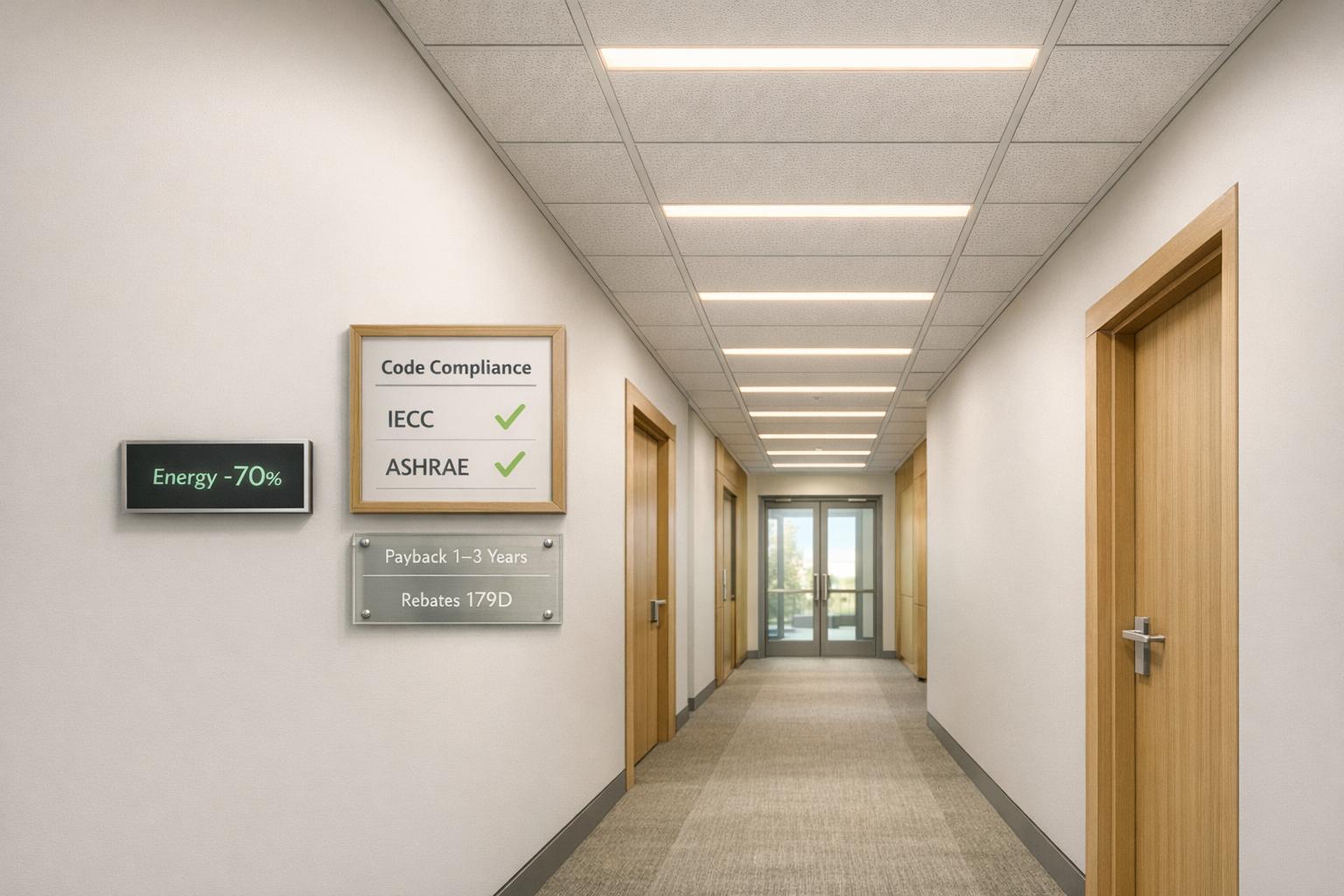
Switching to LED lighting isn’t just about energy savings - it’s often required to meet stricter energy codes like IECC 2021 or ASHRAE 90.1-2022. Non-compliance can lead to fines of up to $1,000 per violation, but retrofitting outdated systems with LEDs through our proven process can help you avoid penalties while slashing energy costs by 60–75%.
Here’s the bottom line:
LEDs also last longer, lower maintenance needs, and improve lighting quality. For businesses, this means lower electricity bills, compliance with energy codes, and long-term savings. Don’t wait - delaying upgrades means higher energy costs and lost savings every month.

LED Retrofit Costs, Savings, and ROI Breakdown for Commercial Buildings
Switching to LED lighting involves an initial investment, but the long-term energy and maintenance savings can make it worthwhile. The upfront costs typically include fixtures, labor, and materials. While these costs vary depending on the project, the energy savings and reduced maintenance needs often offset the initial expense fairly quickly.
LED retrofits are known for their ability to lower electricity usage and extend the lifespan of fixtures. This means fewer replacements and reduced labor costs over time.
Another major financial incentive comes from Section 179D tax deductions, which can significantly improve your return on investment. For the 2025 tax year, deduction rates range from $0.58 to $5.81 per square foot, depending on energy savings achieved and compliance with prevailing wage and apprenticeship requirements. For instance, a 25,000-square-foot building that meets the minimum 25% energy savings threshold could qualify for deductions between $14,500 and $145,250.
Here’s a quick breakdown of potential tax benefits by building size:
| Building Type | Square Footage | 179D Deduction Range |
|---|---|---|
| Small Office | 10,000 sq. ft. | $5,800 – $58,100 |
| Mid-Size Office | 25,000 sq. ft. | $14,500 – $145,250 |
| Large Warehouse | 50,000 sq. ft. | $29,000 – $290,500 |
Building owners can refine these estimates using tools like the Department of Energy's 179D Portal for both new construction and retrofits. For existing structures, the U.S. EPA's ENERGY STAR® Portfolio Manager® can provide utility data before and after retrofits, which is essential for the alternative compliance pathway. These tools make it easier to evaluate the financial benefits and weigh the overall value of an LED retrofit.
For a detailed, customized analysis, reach out to Luminate Lighting Group.
Utility rebates and tax incentives can significantly reduce the cost of LED retrofits, often by 30–70%. These programs are designed to promote energy-efficient upgrades, helping building owners meet energy codes without breaking the bank. In 2023 alone, U.S. utility rebates for lighting efficiency projects amounted to over $1.2 billion, with LEDs accounting for 65% of those funds. Let’s break down how these savings work.
Utility rebate programs typically provide incentives based on energy savings or specific fixtures. For instance, Duke Energy offers approximately $75 for each high-bay LED fixture, while Southern California Edison provides about $0.08 per kWh saved. These rebates can often be combined with Section 179D tax deductions, creating a powerful cost-reduction strategy.
Here’s a real-world example: In 2023, Luminate Lighting Group retrofitted a 200,000 sq. ft. municipal warehouse. The project received $150,000 in utility rebates through Southern California Edison and an $800,000 Section 179D deduction. These incentives slashed the $1.2 million project cost by 78%, leaving a net expense of $260,000. Thanks to $450,000 in annual energy savings, the payback period was just 1.2 years.
Navigating these rebate and deduction programs is essential for lowering retrofit costs and ensuring energy code compliance. Luminate Lighting Group simplifies this process by offering free energy audits, pre-qualifying projects for rebates, and preparing all Section 179D documentation with licensed engineers for IRS certification. Their streamlined approach often secures rebate approvals within 4–6 weeks and has helped industrial clients cut costs by 60% through stacked incentives.
To maximize savings, check the DSIRE database for local rebate programs and involve a 179D-eligible designer early in your planning - this typically requires 10–15% of your project budget. With performance-based rebates increasing by 20% annually since 2022, thanks to updated energy codes, the financial benefits of LED retrofits are only getting stronger.
LED retrofits for code compliance come with their own set of trade-offs, affecting both budgets and operational strategies. Building on the earlier discussion around costs and savings, let’s break down the distinct advantages and disadvantages of LED retrofits.
The standout benefit is their long-term savings. LEDs are 6–7 times more energy-efficient than incandescent bulbs and boast a lifespan exceeding 50,000 hours - about 50 times longer than traditional options. This makes them particularly effective in areas where lighting is used continuously. Michael Mar, an Electrical Engineer at Environmental Systems Design Inc., sums it up well:
Despite higher initial costs, this luminaire can be the most economical choice over time.
That said, the initial cost remains a significant barrier. For projects where upfront costs are the primary concern, this can be a limiting factor. Additionally, outdoor retrofits may require additional light poles, as some LED replacement heads don’t match the initial lumen output of a 400 W high-pressure sodium lamp, which can deliver up to 2.5 times the lumens.
| Aspect | Advantages | Disadvantages |
|---|---|---|
| Cost-Effectiveness | Significant energy savings; reduced maintenance; potential utility rebates to offset costs. | High upfront costs; outdoor applications may require additional light poles. |
| Energy Efficiency | 6–7× more efficient than incandescent bulbs; lower cooling loads due to reduced heat; ideal for continuous use. | Performance may vary by manufacturer; compliance with standards like LM-79 and LM-80 is required. |
| Code Compliance | Meets strict Lighting Power Density limits; dimmable (20%–100%); instant-on response works well with occupancy sensors. | May require advanced controls (e.g., occupancy or photo sensors), increasing installation complexity. |
| Durability | Lifespan of over 50,000 hours; resistant to vibration and breakage; handles frequent on/off cycling well. | Light output diminishes over time; replacement needed when output falls to about 70% of initial levels. |
The regulatory landscape has also tightened. For instance, ASHRAE 90.1-2013 reduced Lighting Power Density limits to 1.26 W/sq. ft. for retail spaces (down from 1.4) and 0.82 W/sq. ft. for offices (down from 0.9). LEDs generally meet these stricter requirements more easily than traditional lighting solutions. However, incorporating advanced controls - such as occupancy or photo sensors - can add layers of complexity to installation.
The potential payoff is huge. If LEDs were widely adopted across the U.S., the savings could exceed $30 billion annually at current electricity rates. These figures highlight the importance of thoroughly evaluating LED retrofit projects as part of a broader energy compliance strategy.
LED retrofits offer impressive financial returns, even when the upfront costs are on the higher side. While the initial investment typically ranges from $50 to $150 per fixture, the benefits are hard to ignore. With energy savings of 40–60%, maintenance reductions of 70%, and payback periods between 2–4 years, they’re a solid long-term choice for commercial facilities. For example, a 10,000 sq. ft. warehouse could save $5,000–$10,000 annually at an electricity rate of $0.12/kWh. This means a $20,000 investment could pay for itself in less than three years.
The financial appeal grows even stronger when you include utility rebates and tax incentives. Utility rebates, which average between $0.50 and $2.00 per watt, along with 179D tax deductions of up to $1.88 per sq. ft., can reduce net costs by 20–50%. These incentives can shorten the payback period to just 1–2 years for projects that meet code requirements. For instance, a 50,000 sq. ft. facility retrofitting 1,200 fixtures significantly lowered its costs and achieved a three-year payback.
To make the most of these financial benefits, it’s crucial to customize your retrofit strategy. Different facilities and budgets require different approaches. Lamp retrofits are a cost-effective option for offices, delivering 30–40% energy savings. On the other hand, full fixture replacements in warehouses or industrial spaces can achieve 70% savings and improved lighting quality. Start with a professional energy audit to understand your current energy use, focus on high-hour fixtures, and ensure you select DLC-listed LEDs to qualify for incentives. Projects with payback periods under three years are ideal for maintaining healthy cash flow. This approach not only aligns with energy code requirements but also maximizes operational savings.
For facilities like warehouses, industrial spaces, or municipal buildings that need specific solutions, working with experts such as Luminate Lighting Group can simplify the process. Their services - including energy audits, rebate management, and turnkey installation - help ensure you maximize 179D deductions while meeting both compliance and sustainability goals. Don’t wait - every month you delay adds unnecessary energy costs and lost savings.
New lighting controls might not always be mandatory to comply with codes when using LEDs. That said, incorporating features like occupancy sensors or daylight harvesting can significantly increase energy efficiency and assist in meeting certain energy codes and regulations. Be sure to check your local code requirements to decide if adding controls is necessary for your retrofit project.
To qualify for the 179D tax deduction, your project needs to meet specific energy efficiency standards. This involves certification through energy modeling and verification by a third party. Both interior and exterior lighting upgrades must adhere to energy codes to ensure compliance and eligibility for the deduction.
To figure out your building’s payback period, focus on a few important elements: energy savings from using less power, lower maintenance costs, and initial expenses like fixtures and labor, which usually range from $3 to $8 per square foot. Don’t forget to include rebates and tax incentives, such as Section 179D deductions, to help reduce upfront costs. Once you’ve accounted for these, calculate the simple payback period by dividing your net project costs by the annual savings. This will give you a clearer idea of how long it’ll take to recoup your investment.


