.svg)
How LED retrofits restore aviation lighting compliance—reducing outages, glare, and energy use while meeting FAA standards.

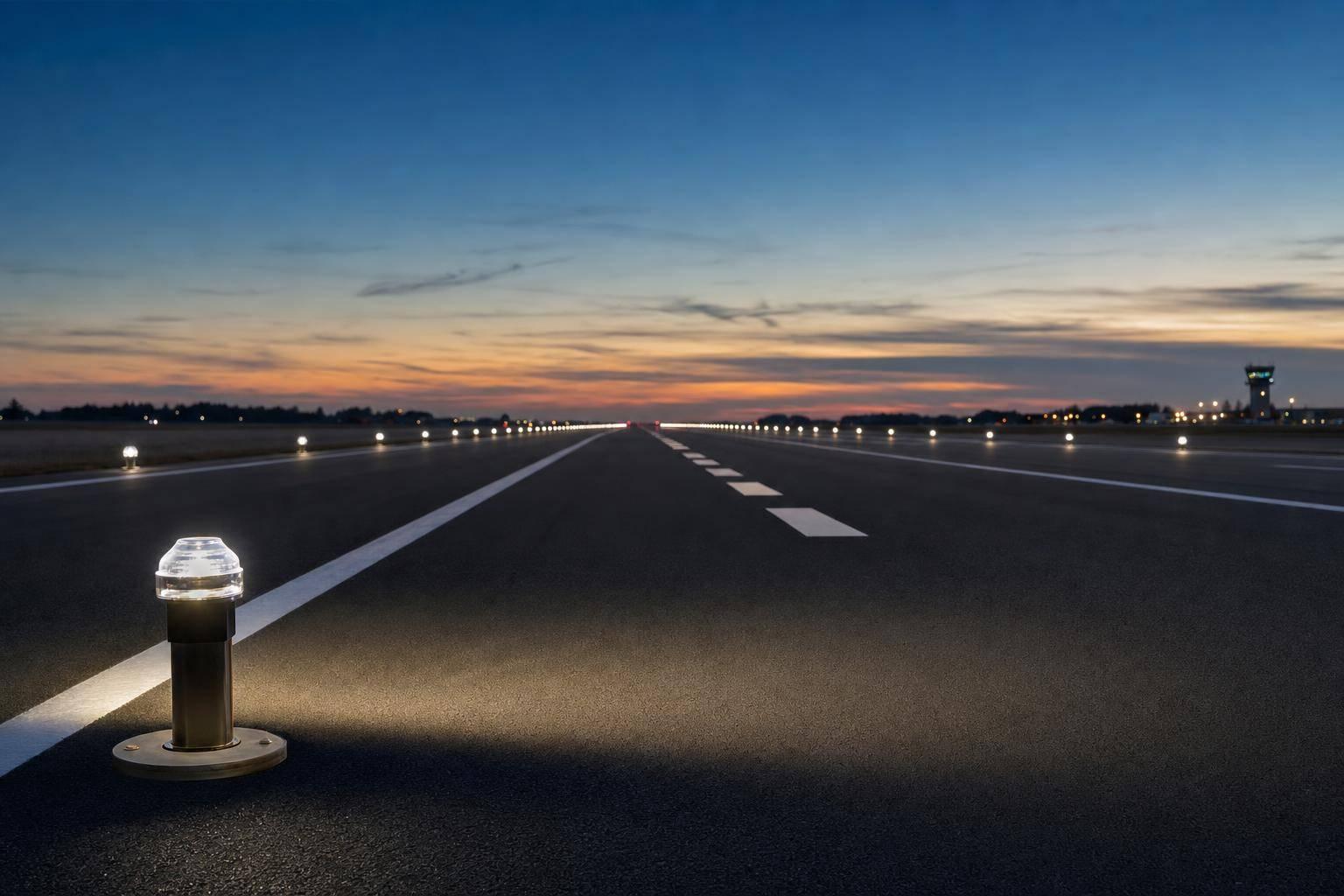
Old aviation lights often fail code for three simple reasons: not enough light, too much glare, and too many outages. If I had to sum it up fast, that’s the issue - and LED retrofits fix it by cutting power use, holding light levels longer, and reducing failure points in hangars, aprons, heliports, and obstruction sites.
Here’s the short version:
What I take from this article is simple: LED retrofits are not just about lower electric bills. They are a code, safety, and maintenance fix at the same time. The main job is to match the fixture, controls, and circuit design to the site, then document the work well enough to show compliance.
That’s the core idea behind everything that follows.

Older aviation lighting usually slips out of compliance in three main ways: light levels drop, coverage gets uneven, and warning signals stop working the way they should. On the ground, that tends to show up as three direct compliance failures: low light, unsafe glare, and warning systems you can't count on.
As metal-halide and incandescent lamps get older, they lose output. Over time, inspection zones, apron positions, and movement areas can fall below code-required lighting targets.
ANSI/IES RP-37-2025 sets specific targets by zone. Engine test areas need 100 lux at 2:1 uniformity, while commercial apron parking positions need 20 lux at 4:1. The standard also recommends two-direction lighting for aircraft parking positions to cut down on shadows.
Glare makes the issue worse. During aircraft movement, pilot-line-of-sight intensity should stay below 25,000 candelas. At tower windows, luminous intensity should stay below 1,500 candelas. Older fixtures without cutoffs or shielding often go past those glare limits.
The same kind of compliance drift shows up in exterior warning systems, where a single failed light can affect the whole site.
Tower and rooftop warning lights have to run without interruption. If a beacon fails, ATC must issue a NOTAM and send out maintenance. Each outage becomes a compliance event. It also adds labor cost and can interrupt normal operations.
Frequent burnout cycles make the problem pile up. Crews have to reach elevated structures over active areas, which adds labor cost and safety risk every time a lamp fails.
Beyond light levels and warning signals, older systems also put pressure on budgets and maintenance schedules.
Legacy systems use a lot of power. A Medium Intensity Approach Lighting System (MALSR) running on incandescent lamps draws about 14,000 watts. The same system switched to LED drops to about 4,000 watts - a 71% reduction. That gap affects both operating cost and code alignment, especially as energy codes put tighter limits on inefficient systems.
Maintenance access adds another layer of compliance risk. Incandescent lamps are rated for only about 2,000 hours, so service cycles come around often. That means more lift equipment, more crew coordination, and more work over active ramps or restricted areas.
And as incandescent supply keeps shrinking, parts availability turns into one more compliance problem. Those failures set up the retrofit needs covered in the next section. Our proven process for lighting solutions ensures these transitions remain compliant and efficient.
LED retrofits fix these issues in a pretty direct way. They improve light output where it matters, cut harsh glare, and reduce the number of failures that turn into service calls or code problems.
With zone-specific optics and a photometric model, LED retrofits can hit the required light levels and uniformity without throwing spill light beyond the intended area.
Before installation, a photometric layout shows whether the design will meet target light levels and uniformity across hangars, ramps, and maintenance areas. That gives teams a way to check compliance before anything goes in.
LEDs also help with recognition in fog, rain, and other low-visibility conditions. Compared with incandescent sources, they deliver steadier visibility.
Another plus: LED output stays stable over its rated life.
The same optical control that helps work areas can also improve warning lights.
Modern LED fixtures use tighter optics and dimming control to cut glare while still keeping the required visibility. FAA dimming curves and PWM control intensity without the color shift you get when incandescent lamps are dimmed.
LED obstruction retrofits also cut outage risk in a very practical way. These fixtures use clusters of individual diodes, and many are built to stay within FAA brightness specifications even if up to 25% of the diodes fail. So one failed part is less likely to turn into a compliance outage.
For military and emergency operations, red LED obstruction lights still need dedicated IR emitters to stay compatible with NVGs and EFVS.
After a fixture meets code, the next big win is lower power use and fewer maintenance trips.
LED rotating beacons can use up to 65% less power than incandescent equivalents. Replacing older VASI systems with LED PAPI units cuts power consumption by 60% to 70%.
Longer lamp life also means fewer outages. LED sources offer instant-on performance and a typical lifespan of about 50,000 hours, which cuts the need for maintenance-related closures compared with 2,000-hour incandescent lamps. In plain terms, that means fewer climbs, fewer closures, and less service work in hard-to-reach areas.
Built-in tell-tale relays can flag lamp-status changes right away, shifting maintenance from reactive to planned.
Once the retrofit fixes the lighting issue, the next job is proving it meets code. That work starts before any fixture goes in.
Review the FAA, NEC, and IES rules that apply to the site first. Then run a site audit to log the existing fixtures, mounting heights, power feeds, and structural conditions. From there, use that field data in a photometric simulation based on tested fixture data. This lets the team see how the new LED layout is likely to perform before installation.
The model should check illuminance, uniformity, and glare against code targets. Put simply, the photometric model is the dry run. It shows whether the design will pass before the crew ever opens a box.
Fixture choices need to match both the code and the site conditions. Each one should solve a clear operating risk.
Controls need to fit the facility's operating schedule and follow FAA-revised dimming curves so the system stays within FAA and IES glare limits.
Circuit load needs a close look too. Lower wattage can make it tempting to pack more fixtures onto existing circuits, but that can backfire fast. Recalculate total load and voltage against the existing Constant Current Regulators (CCRs) before the design is locked in.
After fixture and control selections are made, document them before installation starts.
Documentation is what turns the project from "installed" into provably compliant. Keep specifications, photometric reports, commissioning records, and test results to support inspections and certifications, including Part 139 Airport Certification and possible utility rebate applications.
After installation, technicians should verify rotation speed, flash signatures, and color wavelengths with portable photometers. Smart monitoring tools can help here too. For example, tell-tale relays that send lamp status straight to the airfield lighting control system can create a running record of compliance.
New LED installations should also be recorded in the U.S. Chart Supplement and the Terminal Procedures Publication (TPP) so pilots are aware of the LED lighting. A qualified retrofit partner can manage the audit, design, documentation, and commissioning work.
Those records make the retrofit simpler to verify, maintain, and defend over time.
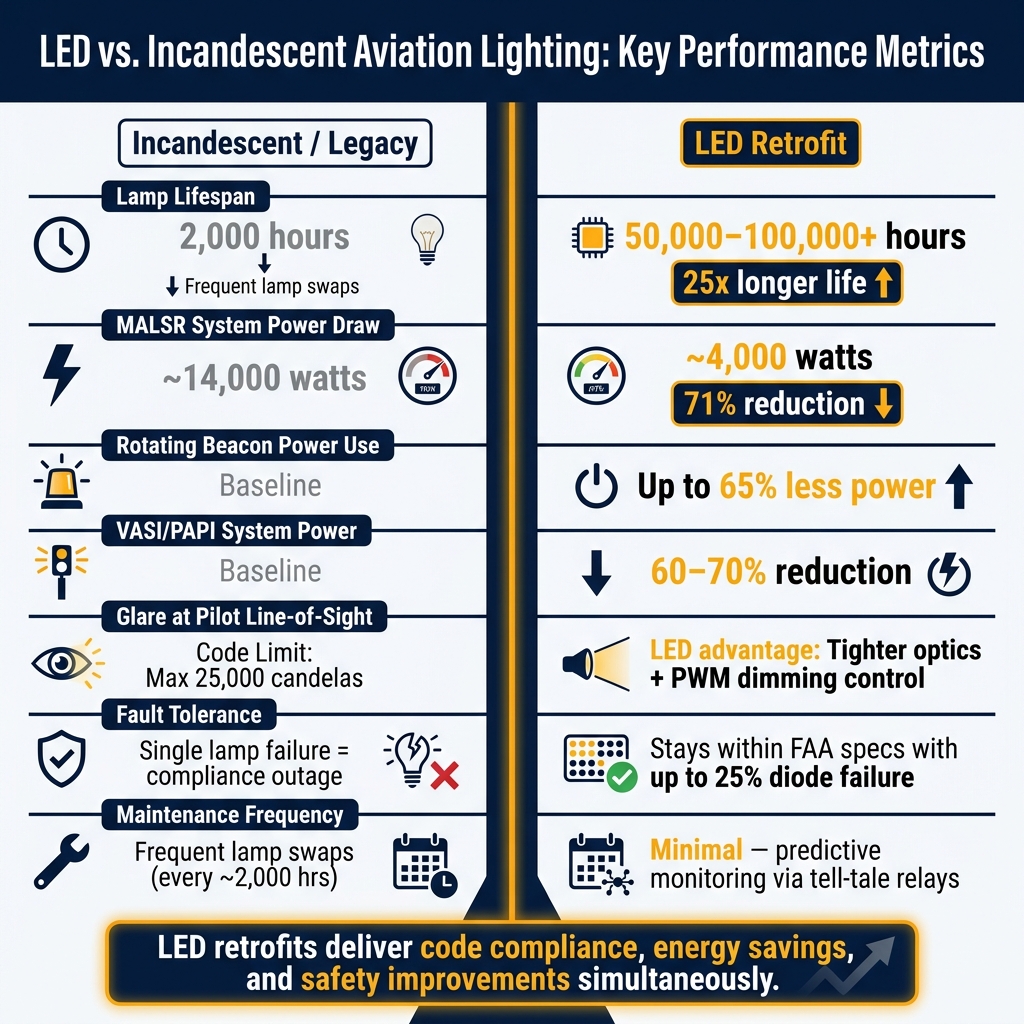
LED vs. Incandescent Aviation Lighting: Key Performance Metrics
Once the retrofit is documented, the payoff starts to show up in day-to-day operations. You see it in power use, maintenance workload, and a steadier path to compliance.
A compliant LED retrofit can cut energy use in a clear, measurable way. A Medium Intensity Approach Lighting System (MALSR), for example, can drop from 14,000 watts to roughly 4,000 watts after moving to LED lighting. That works out to a 71% reduction in energy draw.
The maintenance side matters too. LED fixtures are rated for 50,000 hours, which is about 25 times longer than the 2,000-hour life of a standard incandescent lamp. In plain terms, that means fewer lamp swaps, fewer service calls, fewer shutdowns, and less tower-climb exposure for crews.
The safety side of the equation matters just as much as the lower power bill. LEDs give pilots higher contrast and more dependable recognition in fog, haze, and other low-visibility conditions.
Monitoring tools also help crews stay ahead of problems. Features such as tell-tale relays can flag failures before a pilot has to report them, which shifts maintenance from reactive work to predictive work. The result is fewer unplanned outages and less time spent chasing faults by hand.
For facility owners and managers, the case is pretty direct: a compliant LED retrofit cuts operating cost, improves visibility, and lowers compliance risk. In aviation lighting, energy savings and safety are tied together by the same target: compliance.
Yes. LED retrofits for airport lighting must meet FAA standards for safety, reliability, and compliance.
Some LED bulbs may be FAA-approved. But that alone isn’t enough. Equipment like beacons and taxiway fixtures also has to meet specific photometry and certification rules, including AC 150/5345-46.
Using compliant, certified equipment helps airports keep operational certification in place and avoid regulatory problems.
Verify that the equipment meets the FAA Advisory Circulars that apply to it, such as AC 150/5345-46 or AC 150/5345-43J, along with Engineering Briefs like EB 67. The equipment should also have ETL certification.
Just as important, document the results of functional testing. That includes items like rotation speed, flash signature, and color wavelengths. Keep clear records of equipment specifications, performance testing, and operational tests to support Part 139 Airport Certification.
Fixture selection comes down to the conditions at the site.
That includes the existing infrastructure already in place, such as the beacon model, tower height, available power feed capacity, and any corrosion or structural problems. Those details shape what fixture will fit and work without creating new issues.
Weather matters too. In some regions, snow, sleet, or ice can mean you need fixtures with integrated heaters. And if the site must work with Night Vision Imaging Systems, the fixture may also need infrared-emitting components.


