.svg)
Estimate LED retrofit labor at $3–$8/ft² or $85–$125/hr; understand fixture and hourly rates, key cost drivers, and tactics to reduce installation expenses.


LED retrofit labor costs can make up 35–45% of your project budget, ranging from $3–$8 per square foot depending on the complexity of the work. For example:
Electricians typically charge $85–$125 per hour, with fixture installation costs like $50 per troffer or $85 per high-bay light. Labor costs can increase for projects requiring lifts, advanced controls, or off-hours work. However, long-term savings from reduced maintenance and energy use often offset these upfront expenses. For instance, replacing 1,000 fixtures with LEDs could save $37,730 annually in labor costs. Proper planning, detailed labor breakdowns, and phased scheduling can help you manage these costs effectively while maximizing your return on investment.
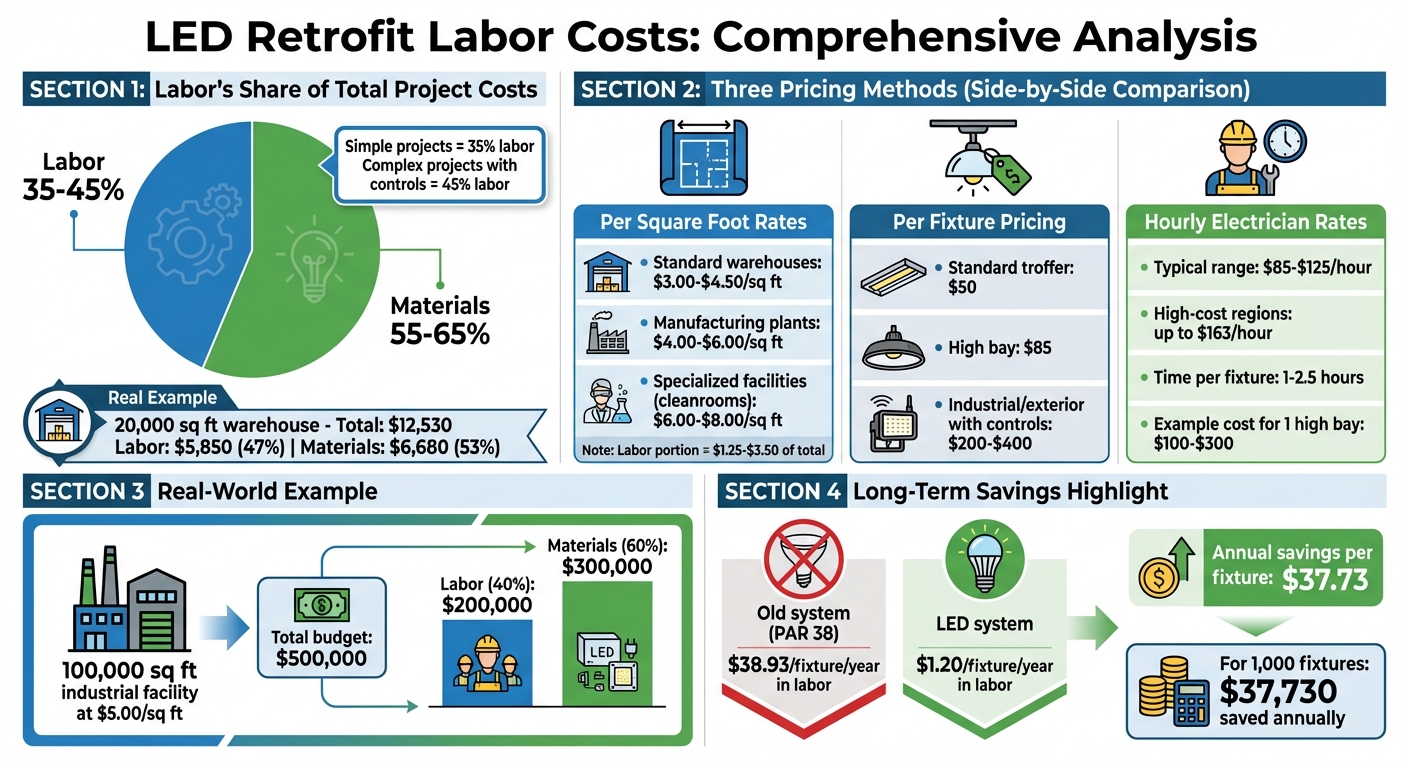
LED Retrofit Labor Costs by Facility Type and Pricing Method
When evaluating an LED retrofit proposal, plan for labor to account for 35-45% of the total project cost, with materials making up the rest. Simpler projects, like swapping out bulbs without altering fixtures, tend to fall at the lower end of this range. On the other hand, full fixture replacements that include integrated controls push labor costs closer to 45%, as these projects involve additional wiring, programming, and coordination.
For example, a 20,000-square-foot warehouse with a 2,000-square-foot office incurred material costs of $6,680 and labor costs of $5,850. Labor represented about 47% of the $12,530 total project cost. While slightly above the typical range, this is reasonable for a mixed-use space featuring both high-bay and troffer fixtures.
Contractors in the U.S. typically price labor using three main methods:
These pricing methods provide a framework for estimating real-world project costs.
Labor expenses scale with the size and complexity of the project. For instance, a 100,000-square-foot industrial facility paying $5.00 per square foot would allocate approximately $200,000 to labor (40% of the $500,000 total budget) and $300,000 to materials. In contrast, commercial office retrofits, which are less labor-intensive, typically cost $2.00-$3.00 per square foot, while new LED installations average $3.20-$4.00 per square foot.
Though upfront labor costs may seem steep, they often lead to significant savings over time. Older systems, such as metal halides and fluorescents, require frequent maintenance, driving up labor costs. For example, one analysis showed $14,800 in avoided maintenance costs over 10 years for a medium-sized facility that transitioned to LEDs. Another comparison revealed annual labor costs of $38.93 per fixture for outdated PAR 38 lamps versus just $1.20 per fixture with LEDs - a yearly savings of $37.73 per fixture. Multiply that by hundreds of fixtures, and the initial labor investment quickly proves its worth in long-term savings.
While earlier sections provided a baseline for labor costs, the specifics of the project and site conditions can significantly alter those figures.
Labor costs are relatively low for straightforward lamp replacements. However, more intricate projects - like full fixture replacements with integrated controls - can quickly increase labor expenses. These tasks often involve removing old fixtures, installing new hardware, extending wiring, programming controls, and commissioning the system. In such cases, labor costs can account for 35–60% of the total project budget.
Costs also vary depending on the type of facility. For example:
Specialized environments like cleanrooms and food processing plants often require additional safety protocols and unique mounting methods, which drive up labor costs. Beyond the project scope, the building's physical characteristics can also affect efficiency and expenses.
The building's layout and ceiling height play a big role in determining labor costs. For example, standard ceilings around 10 feet allow electricians to use ladders, keeping labor costs lower. On the other hand, high-bay warehouses with ceilings over 30 feet require lifts and additional safety precautions, which increase installation time and costs. Labor for these complex installations can range from $6.50–$10.40 per square foot, compared to $3.90–$6.50 per square foot for more straightforward setups.
Occupied spaces add another layer of complexity. Facilities that can’t shut down during business hours often require phased or off-hours work, such as night or weekend shifts. Electricians typically charge premium rates for these schedules, which can extend both the timeline and the overall cost of the project. Additionally, older buildings may need upgrades to electrical panels or new circuits to comply with current codes, further increasing labor hours.
Where the project is located also plays a major role in labor costs. Urban areas with higher living expenses tend to have higher electrician rates, typically ranging from $85 to $125 per hour, with some rates reaching up to $163 per hour. In rural areas, rates are generally lower, but finding skilled labor can be more challenging. Union versus non-union labor is another factor; union electricians usually charge higher hourly rates, but their expertise can make them a worthwhile investment for complex projects.
Keeping labor costs in check can lead to significant savings in your LED retrofit projects. Here are some practical strategies to help you manage these expenses effectively.
Always ask for itemized proposals that clearly outline every aspect of labor costs. A thorough breakdown should include installation expenses, removal of old fixtures, equipment rentals (like lifts for high ceilings), programming for control systems, and commissioning. Labor rates can vary depending on the type of facility. For example:
This level of detail not only ensures transparency but also allows you to compare bids more accurately and make informed decisions.
Breaking the project into phases can help you avoid premium labor rates and minimize disruptions. For instance, you can plan the work in stages such as pre-planning (permits, safety protocols, material staging), mobilization, zonal installations starting with less critical areas, and commissioning. A phased approach also helps streamline the process. For example, bundling multiple fixtures on the same circuits can reduce installation time by up to 40%, potentially saving $200–$400 in labor costs per zone. Careful scheduling and preparation set the stage for smoother execution and fewer delays.
Investing in professional lighting design and energy audits upfront can save you from costly changes later. A thorough audit will document your existing fixtures, create tailored retrofit solutions, and provide accurate labor estimates. This kind of preparation ensures compliance with codes from the outset and reduces the risk of expensive rework.
As Luminate Lighting Group explains:
"Every project begins with a no-obligation lighting audit. We'll walk your facility, identify opportunities, and provide a custom LED lighting proposal with energy savings projections and rebate options".
While upfront labor costs can be hefty, the long-term savings from an LED retrofit make it a smart investment.
LEDs boast a lifespan of 35,000–100,000 hours compared to the 1,500–5,000 hours typical of traditional lamps. This durability means fewer replacements and less time spent on maintenance tasks like ordering bulbs, replacing hard-to-reach fixtures, and disposing of old lamps.
Take this example: replacing 90W PAR38 lamps (with a 1,500-hour lifespan) with 14W LED PAR38 lamps (lasting 50,000 hours) significantly reduces replacements. At a labor rate of $80 per hour and 10 minutes per lamp change, the older system required 2.92 replacements per fixture annually, costing $38.93 in labor per year. With the LED retrofit, replacements drop to just 0.09 per fixture annually, bringing labor costs down to $1.20 per year - a 97% decrease.
For a facility with 1,000 fixtures, these savings add up to approximately $37,730 in reduced labor costs each year. Other studies, assuming a $45 hourly labor rate, show that switching 1,000 halogen lamps to LEDs can save around $125,790 in labor costs over eight years. These savings allow maintenance teams to focus on more critical tasks, especially in 24/7 operations where accessing fixtures often requires costly lift equipment and can disrupt production. Such reductions in maintenance costs directly improve the return on investment (ROI) for LED retrofits.
To accurately assess the ROI of an LED retrofit, it's essential to include both installation labor and future maintenance savings. The formula for ROI is: Total Cost ÷ (Annual Energy Savings + Maintenance Savings).
For instance, if your project costs $400,000 and generates $120,000 in annual energy savings plus $40,000 in labor and material savings, your total annual benefits amount to $160,000. This results in a payback period of 2.5 years. If your initial analysis only considered energy savings and showed a 3-year payback, adding $30,000 annually in avoided labor and lamp costs could reduce the payback period to under 2.5 years while boosting the internal rate of return. Over a 10-year span, the avoided costs of truck rolls, lift rentals, and technician time - calculated at U.S. labor rates of $45–$80 per hour - could add hundreds of thousands of dollars to your project's net present value. These combined savings highlight the financial advantage of working with professionals for your retrofit.

To fully capitalize on these savings, partnering with an experienced provider is key. Luminate Lighting Group offers end-to-end LED retrofit services, starting with a detailed energy audit to provide precise labor estimates and ensure compliance with regulations.
Their licensed electricians manage every aspect of the project, from installation and permitting to handling rebate submissions. This reduces your internal workload and ensures smooth project execution with minimal disruption to daily operations. Luminate's approach helps you start benefiting from energy and maintenance savings sooner. After installation, their team remains available to provide warranty support and maintenance advice, ensuring your LED system performs optimally for years to come.
Project Manager T. Fiddler shares, "Luminate Lighting Group exceeded my expectations with clear communication and professionalism".
This level of expertise ensures that your LED retrofit delivers maximum labor savings and long-term value.
Labor costs for LED retrofits typically account for 35–45% of the total budget, averaging $3–$8 per square foot, depending on the project's complexity. Managing these costs effectively requires careful planning, such as breaking down labor expenses, scheduling the work in phases, and conducting professional energy audits. These strategies not only help keep expenses in check but also ensure the job is done right.
The long-term benefits make the investment worthwhile. LEDs significantly reduce maintenance needs, leading to noticeable annual labor savings that further enhance your return on investment. Add to this the 50–73% energy savings and utility rebates that can cover 20–50% of project costs, and most commercial retrofits see a payback period of just 12–24 months.
To get a handle on labor costs for your LED retrofit project, the best starting point is a professional on-site lighting audit. This step helps pinpoint the size of the project, any complexities, and specific needs, allowing for a customized plan. Factors such as how many fixtures you’re dealing with, the difficulty of installation, and even your location will play a role in determining costs.
Luminate Lighting Group takes the hassle out of the process by handling everything - from design and permitting to the actual installation. With a thorough audit, you’ll get a clear, accurate estimate, so there are no unexpected surprises down the line.
Labor costs for LED retrofits depend on a few key factors. The size of the project is a major consideration - larger spaces or extensive upgrades naturally demand more time and effort. The complexity of the job also plays a role; for instance, custom designs, fixtures in hard-to-reach places, or older systems can add to the time and labor needed. Location is another variable, as labor rates can vary widely depending on the region or city.
To keep expenses under control, it’s a smart move to hire professionals who can create solutions tailored to your specific needs. This approach not only improves efficiency but can also lead to savings in the long run.
To keep labor costs in check during an LED retrofit, begin with a detailed on-site lighting assessment. This will help you identify the most efficient and budget-friendly options for your project. Addressing potential roadblocks early on can save both time and money down the line.
Opting for turnkey services - which handle everything from design and installation to securing permits - can simplify the process. This approach reduces the need for juggling multiple contractors and keeps the project running smoothly. Don’t forget to explore utility rebates, tax incentives, and energy savings programs to help offset initial expenses.
Partnering with experienced professionals is key. Their expertise ensures the work is done efficiently, minimizes disruptions, and helps you get the most out of your investment.


