.svg)
LED lighting reduces energy use, improves indoor quality, and minimizes light pollution to meet LEED v4/v4.1 requirements.

LED lighting is a powerful tool for achieving LEED certification, a globally recognized green building standard. It enhances energy performance, improves indoor lighting quality, and reduces light pollution, all while aligning with LEED’s specific credit requirements. Here's what you need to know:
To ensure compliance, projects must document energy savings, lighting quality metrics, and control designs. Upgrading to LED solutions not only supports LEED certification but also reduces energy costs and enhances building performance.
When it comes to LEED compliance, LED lighting plays a crucial role in improving energy performance, which directly impacts your LEED score. Under LEED v4, energy performance is benchmarked against the ASHRAE Standard 90.1-2010, which aims for a 30% energy-cost savings compared to the 2007 standard. LED systems excel in this area by significantly reducing Lighting Power Density (LPD), making them a key component in meeting LEED's demanding energy requirements.
To fulfill the minimum energy performance prerequisite, projects must show a reduction in LPD relative to the ASHRAE 90.1-2010 baseline. This can be achieved through two approaches:
High-efficiency LED fixtures, typically rated at 90–100 lumens per watt, make these reductions achievable.
Another critical requirement under ASHRAE 90.1-2010 is automatic shutoff in all spaces - an upgrade from the 2007 version, which limited this rule to buildings larger than 5,000 sq. ft.. Additionally, lighting systems must include wiring that allows for a 30%–70% power reduction beyond the "off" state. LEDs, with their natural dimming capability, meet this requirement without the need for costly specialty ballasts.
"The most energy-efficient light fixture is the one that doesn't turn on when it isn't needed." - John Yoon, Lead Electrical Engineer, McGuire Engineers Inc.
Going beyond the minimum requirements, further reductions in LPD can earn additional LEED credits.
LED retrofits unlock higher energy credits by combining high-efficiency fixtures with advanced control strategies like occupancy sensors, daylight harvesting, and task tuning. Together, these strategies can cut lighting energy consumption by nearly 30%.
LEED awards extra points for greater LPD reductions:
| LPD Reduction Beyond Baseline | Earned LEED Points |
|---|---|
| 10% | 1 point |
| 15% | 2 points |
| 20% | 3 points |
| 25% | 4 points |
Source:
For retrofit projects, LEED v4 introduces a lower compliance threshold: any alteration affecting 10% or more of the connected lighting load must meet ASHRAE 90.1-2010 standards. This is a significant change from the previous 50% threshold. While this means even small upgrades may trigger compliance, it also creates opportunities to earn meaningful energy credits. By focusing on LED retrofits, you not only satisfy LEED requirements but also enhance your building's overall energy efficiency.
Luminate Lighting Group offers energy audit and retrofit services to help pinpoint these opportunities and maximize your LEED score.
LEED certification isn’t just about energy efficiency. The Indoor Environmental Quality (IEQ) credit category emphasizes creating spaces that promote health, comfort, and well-being for occupants. According to the U.S. Green Building Council, "High-quality lighting helps eliminate distractions, creates visual interest and a sense of place, supports interaction and communication, contributes to occupants' well-being, and reduces health problems." LED lighting systems align perfectly with these goals by leveraging advanced features and metrics. Below, we’ll explore how LEDs align with LEED’s IEQ requirements.
LEED v4.1 IEQ credits for interior lighting focus on four measurable areas: glare control, color rendering, lighting control, and surface reflectivity. Here’s how LEDs meet each of these criteria:
| LEED Strategy | Requirement | How LEDs Meet It |
|---|---|---|
| Glare Control | Luminance < 7,000 cd/m² (45°–90° from nadir) or UGR < 19 | Precision optics and baffles minimize direct glare, ensuring visual comfort. |
| Color Rendering | CRI ≥ 90, or Rf ≥ 78 and Rg between 97–110 (TM-30) | Modern LEDs consistently achieve CRI 90+ and meet TM-30 standards. |
| Lighting Control | Dimmable/multilevel in 90% of regularly occupied spaces | LEDs are naturally dimmable, simplifying compliance with multi-level control requirements. |
| Surface Reflectance | Ceilings ≥ 80%, walls ≥ 55% | When paired with high-reflectance finishes, LEDs ensure uniform, efficient lighting. |
However, meeting these metrics isn’t as simple as checking labels. For example, a "UGR < 19" claim on a luminaire’s spec sheet doesn’t guarantee compliance. As Jason David from Access Fixtures explains: "A 'UGR<19' claim on a luminaire's specification sheet indicates that the product has a light distribution designed to assist a designer in achieving a UGR of less than 19 if the fixture is used appropriately in a typical office environment." To confirm compliance, application-based modeling tools like DIALux or AGi32 are essential for factoring in room geometry and layout.
LED lighting doesn’t just meet technical requirements - it also enhances the everyday experience of occupants. One major improvement is the elimination of flicker, a common issue with older lighting systems. According to IEEE Std 1789-2015, flicker should remain below 4% at 120 Hz to avoid observable effects like eye strain and headaches. High-quality LED drivers keep flicker well below this threshold, contributing to a more comfortable environment.
Another critical aspect is color quality. While CRI has long been the standard for assessing color rendering, the industry is shifting toward IES TM-30, which evaluates light quality using 99 Color Evaluation Samples instead of CRI’s 8. LEDs with a CRI of 90 or higher - or those meeting TM-30’s Rf ≥ 78 and Rg between 97 and 110 - provide a richer, more accurate representation of colors, aligning with both current and anticipated LEED v4.1 standards.
Lighting controls are another area where LEDs excel. LEED requires individual lighting controls for at least 90% of individual occupant spaces and controls for 100% of shared multi-occupant spaces. These controls must offer three distinct settings: on, off, and a midlevel (30%-70% of maximum output), excluding daylight adjustments.
LEDs naturally support these multi-level controls without requiring additional components. They also integrate seamlessly with occupancy sensors and daylight harvesting systems, making it easy to create flexible, responsive lighting zones for both individual and shared spaces. This adaptability ensures compliance with LEED standards while empowering occupants to tailor lighting to their needs.
Minimizing light pollution isn't just about energy savings or comfort - it’s also a key part of earning LEED credits. Under the Sustainable Sites (SS) category, the SSc6 credit focuses on reducing light pollution both inside and outside your building. The goal is simple: limit light trespass and skyglow. As Bill Swanson, Sr. Electrical Engineer at Integrated Design Solutions, explains:
"All customer owned lights, existing and new, within the project boundary need to comply with this credit's requirements."
In other words, every light fixture on your property matters.
Light spilling out of windows at night contributes to skyglow and trespass, making it a focus for LEED compliance. To address this, LEED follows ASHRAE 90.1-2010, which requires automatic lighting shutoff in all spaces. Installing vacancy sensors is a practical way to meet this standard - they turn lights off when spaces are unoccupied, ensuring minimal light escapes after hours. Combining these sensors with LED fixtures and time-based scheduling, like an "after-hours dim mode", gives you precise control over interior lighting.
Exterior lighting design is just as critical for reducing light pollution. LEED uses the BUG (Backlight, Uplight, Glare) rating system to evaluate outdoor lighting. Selecting LED fixtures with low uplight and glare ratings is essential. Full-cutoff fixtures, properly mounted and oriented, prevent upward light and ensure backlight is directed toward property boundaries - not beyond them.
Color temperature also plays an important role. LEDs with higher color temperatures (above 4,000K) emit more blue light, which scatters in the atmosphere and worsens skyglow. Edith Ayala highlights this issue:
"choosing warmer tones (3000K or below) reduces the blue light that contributes to skyglow".
Additionally, astronomical time clocks that adjust to local sunrise and sunset schedules help ensure compliance with ASHRAE 90.1-2010. These clocks keep exterior lights off during the day and reduce nighttime lighting as required.
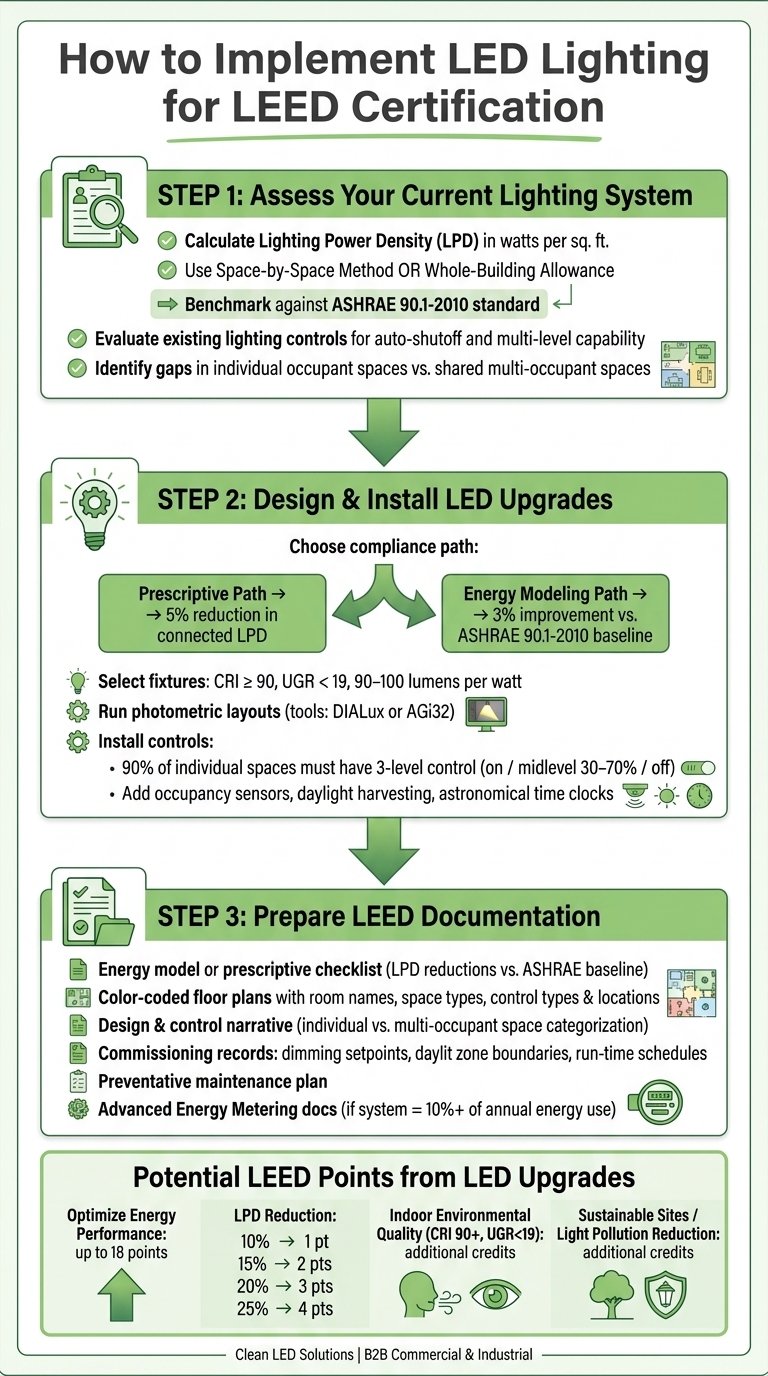
How LED Lighting Earns LEED Credits: Step-by-Step Implementation Guide
To align LED lighting upgrades with LEED certification, you’ll need a structured approach: start with an assessment of your current system, design an effective upgrade plan, and meticulously document every step.
Begin by establishing your baseline according to ASHRAE 90.1-2010, which serves as the reference standard for LEED v4. Calculate your current Lighting Power Density (LPD) - the wattage of lighting per square foot - using either the space-by-space method or the whole-building allowance. This calculation will show how much you can reduce LPD to earn credit points (up to 4 points for achieving a 25% reduction).
Next, evaluate your existing lighting controls to ensure they meet LEED’s requirements for automatic shutoff and multi-level control capabilities. Identify areas needing upgrades, particularly in spaces categorized as individual occupant spaces (like private offices) or shared multi-occupant spaces (such as conference rooms), as these have distinct control thresholds under the Interior Lighting credit.
With this analysis in hand, you’ll be ready to focus on designing targeted LED upgrades.
Once you’ve identified the gaps in your current system, select a compliance path. The prescriptive path requires a 5% reduction in connected LPD, while the energy modeling path involves a 3% improvement compared to the ASHRAE 90.1-2010 baseline. For many LED retrofit projects, the prescriptive path is often simpler to follow.
Carefully choose fixtures that align with LEED standards. For instance, LEED v4.1 awards points for fixtures with a Color Rendering Index (CRI) of 90 or higher. Running photometric layouts early in the design phase is essential to ensure compliance with glare control requirements.
"It is much more difficult to backtrack and update a completed design to meet LEED compliance." - Katherine Clark, Electrical Engineer I, Smith Seckman Reid Inc.
For lighting controls, ensure at least 90% of individual occupants have access to three-level lighting options (on, off, and a midlevel between 30% and 70%). Place manual controls within the occupant’s direct line of sight to the fixtures they control. Services like Luminate Lighting Group’s proven process for lighting solutions, including energy audits and photometric layouts, can help map out these details before installation begins.
Once the upgrades are in place, the next step is preparing thorough documentation to support your LEED submission.
Clear and comprehensive documentation is critical for LEED certification. Reviewers need a detailed record of energy performance, control design, and commissioning. Key documentation includes:
It’s especially important to ensure that the commissioning report’s sequence of operations matches the narratives submitted for the Energy and Atmosphere (EA) and Indoor Environmental Quality (IEQ) credits. Discrepancies between these documents are a common cause of reviewer comments and delays.
"The floor plan should indicate the room-name identification, space type, and lighting control type used in that area along with the location of the associated controls." - John Yoon, Lead Electrical Engineer, McGuire Engineers Inc.
Additionally, if your project includes systems responsible for 10% or more of total annual energy use, you’ll need to provide metering documentation for the Advanced Energy Metering credit. This can be achieved through direct electrical measurement or by extrapolating run-time data.
LED lighting plays a crucial role in earning LEED points across several credit categories. High-efficiency LED fixtures - delivering at least 90–100 lumens per watt - can slash energy use by up to 75% when compared to traditional incandescent or fluorescent systems. This directly supports the Optimize Energy Performance credit, which can contribute up to 18 points toward LEED certification.
But energy savings aren’t the only benefit. LEDs enhance occupant comfort with superior color rendering (CRI of 90+) and effective glare control (UGR below 19), both of which align with Indoor Environmental Quality credits. Additionally, using Dark Sky–compliant exterior fixtures helps minimize light pollution, further boosting your project's LEED potential.
"Achieving LEED certification isn't just about earning a plaque - it's about creating sustainable, energy-efficient spaces that benefit both the environment and your bottom line." - Elevate Lighting
This makes LED upgrades a clear choice for advancing your sustainability goals.
LEED v4 and v4.1 registrations are open only until June 30, 2026. If your project is aiming for certification under these versions, now is the time to move forward.
Start by benchmarking your building's Lighting Power Density against the ASHRAE 90.1-2010 standard. From there, identify which LEED credits offer the best opportunities for your facility. A professional energy audit and photometric layout can help pinpoint the right fixtures, control systems, and documentation to meet your goals. Luminate Lighting Group offers tailored energy audits and custom lighting designs to help commercial, industrial, and municipal clients lower energy costs, meet codes, and achieve LEED certification efficiently.
LED lighting plays a key role in earning LEED credits by improving energy performance. It helps meet the Minimum Energy Performance prerequisite and boosts energy efficiency, particularly when paired with advanced lighting controls. Additionally, it supports indoor environmental quality by encouraging sustainable lighting solutions and enhancing overall lighting effectiveness.
To confirm that your LED upgrade aligns with LEED standards, you'll need to provide detailed documentation showcasing compliance with specific performance metrics. These include energy efficiency, lighting controls, glare reduction, and color rendering.
Focus on meeting both LEED prerequisites and credits by supplying the following:
These documents collectively prove your lighting system's alignment with LEED requirements, ensuring it supports both performance and sustainability goals.
When choosing LED fixtures, prioritize those with effective luminance control and a low Unified Glare Rating (UGR) to ensure comfortable lighting. Carefully examine IES files for photometric data, paying special attention to the "Zonal Lumen Summary" and uplight components. This helps in reducing both glare and unnecessary light spill.
Select fixtures with full cutoff designs or shielded optics for better light direction and control. Additionally, adhere to LEED guidelines to manage glare and surface reflectivity effectively. This not only improves visual comfort but also helps in reducing light pollution, creating a more sustainable and user-friendly lighting environment.


