.svg)
Summarizes IECC 2021 warehouse lighting: 0.45 W/ft² LPD, aisle occupancy zoning, daylight dimming to 15%, and mandatory energy monitoring for large facilities.


The IECC 2021 introduces updated lighting rules for warehouses to reduce energy use, improve efficiency, and maintain safety. Key changes include stricter Lighting Power Density (LPD) limits, mandatory occupancy sensors, daylight-responsive controls, and energy monitoring for larger facilities. These rules aim to cut down on power usage while ensuring adequate lighting for worker safety.
Proper planning, functional testing, and compliance documentation are essential to meet these requirements. Partnering with experts like Luminate Lighting Group can simplify the compliance process, from LED retrofits to control system installation and AHJ approvals.
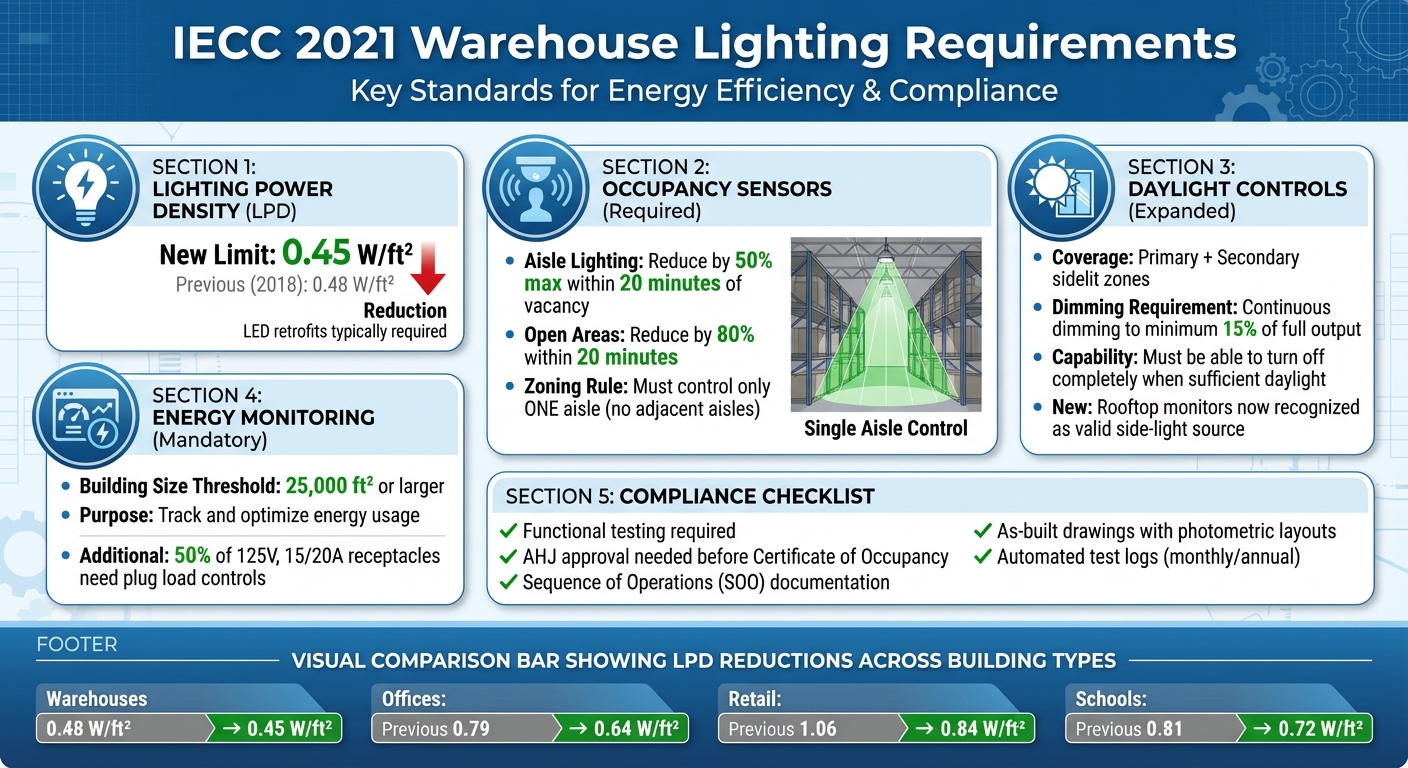
IECC 2021 Warehouse Lighting Requirements: Key Standards and Compliance Checklist
The IECC 2021 code reduces warehouse Lighting Power Density (LPD) limits to 0.45 W/ft², a decrease from 0.48 W/ft² in the 2018 edition. This change reflects advancements in LED technology and its growing reliability.
"The steady decline in allowances recognizes the growing maturity of LED technology." – Craig DiLouie, Journalist and Educator
This trend isn't limited to warehouses. Other building types also saw LPD reductions: offices dropped from 0.79 to 0.64 W/ft², retail spaces from 1.06 to 0.84 W/ft², and schools from 0.81 to 0.72 W/ft². To meet the stricter 0.45 W/ft² limit, warehouses typically need modern LED fixtures designed specifically for high-bay applications. Legacy systems like metal halide or fluorescent lighting often exceed these limits, making retrofitting necessary for compliance.
Warehouses must now incorporate automatic lighting controls to reduce energy use when spaces are unoccupied. IECC 2021 outlines two paths for compliance: installing specific control systems - such as occupancy sensors, time switches, or daylight controls - or adopting Luminaire Level Lighting Controls (LLLC). LLLC systems feature sensors embedded directly into fixtures, enabling individual monitoring of occupancy and ambient light, as well as wireless zoning and remote adjustments.
Occupancy sensors play a critical role, requiring lighting to dim by at least 50% in corridors and aisles and by 80% in open-plan areas within 20 minutes of vacancy. These systems must undergo functional testing during final inspections to ensure proper calibration and alignment with construction plans.
For larger buildings - those 25,000 square feet or more - energy monitoring systems are mandatory. These systems track energy usage and help identify inefficiencies. Additionally, at least 50% of all permanently installed 125V, 15/20A receptacles must be equipped with plug load controls that integrate into the lighting control system.
IECC 2021 expands daylight control requirements to include secondary side-lighted zones, which are areas adjacent to primary zones near windows. The code now officially recognizes rooftop monitors as a valid source of side-light illumination for these zones.
"IECC 2021 now identifies secondary daylit zones, which potentially doubles the reach of daylight-responsive control." – Craig DiLouie, LC
Daylight-responsive controls must dim artificial lighting continuously to at least 15% of full output and be capable of turning lights off entirely when natural light is sufficient. However, these controls must not exceed the maximum light levels set by occupancy sensors. To ensure proper functionality, calibration points for these controls must be accessible within the space, allowing technicians to make adjustments without unnecessary complications.
These updated control requirements aim to address common compliance challenges, paving the way for more energy-efficient warehouse operations in the sections to follow.
The IECC 2021 introduced new rules for aisle lighting that have caught many warehouse operators by surprise. One key requirement is that occupancy sensors must be zoned to control lighting for a single aisle only, without affecting lights in adjacent aisles. This means sensors need to be carefully positioned or shielded to avoid detecting movement outside their designated aisle.
"Occupancy sensors are required in warehouse aisles. Here, the sensor must reduce lighting power by no more than 50% after the aisle becomes vacant. The sensor must be zoned to a single aisle and not control any lighting outside the aisle." – Craig DiLouie, Education Director, Lighting Controls Association
To ensure compliance, designers should verify the sensor's field of view during the planning stage. Shielding or angling sensors can help keep their detection area limited to the assigned aisle. A more streamlined solution is using Luminaire Level Lighting Controls (LLLC), which have built-in sensors and naturally meet the single-aisle zoning requirement by functioning as independent zones. Wireless mesh networking is another great option for retrofits, as it eliminates the need for extensive rewiring and allows easy adjustments to sensor zones. Once zoning is addressed, attention can turn to power reduction strategies.
Another challenge is meeting the requirement to reduce lighting power by 50% within 20 minutes of an aisle becoming vacant. Warehouses can achieve this through two main methods: continuous dimming, which gradually lowers lighting from full output to less than 20% power, or stepped switching, which reduces output to a range between 30% and 70% of full power. Both approaches save energy while maintaining safe lighting levels.
In areas where daylight-responsive controls work alongside occupancy sensors, daylight controls can further reduce power but cannot increase it beyond the level set by the occupancy sensors. Functional testing during system commissioning is essential to confirm that these control sequences operate as intended without disrupting daily operations. For older systems, upgrading lighting controls is often necessary to meet these more demanding standards.
Older lighting fixtures that exceed the new lighting power density (LPD) limit of 0.45 W/ft² can be replaced with energy-efficient LED retrofits. Modern high-bay LED fixtures provide excellent illumination while using significantly less power. When upgrading, it’s smart to choose fixtures with integrated controls, as these address both LPD compliance and control requirements.
Wireless control systems are a practical choice for minimizing downtime during installation since they eliminate the need for extensive rewiring [3]. For larger warehouses - those over 25,000 square feet - retrofits must also include energy monitoring capabilities, as required by IECC 2021. These LED upgrades not only bring warehouses into compliance but also integrate seamlessly with advanced control strategies, making them a win-win for efficiency and regulation adherence.
Functional testing and commissioning ensure your lighting system aligns with IECC 2021 standards. The Authority Having Jurisdiction (AHJ) reviews equipment listings, operation sequences, and test plans before observing on-site testing. Without passing these inspections, you won’t secure a Certificate of Occupancy.
Testing confirms that daylight-responsive controls can dim to at least 15% of full output and that individual aisles operate independently. To streamline the AHJ review process, maintain automated logs of monthly and annual tests[2].
"The whole system needs to be evaluated as installed for that facility and accepted by the AHJ." – Martin Mercier, Strategic Marketing Manager, Cooper Lighting Solutions[2]
Your Sequence of Operations (SOO) document must clearly outline how each control device functions, including details on shutoff, dimming, and fail-safe mechanisms[2]. Since the AHJ will carefully review this documentation before granting approval, precision is key. For buildings larger than 25,000 square feet, you’ll also need to document energy monitoring capabilities.
Additionally, as-built drawings should incorporate photometric layouts to prove that light levels meet safety standards while adhering to the 0.45 W/ft² Lighting Power Density (LPD) limit. This level of detail helps ensure a smooth compliance process.

Luminate Lighting Group provides comprehensive support throughout the compliance journey. From energy audits and design documentation to functional testing and assistance with rebate and tax applications, their expertise simplifies every step of the process.
The way states adopt and amend the IECC 2021 code varies significantly, influencing how it's applied locally. Currently, states like Alabama, Alaska, Colorado, Connecticut, Illinois, Maine, Maryland, Massachusetts, Montana, Nevada, and North Dakota have moved forward with implementing IECC 2021 standards. Meanwhile, California follows its own Title 24, which includes the 2023 updates for occupancy sensing and demand-responsive controls.
Although the AHJ (Authority Having Jurisdiction) enforces standards across the board, there can be differences in how equipment listings and test plans are interpreted regionally. Local jurisdictions may also introduce their own amendments or specific requirements. That’s why it’s a smart move to involve your AHJ early in the planning process - this can help you avoid last-minute design changes that could become costly.
These regional differences mean that careful, early planning is essential to meet code requirements without unnecessary setbacks.
To navigate these regional variations, it's important to incorporate IECC 2021 standards into your project planning right from the start. For instance, lighting power density (LPD) calculations should be addressed early on. The LPD allowance for warehouses has been reduced from 0.48 to 0.45 watts per square foot, so your lighting designs need to meet this stricter limit upfront. If overlooked, you might face delays caused by violations that require fixture replacements or redesigns.
Another key step is integrating control zoning early in the process. This includes mapping occupancy sensors, installing daylight-responsive controls, and planning energy monitoring systems for buildings larger than 25,000 square feet. Additionally, you’ll need to allocate enough time for functional testing and commissioning, which are mandatory. Failing to meet these requirements during AHJ inspections could delay your Certificate of Occupancy or result in a provisional one with strict correction deadlines [2].
The IECC 2021 introduces specific mandates for warehouse lighting, including LED retrofits, precise zoning for controls, and thorough documentation. A 0.45 W/sq.ft. LPD standard means upgrading to modern LED fixtures, while occupancy sensors must be set to control individual aisles and reduce power by no more than 50% when the space is unoccupied. Additionally, daylight-responsive controls are now required to manage secondary sidelit zones, with continuous dimming down to at least 15% of full output.
Compliance hinges on proper documentation and functional testing approved by the AHJ. For warehouses exceeding 25,000 square feet, energy monitoring systems are mandatory. The AHJ must also witness functional testing before issuing a Certificate of Occupancy [2].
To avoid delays or costly redesigns, it’s crucial to integrate these requirements into your project planning early on. Completing LPD calculations, creating detailed zoning maps, and coordinating proactively with the AHJ can make a significant difference. As Martin Mercier from Cooper Lighting Solutions puts it:
"The fastest path to safer buildings is staying current on the tools that make compliance easier and outcomes better" [2].
Professional expertise can simplify these challenges and ensure a smoother path to compliance.
Luminate Lighting Group offers end-to-end warehouse lighting solutions that align with IECC 2021 standards. From initial energy audits and photometric layouts to fixture selection, control system design, and final commissioning, we handle it all. Our team also prepares required documentation - lighting narratives, maintenance plans, and test schedules - to secure AHJ approval on the first attempt.
We specialize in LED retrofits that meet the stringent 0.45 W/sq.ft. LPD requirement while improving light quality and cutting energy costs. Our custom lighting designs include compliant occupancy sensors, daylight-responsive controls, and energy monitoring systems tailored to your facility. Additionally, we help you access utility rebates and 179D tax deductions to offset your investment. Visit luminatelightinggroup.com to discuss your warehouse lighting needs and ensure seamless code compliance from start to finish.
The IECC 2021 brings tighter energy efficiency requirements for warehouse lighting. One key change is the reduction of the interior lighting power allowance from 0.48 W/ft² to 0.45 W/ft², pushing warehouses toward adopting more efficient lighting technologies.
The code also introduces new mandatory controls, including daylight-responsive controls for secondary zones, occupancy sensors for corridors, and systems that automatically dim or shut off lights when spaces are not in use. These controls come with manual override options and must undergo functional testing to ensure they work as intended.
These updates are designed to enhance energy efficiency, lower operational costs, and help warehouses stay compliant with modern standards.
Occupancy sensors and daylight controls work together to improve energy efficiency while meeting IECC 2021 standards. Occupancy sensors activate lights when they detect movement in a space and either dim or turn them off once the area is no longer in use. On the other hand, daylight sensors adjust indoor lighting levels based on the amount of natural light, ensuring the space stays properly lit without wasting energy.
This combination ensures warehouse lighting operates only when needed and at just the right brightness, cutting down on energy use and staying compliant with code requirements.
To meet the IECC 2021 lighting standards for warehouses, it’s essential to start by familiarizing yourself with the code's requirements. One key aspect is the reduced lighting power density (LPD) limit of 0.48 W/ft². Keep in mind that states or municipalities may adopt different versions of the code or apply local modifications, so verify the specific regulations in your area.
Next, calculate your lighting power using either the building-area method or the space-by-space method. This step ensures that your total connected lighting power stays within the allowed limits. Incorporating mandatory controls is another critical component. Use features like occupancy sensors, daylight-responsive systems, and automatic shut-offs to boost energy efficiency while meeting the code’s requirements. Pair these controls with high-efficiency LED fixtures that are designed to work seamlessly together.
To simplify the process, consider collaborating with a commercial lighting expert. They can help design a compliant system, conduct energy audits, and even guide you in leveraging utility rebates or 179D tax deductions. Not only does this approach ensure compliance, but it can also lower energy costs and improve overall lighting quality.


