.svg)
Match fixtures to site exposure—IP rating, wet-location listing, materials, impact and temperature limits—to avoid failures and cut lifecycle cost.
The short answer: match the light to the site, not the label. If I were buying waterproof LED fixtures for a harsh space, I’d check water exposure, IP rating, U.S. wet-location listing, chemicals, impact risk, temperature range, controls, and total cost before I looked at price.
A fixture marked “waterproof” can still fail fast. For example, IP65 fits many damp or wet areas, IP66 is better for washdown spray, and IP67 is for spots that may see brief submersion. But that’s only part of the job. I’d also check for UL or ETL wet-location marking, 316L stainless steel in chemical wash areas, silicone gaskets below -4°F (-20°C), and IK10 where forklifts or hard hits are a risk.
Here’s the full checklist I’d use:
If I had to boil it down even more, I’d say this: first match exposure, then materials, then lifecycle cost.
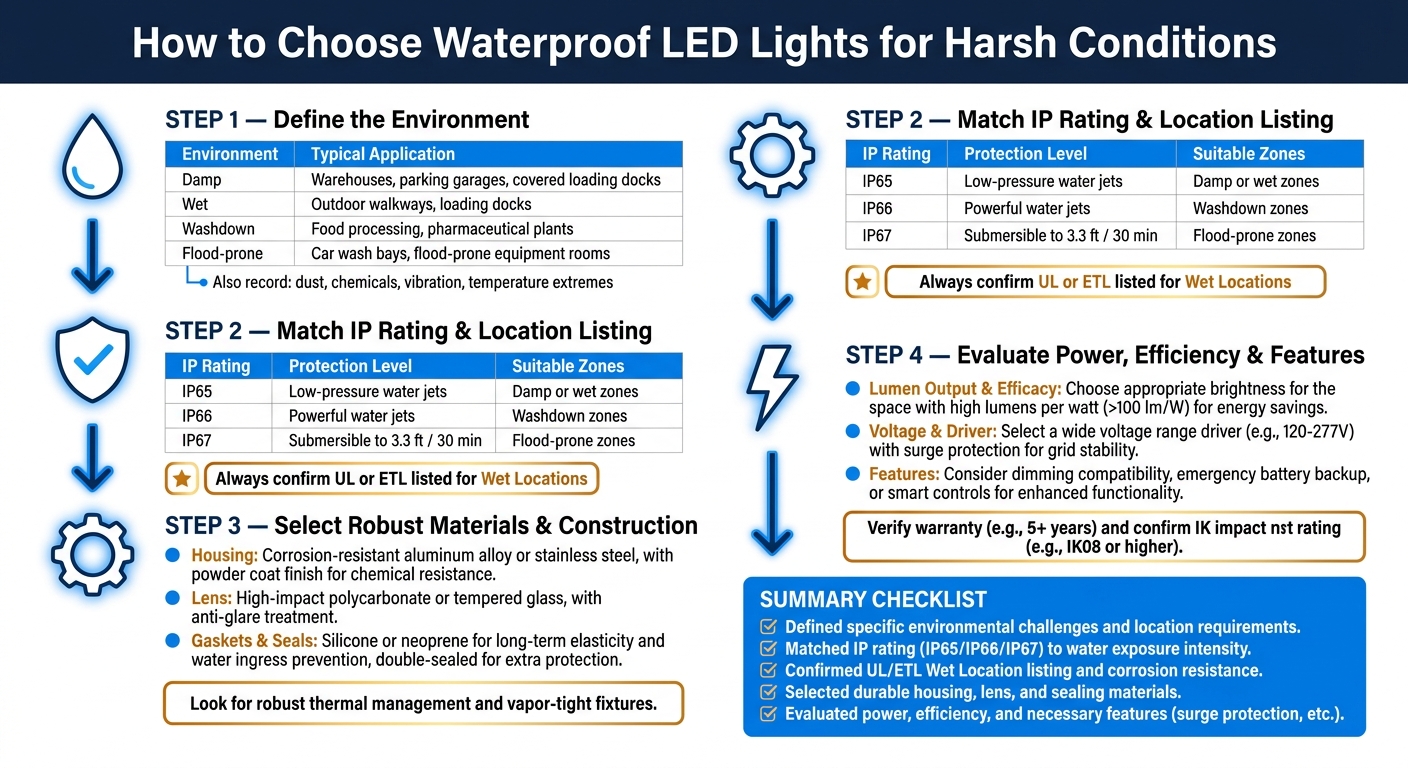
How to Choose Waterproof LED Lights: 4-Step Selection Process
| Check | What I’d look for | Common fit |
|---|---|---|
| Water exposure | Damp, wet, washdown, flood-prone | Defines base fixture type |
| IP rating | IP65 / IP66 / IP67 | Spray, jets, or brief submersion |
| U.S. listing | Wet-location marked | Outdoor or direct water contact |
| Corrosion resistance | 316L stainless steel | Food plants, coastal, sanitizer use |
| Impact protection | IK08 / IK10 | General industrial or forklift zones |
| Temperature range | Down to -40°F or high-heat rated | Cold storage or hot equipment areas |
| Efficiency | 110–130 lm/W or 160–210 lm/W | Lower first cost vs. lower energy use |
| Controls | 0-10V, DALI, PIR, microwave | Dimming, sensors, BMS tie-in |
Bottom line: if I verify the rating, listing, materials, and operating limits against the actual site conditions, I’m far less likely to end up with early failures, extra labor, or the wrong fixture for the job.
Start by mapping the actual water exposure in each zone before you compare fixtures. A truck bay, a process line, and an exterior walkway may sit in the same building, but they don't face the same conditions. Treat each area on its own so the fixture fits the job. Professional lighting design services can help map these zones accurately.
Those notes become your baseline for Step 2, when you compare IP ratings.
Classify each zone by its exposure level:
| Environment Type | Exposure Level | Typical U.S. Application |
|---|---|---|
| Damp | Humidity, light moisture, or airborne dust with no direct spray | Warehouses, parking garages, covered loading docks |
| Wet | Condensation risk or direct water streams | Outdoor walkways, loading docks |
| Washdown | High-pressure, high-temperature cleaning | Food processing, pharmaceutical plants |
| Flood-prone | Temporary standing water or brief submersion | Car wash bays, flood-prone equipment rooms |
Low-mounted fixtures usually need more protection. If a fixture sits closer to spray, splash, impact, or standing water, the bar goes up.
Water is rarely the only problem. In most facilities, it shows up with dust, chemicals, heat, cold, or vibration. So for each zone, record the full set of conditions, not just moisture.
If the cleaning crew uses chlorinated or peracetic sanitizers, call for chemical-resistant gaskets and 316L stainless steel end caps. That's because 316L resists chloride pitting better than 304L.
Temperature matters too. In cold storage, fixtures can fail from thermal shock when warm, humid air hits a frozen housing. Below -4°F (-20°C), specify silicone gaskets instead of standard rubber so the seal doesn't harden and shrink. On the other end, areas near industrial equipment can see ambient temperatures above 113°F (45°C).
For truck bays and warehouse aisles, mark forklift-impact zones. In those spots, use IK10-rated luminaires.
Before you move on, build a short profile for each area. Write down:
That zone-by-zone profile gives you a clear way to match fixture ratings in Step 2.
Use the zone profile from Step 1 to pair each area with the right IP rating.
An IP rating has two digits: the first covers solids; the second covers liquids.
| IP Rating | Dust Protection | Water Protection | Exposure Match |
|---|---|---|---|
| IP65 | Dust-tight | Protected against low-pressure water jets from any direction | Damp or wet zones |
| IP66 | Dust-tight | Protected against powerful water jets | Washdown zones |
| IP67 | Dust-tight | Submersible to 3.3 ft for 30 minutes | Flood-prone zones |
The key is to match the rating to what the fixture will face in the field, not what might happen once in a while.
Use IP66 for high-pressure spray or heavy condensation. Use IP67 where standing water or brief submersion is possible. After the IP rating lines up with the exposure, check the U.S. listing before you spec the fixture.
For U.S. projects, the IP code by itself is not enough. An IP rating is a test result, not a wet-location approval. Fixtures exposed to dripping, splashing, or flowing water must be listed to UL 1598 and marked "Suitable for Wet Locations" when direct water contact is expected.
A simple check goes a long way here:
Then verify the model number in UL Product iQ or the Intertek directory.
Once you've nailed down water protection, the next screen is simple: can the fixture handle the site day after day? IP rating and wet-location approval matter, but they don't tell the whole story. You also need to check how well the fixture stands up to corrosion, impact, vibration, and temperature swings over time.
Pick materials based on the exposure profile from Step 1. For general industrial spaces, aluminum is usually the right fit. In food plants, coastal sites, or chemical areas where chloride-based sanitizers are used, go with 316L stainless steel. It holds up better in harsh conditions.
Lens choice matters too. Polycarbonate works best in impact-prone areas. Tempered glass is a better pick for aggressive chemical washdowns. And if strikes are a real risk, skip acrylic.
Before you sign off on any fixture, pull the facility's Safety Data Sheet (SDS) for its cleaning chemicals. Then check those chemicals against the housing and lens materials. It's a small step, but it can save you from a bad match.
In forklift aisles and other vehicle-traffic zones, specify IK10. For lower-impact industrial spaces, IK08 is often enough.
For cranes, compressors, and presses, use rigid housings with bracket or yoke mounts to help keep the fixture aligned.
Temperature is another place where people get tripped up. Match the fixture's operating range and driver case temperature to the site's actual mounting temperature, not just the room setpoint. In cold storage, confirm start-up down to −40°F (−40°C). In high-heat areas, the driver usually takes the hit first, so check the driver's rated case temperature against the expected ambient conditions at mounting height.
With those checks done, you're ready to compare efficiency, controls, and lifecycle cost.
Once you've confirmed the fixture can handle the environment, the next job is simple: compare what it costs to run, how well it works with controls, and how much maintenance it can help you avoid. Don’t judge by purchase price alone.
Start with system efficacy. That means lumens per watt measured at the fixture while the driver is operating, not the raw LED chip number. That distinction matters. Driver losses and lens attenuation can cut actual light output, so the lab number on the chip doesn’t tell the whole story. Standard industrial waterproof fixtures usually land in the 110 to 130 lm/W range, while higher-output models can hit 160 to 210 lm/W. That spread has a direct effect on energy spend.
Controls need to fit the space too. A sensor that works well in one area can be a poor match somewhere else. In practice, that usually means:
| Feature | Basic Waterproof Fixture | High-Efficacy / Controls-Ready Fixture |
|---|---|---|
| Initial Cost | Lower | About 20–30% higher |
| Efficacy | 110–130 lm/W | 160–210 lm/W |
| Controls | On/Off only | 0-10V or DALI; integrated sensors |
| Lumen Maintenance | 50,000 hrs (L70) | 50,000–100,000 hrs (L90) |
| Energy Savings vs. HID | 40–60% | Up to 75% with dimming and sensors |
| Lifecycle Value | Moderate | High |
L90 at 50,000 hours means the fixture still puts out 90% of its original light at that point. In harsh spaces, that tells you more than L70 alone. It’s also smart to check whether the fixture appears on the DesignLights Consortium (DLC) Qualified Products List (QPL). DLC Premium products can open the door to higher incentive tiers and larger utility rebates.
The cost model should include maintenance labor as well. Fewer lamp swaps and driver replacements can save a lot over time. And in cooled industrial spaces, lighting cuts help twice: every watt removed from lighting usually trims 0.25 to 0.35 watts of cooling load per watt of lighting reduced.
Before you lock in a fixture, run through a short final check. It helps trim the shortlist to products that work on paper and in purchasing.
Use that checklist to compare shortlisted fixtures on performance, controls, durability, and total cost.
The right fixture should fit the site, not just look good on a spec sheet.
Don’t pay for extra water protection if impact resistance is the bigger issue. Once you know what the space is like, you can rule out fixtures that are overbuilt for the job or too weak for it.
Start with the actual conditions in the field: water exposure, chemical contact, temperature range, and physical hazards. Then line up the IP ratings and any required location listings with those conditions. From there, check that the housing material, gasket type, and impact rating can handle the way the area is cleaned and used. First match the exposure. Then check durability. Then look at lifecycle cost.
The final decision should come down to total cost of ownership - fixture price, energy use, control savings, and labor for replacements, not just the price on the quote. Fixtures with long lumen maintenance and DLC Premium listings give back more over the full life of the installation.
Verify the exact model in the test-house directory and the DLC QPL before you specify it for rebate eligibility. A logo on a spec sheet is not proof of listing.
That order helps keep the fixture matched to the site, not the spec sheet.
IP65 is enough when you need full dust protection and protection from water jets coming from any direction. It’s a solid fit for damp spaces, warehouses, parking lots, and most indoor or outdoor industrial areas with heavy dust or occasional cleaning.
Go with IP66 or IP67 if your facility deals with frequent high-pressure washdowns, chemical exposure, or any chance of temporary submersion. It’s also smart to check IK ratings if impact resistance matters.
Choose IP67 instead of IP66 if there’s a chance the equipment could be temporarily submerged, not just hit with strong water jets. IP66 guards against high-pressure water jets. IP67 does that too, while also helping protect internal parts during immersion in water up to 3.3 feet.
That makes IP67 a better match for outdoor industrial sites that may flood or for facilities with very heavy moisture. Just make sure your conditions call for that added level of protection, since it can come with a higher price.
Beyond waterproofing, pay close attention to IK ratings, which measure impact resistance. That matters a lot in spaces with vibration, heavy equipment, or forklift traffic, where a light can take more abuse than you might expect.
You’ll also want to check thermal management. Pick fixtures rated for your operating range, which is often -40°F to 140°F. If a fixture can’t handle the heat or cold in your space, it can fail sooner than expected.
Material quality plays a big role too. In harsh chemical settings, look for 316L stainless steel or corrosion-resistant coatings. And for peace of mind on safety and possible energy rebate programs, check for UL and DLC certifications.


