.svg)
Learn how custom integrators grow lighting and control programs with dedicated teams, showroom strategy, project management, and linear lighting design.

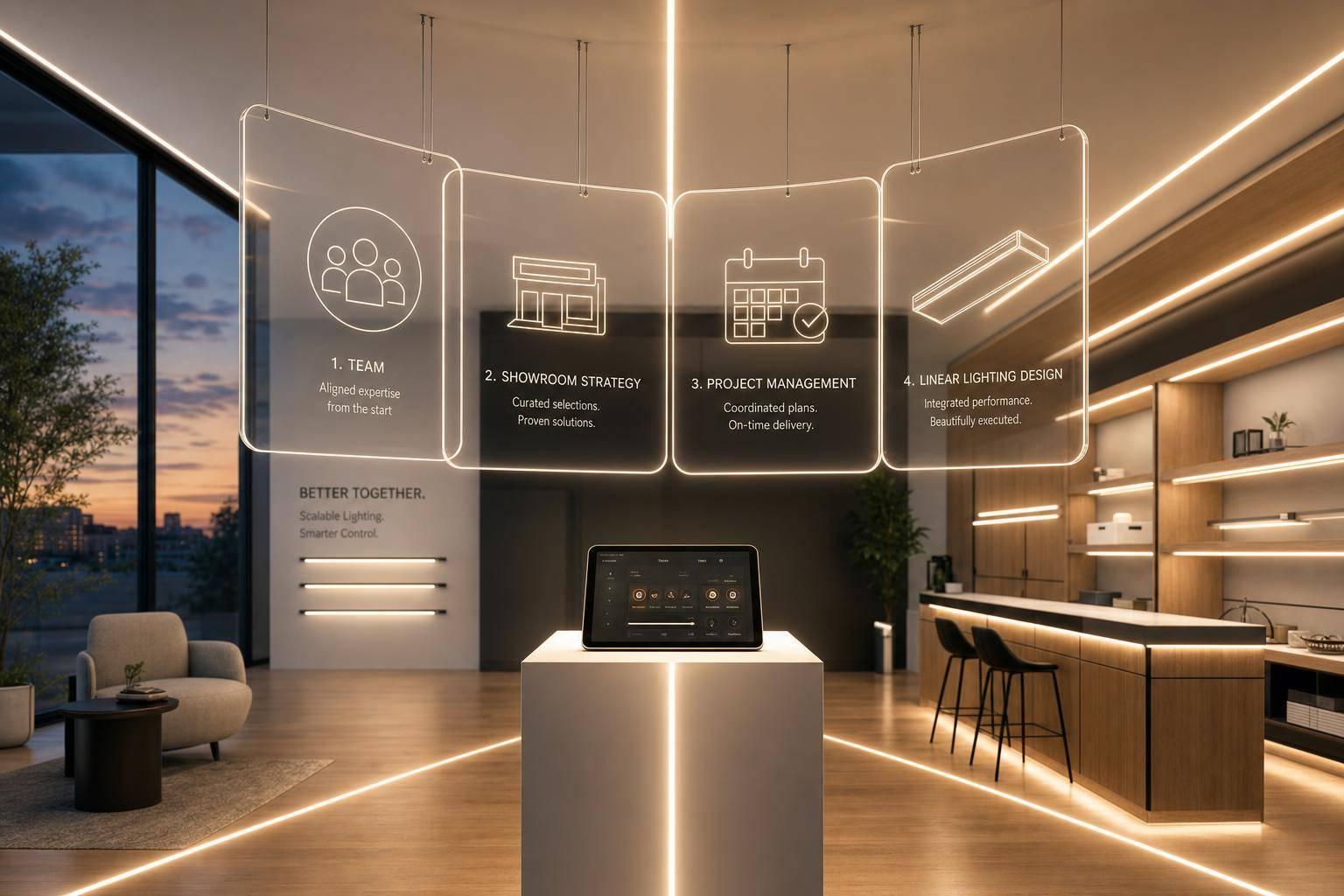
Lighting has moved from a finishing touch to a strategic system. In the video discussion behind How Integrators Build Scalable Lighting & Control Programs, that shift is framed through the lens of custom integration and luxury residential work. But the underlying lesson reaches far beyond homes.
For commercial property owners, facility managers, municipalities, and institutions, the message is highly relevant: lighting becomes scalable only when it is treated as an operational discipline, not a commodity purchase.
That distinction matters. Many organizations still approach lighting retrofits and controls in fragments - fixtures from one source, controls from another, electrical scope handed off separately, and expectations for performance left to chance. The conversation in the video makes clear that this model is increasingly outdated. As lighting systems become more dynamic, connected, and experience-driven, success depends less on buying hardware and more on building a repeatable program around design, accountability, and project execution.
This article unpacks the bigger lesson from that discussion and translates it for decision-makers managing larger, more complex facilities.
One of the strongest ideas in the video is that lighting has become a purpose-built business, not an add-on. In the residential integration world, that means companies are creating dedicated lighting divisions rather than folding lighting into general AV or controls work.
For commercial and institutional audiences, the parallel is obvious.
A lighting upgrade program should not be treated as:
Instead, it should be treated as a managed program that includes:
That shift is especially important for owners with multiple facilities. A scalable program is not simply "doing more projects." It is building a framework that makes each project faster, more predictable, and easier to maintain than the last.
A recurring theme in the discussion is the danger of assuming lighting is simple because it looks familiar. The speaker warns against trying to participate in sophisticated lighting work casually. That warning applies just as strongly in commercial environments.
On paper, a retrofit may seem straightforward:
In practice, performance depends on dozens of details:
When organizations underestimate these variables, problems show up quickly:
The lesson from the video is not that lighting is overly complicated for its own sake. It is that modern lighting behaves like a system, and systems do not scale well without process discipline.
In the interview, one clear marker of successful integrators is that they appoint someone to be fully accountable for lighting. Sometimes that person is developed internally; sometimes they are hired for their expertise. Either way, ownership matters.
For commercial real estate and public-sector organizations, this idea deserves serious attention.
A lighting champion might be:
The title matters less than the role. Someone must own:
Without that ownership, lighting projects tend to drift between departments. Procurement focuses on price, operations focuses on uptime, finance focuses on payback, and contractors focus on install completion. All are important, but none alone ensures a successful outcome.
A dedicated champion helps unify those priorities into one program.
One of the most valuable insights in the video is that the visible fixture is only a small part of the real work. Much of the complexity happens behind the scenes: wire sizing, driver location, dimming module selection, control compatibility, and application-specific configuration.
That maps directly to commercial projects.
In many retrofit failures, the issue is not the luminaire itself. The issue is the hidden infrastructure around it:
This is why turnkey execution matters so much. A capable lighting partner does more than deliver products. They coordinate the technical and administrative details that determine whether the installed system performs as designed.
For large facilities, this hidden work affects more than aesthetics. It affects:
The speaker in the video talks about narrowing options and reducing unnecessary complexity. That is an important nuance. Scalability does not mean eliminating sophistication. It means containing complexity inside a repeatable process.
For multi-site commercial portfolios, standardization is one of the biggest levers available.
That may include standardizing:
This approach delivers several benefits:
The video frames this through product portfolio discipline. In commercial settings, the same logic supports enterprise rollout strategies. The goal is not to use one product everywhere regardless of need. The goal is to define a rational set of standards that can be deployed repeatedly with confidence.
Another major point from the discussion is that when integrators provide lighting, they get involved earlier in the project. That early participation improves coordination and lets them shape outcomes instead of reacting to them.
Commercial owners should pay close attention to this.
Too many lighting projects begin after major decisions are already fixed:
By that point, the team is solving around limitations rather than optimizing the result.
Early lighting involvement creates opportunities to:
For owners pursuing 179D, utility rebates, or broader ESG objectives, this early coordination is even more valuable. Financial performance is strongest when incentives, design, and installation are planned together rather than layered in afterward.
One of the most practical moments in the video is the discussion about finger-pointing. When a light does not dim properly or a system underperforms, each party can blame another: controls, drivers, lighting, programming, or installation.
That dynamic is common in commercial projects too.
It usually appears when responsibilities are fragmented:
This is where integrated accountability becomes invaluable.
A scalable lighting program needs clear ownership for:
For portfolio owners and facility managers, this is not just a technical issue. It is a procurement strategy issue. If the project structure makes accountability ambiguous, resolution time increases and operational confidence drops.
A stronger model is to require one lead party to coordinate the full lighting-and-controls outcome, even when multiple manufacturers are involved.
The video makes an insightful point about scale: in the residential channel, growth still happens "one house at a time." The same is true for commercial retrofits. Even when you manage hundreds of sites, each building has unique conditions.
That does not mean scale is impossible. It means scale must come from the program, not from pretending every site is identical.
For commercial and institutional owners, scalable execution often looks like this:
This approach respects the individuality of each property while still building enterprise efficiency.
In other words, scale is operational, not purely physical.
The video highlights the resurgence of showrooms in the integration world because clients need to experience good lighting, not just hear about it. In commercial settings, the equivalent is not necessarily a showroom. It is proof.
Stakeholders often need to see:
This matters because lighting decisions are often made by groups with different priorities:
Demonstration bridges those priorities. It turns a technical specification into a decision people can understand and support.
For schools, cities, healthcare environments, warehouses, and office portfolios, this can be the difference between approval and delay.
A notable thread in the discussion is the distinction between buying cheap and owning smart. While the examples focus on luxury expectations, the principle is universal.
Commercial buyers know this instinctively, yet procurement structures often still reward the lowest initial cost.
That can be expensive when it leads to:
Lifecycle thinking is especially important when projects are funded through energy savings, incentives, or capital improvement budgets intended to reduce long-term operating costs.
A better evaluation framework includes:
This is where experienced lighting partners add measurable value. They help owners avoid false economies that look attractive in bid form but become liabilities in operation.
One of the strongest strategic points in the video is that this work should be treated as a partnership, not a turf battle. The manufacturer should be the expert in lighting. The integrator should be the expert in bringing systems together. Problems emerge when either party overreaches or assumes the other will absorb critical tasks by default.
That lesson applies directly to commercial delivery teams.
A strong project structure typically includes:
These roles can overlap in collaboration, but they should not blur in accountability.
For example:
Clear roles create speed. Ambiguous roles create rework.
For Luminate Lighting Group’s core audience - commercial owners, facility leaders, industrial operators, school districts, municipalities, and other public-sector institutions - the video’s residential focus still delivers a timely business lesson.
The opportunity is not merely to install more efficient fixtures. It is to create repeatable, transparent lighting modernization programs that combine:
That is particularly important across Texas, Oklahoma, Arkansas, and surrounding markets where building types, utility territories, climate conditions, and budget cycles can vary widely. In those environments, turnkey execution and clear accountability often matter more than any individual fixture specification.
A mature lighting partner should help clients:
Those capabilities are what turn a retrofit into a program.
The most useful takeaway from the video is simple: successful lighting businesses do not grow by accident. They grow because someone commits to process, expertise, accountability, and long-term learning.
That lesson transfers cleanly to commercial lighting modernization.
If you want a lighting and controls program that scales across buildings, departments, or campuses, start by asking different questions:
Modern lighting can absolutely deliver lower energy use, better occupant experience, and stronger asset performance. But those results come from disciplined execution, not from hardware alone.
In that sense, the video is less about residential integration than it first appears. It is really about a broader market truth: lighting becomes transformative when it is treated as a coordinated system with a clear champion and a repeatable plan.
Source: "The Shift That's Making Lighting a Real Business: Where Manufacturers team up with integrators..." - Lytei, YouTube, Jun 9, 2026 - https://www.youtube.com/watch?v=E3TnVHFf5gY


