.svg)
10-year HID vs LED high-bay maintenance comparison: LEDs cut relamping, ballast failures, lift rentals and labor for major savings.

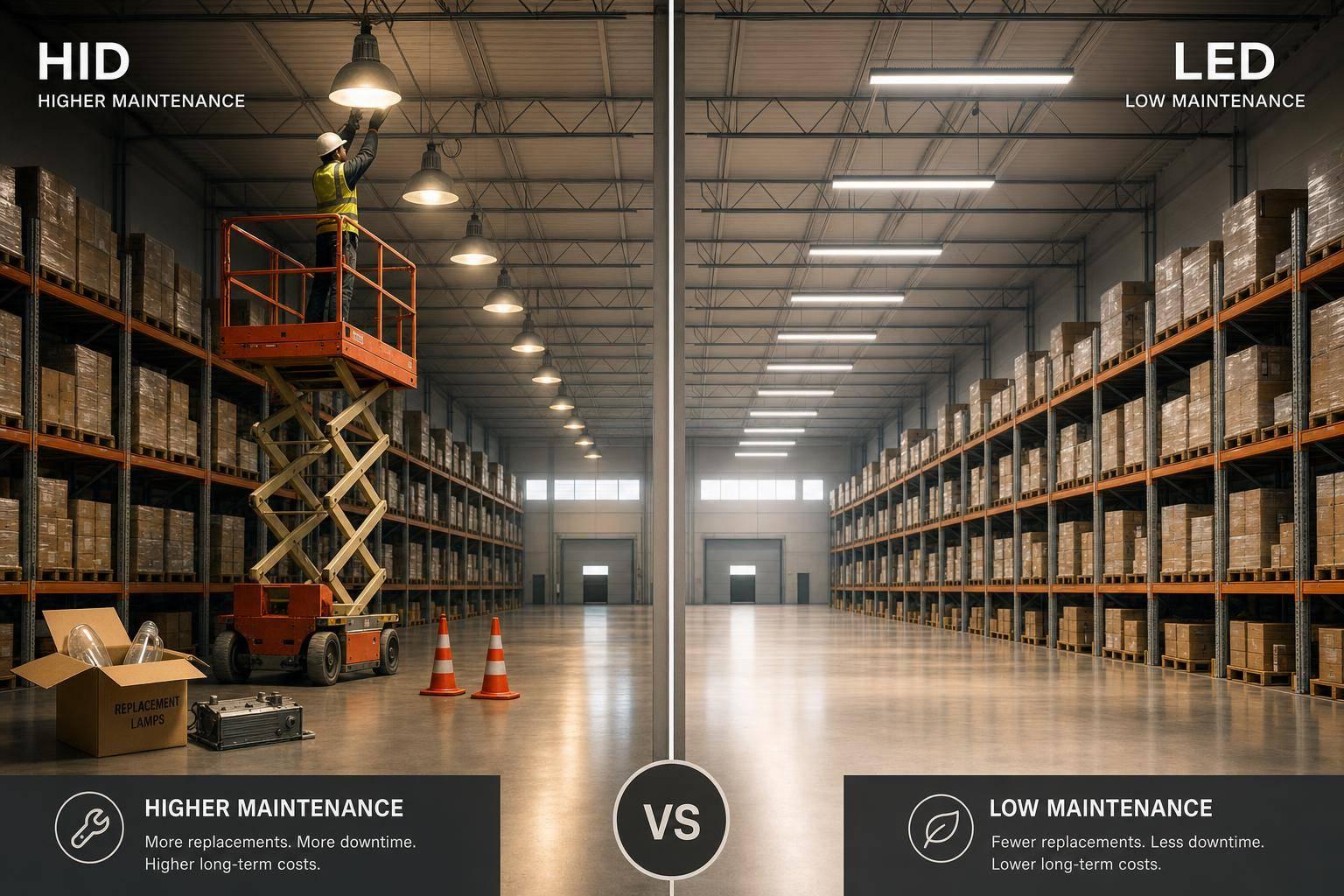
If you want the lower maintenance bill, LED wins. In high-bay spaces, HID fixtures often need lamp changes every 2 to 3 years, ballast work every 4 to 8 years, and lift access for almost every service visit. Over 10 years, that can put HID maintenance at about $1,175 to $2,500 per fixture, while LED is often near $0 to $50 per fixture.
Here’s the short version:
If I boil the whole article down to one point, it’s this: the higher the ceiling and the more hours your lights run, the more LED cuts service cost.

HID vs LED High-Bay Lighting: 10-Year Maintenance Cost Comparison
| Factor | HID High-Bay | LED High-Bay |
|---|---|---|
| Typical life | 10,000–20,000 hours | 50,000–100,000 hours |
| Relamping | Every 2–3 years | Usually none for 10+ years |
| Main repair item | Lamp + ballast | Driver, sometimes after many years |
| Lift use | Frequent | Rare |
| 10-year maintenance per fixture | $1,175–$2,500 | $0–$50 |
| 200-fixture, 10-year maintenance | $235,000–$500,000 | $0–$10,000 |
So if you’re comparing HID and LED for a warehouse or plant, the main question is simple: How much do you want to spend getting back up to the ceiling?
Metal halide lamps may be rated for 10,000 to 20,000 hours, but in day-to-day use, their usable life is often closer to 8,000 to 12,000 hours.
And that gap matters.
These lamps don’t just fail at the end of life. They fade long before that. Metal halide lamps can lose about 20% of their light output within the first six months. By 10,000 hours, brightness may be down 30% to 50%. So even if the lamp is still on, the fixture may no longer deliver the light level a facility needs for safe work on the floor.
That pushes many facilities to relamp early just to keep illumination at a usable level. Over a 10- to 15-year lifecycle, that repeat replacement cycle ends up driving a large share of HID maintenance spend.
There’s also the issue of light quality. As HID lamps age, their color can drift to a greenish or pinkish tint, and they can drop below 60 CRI. In plain terms, colors get harder to judge correctly, which can create problems during inspections, picking, or precision work.
Lamps are only one part of the picture. Ballasts and lift access can push costs even higher.
HID systems aren’t built around a single failure point. The lamp, ballast, ignitor, and capacitor can all fail on their own. That means one fixture problem doesn’t always equal one fix.
Ballasts, in particular, often need replacement after several years of service. When that happens, it usually means another service call. In a high-bay facility, that’s where costs start piling up. A service visit can mean renting a scissor lift for about $250 to $500 per day, along with labor for lockout/tagout and elevated work.
Ballast replacement by itself can cost $150 to $300 per incident in parts and labor. And if a site needs a relamping event across only 50 fixtures, the combined labor and material cost can land between $2,500 and $5,000.
Now stretch that across dozens - or hundreds - of fixtures, and the math gets ugly fast.
HID fixtures also bring routine cleaning into the mix. Dust and grime on reflector surfaces can cut usable light by 20% to 30% before the light even reaches the floor. So the fixture may be working, but the space still looks dim. Fixing that means more lift time, more labor hours, and more scheduled maintenance just to keep output where it should be.
Then there’s troubleshooting after power interruptions. HID systems often need 5 to 15 minutes to restart. That delay can leave parts of a facility underlit and can pause work at the worst time.
Those labor, access, cleaning, and downtime costs don’t always show up as one big line item. More often, they pile up quietly over time.
LED high-bays cut out most of these repeat service events.
Compared with the repeat lamp and ballast work that comes with HID, LED maintenance is much lighter. Most of the time, it comes down to occasional driver service and basic cleaning. LED high-bays usually last 50,000 to 100,000 hours, which is far longer than the 10,000 to 20,000 hours common for metal halide lamps. That changes the whole maintenance schedule.
Here’s what that looks like on the ground. A 100,000-hour LED fixture running two shifts, or about 5,000 hours per year, can last about 20 years. Run that same fixture 24/7, and it still lasts about 11.4 years. Over that span, one LED fixture at that rating can remove 5 to 6 maintenance cycles. That means fewer lift rentals, fewer service visits, and less downtime on the floor.
With LED high-bays, the driver is the main part that may need service over the long run. In most cases, that happens after 7 to 10 years of operation, and driver failure rates are much lower than HID ballast failure rates. If the retrofit is well designed, day-to-day upkeep usually stays limited to inspections and the occasional lens cleaning.
HID systems are a different story. They need lamp changes more often, plus ballast work, and every visit usually means labor and access gear to reach fixtures mounted high overhead. Over 10 years, the per-fixture maintenance difference is hard to ignore:
| Cost Factor | 400W Metal Halide | 150W LED High-Bay |
|---|---|---|
| Lamp replacements | $225–$600 | $0 |
| Ballast Replacements | $150–$300 | $0 |
| Labor and Lift Rental | $800–$1,600 | $0 |
| Total 10-Year Maintenance | $1,175–$2,500 | $0–$50 for rare driver service |
Once the driver is set aside, a well-chosen LED retrofit needs very little routine work. Fixture choice plays a big role here. In enclosed high-bay setups, integrated LED fixtures with die-cast aluminum heat sinks handle heat better than screw-in retrofit lamps installed inside old HID housings. That older setup can trap heat, give it nowhere to escape, and shorten part life.
In dusty or damp spaces, IP65 fixtures help block dust and moisture, which cuts down on surprise service issues.
Those lower service demands are what the 10- to 15-year cost comparison measures next.
Once you look at the main maintenance drivers, the next piece is simple: how those costs stack up over 10 to 15 years.
The table below uses one steady set of assumptions for a U.S. high-bay facility running about 5,000 to 6,000 hours per year.
| Maintenance Category | 400W Metal Halide (HID) | 150W LED High-Bay |
|---|---|---|
| Rated Lamp/Fixture Life | 10,000–20,000 hours | 50,000–100,000+ hours |
| Relamping Frequency | Every 2–3 years | None for 12+ years |
| Component Replacement | Ballast every 4–8 years | Driver service possible after 10–15 years |
| Labor Burden | 0.5–1.0 hour per service visit | Near zero for the first decade |
| Access Equipment Needed | Every 18–36 months; lift rentals often run $250–$500 per day | Every 10–15 years at most |
These ranges reflect source data on lamp life, relamping frequency, ballast replacement, LED driver service, labor, lift rentals, and 10-year maintenance cost per fixture.
That difference is hard to miss. With HID, each relamping cycle usually means booking a lift, paying a technician $80 to $120 per hour, and taking people away from other work on the floor. With LED, that repeat cycle usually doesn't show up at all during the first 10 years.
At the facility level, per-fixture costs can snowball fast.
Take a 200-fixture U.S. manufacturing site, which sits right in the middle of a 100- to 300-fixture high-bay plant. Assume the fixtures are mounted at 25 feet and run 6,000 hours per year. The table below scales lamp changes, ballast replacements, labor, and lift rentals across both setups over 10 years:
| Maintenance Category | 400W Metal Halide (200 Fixtures) | 150W LED High-Bay (200 Fixtures) |
|---|---|---|
| Maintenance Cost (10 Years) | ~$235,000–$500,000 | ~$0–$10,000 |
| Operational Impact | High (HID restrike delays add downtime and safety risk) | Low (instant-on) |
Maintenance totals are scaled from the per-fixture 10-year ranges established in the prior section.
The pattern stays the same as facilities get bigger. HID systems add cost in layers: lamp materials, ballast materials, service labor, and lift rentals that can run $250 to $500 per day every time a fixture needs work at height.
And here's the part that trips people up: those costs don't hit all at once. They show up in pieces, spread across service calls and replacement cycles, which makes them easy to miss in an annual budget.
LED systems avoid most of those repeat maintenance events. When you scale the numbers across a high-ceiling industrial space, the gap in maintenance cost becomes pretty clear.
LED high-bay lighting cuts maintenance costs over 10 to 15 years. That’s the main reason maintenance cost - not just fixture price - shapes the HID vs. LED decision.
HID costs climb over time because of relamping, ballast repairs, labor, and lift access. LED avoids most of that repeat service. LED high-bays also last much longer and hold their light output better, which means fewer relamping cycles.
The result is pretty simple: fewer service calls, fewer disruptions, and steadier light over the full lifecycle.
A lighting audit turns those maintenance gaps into a clear budget forecast. It can measure current maintenance spending, including lamp cycles, ballast replacements, lift rentals, and labor hours. Then it can estimate what an LED retrofit could save over 10 to 15 years.
It can also flag the areas with the heaviest usage - like 24/7 spaces - where LED ROI often shows up fastest.
Luminate Lighting Group provides lighting audits and retrofit design to quantify maintenance savings.
LED lowers maintenance cost more than HID over a 10- to 15-year lifecycle.
HID lighting costs a lot to maintain for one simple reason: it needs attention far more often.
Metal halide lamps usually need to be replaced every 10,000 to 20,000 hours. That means you can go through several re-lamping cycles during the lifespan of a single LED fixture. In a busy industrial space, that adds up fast.
The labor side makes it even tougher. These fixtures are often installed high overhead, so even a basic lamp change isn't simple. You usually need lifts, extra safety steps, and trained workers just to reach them.
There’s another cost many facilities run into: ballast failure. HID systems rely on ballasts, and when those parts go bad, you’re paying for both replacement parts and labor again.
In high-bay spaces, LED lighting usually pays for itself in 1 to 3 years. That comes from big energy savings - often 60% or more - plus lower maintenance costs.
LED fixtures also last a long time, usually 50,000 to 100,000 hours. So unlike old HID systems, you won’t be dealing with frequent bulb and ballast replacements.
The biggest maintenance savings from switching from HID to LED come from cutting out frequent bulb and ballast replacements, plus the labor and equipment needed to handle those repairs.
HID systems need service more often, which means facilities often end up paying for scissor lift rentals, skilled electrical labor, and replacement parts. LEDs usually last 50,000 to 100,000 hours, which helps trim those repeat maintenance costs.


