.svg)
Seven ways—LED high‑bays, motion sensors, daylight harvesting, smart controls, audits, layout tuning, and solar—to cut warehouse lighting energy up to 80%.

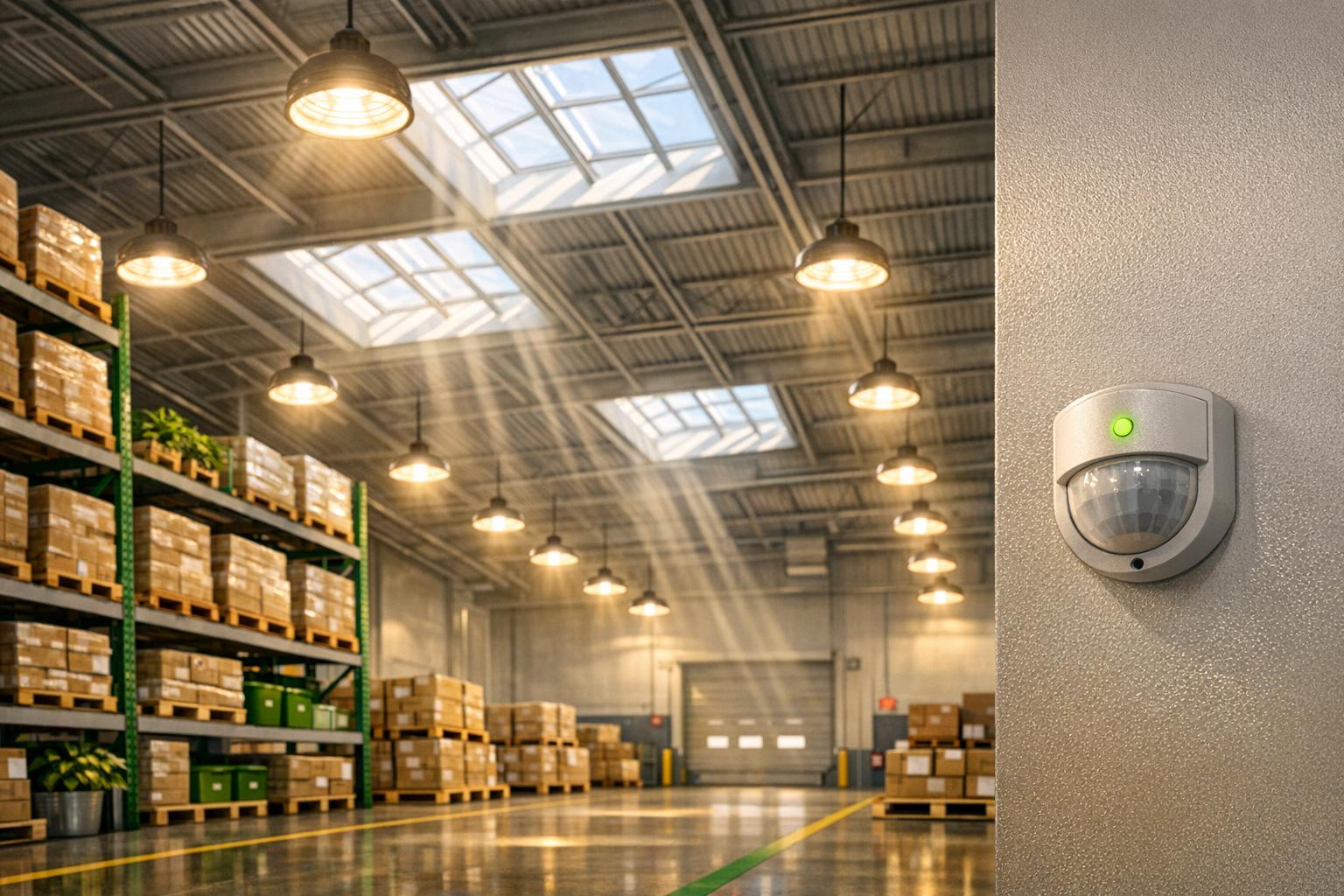
Lighting accounts for a large portion of warehouse energy costs, but upgrading to energy-efficient systems can drastically cut expenses and reduce waste. Here are seven proven practices to improve lighting efficiency in warehouses:
These strategies not only reduce costs but also improve compliance with energy standards and create a safer, well-lit workspace. For tailored solutions, consider consulting experts like Luminate Lighting Group.
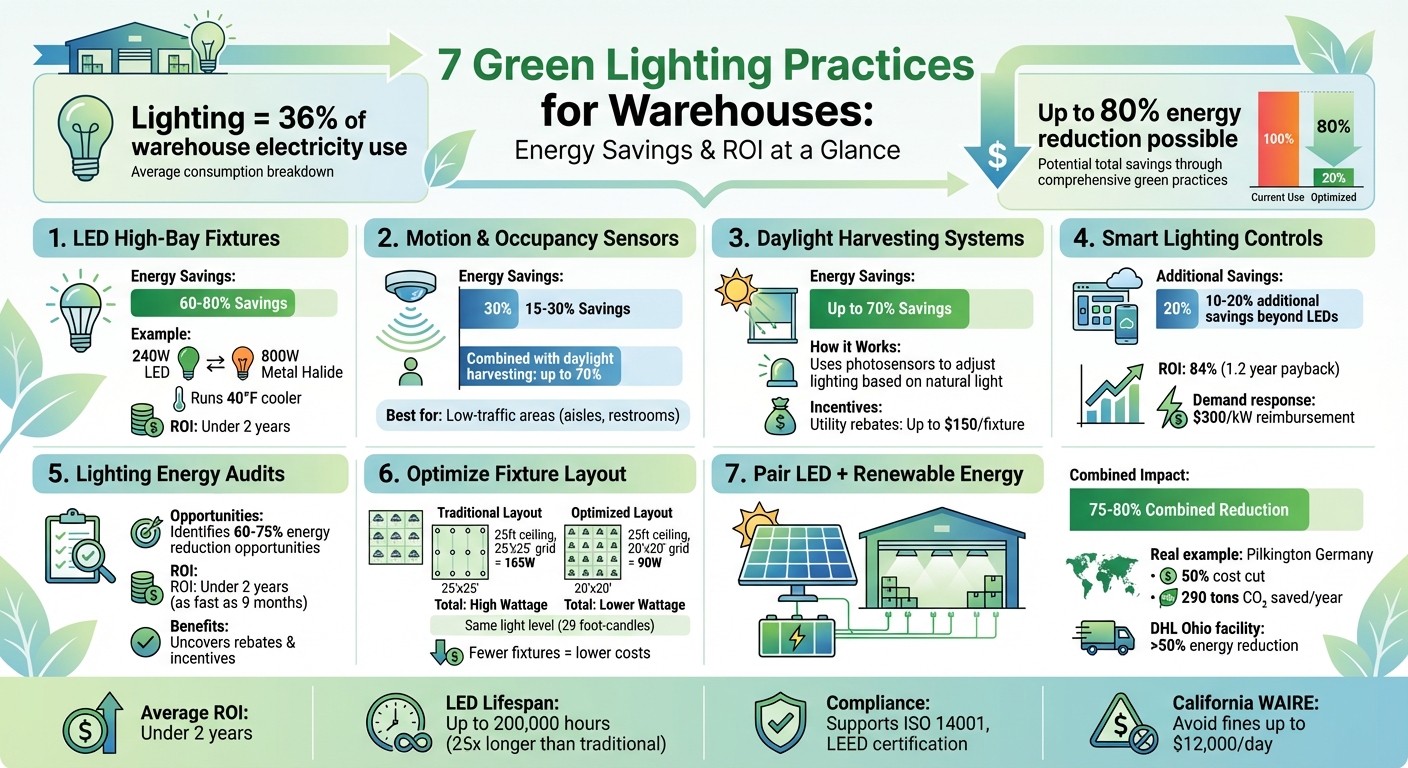
7 Green Lighting Practices for Warehouses: Energy Savings and ROI Comparison
LED high-bay fixtures outperform traditional metal halide or fluorescent systems in almost every way. For instance, a 240W LED fixture can replace an 800W metal halide while providing equal or better illumination. Thanks to their higher lumens per watt and the ability to focus light exactly where it’s needed, LEDs are a game-changer for energy efficiency.
Another key advantage is how LEDs convert energy. Unlike older systems that waste a lot of energy as heat, LEDs remain cooler - up to 40°F cooler than HID or fluorescent fixtures. In climate-controlled warehouses, this reduced heat can lead to noticeable savings on cooling costs during warmer months. Plus, LEDs turn on instantly, with no warm-up or restrike delays, making them perfect for pairing with motion sensors and smart controls.
Switching to LED high-bay fixtures can slash energy costs by 60% to 80% compared to traditional lighting systems. Given that lighting often accounts for over 30% of a warehouse's energy expenses, these savings can add up fast. Most LED retrofits pay for themselves in under two years through energy savings alone.
LEDs also last much longer than traditional bulbs, which means fewer replacements and less maintenance - especially important in warehouses with high ceilings. On top of that, many facilities can take advantage of utility rebates and tax incentives, making the financial case even stronger.
For businesses looking for tailored solutions, Luminate Lighting Group offers services like energy audits, custom lighting designs, and turnkey installations to help warehouses cut energy costs while meeting sustainability goals. Check out their offerings at Luminate Lighting Group.
Installing LED high-bays is surprisingly straightforward. Many fixtures are designed as "plug and play", allowing easy integration with existing setups using simple hook-and-chain mounts or retrofit kits. Type A plug-and-play bulbs work with existing ballasts, while Type B ballast-bypass bulbs eliminate the ballast altogether, saving an extra 5%–10% on energy use.
When planning a retrofit, it’s important to match the fixture output to the ceiling height. For ceilings between 20–25 feet, aim for fixtures that produce around 22,500 lumens. For ceilings over 35 feet, go for 45,000 lumens or more. To ensure even lighting, space fixtures at about 1.5 times the mounting height. Choosing a cool white color temperature (5000K) can also mimic natural daylight, boosting worker alertness. For environments exposed to dust, moisture, or frequent cleaning, opt for fixtures with IP65 or IP66 ratings for durability.
The benefits of LED high-bays go beyond cost savings - they're a win for the environment too. Their long lifespan significantly reduces waste from discarded bulbs and packaging. Plus, the 70% to 80% reduction in energy consumption lowers greenhouse gas emissions tied to power generation. Because LEDs produce less heat, they also reduce the strain on HVAC systems, further cutting energy use. For warehouses aiming to meet green building standards, LED high-bays are an essential step toward sustainability.
Motion and occupancy sensors rely on passive infrared (PIR) or ultrasonic technology to detect movement. These sensors automatically turn lights on when motion is detected and dim or switch them off after a period of inactivity. This automation eliminates the energy wasted by lights left on unnecessarily, a common issue with manual switches or pre-set schedules.
These sensors are particularly effective in low-traffic areas such as storage rooms, restrooms, break rooms, and back-of-house spaces where lights often remain on longer than needed. Many LED high-bay fixtures now come with built-in motion sensors, enabling instant activation and dimming to reduce energy use without completely turning off the lights. When paired with dimming-capable LED drivers, these fixtures can shift to a low-power mode that maintains essential lighting for safety while cutting down on energy consumption. This functionality not only saves energy but also reduces costs over time.
Installing occupancy sensors can lead to 15% to 30% savings on lighting costs. When combined with strategies like daylight harvesting, warehouses can achieve energy savings of up to 70%. This is especially impactful since lighting typically accounts for more than 30% of a warehouse's total energy use.
Sensor-integrated LED systems often pay for themselves quickly through energy savings alone. In addition to lowering kilowatt-hour consumption, these systems extend the lifespan of LED fixtures by reducing the total time they’re in use. This means fewer replacements and lower maintenance costs over time. Many utilities also offer rebates for sensor-based lighting controls, further enhancing the return on investment. Plus, the installation process is simple and causes minimal disruption.
Adding sensors to a warehouse lighting system is a straightforward process. Many industrial LED fixtures come equipped with pre-installed sensors or plug-and-play options that integrate seamlessly with existing systems. For warehouses already using LED high-bays, fixture-mounted sensors can automatically dim or turn off lights in inactive areas.
The success of sensor implementation depends on proper placement. To ensure effective motion detection, sensors should have an unobstructed line of sight and should not be installed behind shelving, doors, or large equipment. Companies like Luminate Lighting Group offer comprehensive services, including energy audits, custom lighting designs, and sensor integration, all while minimizing disruptions to operations. For more details, visit Luminate Lighting Group.
Motion and occupancy sensors play a role in sustainability by ensuring energy is only used when necessary, which reduces greenhouse gas emissions from power generation. By lowering the total burn time of LED fixtures, sensors also extend their lifespan, reducing the frequency of replacements and minimizing material waste. This precise control over energy usage helps warehouses align with green building standards and environmental goals.
Daylight harvesting relies on photosensors to automatically adjust electric lighting based on the amount of natural light streaming in through windows or skylights. When sunlight is sufficient, the system dims or switches off artificial lighting to maintain a target brightness level. This method is particularly effective in areas like loading docks, skylights, and other perimeter zones where natural light levels vary throughout the day.
In warehouses, open-loop systems are the go-to choice. Unlike closed-loop systems commonly used in offices, open-loop sensors focus solely on natural light levels, ignoring the artificial light they control. These sensors can manage large groups of fixtures at once, measuring light levels that often exceed 1,000 foot-candles - far more than what office spaces require. When paired with networked controls, these systems ensure smooth dimming transitions, maintaining energy efficiency without causing distractions. Wireless connectivity is a game-changer for high-ceiling applications, making retrofits easier by eliminating the need for additional control wiring. This seamless combination of natural and artificial lighting creates an ideal foundation for further energy-saving measures.
Daylight harvesting can cut warehouse lighting energy use by as much as 70%. When combined with other lighting control strategies, total savings can exceed 45%. Since high-bay fixtures in warehouses consume much more power than office lighting, the energy savings per fixture are significantly greater. Advanced LED systems incorporating daylight harvesting can reduce annual energy consumption by over 80% compared to traditional lighting setups.
The benefits don’t stop at energy savings. Lowering the hours fixtures operate at full brightness extends the lifespan of LED lights, reducing maintenance costs over time. Many utilities also provide rebates - up to $150 per fixture - for upgrading to high-bay LEDs with energy-efficient controls. On top of that, these systems often pay for themselves within two years.
The ease of integrating these systems into existing structures makes them an even more attractive option for warehouses.
Modern LED high-bays often come equipped with Zhaga Book 18 sockets, making it simple to install daylight sensors without the need for complicated rewiring.
Proper placement of photosensors is key. Sensors should face natural light sources, such as skylights or windows, rather than work surfaces, to ensure accurate readings. Grouping fixtures into zones based on their distance from natural light sources optimizes control. For instance, rows running parallel to windows are ideal for sidelighting, while skylights offer more uniform light distribution and greater flexibility in grouping fixtures.
Daylight harvesting doesn’t just save energy - it also reduces peak electricity demands, extends the lifespan of LED fixtures, and minimizes waste. With LEDs lasting longer, fewer replacements are needed, resulting in less material waste over time. Beyond these practical benefits, increased natural light exposure can boost employee focus, alertness, and overall productivity. This creates a healthier work environment while aligning with sustainability goals.
Smart lighting controls take LED savings to the next level. By combining features like occupancy sensing, task tuning (adjusting brightness to around 70%), and scheduling, these systems ensure lights are only on when truly needed. Add daylight harvesting into the mix, and networked lighting controls can save an extra 10–20% of energy beyond what LED fixtures alone provide.
Another standout feature is demand response. This allows lighting systems to automatically reduce loads during peak energy demand periods when utility companies send alerts. Some demand response programs even offer reimbursements of up to $300 per kilowatt for temporarily cutting energy use. Advanced wireless controls can slash energy costs by as much as 70% compared to traditional HID or fluorescent setups.
These combined features not only improve energy efficiency but also result in noticeable cost reductions.
Smart lighting controls don’t just save on energy - they also cut maintenance expenses. Automated monitoring can identify lamp failures or sensor issues early, streamlining upkeep. For example, industrial retrofits using high-efficiency fixtures paired with smart controls have shown a return on investment (ROI) of 84%, with payback periods as short as 1.2 years. On top of that, many utility providers offer rebates for upgrading to energy-efficient controls, further speeding up your ROI .
Modern systems go beyond lighting. They can integrate Real-Time Location Services to track equipment, inventory, and even personnel, saving time and boosting operational security. Plus, the wireless lighting network can act as a backbone for other building systems - like thermostats or CO₂ sensors - eliminating the need for separate networks.
"You cannot manage what you cannot measure, and centralized energy management software tools provide the capability to do both."
- Mandeep Khera, Vice President, Marketing and Channels, Daintree Networks, Inc.
Wireless control technology makes installation straightforward, especially compared to older wired systems. These controls can be centrally managed without the hassle of running new wiring. Turnkey installations are designed to integrate smart controls with minimal disruption to daily warehouse operations. Additionally, open wireless networks allow devices from various manufacturers to work together seamlessly, reducing long-term management headaches .
To maximize savings, warehouses can use sensors and daylight harvesting strategies while creating zones based on activity. Conducting a photometric study ensures consistent light distribution and reduces glare . Proper planning from the start ensures you get the most out of your investment.
For warehouse managers ready to upgrade their energy efficiency with smart lighting controls, Luminate Lighting Group offers complete, turnkey solutions from design to installation.
A lighting energy audit is a practical way to identify waste and inefficiencies in your current lighting setup. By evaluating your fixtures and measuring light levels with tools like light meters, auditors can pinpoint areas that need attention. They also review your electricity bills to calculate your current energy consumption in kilowatt-hours (kWh) and highlight specific opportunities for improvement.
Part of the process includes a photometric study, which maps out how light is distributed across your facility. Since lighting often accounts for over 30% of energy costs in warehouse spaces, these audits frequently uncover ways to cut energy consumption by as much as 60% to 75% through upgrades like LED lighting and smart controls.
One of the most compelling aspects of lighting energy audits is the potential for cost savings. Auditors provide a detailed cost analysis showing how much you can save by switching to LED lighting. The results speak for themselves: warehouses that implement LED upgrades based on audit findings typically see a return on investment (ROI) in under two years. In some cases, payback can occur in as little as nine months. For example, an industrial retrofit project achieved an impressive 84% ROI with a payback period of just 1.2 years.
Auditors also help identify utility rebates and tax incentives that can significantly lower your upfront costs and shorten the payback period. When these rebates are factored in, many facilities see their ROI drop to under a year. This financial clarity makes the decision to conduct an audit and upgrade your lighting a no-brainer.
The audit process is designed to be simple and minimally disruptive. Using tools like cameras, tape measures, laser devices, and light meters, auditors thoroughly document your current setup. They also collect floor plans, ceiling dimensions, and recent utility bills to create a detailed baseline.
The end result is a customized report tailored to your facility’s specific needs and budget. This report prioritizes upgrades such as LED retrofits and smart controls, helping you align with green building standards. If you’re leasing space, the ideal time to conduct an audit is before moving in, allowing you to retrofit the facility without disrupting operations. Additionally, the report specifies which fixtures meet certifications like DLC, ENERGY STAR, or UL, ensuring you qualify for rebates and receive high-quality equipment.
The benefits of a lighting audit extend beyond financial savings - it’s also a step toward sustainability. By enabling LED upgrades, audits can reduce your energy use by up to 70%, which in turn lowers your carbon footprint and HVAC loads. LED fixtures also run up to 40°F cooler than traditional HID or fluorescent lights, further easing the strain on your HVAC system.
Audits tackle waste and hazardous material concerns as well. Traditional HID and fluorescent lamps often contain mercury and require frequent replacements, leading to disposal challenges. LEDs, on the other hand, have a much longer lifespan, reducing landfill waste and eliminating the environmental risks tied to mercury-containing bulbs.
For expert guidance, Luminate Lighting Group offers comprehensive energy audits. They help identify cost-effective and sustainable lighting solutions tailored to your facility’s needs, paving the way for smarter energy use and long-term savings.
Taking energy efficiency to the next level goes beyond smart controls and LED retrofits - it’s also about optimizing how fixtures are arranged. The layout of your fixtures directly influences energy use. By using data-driven photometric planning, you can determine the exact number of fixtures needed based on ceiling height, surface reflectivity, and floor layout. This ensures you get the right amount of light (measured in foot-candles) with the least energy possible.
"Photometric plans ensure optimal light distribution, minimize shadows, and reduce fixture count while achieving target foot-candles." - Pacific Energy Concepts (PEC)
The right spacing can significantly lower energy requirements. For instance, in a warehouse with 25-foot ceilings, switching from a 25' x 25' grid to a 20' x 20' grid lets you use 90W fixtures instead of 165W ones - while maintaining the same 29 foot-candles of light. The Illuminating Engineering Society (IES) suggests 10 to 30 foot-candles for general warehouse lighting, and strategic fixture placement helps you meet these recommendations without wasting power.
Aligning fixtures over aisles focuses light where it’s needed most - on floors and rack faces - avoiding unnecessary energy use in less critical areas. For warehouses with ceilings between 20 and 25 feet, 22,500-lumen fixtures are often sufficient, while higher ceilings over 35 feet may require 45,000 lumens or more. This approach not only saves energy but also trims costs.
A well-thought-out fixture layout can deliver impressive cost savings. Fewer, strategically spaced fixtures mean lower upfront material costs and reduced energy bills. By carefully planning your layout, you can use fewer fixtures while still meeting your lighting needs.
Proper spacing also allows for lower-wattage fixtures, which saves money right away. Closer fixture spacing achieves the same light levels with less powerful (and less expensive) units. Plus, optimized layouts eliminate hot spots and dark areas, which helps reduce picking errors and improve worker safety - indirectly saving costs from accidents or mis-shipments.
| Ceiling Height | Fixture Grid | Wattage | Light Level |
|---|---|---|---|
| 25 ft | 25' x 25' | 165W | ~29 Foot-Candles |
| 25 ft | 20' x 20' | 90W | ~29 Foot-Candles |
| 35 ft | 25' x 28' | 225W | ~31 Foot-Candles |
| 35 ft | 20' x 25' | 165W | ~30 Foot-Candles |
A photometric study is the first step to implementing these savings effectively.
Getting started with an optimized layout is straightforward when you begin with a photometric study. This analysis determines the exact number and placement of fixtures needed to achieve proper lighting levels without over-lighting. It accounts for variables like ceiling height, racking setup, and surface colors.
Once you have the data, selecting the right fixtures is simple. For open areas with high ceilings, UFO high-bay lights are ideal. For aisles, linear LED strips work best.
"In warehouses where the ceiling height is 20 - 25 ft we typically suggest 22,500 lumens 150 watt LED UFO high bay lights. For ceiling heights over 35 ft, we've found 45,000 lumens 300 watt LED UFO high bay lights are a great fit." - Tyler, Lighting Specialist at LED Lighting Supply
If your warehouse layout evolves over time, using fixtures with 10 to 12-foot cords allows for easy repositioning. You can also group fixtures into task-specific zones, providing brighter light for packing areas and lower levels for bulk storage, which optimizes energy use.
Optimizing your fixture layout doesn’t just save energy - it also reduces your environmental footprint. Surface reflectivity plays a big role here. Dark-colored walls or ceilings may need 33% more fixtures than lighter surfaces to achieve the same lighting levels. Painting walls and ceilings in lighter colors can cut down the number of fixtures required, reducing waste and material use.
Proper spacing also maximizes the benefits of LED technology. LED high-bay fixtures can use up to 75% less energy than traditional metal halide lights. They also run up to 40°F cooler, which eases the burden on your facility’s cooling systems during warmer months. By optimizing your layout, you make the most of these energy savings while minimizing the number of fixtures needed for effective lighting.
Switching to LED lighting already offers impressive energy savings, but combining these systems with on-site renewable energy takes efficiency to the next level. By reducing energy demand, solar power can cover a larger share of a facility's lighting needs. Add in smart controls and daylight harvesting, and you’re looking at an additional 10–20% in energy savings. Advanced lighting systems can also participate in Demand Response programs, cutting lighting loads by at least 15% during peak demand periods. These improvements not only lower energy consumption but also lead to substantial cost reductions.
LED lighting slashes energy usage by 75–80%, which means solar panels can easily meet a larger portion of a warehouse’s power needs. Warehouses, with their expansive, flat rooftops, are ideal for on-site solar installations that reduce reliance on the grid.
"Solar energy lowers dependence on fossil fuels and also reduces electricity costs in the long run." - Nebraska Warehouse
A great example of this is the Carlisle Companies facility in Sikeston, Missouri. In April 2025, they installed an 823 kW solar array paired with a 100 kW battery system, reducing their energy load by 10%.
The process starts with a lighting audit to pinpoint inefficiencies and calculate wattage needs. This step ensures both the LED upgrade and renewable energy system are properly sized. Modern LED fixtures are designed for easy retrofitting, and solar panels can be scaled based on rooftop space. With large rooftops, warehouses can install scalable solar arrays paired with battery storage to handle peak energy loads. Meanwhile, control systems with task tuning prevent over-lighting and minimize energy waste.
The benefits extend far beyond cost savings. Warehouses are responsible for 7% of global carbon emissions in the logistics sector, and lighting alone accounts for 36% of the electricity used in non-refrigerated U.S. warehouses. Pairing LED lighting with on-site renewables can significantly cut emissions and reduce reliance on fossil fuels.
"The expansive roof space typical of warehouses presents an ideal opportunity for solar panel installation. In many climate zones, warehouses can generate sufficient renewable energy to significantly offset (or even exceed) their power requirements." - Raymond Handling Consultants
Real-world examples highlight these advantages. Pilkington Automotive in Germany reduced energy costs by 50% and cut its annual carbon footprint by 290 tons after retrofitting with LED lighting and connected sensors. Similarly, DHL Supply Chain’s 383,000-square-foot facility in Lockbourne, Ohio, achieved over a 50% reduction in energy use, surpassing its annual savings goal of one million kilowatt-hours. Plus, unlike metal halide bulbs, LEDs are mercury-free, making them an environmentally safer choice that supports LEED certification. Integrating renewable energy with LED lighting demonstrates a warehouse’s commitment to sustainability while boosting operational efficiency.
Upgrading to LED lighting and integrating smart controls can slash energy use by up to 80% while offering a return on investment in under two years. With lighting responsible for about 36% of electricity consumption in non-refrigerated U.S. warehouses, this shift brings more than just financial benefits.
LED lighting improves workplace safety by reducing accidents and minimizing worker fatigue. These lights also last up to 25 times longer than traditional bulbs, with some industrial fixtures boasting lifespans of up to 200,000 hours. Plus, they emit far less heat, which helps cut cooling costs in temperature-controlled environments.
On top of cost savings, modern lighting systems simplify regulatory compliance. They align with standards like ISO 14001 and support sustainability reporting requirements. For example, in California, where the Warehouse Indirect Source Rule can result in fines as high as $12,000 per day for noncompliance, investing in sustainable lighting can earn WAIRE points, helping businesses meet emissions regulations.
LED solutions also offer environmental advantages. They are mercury-free, making disposal safer, and have been shown to significantly reduce carbon emissions and energy use during real-world retrofits.
Luminate Lighting Group provides energy audits, custom photometric designs, and turnkey LED retrofit services to help you achieve maximum ROI while staying compliant. Visit https://luminatelightinggroup.com to start cutting energy costs and reducing your environmental footprint today.
Warehouses can slash energy costs by switching to LED lighting, which uses 70–80% less electricity than traditional metal-halide or fluorescent fixtures. This is thanks to their higher light output per watt, reduced heat production, and focused directional lighting that minimizes energy waste.
On top of that, LED lights last significantly longer, cutting down on maintenance costs and reducing the hassle of frequent replacements. Making the switch to these energy-efficient solutions not only lowers utility bills but also aligns with sustainability efforts. Plus, warehouses may qualify for utility rebates or tax incentives, such as the 179D deduction, adding even more value to the upgrade.
Smart lighting controls - like occupancy sensors, daylight-responsive dimmers, and programmable schedules - are game-changers for warehouse lighting. These systems adjust light levels automatically based on real-time activity, ensuring well-lit spaces where needed while reducing glare and unnecessary energy use.
One of the standout advantages? Energy savings. Features like occupancy-based dimming and daylight harvesting can slash electricity consumption by up to 70%. This not only cuts utility bills but also opens the door to energy rebates and 179D tax deductions. On top of that, smart controls help extend the life of LED fixtures by dialing down their output in empty areas, which means fewer replacements and lower maintenance costs.
At Luminate Lighting Group, we specialize in creating and retrofitting smart lighting solutions tailored for warehouses. Our systems are designed to help clients save money, boost sustainability, and meet energy efficiency standards - all while taking advantage of available financial incentives.
Combining energy-efficient LED lighting with on-site renewable energy, like solar power, can make a big difference in how sustainable a warehouse becomes. LEDs alone cut electricity use by a whopping 70–80% compared to traditional lighting. Pair that with clean, self-generated solar energy, and you’re looking at lighting-related carbon emissions that can get close to zero. This setup not only slashes reliance on fossil fuels but also reduces peak energy demand and boosts energy independence, all while shrinking the facility’s carbon footprint.
But it’s not just about the environmental perks - there’s real money to be saved too. Warehouses can see lower utility bills, qualify for solar-related rebates, and benefit from 179D tax deductions. Companies like Luminate Lighting Group are experts in creating tailored LED systems, performing energy audits, and integrating solar solutions. They help warehouses hit their sustainability targets, cut costs, and align with U.S. green building standards.


