.svg)
Claim federal tax deductions for LED retrofits: Section 179D, bonus depreciation & QIP, utility rebates, and key documentation steps.

Switching to LED lighting in commercial buildings not only cuts energy use by 50–80%, but it also opens the door to federal tax deductions. Key programs like Section 179D, bonus depreciation, and Qualified Improvement Property (QIP) can reduce upfront costs and speed up financial returns. Here’s what you need to know:
Utility rebates, ranging from $0.50 to $2.50 per bulb, further reduce costs and are expected to increase by 10–20% in 2025. To claim these incentives, businesses must follow strict IRS rules, including energy modeling, third-party certification, and detailed documentation. Acting in 2025 ensures maximum savings before certain benefits phase out.
Section 179D is a federal tax deduction introduced under the Energy Policy Act of 2005 to incentivize energy-efficient upgrades in commercial buildings. It covers improvements to lighting, HVAC systems, and building envelopes, making it particularly appealing for projects like LED retrofits. Unlike a tax credit, which directly reduces your tax liability, this deduction lowers your taxable income - offering meaningful savings on larger-scale projects.
The deduction is available for nonresidential commercial buildings and government or public buildings, where designers can also benefit. For privately owned properties, the deduction is claimed in the same tax year the LED system is installed and operational. For government buildings - such as federal, state, or local facilities, public schools, or municipal structures - the deduction can be allocated to the primary designer responsible for the technical specifications. This could include architects, engineers, lighting design firms, or energy service companies (ESCOs) involved in the project. Let’s break down the eligible properties, who can claim the deduction, and the specific requirements for LED systems.
The deduction applies to a broad range of structures, including offices, warehouses, manufacturing plants, retail stores, healthcare facilities, and hotels, among other nonresidential commercial buildings. Government and tax-exempt buildings also qualify, but since they don’t pay federal income taxes, they must assign the deduction to the designer via a written allocation letter.
For privately owned buildings or tenants making LED upgrades, the deduction can be claimed if they are treated as the owner for tax purposes. On government projects, the designer, as defined by IRS guidelines, is the individual or firm responsible for creating the technical specifications. They can claim the deduction once the government owner provides the necessary allocation letter.
Luminate Lighting Group supports private property owners and public project designers by conducting energy audits, crafting custom lighting designs, and preparing the technical documentation needed for 179D eligibility. Their expertise helps both designers and owners maximize their potential deductions.
Qualifying for the 179D deduction involves meeting specific energy efficiency thresholds, which are verified through energy modeling. LED upgrades must generally achieve a 25% reduction in energy usage compared to a baseline. Larger reductions in energy consumption can unlock higher per-square-foot deduction amounts. LED technology often surpasses this benchmark, making it a reliable option for meeting the 25%+ requirement.
To certify eligibility, projects must adhere to relevant energy standards and complete energy modeling to document the savings. This process involves comparing the installed LED system - encompassing fixtures, controls, and sensors - against a reference baseline to calculate energy reductions. A qualified third-party certifier must then conduct a site inspection to confirm that the installed system matches the modeled design and issue the necessary certification documentation.
Figuring out your 179D deduction starts with a simple formula: multiply the eligible square footage by the applicable per-square-foot rate. This rate is tied to the percentage of energy savings your LED upgrade achieves compared to the ASHRAE baseline. If your project meets prevailing wage and apprenticeship (PWA) requirements, you may qualify for higher rates - potentially up to $5.00 per square foot.
Before diving into the math, make sure you determine the conditioned floor area - this refers to the space actually served by the new lighting system. For partial-building retrofits, only count the areas that have been improved. For instance, if you’re upgrading a 50,000-square-foot warehouse but only improve 40,000 square feet, use the improved area in your calculations. For mixed-use buildings, separate qualifying commercial areas from non-qualifying ones, and for phased projects, claim deductions based on the square footage placed in service during each tax year. Accurate measurements and modeling are key to getting the most out of your deduction. Let’s break down the per-square-foot calculation method and the thresholds for partial and full deductions.
Once you’ve identified your eligible square footage, an energy modeler will run a simulation comparing your upgraded LED system to the ASHRAE reference building. This simulation calculates the percentage reduction in energy and power costs, which determines your per-square-foot rate. For example, if a 50,000-square-foot facility installs high-efficiency LEDs that achieve a 30% reduction in energy use, it qualifies for a $2.00 per-square-foot rate, leading to a total deduction of $100,000.
The IRS uses a sliding-scale system, meaning the higher the energy savings, the higher the per-square-foot rate. To ensure your measurements match your as-built drawings, coordination between your energy modeler and tax advisor is crucial.
After calculating the per-square-foot rate, you’ll need to determine whether your project qualifies for a partial or full deduction. A lighting-only retrofit can qualify for a partial deduction if it meets the lighting subsystem criteria - typically requiring at least a 25% energy reduction. However, if the entire building doesn’t achieve the deeper energy savings needed for a full deduction, the partial option is the way to go.
To qualify for a full-building deduction, lighting upgrades must work alongside improvements to HVAC systems and the building envelope to deliver more comprehensive energy reductions.
Luminate Lighting Group supports property owners and designers by conducting energy audits, designing tailored LED systems, and managing the energy modeling and certification process. Whether you’re aiming for a lighting-only partial deduction or a full-building deduction, their expertise ensures you maximize your 179D benefits.
In addition to the 179D deduction, bonus depreciation and Qualified Improvement Property (QIP) provide further opportunities for accelerated cost recovery. These tax provisions operate independently of 179D, allowing you to stack tax benefits from the same LED lighting project. While 179D incentivizes energy efficiency, bonus depreciation and QIP focus on speeding up the recovery of your capital investment, giving you quicker access to your money.
These provisions work together to enhance your overall tax strategy. Timing is key here - bonus depreciation rates are set to decline in the coming years. However, recent federal tax updates bring back 100% bonus depreciation for qualifying equipment installed in 2025. To take full advantage, your LED system must be purchased and operational within that year. Let’s break down how bonus depreciation and QIP rules can further boost the tax advantages of your LED retrofit.
Bonus depreciation allows you to deduct the full cost of qualifying LED systems in the year they are placed in service, rather than spreading the deduction over several years. For projects completed in 2025, updated legislation reinstates 100% bonus depreciation. This means that if your LED retrofit costs $100,000, you can deduct the entire $100,000 immediately, reducing your taxable income right away.
The bonus depreciation rate is scheduled to phase out in the following years: 60% in 2024, 40% in 2025 (unless the temporary 100% rate applies), and 20% in 2026. Acting in 2025 provides a rare opportunity to maximize this deduction while also taking advantage of 179D benefits for the same project.
Now, let’s explore how QIP rules complement these deductions.
Most interior LED lighting retrofits qualify as QIP, making them eligible for bonus depreciation. QIP applies to improvements made inside nonresidential buildings after the building is already in use.
To qualify as QIP, your LED upgrade must meet the following criteria:
This makes QIP particularly relevant for commercial LED upgrades in spaces like warehouses, offices, and industrial facilities, which typically meet these requirements.
The QIP classification is especially valuable because it allows you to combine Section 179 expensing with bonus depreciation. For larger projects, you can use Section 179 to expense part of the cost and apply bonus depreciation to the remaining amount. This strategy can significantly increase your first-year tax deductions.
Luminate Lighting Group works closely with clients to navigate these tax provisions. By collaborating with energy modelers and tax advisors, they ensure LED retrofits are properly documented for both QIP classification and bonus depreciation claims. Accurate documentation - such as purchase invoices, installation dates, and cost segregation studies - is crucial to support your deductions and avoid potential audit issues.
Claiming a 179D deduction requires strict adherence to IRS rules and thorough documentation. Without the right paperwork, your deduction could be denied during an audit. The process revolves around two main components: independent energy modeling conducted by a qualified professional and detailed record-keeping for your LED project.
To start, you need to hire a qualified third party - either a licensed professional engineer (PE) or a contractor with the required credentials - who has no ties to your business. This certifier uses IRS-approved software to model your LED system’s energy performance against the ASHRAE 90.1 baseline. The model must accurately reflect your building’s geometry, usage type, and operating schedules, and it must show at least a 25% reduction in energy costs to qualify for the deduction.
After installation, the certifier conducts an on-site inspection to confirm that the LED fixtures and controls are installed as planned. They then issue a formal 179D certification report, including a signed statement attesting that the project meets all requirements. For government-owned buildings, you’ll also need an allocation letter from the government entity assigning the deduction to the designer. Once these steps are completed, you’ll have the documentation needed to be prepared for any potential audits.
Energy modeling is a critical technical step in claiming the 179D deduction. Using IRS-approved software, the certifier models both the baseline and upgraded energy costs for your building. The difference between these costs determines your energy savings and, ultimately, your deduction.
The certifier must be independent and properly licensed. Choose a PE or lighting professional with proven expertise and access to approved modeling tools. They’ll need detailed information, including lighting layouts, fixture specifications (such as DLC or ENERGY STAR listings), control sequences, and operating schedules. Once the modeling is complete and the on-site inspection verifies proper installation, you’ll receive a certification package. This package includes a signed certification statement, a full energy modeling report comparing baseline and proposed costs, and documentation of the floor area to support your per-square-foot calculation.
Luminate Lighting Group works closely with qualified energy modelers throughout the project. By designing LED layouts and controls that meet 179D requirements from the beginning, they help ensure your system qualifies. Their team also assists in gathering the technical specifications and documentation needed by the certifier, simplifying the entire process.
Once energy modeling and on-site certification are complete, precise documentation is essential to back up your claim. You’ll need to gather design records, as-built drawings, product cut sheets, and financial documents to confirm your project’s eligibility and cost basis. Start with the design and construction records, which should include as-built drawings showing the final installed conditions, product cut sheets with efficiency ratings, and commissioning or functional test reports for lighting controls. Financial records such as contracts, change orders, paid invoices, proof of payment (like canceled checks or ACH confirmations), and fixed-asset ledger entries are also necessary. These records establish your project’s placed-in-service date and cost basis for both the 179D deduction and depreciation purposes.
The 179D certification package is the cornerstone of your claim. It should include the signed certification statement, the complete energy modeling report with all inputs and outputs, and any allocation letters. Keep these documents in a dedicated digital folder. While this package isn’t submitted with your tax return, your CPA will need it to calculate and report the deduction, and the IRS may request it during an audit.
It’s recommended to retain all 179D-related documentation for at least seven years. Although the IRS generally requires records to be kept for three years after filing, many tax professionals suggest longer retention for deductions like 179D. Organize your records into clearly labeled subfolders - such as design, construction, certification, financials, and tax filings - and include a summary memo that links square footage, cost basis, deduction amount, and key dates. Be sure to store energy model files alongside PDF copies for easy access in the future.
Common mistakes to avoid include hiring a certifier who isn’t truly independent, failing to clearly document square footage, or confusing 179D deductions with depreciation treatments. Luminate Lighting Group helps clients sidestep these issues by maintaining detailed project records, coordinating with certifiers and tax advisors, and ensuring all documentation is ready for audit before filing your return.
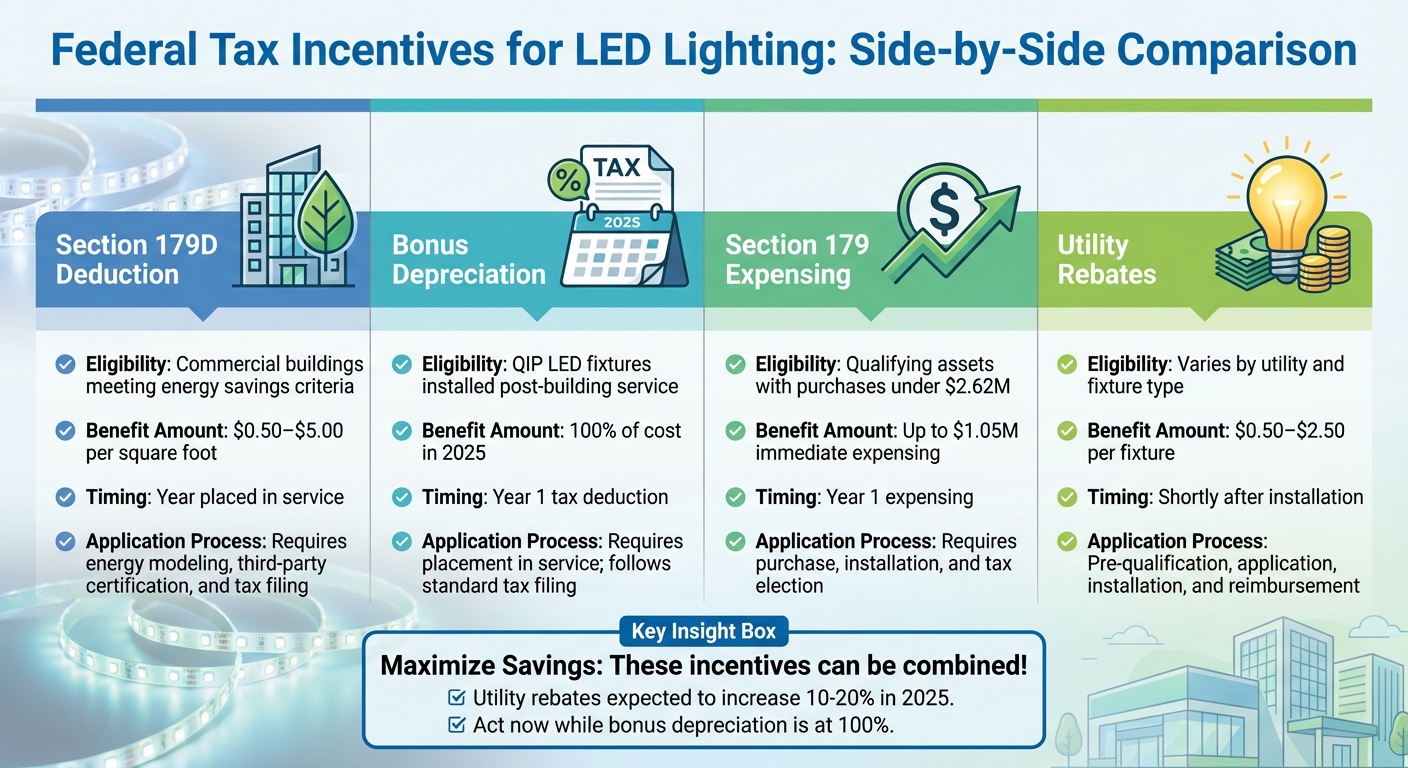
Federal Tax Incentives for LED Lighting Comparison Chart
While Section 179D offers compelling tax benefits for LED upgrades, it's not the only game in town. Other federal tax incentives, like bonus depreciation and Section 179 expensing, allow businesses to write off a portion of project costs upfront. Add to that utility rebates and state programs, and the potential savings grow even more. Understanding how these incentives work together can significantly boost your bottom line. Below, we’ll break down how these programs compare.
Each federal tax incentive comes with its own set of rules, benefits, and timelines. For instance, bonus depreciation lets you deduct a percentage of your LED lighting costs in the first year, provided the fixtures qualify as Qualified Improvement Property (QIP) installed after the building is in service. In 2025, bonus depreciation still allows a full first-year deduction. On the other hand, Section 179 permits immediate expensing of up to $1,050,000, though this amount phases out if total equipment purchases exceed $2,620,000. Unlike Section 179D, these two incentives don’t require energy modeling or third-party certification - they’re based solely on equipment costs.
Here’s a side-by-side look at the key programs:
| Incentive | Eligibility | Benefit Amount | Timing | Application Process |
|---|---|---|---|---|
| 179D Deduction | Commercial buildings meeting energy savings criteria | $0.50–$5.00 per sq ft | Year placed in service | Requires energy modeling, third-party certification, and tax filing |
| Bonus Depreciation | QIP LED fixtures installed post-building service | 100% of cost in 2025 | Year 1 tax deduction | Requires placement in service; follows standard tax filing |
| Section 179 | Qualifying assets with purchases under $2.62M | Up to $1.05M immediate expensing | Year 1 expensing | Requires purchase, installation, and tax election |
| Utility Rebates | Varies by utility and fixture type | $0.50–$2.50 per fixture | Shortly after installation | Involves pre-qualification, application, installation, and reimbursement |
Utility rebates, unlike tax deductions, offer direct cash incentives from electric utilities to offset upfront costs. For example, Oncor in Texas typically provides rebates ranging from $0.50 to $2.50 per fixture, with these rates expected to increase by 10–20% in 2025. The best part? These rebates are available regardless of your tax situation.
To maximize savings, projects can combine several incentives - but this requires careful planning. Federal tax deductions like 179D, bonus depreciation, and Section 179 can affect the depreciable basis of your project, so it’s crucial to consult with a tax advisor to understand their interaction. Utility rebates, on the other hand, generally reduce project costs without interfering with federal deductions, though they can impact depreciation calculations. Timing is everything: for 2025 projects, take advantage of the 100% bonus depreciation before reductions in subsequent years. Also, secure utility rebates early to avoid missing out, and make sure all necessary documentation is in place by working closely with your energy modeler and tax advisor.
Luminate Lighting Group simplifies this process by pre-qualifying utility rebates, designing LED systems that align with 179D requirements, and assisting with tax and rebate documentation. Their expertise ensures you capture every available incentive while staying compliant with regulations, making your LED upgrade as financially rewarding as possible.
Federal tax deductions, such as the 179D deduction, bonus depreciation, and utility rebates, provide substantial financial benefits that go well beyond the initial installation costs. The 179D deduction, now a permanent fixture, offers up to $5.00 per square foot if prevailing wage requirements are met. When combined with bonus depreciation and utility rebates, these incentives create a compelling stack of savings. Plus, with LED lighting slashing electricity use by 50–80% compared to older systems, the operational savings further enhance the upfront tax advantages. In many cases, these combined benefits lead to payback periods of just a few years.
Timing plays a pivotal role in maximizing these opportunities. 2025 is a key year to act, as bonus depreciation remains at 40% before dropping to 20% in 2026. Additionally, utility rebate programs are growing, with some regions projecting increases of 10–20%. Acting quickly ensures you capture the highest possible value from these incentives.
However, navigating the complexities of energy modeling, third-party certifications, and documentation can be challenging. This is where Luminate Lighting Group steps in. They simplify the process, offering services like detailed energy audits, custom lighting design, rebate pre-qualification, and tax incentive documentation. Their licensed electricians handle code compliance, while their team manages the paperwork required to support your 179D claim. By working with experienced professionals, you ensure your project is designed to maximize deductions, with careful fixture selection, control integration, and energy performance modeling all accounted for.
A trusted partner also helps coordinate timing across various incentive programs, avoiding conflicts and ensuring you achieve the highest total savings. With proper planning, thorough documentation, and expert guidance, your LED lighting upgrade can deliver immediate tax benefits, long-term energy savings, and a stronger financial foundation for your business.
To take advantage of the Section 179D tax deduction for LED lighting, your project needs to focus on upgrading energy efficiency in a commercial building. Specifically, the lighting system must achieve energy savings of at least 25% compared to baseline standards. A qualified professional must also certify the project to ensure it meets the necessary compliance requirements.
Accurate documentation is critical. This includes energy modeling and proper certification to support your deduction claim. The incentive is available for both new construction projects and retrofits of existing buildings, offering businesses a way to cut energy costs while enjoying tax benefits.
Bonus depreciation allows you to deduct the entire cost of LED lighting upgrades in the same year you make the purchase, offering immediate tax savings. On the other hand, Qualified Improvement Property (QIP) covers certain interior improvements, including eligible lighting upgrades. These may qualify for the 179D deduction or need to be depreciated over an extended period.
Bonus depreciation is a great choice if you’re looking to reduce your tax liability quickly. However, QIP requires adherence to specific IRS rules for energy-efficient improvements. Both options can help lower your overall costs, but which one works best for you will depend on your project’s scope and your financial objectives.
When pursuing federal tax deductions for LED lighting upgrades, thorough documentation is key. Make sure to keep invoices, receipts, and detailed records that describe the scope of your project. For the 179D tax deduction, you'll also need a certification from a qualified third party. This certification confirms the energy savings achieved and ensures compliance with IRS requirements. Staying organized with these records will make filing for deductions much easier.


