.svg)
How UL 844 and NEC-certified explosion-proof LED fixtures meet Class I Division 1 and 2 requirements, plus installation and maintenance essentials.
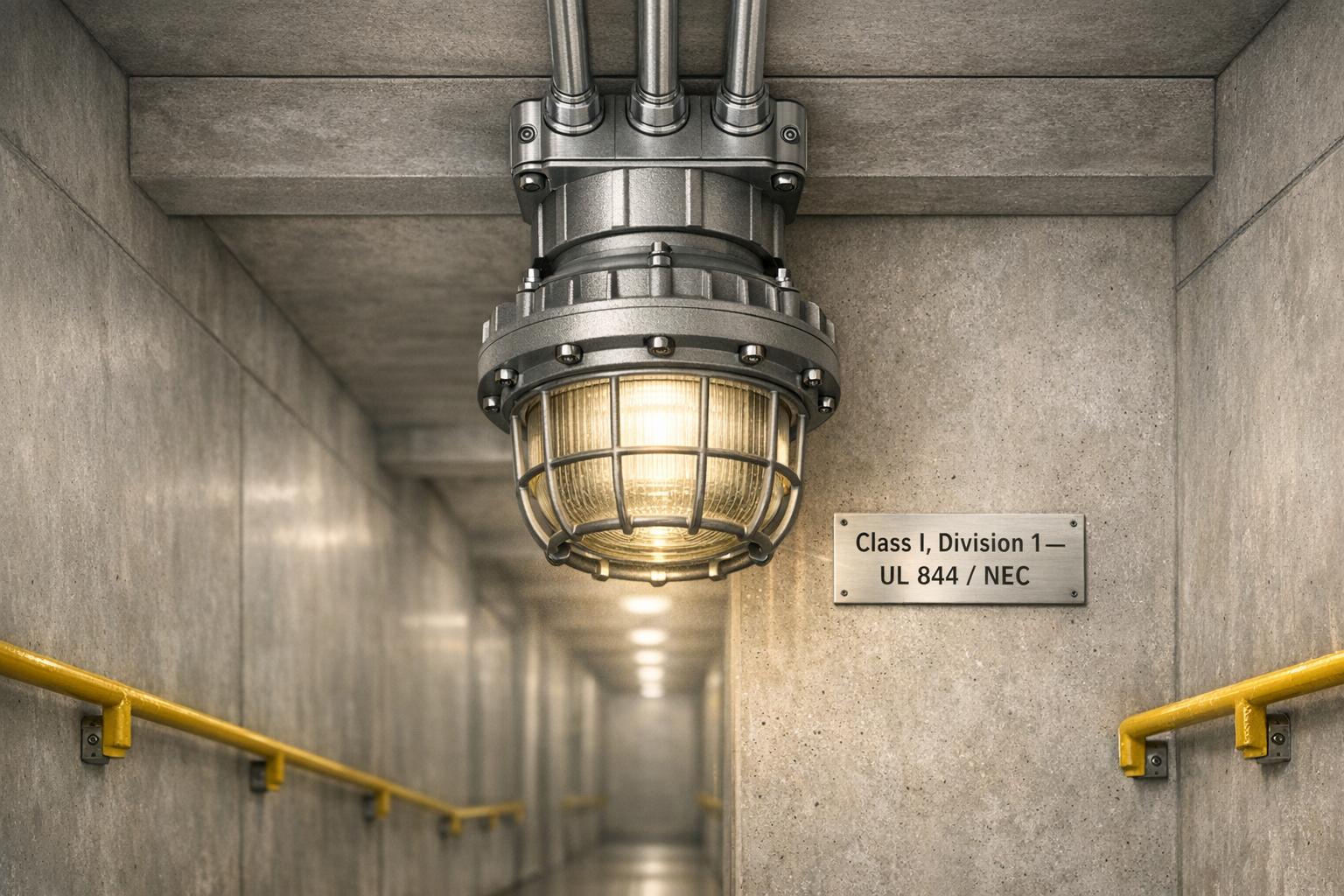
Explosion-proof LED lighting is designed to prevent sparks, arcs, or heat from igniting flammable gases, vapors, or dust in hazardous locations. These fixtures are essential for safety in environments like oil refineries, chemical plants, and grain silos, where explosions could occur. They meet strict safety standards set by OSHA and the NEC, ensuring compliance and reducing risks.
Key points:
Explosion-proof LEDs are tailored for specific hazard classifications, such as Class I Division 1 (high-risk areas) and Division 2 (lower-risk areas). Proper installation and regular maintenance are critical for ensuring safety and reliability.
The National Electrical Code (NEC) uses a classification system to define industrial environments based on the type and frequency of flammable materials present. Class I locations pertain to areas where flammable gases or vapors are present in amounts that could create explosive or ignitable mixtures. These are further divided into Division 1 and Division 2, depending on how often the hazard occurs.
Understanding these classifications is essential for ensuring safety and meeting compliance standards. Both OSHA and the NEC mandate the use of certified lighting in classified areas. Using uncertified fixtures can lead to fines, insurance complications, or even facility shutdowns. Explosion-proof LED fixtures are specifically designed to contain any ignition source, ensuring that sparks, arcs, or heat remain within the fixture's housing.
| Classification | Hazard Presence | Typical Environments |
|---|---|---|
| Class I, Division 1 | Normal operating conditions | Oil refineries, spray finishing areas, fuel storage |
| Class I, Division 2 | Abnormal conditions (e.g., leaks) | Closed storage systems, chemical processing bypasses |
Class II addresses environments with combustible dust, while Class III focuses on ignitable fibers. Each classification requires different types of fixtures to meet safety standards.
Let’s dive into the specific requirements for Class I Division 1 and Division 2 environments.
Division 1 applies to areas where flammable gases or vapors are present continuously, intermittently, or periodically during normal operations. These hazards are expected as part of everyday activities or during routine maintenance and repairs. Examples include open-air fuel loading docks, areas near uncovered chemical vats, and zones where refinery processes are actively taking place.
Lighting in Division 1 areas must meet the strictest safety standards. Fixtures need to be designed to contain any internal explosions, preventing ignition of the surrounding atmosphere. This requires reinforced seals, advanced thermal management, and other safety features. Only explosion-proof fixtures are suitable for these environments. Additionally, the fixture's surface temperature (T-Rating) must remain below the ignition temperature of the gases or vapors present. Accurate classification is critical for selecting the right lighting to comply with safety codes.
Division 2 covers environments where flammable gases or vapors are typically confined within closed systems or containers. The hazard only arises under abnormal conditions, such as equipment malfunctions, accidental leaks, or ventilation failure. Common examples include storage areas for sealed drums, facilities using mechanical ventilation, and spaces near Division 1 zones.
Although the risk is lower than in Division 1, proper lighting is still essential. A Division 2 classification can also apply to areas adjacent to Division 1 zones, as explosive gases could migrate if ventilation systems fail. Fixtures in these areas must still be explosion-proof, though the design requirements may not be as stringent as those for Division 1. To ensure safety and compliance, always match the fixture's Class, Division, and Group ratings to the specific hazards of the environment.
Explosion-proof LED lighting must adhere to strict safety standards for hazardous environments. In the United States, the National Electrical Code (NEC) serves as the primary regulatory framework, while UL 844 certification ensures that the fixtures can safely operate in explosive atmospheres. For U.S.-based facilities, compliance with NEC and UL 844 is crucial for deploying lighting in Class I Division 1 or Division 2 areas. These standards guide the design and selection of explosion-proof LED fixtures for industrial settings. Below, we’ll explore the key NEC requirements and UL 844 testing procedures that ensure safe installation.
The NEC provides a classification system to determine which fixtures are suitable for specific hazardous environments. For Class I locations, where flammable gases or vapors may be present, the code mandates that fixtures are listed or certified for the appropriate Class, Division, and Group rating of the site. Additionally, fixtures must maintain a surface temperature below the ignition point of the flammable substances in the area. This is verified through the Temperature Class (T-Rating), which specifies the maximum allowable surface temperature.
Another critical NEC requirement is the use of engineered flame paths within the fixture housing. These paths safely vent explosion gases, preventing the ignition of surrounding flammable materials.
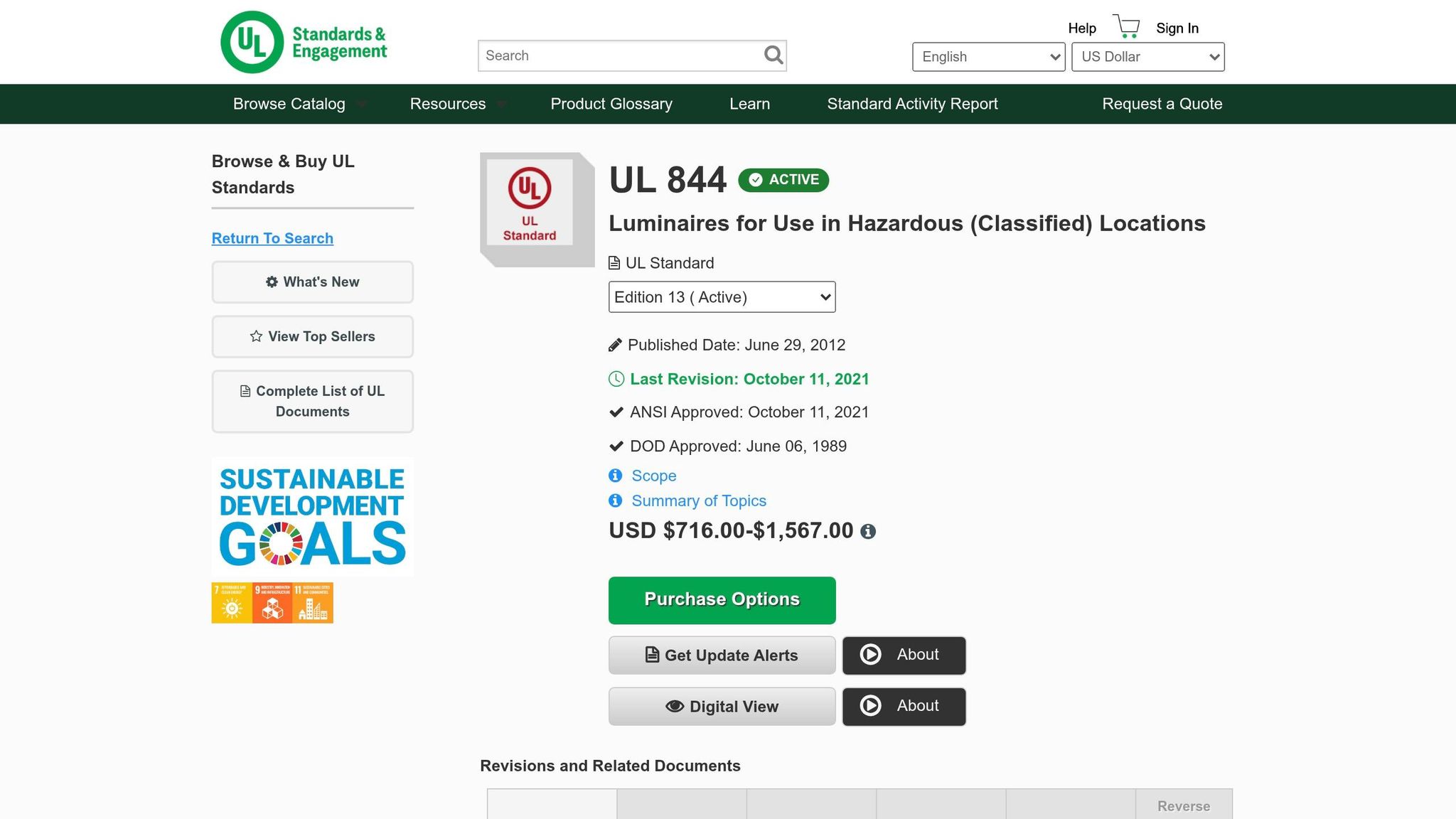
UL 844 certification builds upon NEC requirements by rigorously testing fixtures to validate their safety. This certification is the benchmark for luminaires used in hazardous locations as defined by the NEC. It ensures that fixtures can contain internal electrical arcs, sparks, or thermal events, preventing the ignition of flammable gases or vapors. UL 844 evaluates three primary safety features:
LED fixtures excel in meeting UL 844 standards due to their lower surface heat output compared to traditional lighting options like metal halide or high-pressure sodium lamps. This thermal efficiency not only enhances safety but also delivers energy savings of 60% to 70%. Understanding UL 844 compliance is essential for selecting the right LED fixture for hazardous environments.
| Certification | Region | Primary Purpose |
|---|---|---|
| UL 844 | United States | Class & Division compliance for hazardous locations |
| CSA | Canada | Electrical safety validation |
| ATEX | European Union | Equipment certification for explosive atmospheres |
| IECEx | International | Global hazardous area certification |

Class I Division 1 vs Division 2 Hazardous Location Requirements Comparison
Choosing the right explosion-proof LED fixture means aligning its ratings - Class, Division, Group, and T-Rating - with the specific hazards present in your facility. Whether the risks involve gas, vapor, or dust, the fixture must be tailored to address those dangers effectively.
You’ll also need to account for environmental conditions like corrosion, vibration, and moisture. For corrosive settings, opt for fixtures with enhanced corrosion resistance. In areas with heavy machinery, vibration-resistant LEDs are ideal since their solid-state design avoids the fragility issues common with traditional HID lamps. If your facility involves washdown or high-humidity zones, look for a fixture with an appropriate IP rating. Don’t forget to factor in mounting height when determining the required lumen output and optical distribution.
Maintenance in hazardous environments can be a challenge, often requiring production shutdowns. LEDs, with lifespans ranging from 50,000 to 100,000 hours - three to five times longer than HID alternatives - help minimize maintenance needs. By focusing on these criteria, you can select the right fixture for any hazardous location.
Breaking down the differences between Class I, Division 1 and Division 2 areas helps refine your fixture choice. Division 1 zones require fixtures capable of containing internal explosions during normal operations. Division 2 zones, on the other hand, only need fixtures that prevent ignition during abnormal conditions, such as leaks or equipment malfunctions.
| Feature | Class I, Division 1 | Class I, Division 2 |
|---|---|---|
| Hazard Presence | Present during normal daily operations | Present only during abnormal conditions (e.g., leaks, equipment failure) |
| Risk Level | High; explosions are likely or expected | Lower; explosions are accidental or infrequent |
| Fixture Requirement | Must contain internal explosions and prevent flame escape | Must prevent ignition during accidental releases or ventilation failures |
| Typical Locations | Near open vents, spray booths, or fuel loading docks | Storage areas, adjacent rooms with positive ventilation |
Explosion-proof LED fixtures, designed in line with NEC and UL 844 standards, are built to safely contain internal explosions. Their heavy-duty sealed housings, often made from reinforced aluminum or steel, are engineered to contain sparks or explosions, ensuring they don’t ignite the surrounding atmosphere.
LED technology also offers superior thermal management, producing far less heat than traditional HID or high-pressure sodium lamps. This keeps surface temperatures below ignition thresholds, reducing the risk of accidental ignition. Another advantage is the instant-on capability of LEDs, which provides full brightness immediately - a critical safety feature in emergencies where delays could increase risks.
For U.S. installations, always confirm that the fixture has UL 844 certification. Importantly, don’t confuse vapor-tight fixtures with explosion-proof ones. While vapor-tight lights are designed to resist moisture and dust, they lack the containment features needed for hazardous locations.
"The fixture doesn't prevent explosions from occurring inside - it contains them."
Getting the installation and maintenance right is just as critical as choosing the correct explosion-proof LED fixture. Even the sturdiest fixture can become a safety risk if it's installed improperly or not maintained regularly.
A successful installation starts with thorough planning to ensure compliance with safety codes. Begin with a lighting audit to identify hazards and determine the best photometric layout. This step will guide decisions on mounting height and optical distribution for even lighting. Follow our proven process: classify hazards, confirm UL 844 certification, match fixture ratings (Class, Division, Group, T-Rating) to the environment, create photometric layouts, install according to NEC guidelines, and finally, inspect and commission the setup.
It's crucial to align fixture ratings - Class, Division, Group, and T-Rating - with the specific hazards in your facility. Consider environmental factors like corrosion, vibration, and moisture, and choose fixtures with suitable ingress protection (IP66 or IP67). Plan the placement of fixtures to ensure they provide adequate lighting while remaining accessible for future inspections.
Once the fixtures are installed, consistent maintenance is key to sustaining safety and compliance.
After installation, regular inspections are essential to catch potential issues early. Routine checks help maintain fixture integrity and prevent safety risks. Look for cracked lenses, damaged seals, or faulty wiring, which could become ignition sources in hazardous environments. Dust or chemical residue buildup can also lead to overheating, potentially affecting the fixture's T-rating and increasing the risk of ignition.
During inspections, pay close attention to gaskets and seals to ensure the fixture remains airtight, keeping out moisture, dust, and flammable vapors. Use a multimeter to test electrical connections and identify any degrading LED drivers before they fail. Replace worn or damaged gaskets immediately with certified explosion-proof replacements. To enhance safety, consider scheduling professional inspections quarterly or biannually in addition to routine in-house checks. Clean lenses and housings with non-abrasive cleaners to maintain their protective surfaces.
LED fixtures, with lifespans ranging from 50,000 to 100,000 hours, require far less maintenance compared to traditional HID lighting. This reduced need for maintenance minimizes the risks associated with entering hazardous zones while also cutting downtime.
Explosion-proof LED lighting plays a critical role in ensuring safety within hazardous facilities. By understanding the distinctions between Class I Division 1 and Division 2 classifications, confirming UL 844 certifications, and aligning fixture ratings with specific environmental risks, you can establish a lighting system that safeguards both personnel and operations while adhering to NEC and OSHA standards.
These fixtures not only meet rigorous compliance requirements but also provide safety, energy efficiency, and cost savings over time. When properly installed and maintained, they deliver reliable performance and long-term protection.
Luminate Lighting Group specializes in creating customized explosion-proof LED solutions for industrial and commercial environments. Their team ensures every installation meets the necessary Class, Division, and Group ratings, while also assisting with utility rebate programs to help you maximize ROI.
Whether you're retrofitting an existing facility or planning a new project, choosing certified explosion-proof LEDs with professional guidance ensures regulatory compliance, enhances safety, and supports uninterrupted operations. This approach protects your workforce and secures the future of your facility.
To verify if a fixture is UL 844 listed, start by checking the certification label or accompanying documentation. Look for the UL mark, a file number, or a clear statement confirming compliance with UL 844 standards. Additionally, review the product datasheet or technical documents to confirm it is designed for use in hazardous locations. This certification ensures the fixture meets the necessary safety and performance standards for classified environments.
To make sure explosion-proof LED lighting complies with safety codes, match the fixture's Class, Division, Group, and T-Rating to the classification of the hazardous environment. For instance, in Class 1 Division 2 areas, the fixtures must be designed to contain any sparks or heat that could ignite flammable substances. The T-Rating indicates the fixture's highest surface temperature, ensuring it aligns with the specific hazardous atmosphere. Always double-check these ratings to meet safety requirements.
Mistakes such as incorrect installation, using uncertified parts, or failing to properly seal explosion-proof fixtures can result in serious code violations. On top of that, maintenance missteps - like skipping seal inspections or letting seals deteriorate - can weaken safety measures. To reduce the risk of ignition in hazardous environments and stay compliant with safety regulations, make sure all fixtures are certified, securely sealed, and regularly maintained.


