.svg)
Practical compliance guide for AI energy analytics: document use cases, minimize data, require human approval, log and secure actions.


AI energy tools can cut building energy use, but if you don’t control the data, decisions, and logs, they can also create privacy, security, audit, and occupant-risk problems.
If I had to boil this article down to a few points, it’s this:
A few numbers make the point fast:
At a basic level, compliant AI energy analytics means the system is lawful, clear, secure, reviewable, and reversible. That applies whether you’re using AI for forecasting, fault detection, lighting control, predictive maintenance, demand response, or audit-backed savings reports.
If I were reviewing a building rollout, I’d ask four simple questions right away:
That’s the core of the article: save energy, but don’t lose control.
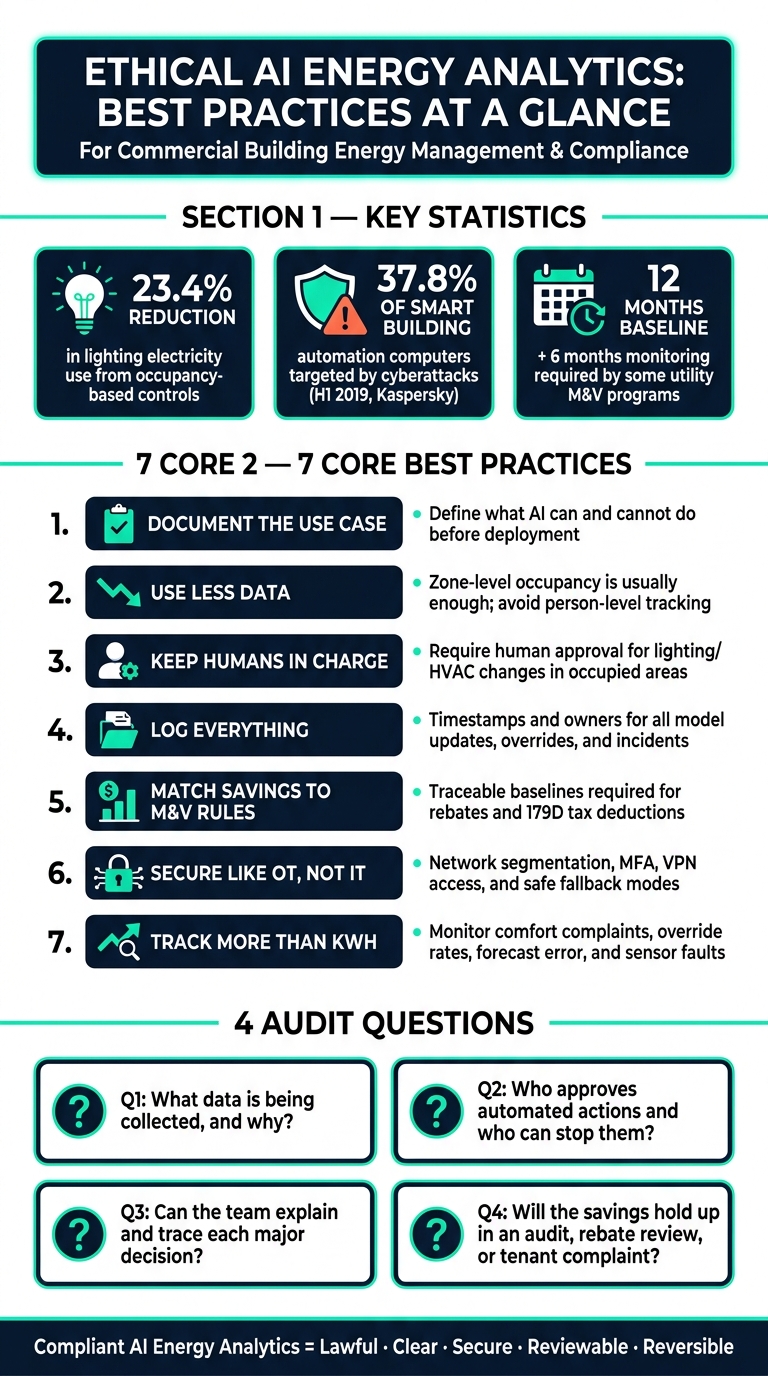
Ethical AI Energy Analytics: Compliance Checklist & Key Stats
There isn't one federal AI law in the U.S. that covers commercial building analytics. Instead, teams deal with a mix of rules, agency guidance, and voluntary frameworks. In practice, that means compliance is no longer just about cutting energy use. It also depends on data handling, system controls, and clear accountability.
The NIST AI Risk Management Framework (AI RMF 1.0) breaks AI risk management into four functions: Govern, Map, Measure, and Manage. It doesn't carry the force of law for private building owners. Even so, federal agencies, including the Department of Energy (DOE), have worked it into internal AI strategies, risk playbooks, and generative AI reference guides. For building teams, it's a useful way to document risk, set oversight rules, and manage AI systems from start to finish.
The DOE already uses AI for HVAC optimization, demand response, load forecasting, and digital twins. Its AI Strategy calls for risk-based oversight. Put simply, higher-risk uses of AI, such as systems that touch safety or critical infrastructure, need tighter documentation and oversight than lower-risk uses. Executive Order 14110 on Safe, Secure, and Trustworthy AI adds another layer by requiring federal agencies to guard against bias and civil-rights harms in AI deployments.
On the building code side, state and local adoption of IECC and ASHRAE standards, along with newer Building Performance Standards (BPS), depends on verified and auditable energy data. If AI tools shape load modeling, benchmarking, or performance reporting, their outputs need to be traceable. That matters a lot when money is on the line. Some utility retrofit M&V guidelines require baseline periods of at least 12 months and monitoring periods of at least 6 months that include peak demand hours. If an owner uses AI-generated savings estimates for rebates or tax items like the 179D deduction, those estimates should match those protocols.
Cybersecurity also plays a direct role here. Building automation systems, energy management platforms, and connected sensors fall under NIST SP 800-82 guidance for Operational Technology Security. Federal oversight groups, including GAO and DHS, have flagged cyber risk in building control systems. Their advice is pretty direct: isolate control networks, require multifactor authentication, and limit system connections to approved workstations.
Good documentation is what turns compliance from a claim into evidence. Organizations should keep records in the following areas:
| Documentation Area | What to Capture |
|---|---|
| Data sources | Each sensor, meter, or feed used; data fields collected; legal basis for use; retention periods |
| Model purpose & limits | Intended function, target outcomes, and operational boundaries (e.g., setpoint ranges, dimming limits) |
| Risk classification | Risk level assigned to each AI use case and the governance tier applied |
| Ownership and vendor roles | Which internal team owns the system, what the vendor provides, and who logs changes, handles updates, and responds to incidents |
| Human-in-the-loop controls | Who can override AI decisions, under what conditions, and how overrides are logged |
| Incident response | Severity tiers, response steps, and logs of AI-related anomalies or complaints |
| Energy performance impacts | How AI-driven changes affect reported savings, M&V baselines, and code compliance |
For public agencies, procurement contracts should require vendors to disclose AI features, share their own risk assessments, and commit to logging model updates and configuration changes. For lighting projects tied to utility rebate claims or 179D tax deductions, vendors should also explain how their analytics use meter and sensor data, along with the assumptions behind savings calculations.
Those records set up the privacy, transparency, and security controls covered next.
Good documentation should do more than sit in a folder. It should turn into day-to-day controls: clear owners, tighter data limits, and automated actions that people can understand before they affect a building.
AI energy analytics can produce uneven results when the system learns from patchy schedules or missing sensor data. A night-shift area or a poorly sensed zone might end up with harsher dimming or deeper HVAC cutbacks than the rest of the building. On paper, whole-building energy savings may still look good. But the discomfort lands on specific tenants or shifts, and that can turn into lease disputes, occupant complaints, or operating risk.
The first step is simple: assign named decision owners. Every automated action, whether it's curtailment, dimming schedules, or setpoint changes, should have a person tied to it. That person is responsible for approving the action, checking the impact, and stepping in when something goes wrong. For higher-impact actions, human approval should happen before the action runs, not only after the fact in a log. NIST's AI RMF Govern function can be used to assign decision owners and override authority.
Upfront approval isn't enough on its own. Teams also need regular outcome reviews. Compare comfort complaints, override frequency, and energy reductions by zone, floor, tenant, and shift instead of looking only at whole-building totals. If one area keeps showing deeper dimming or more overrides, that's a warning sign. It's far better to catch that early than wait for a tenant complaint or lease issue.
Those decision rights should also define what data each automated action is allowed to use.
Collect only the data needed for the job. If zone-level occupancy trends are enough to fine-tune lighting schedules, there is no reason to store minute-by-minute movement histories for individuals. DOE guidance calls for anonymized or coded energy data, along with documented data-management plans.
The table below maps common building data types to their privacy risks and the controls that address them most directly.
| Data Type | Privacy Risk | Recommended Controls |
|---|---|---|
| Interval meter data | Can reveal occupancy patterns and routines | Aggregate for non-operational reporting; limit raw access to authorized staff |
| Occupancy sensor data | May expose when and where individuals are present | Aggregate to zone level; do not track individuals; retention limits aligned with operational needs |
| Badge/access-linked data | Directly identifiable; reveals work schedules | Strict role-based access; separate storage from energy analytics; explicit notice to occupants |
| Indoor environmental quality (CO₂, temperature) | Can infer occupancy density and behavior | Anonymize before use in AI models; restrict access to the facility operations team |
| Device-level usage logs | Can profile individual workstations or spaces | Aggregate before analysis; purge logs on a defined schedule |
Role-based access and encryption are the starting point. Data at rest and in transit should use strong encryption, and permissions should follow least privilege. In plain English, people should see only the data their job requires.
Using less data has another upside: it makes system behavior easier to explain and audit.
Operators won't trust a system if they can't tell what it's doing. When AI changes lighting levels, adjusts HVAC setpoints, or flags a fixture for maintenance, the dashboard should show why. Staff should be able to see which inputs drove the recommendation, what threshold was crossed, and what impact the system expects. Decision logs should also make actions easy to trace so teams can verify, question, or override them without digging through raw data.
The security risk here isn't abstract. It's already showing up in the field. A Kaspersky study of 40,000 smart buildings worldwide found that 37.8% of smart building automation system management computers were targeted by attacks in the first half of 2019, including spyware, worms, phishing, and ransomware. Smart building systems are common attack targets, so they should be treated like operational technology.
Once data access is narrowed, the connected systems that handle it need tight protection. Connected lighting and energy analytics platforms should run on segmented networks, separated from general IT systems through distinct VLANs or dedicated OT network segments. Default-deny firewall rules, strong authentication, and clear patch ownership are the minimum bar. Remote access should go through a VPN or jump host, never through open ports on exposed controllers. Test every automation rule change in a single zone before wider rollout. And if connectivity fails, the system should have a fallback mode that restores safe lighting and HVAC defaults.
Once privacy and security controls are in place, governance decides whether a model stays dependable after launch. It’s the layer of oversight that keeps an AI model accurate, lawful, safe, and tied to business goals from design through retirement. The hard part? Holding that line as occupancy, equipment, and schedules shift over time.
Before deployment, start with the failure mode: what happens if this model gets it wrong? The NIST AI RMF’s Govern, Map, Measure, and Manage functions apply across the full AI lifecycle, not only at launch. That means use-case approval should include risk tiering before deployment.
A pre-deployment review should look at the use case, training data, validation against live facility conditions, impact review, and vendor due diligence. Meter readings, occupancy sensors, weather feeds, and equipment schedules need to match the facility the model is meant to represent. If the inputs don’t match the building, the output won’t either.
The data window also needs to be long enough to reflect seasonal and operating variation. Abnormal periods - like renovations or shutdowns - should be flagged or removed so they don’t skew results. Before a model gets control authority, validate it in shadow mode or through a limited pilot. Then check comfort, safety, and code compliance before any live use.
It also helps to ask vendors for the nuts and bolts: training-data lineage, model documentation, update schedules, security controls, retention rules, and rollback support. You also need to verify how they manage changes that affect control behavior. For higher-risk use cases, an internal or third-party audit can check performance, fairness, cybersecurity, and compliance before the model gets broader operating control.
| Use Case | Primary Ethical Risks | Recommended Governance Controls |
|---|---|---|
| Demand response | Comfort complaints, critical-load disruption, zone imbalance | Human approval before curtailment; defined override thresholds; comfort monitoring by zone |
| Predictive maintenance | Missed critical repairs, unnecessary work | Confidence thresholds before triggering work orders; human review for high-priority assets |
| Lighting control optimization | Task-level dimming violations, tenant imbalance | Minimum setpoint floors; zone-by-zone validation; occupant feedback loop; egress compliance check |
After deployment, those same controls still matter. Buildings change. Tenants change. Equipment changes. Governance has to keep up.
Model drift happens when performance slips as building conditions change. A tenant move-out, new equipment, seasonal swings, or a shift in occupancy schedules can all change the link between inputs and outputs without setting off any obvious alarm.
Good monitoring looks at more than forecast accuracy. Teams should watch signals like forecast error, control success rate, comfort complaints by zone, override frequency, energy savings versus baseline, sensor fault rates, and exceptions tied to abnormal conditions. If one of those metrics crosses its validation threshold, it should go to human review, and automation should pause if needed. That process shouldn’t be vague. Teams need to decide ahead of time who reviews alerts, how fast they respond, and which conditions mean automation must stop until the model is revalidated.
Every model update, parameter change, data-source swap, approval, override, and incident should be logged with a timestamp and owner. That paper trail matters. If lighting levels shift after a software update and a tenant complains, the record should show exactly which model version was running and what changed.
For higher-impact actions - like changes to lighting levels, operating hours, or HVAC setpoints in occupied spaces - human sign-off should happen before the change goes live, not just after the fact. Rollback procedures should let operators return to the last validated configuration fast, and fail-safe modes should fall back to conservative defaults if data feeds fail or model outputs move past safe thresholds.
Revalidation should happen on a set schedule and after major events, such as a large tenant change, equipment replacement, repeated occupant complaints, or a vendor-pushed model update. Repeated complaints, in particular, should not be brushed off. They often point to problems that technical metrics don’t catch.
These controls matter most in lighting retrofits, controls tuning, and audit-backed savings claims, where even small model errors can affect comfort, rebates, and compliance.
Once governance is set, the next step is to use it in the field: LED retrofits, controls tuning, and energy audits.
AI shows up in commercial lighting work in a handful of direct, practical ways. Think occupancy-based lighting controls, daylight harvesting, predictive maintenance for luminaires and control gear, and automated measurement and verification (M&V) for utility savings.
Occupancy-based lighting controls can cut lighting electricity use by 23.4%. That said, the data side matters just as much as the savings. Sensor data should be grouped at the zone level, not tied to individuals, and minimum illuminance floors for egress paths and task areas should stay fixed.
With daylight harvesting, light levels still need to stay above task-based thresholds in IES specs and project requirements. Those minimum floors should be written directly into the control logic. That paper trail helps support ASHRAE 90.1 or IECC compliance.
For M&V and rebate reporting, there isn't much room for guesswork. If a model reports savings without a traceable baseline - baseline capacity in kilowatts, documented hours of use, and post-retrofit metering - under protocols like IPMVP, rebate eligibility and 179D tax deduction claims can be put at risk.
In LED retrofit and audit work, every AI-driven control change should connect to three things: a named owner, a documented limit, and a saved baseline.
For project teams, the standard is pretty simple: every AI-driven lighting decision needs to be documented, reviewable, and reversible.
Treat an AI energy use case as high risk when a bad output could lead to major energy waste, physical damage, or serious disruption to operations. That matters most when the system touches critical infrastructure or energy-intensive equipment, where a poor call can do more than nudge up utility costs.
A simple way to judge it is to look at three things: the impact of failure, how reliable the data is, and whether the AI is being used for routine monitoring or critical control. Monitoring is one thing. Direct control is a different ball game.
If you're not sure where the use case falls, play it safe. Start in recommendation-only mode and include a formal risk assessment in your energy audit.
Keep solid records from start to finish on any energy efficiency project. It’s the kind of paperwork that can save you a headache later.
For utility rebates, hold on to:
For the 179D tax deduction, keep a certified energy analysis that meets ASHRAE standards, along with your project records and professional certification.
You should also retain 12 months of utility bills, lighting inventories, maintenance logs, photos, electrical panel diagrams, and any commissioning or functional testing reports.
Human approval should be required any time AI output could affect building operations or compliance. That includes acting on alerts, following predictive maintenance recommendations, and making control or load-shifting changes.
Human sign-off should also be part of the process after the initial setup and calibration, and during regular reviews. This gives facility managers and trained staff a chance to confirm that the insights line up with energy goals and support audit documentation needs.


