.svg)
Upgrade parking lot lighting to LEDs to cut energy use up to 70%, reduce maintenance by up to 90%, shorten payback, and enable smart controls and rebates.

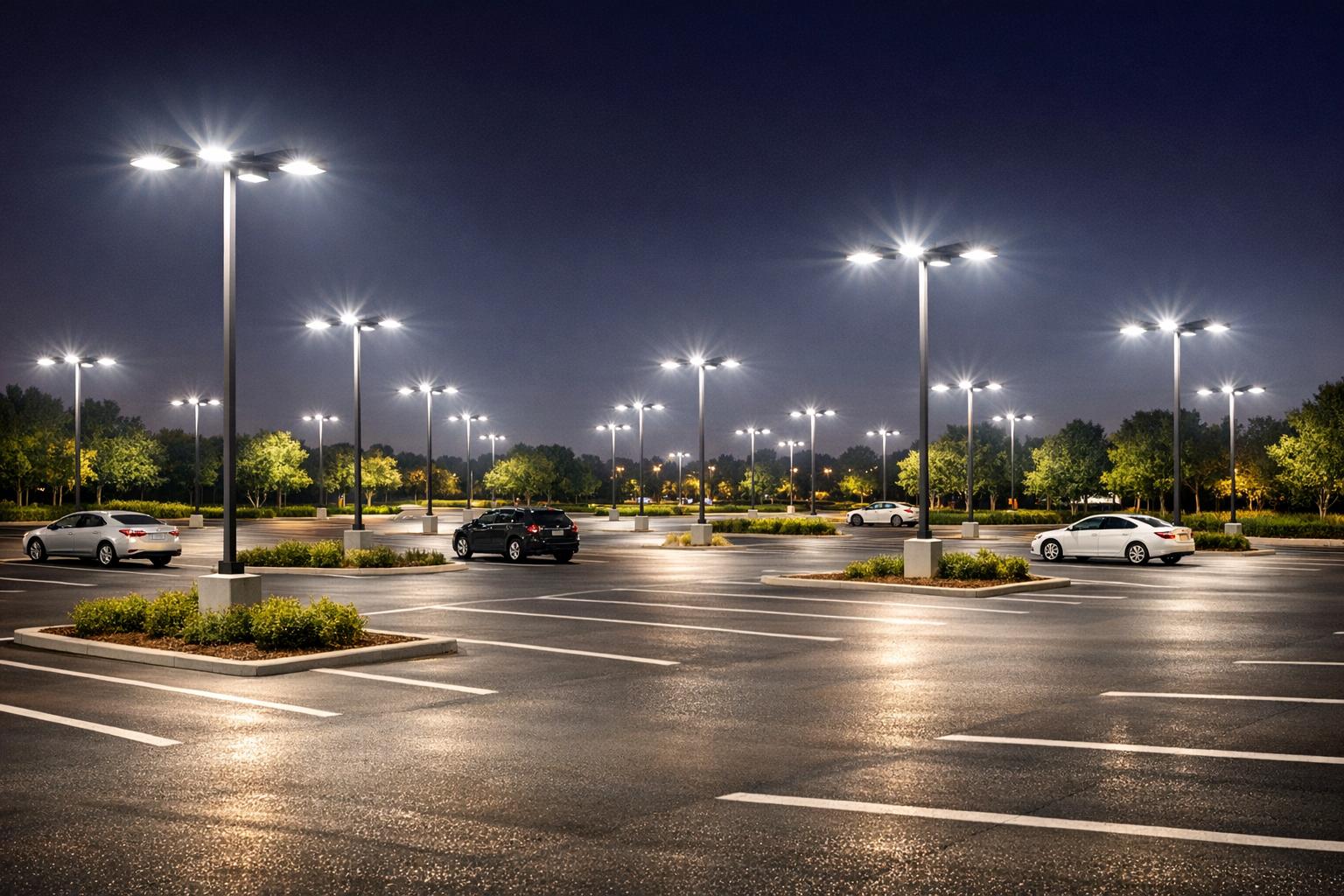
Switching to LED parking lot lights can cut energy costs by up to 70% and reduce maintenance expenses by as much as 90%. LEDs outperform older HID systems in efficiency, lifespan, and functionality while offering better light quality. Here's why upgrading to LEDs is a smart move:
LEDs not only save money but also improve visibility, reduce heat waste, and offer consistent performance over time. Whether you're managing a business, a college campus, or a retail parking lot, upgrading to LED lighting is a cost-effective and long-lasting solution.
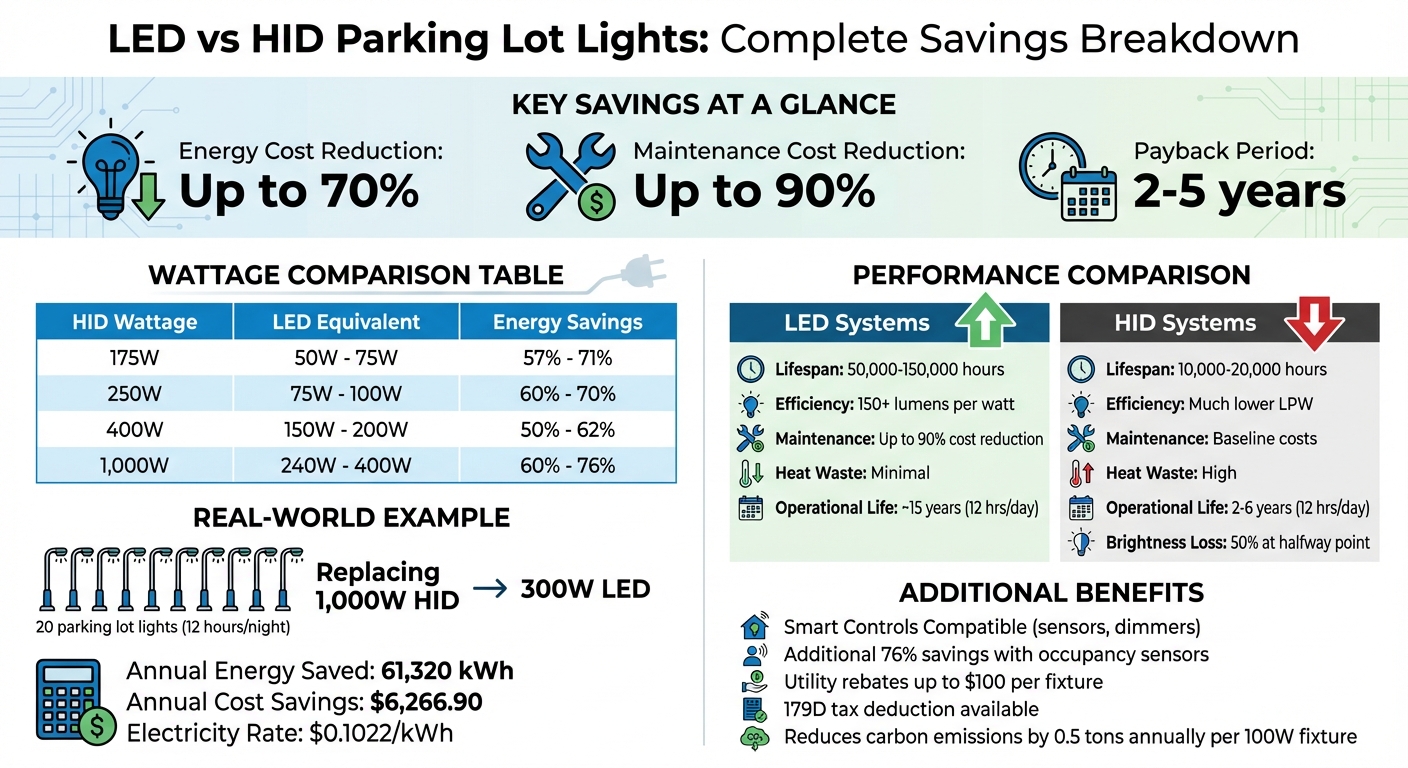
LED vs HID Parking Lot Lights: Energy Savings and Cost Comparison
LEDs provide the same brightness as traditional lighting but use far less energy. For example, a 300W LED fixture generates around 39,000 lumens, matching the output of a 1,000W metal halide lamp. This means LEDs can cut power consumption by 70% while delivering identical light levels. Even when replacing 400W HID fixtures, LEDs require only 150W to 200W, reducing energy use by 50% to 62%.
Let’s break it down further: In a parking lot with 20 poles, each running 12 hours a night, switching one 1,000W HID lamp to a 300W LED would save 61,320 kWh annually. With an electricity rate of $0.1022/kWh, that's a savings of $6,266.90 per year. Smaller upgrades also make a big difference. Replacing 400W HID fixtures with 150W LEDs, for instance, saves 21,900 kWh annually.
| HID Wattage | LED Equivalent | Energy Savings |
|---|---|---|
| 175W | 50W - 75W | 57% - 71% |
| 250W | 75W - 100W | 60% - 70% |
| 400W | 150W - 200W | 50% - 62% |
| 1,000W | 240W - 400W | 60% - 76% |
These savings aren’t just theoretical - they’ve been proven in real-world applications. In 2019, a discount retailer retrofitted lighting across 532 locations, slashing energy use by 74% and saving an estimated $1,278,214 over three years. Similarly, a Mid-Atlantic college replaced 400W HPS floodlights with 141W LEDs, achieving a 63% energy reduction.
LEDs also pair seamlessly with technologies like photocells, occupancy sensors, and dimming controls. These features adjust brightness automatically during low-use periods, driving energy savings even further.
Modern LED fixtures deliver an impressive 150+ lumens per watt, far surpassing the federal minimum standard of 65 lumens per watt. Unlike HID lamps, LED fixtures are designed to direct light precisely where it’s needed, reducing wasted output. This efficiency not only conserves energy but also reduces heat production, contributing to longer fixture lifespans.
Here’s a practical comparison: A 400W metal halide system, including ballast losses, consumes 458W, while an equivalent LED fixture uses just 160W. This lower energy consumption means less heat is generated, which helps extend the life of the LED fixture. For example, when used 12 hours daily, HID fixtures typically last 2 to 6 years, whereas LEDs can operate for about 15 years.
Maintenance savings are another major advantage. LEDs last 2 to 5 times longer than traditional outdoor lighting systems, cutting maintenance costs by up to 90%. In contrast, metal halide bulbs lose 50% of their brightness halfway through their lifespan, leading to dim, yellowish lighting that can compromise safety in areas like parking lots. LEDs, on the other hand, maintain consistent brightness and color throughout their operational life, ensuring better visibility and reliability. Combined with energy savings, reduced maintenance costs significantly enhance ROI.
Replacing bulbs on high poles comes with additional expenses, such as labor, equipment like bucket trucks, and replacement lamps. These costs should be factored into ROI calculations. A real-world example of cost savings comes from the Army Reserve 63d Regional Support Command, which replaced twelve 1,000W HID fixtures with twelve 120W LED fixtures at Camp Pike in Little Rock, Arkansas, back in 2014. This upgrade resulted in an 85% reduction in energy use, saving 62,000 kWh and $4,000 annually, with a payback period of just 4.4 years. This project highlights how LED lighting upgrades can achieve significant energy savings and quick payback periods, especially in parking lot applications.
| Feature | LED Systems | HID Systems |
|---|---|---|
| Typical Lifespan | 50,000 - 150,000 hours | 10,000 - 20,000 hours |
| Lumens per Watt | 150+ LPW | Much lower |
| Maintenance Cost Reduction | Up to 90% | Baseline |
| Heat Waste | Minimal | High |
These advantages in performance and maintenance make LED lighting a clear choice for achieving long-term cost savings, as explored further in the following analysis.
The return on investment (ROI) for upgrading to LED lighting in parking lots comes from three key areas: energy savings, reduced maintenance costs, and the net project cost after incentives. Calculating energy savings is straightforward: take the wattage difference between your existing HID system and the new LED fixtures, then multiply it by the total number of lamps, annual operating hours, and your local electricity rate per kWh. On average, LED fixtures and installation cost about $250 per unit. However, utility rebates - sometimes as high as $100 per fixture - can bring the net cost down to roughly $150. This simplified approach helps you estimate practical payback periods.
Payback periods generally fall between 2 and 5 years, with high-use facilities often seeing returns in under a year. Real-world examples consistently show paybacks within this range, and some projects even achieve faster returns. In many cases, energy savings alone can reduce payback periods to as little as three years.
Adding smart controls to your LED system can further boost your ROI. For instance, occupancy sensors can deliver an additional 76% in energy savings. Features like photocells, dimmers, and curfew dimming (reducing light levels to 10%–50% during low-activity hours) also help cut operational costs. However, proper commissioning is essential. Without careful setup, even advanced sensors might fail to deliver significant savings.
Financial incentives make the case for LED upgrades even stronger. Many utilities offer rebate programs that provide instant discounts at the time of purchase. On top of that, the 179D tax deduction and bonus depreciation for energy-efficient commercial building improvements can dramatically lower your overall investment. Simplified application processes for rebates make it even easier to take advantage of these savings upfront.
LED parking lot lights deliver up to 75% energy savings compared to traditional HID systems. While HID fixtures typically consume between 400 and 1,000 watts, LED alternatives operate efficiently within a range of just 65 to 400 watts. This energy efficiency directly lowers utility bills and slashes maintenance costs - LEDs can reduce maintenance expenses by up to 90% since they last 2 to 5 times longer than traditional outdoor lighting systems. On top of these savings, LEDs offer advanced controls and uniform light distribution that boost their overall efficiency. They are compatible with occupancy sensors and dimmers, which can provide an additional 70% in energy savings. Plus, their even light distribution enhances visibility, often allowing for fewer fixtures to be installed. Unlike HID lamps, which lose brightness quickly and need frequent replacements, LEDs maintain their output more consistently, dimming gradually over their 50,000+ hour lifespan. These factors contribute to LEDs' lower total cost of ownership over time.
However, the higher initial cost of LED systems can be a drawback. In some cases, additional poles or fixtures may be necessary to match the illuminance levels of high-wattage HID systems, such as 1,000W metal halide lamps. The payback period for LEDs depends on local electricity rates - sites with very low utility costs (around $0.056/kWh) may experience payback timelines extending beyond seven years.
Despite these initial barriers, LEDs consistently prove to be a better long-term investment. Over a 10-year period, their operational savings in energy and maintenance far outweigh the upfront expense, as seen in real-world applications.
| Factor | LED Lighting Systems | HID Lighting Systems |
|---|---|---|
| Energy Efficiency | High (up to 75% less energy) | Low (high power consumption) |
| Wattage Range | 65W – 400W | 400W – 1,000W |
| Lifespan | 50,000+ hours; 2–5x longer | Shorter; rapid brightness loss |
| Maintenance Costs | Up to 90% reduction | Frequent bulb and ballast replacement |
| Initial Investment | Higher upfront cost | Lower purchase price |
| Total Cost of Ownership | Lower over 10 years | Higher due to energy and labor costs |
| Control Compatibility | Excellent (dimming, sensors, wireless) | Poor (limited dimming options) |
Switching to LED lighting for parking lots offers a blend of cost efficiency and performance improvements that’s hard to ignore. Upgrading to LED fixtures can deliver up to 70% energy savings and reduce maintenance costs by 90%. While the initial investment might seem higher compared to traditional HID systems, a 10-year cost analysis shows that LEDs are more economical in the long run. Lower utility bills, fewer replacements, and reduced labor expenses make LEDs a smart financial choice. Plus, real-world projects often see payback periods ranging from 2 to 6 years, with some achieving returns even faster.
Beyond financial benefits, LED systems contribute to sustainability goals. They eliminate the need for mercury disposal and cut carbon emissions by approximately 0.5 tons annually per 100W fixture. These environmental advantages, paired with cost savings, make LED upgrades a strategic move for businesses. Additionally, LEDs are compatible with advanced control systems, allowing for even greater energy optimization.
Investing in LED retrofits goes beyond just cutting costs - it aligns with long-term sustainability and energy efficiency priorities. For businesses aiming to reduce expenses while meeting environmental responsibilities, upgrading to LED parking lot lights is more than a maintenance decision - it’s a forward-thinking strategy. With immediate savings, extended equipment lifespan, and access to utility rebates, the case for LEDs is clear.
LED parking lot lights are among the most economical and eco-friendly lighting options available today. Upgrading to LEDs is a practical step toward lowering costs and achieving energy efficiency goals.
LED parking lot lights are built to use much less energy than older lighting options like HID or incandescent fixtures. For instance, traditional fixtures often consume between 400 and 1,000 watts, while LEDs typically require only 65 to 400 watts. This translates to energy savings of up to 70–75%.
When combined with smart lighting controls - like motion sensors or timers - LED systems can cut energy use even further, lowering operating costs. Over time, these reductions add up, delivering a strong return on investment (ROI) and making LED lighting a smart choice for parking lots and garages.
Upgrading to LED parking lot lights can slash energy costs, cutting electricity use by an impressive 50% to 75% compared to older lighting systems. This shift can lead to savings of thousands of dollars every year.
Beyond energy efficiency, LED lights boast a lifespan that's 25 to 50 times longer than HID or incandescent fixtures. This durability significantly reduces replacement and maintenance costs. Together, these advantages ensure a fast return on investment (ROI), making LEDs a practical and economical lighting solution for parking lots and garages.
Smart controls take the efficiency of LED parking lot lights to the next level by creating a responsive lighting system. With features like motion sensors, daylight detectors, and programmable dimmers, these lights can adjust their brightness in real time. For instance, they illuminate fully when vehicles or pedestrians are nearby and dim - or even switch off - during low-traffic periods or when there's enough natural light.
This adaptive approach can cut energy consumption by an extra 30%–70%, adding to the already impressive 70%–75% savings achieved by switching to LEDs. Beyond lowering electricity bills, smart controls also help extend the lifespan of the fixtures, minimizing maintenance. For property owners, pairing smart controls with LED upgrades offers additional perks like utility rebates, tax deductions, and quicker returns on investment. It's a practical way to save money while embracing energy-efficient technology.


