.svg)
LED high-bay lighting slashes warehouse energy and maintenance costs, boosts safety, and delivers payback in 2–4 years.

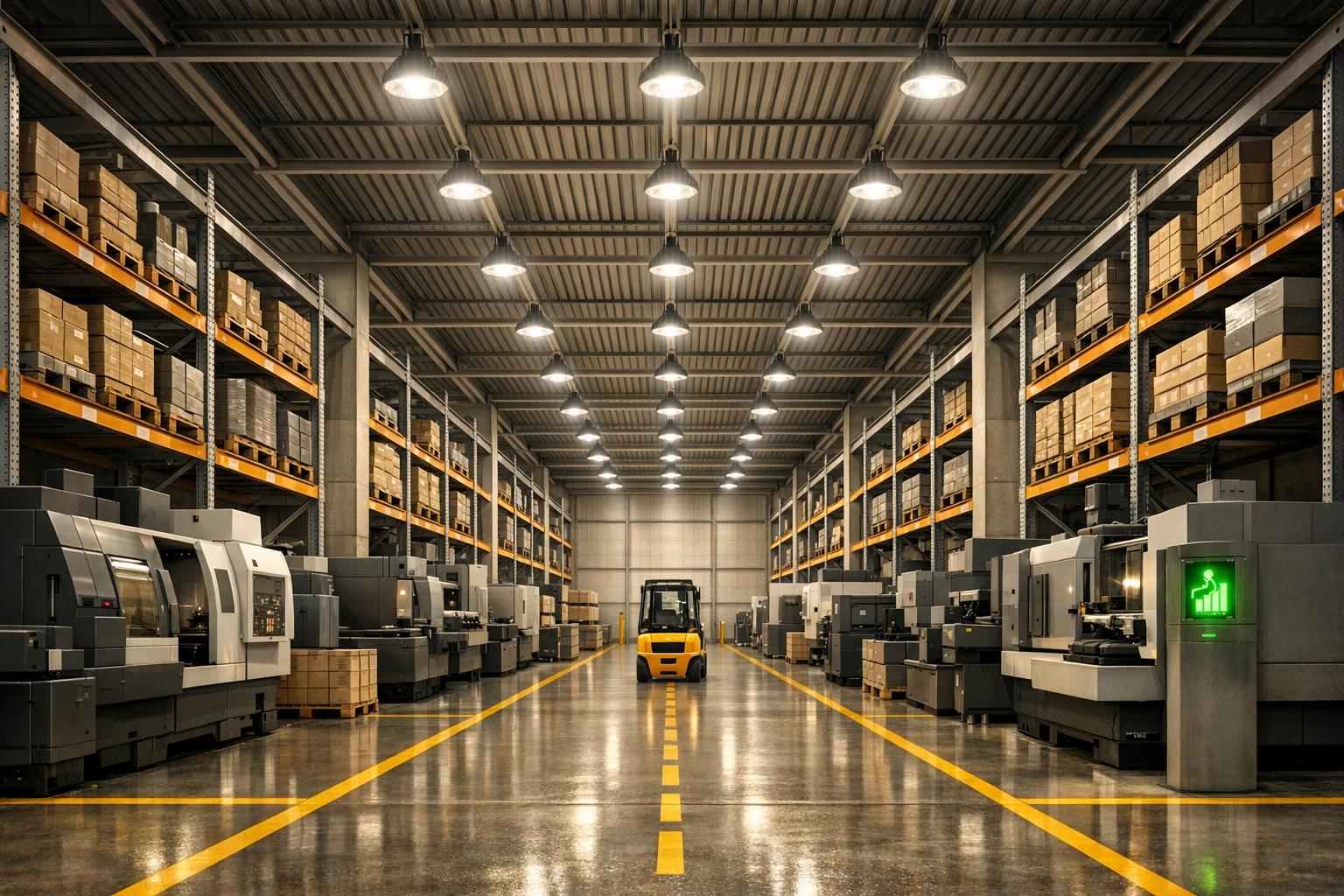
High-bay LED lighting is transforming energy use in machinery warehouses. These fixtures consume 50% to 90% less energy than older technologies like metal halide or fluorescent systems. They also last up to 100,000 hours, cutting maintenance costs significantly. With instant-on functionality, superior light focus, and reduced heat output, LEDs improve visibility and safety while lowering cooling expenses. Adding smart controls (e.g., occupancy sensors) can further reduce energy use by 30% to 50%. Facilities often see a return on investment within 2 to 4 years, thanks to utility rebates and lower operating costs.
Key benefits of high-bay LEDs:
Switching to LED high-bay lighting is a smart move for warehouses aiming to cut costs, improve lighting quality, and reduce long-term maintenance needs.
Research consistently shows that retrofitting with LED high-bay lighting can lead to major energy savings, particularly in warehouse settings. The U.S. Department of Energy’s solid-state lighting program highlights that LEDs can cut energy use by 75% or more compared to traditional high-intensity discharge (HID) lighting systems.
A great example comes from Veeco Services, which revamped its 615,000-square-foot warehouse in North Bergen, New Jersey, in January 2019. They replaced 366 HID and fluorescent fixtures with 168-watt LED high-bays equipped with IoT controls. The result? A 75% reduction in energy use, saving 1,062,500 kWh annually. Richard Lynch, President and COO, noted:
“We have increased the line of sight on the warehouse floor, which is critical to increasing efficiency and safety, and we have driven down energy costs significantly.”
Another project in Williston, North Dakota, documented by LED Lighting Supply in February 2026, replaced 72 T5 fluorescent fixtures (each consuming 373W with ballasts) with 200W LED UFO fixtures. This change cut energy use by 46%, saving $5,369 annually and achieving a return on investment in under 19 months. A separate retrofit swapping 400-watt metal halide fixtures for 200-watt LED units achieved 73% energy savings.
LEDs also generate less heat compared to older lighting technologies, which reduces cooling demands and further lowers energy consumption. When paired with smart controls like occupancy sensors and daylight harvesting, facilities can boost savings by an additional 30% to 50%. These advantages make LED high-bay lighting a smart, energy-conscious choice for warehouses and industrial facilities.
In addition to saving energy, LED lighting offers significant environmental perks. For instance, in 2018, LED adoption across the U.S. saved 1.3 quadrillion Btu of energy - equivalent to $14.7 billion in consumer cost savings. Lower energy use also means fewer carbon emissions from power generation.
Unlike older lighting technologies, LEDs are free of hazardous materials like mercury or lead, and they can last up to 100,000 hours, which minimizes waste and environmental risks. Many high-bay LED fixtures are also made with recyclable components, aligning with circular economy principles.
Looking ahead, McKinsey projects that by 2030, LED lighting will reduce energy consumption by 40%, saving approximately $26 billion annually at today’s prices. For warehouse operators, this translates to immediate cost reductions and long-term sustainability benefits. By adopting high-bay LEDs, businesses can enhance operational efficiency while contributing to environmental responsibility.
In March 2017, United Warehouse Co. undertook an LED retrofit at its 650,000-square-foot flagship facility. Spearheaded by COO Mark Vanderveen, the project involved replacing outdated 400-watt metal halide and T5 fluorescent fixtures with over 900 LED units from Big Ass Light. This upgrade slashed year-over-year energy costs by 50%, resulting in monthly savings of $8,500 to $10,000.
Another example comes from a manufacturing facility in Kewaskum, Wisconsin, which revamped its lighting system by replacing 186 fluorescent high-bay fixtures (224W each) with 122 FSC Lighting LEHB Series LED fixtures running at 158W or 106W. By reducing the number of fixtures by one-third and incorporating occupancy sensors, the facility achieved a 45% reduction in lighting costs. This translated to annual energy savings of 76,943 kWh, or $11,324.
These varied approaches highlight the significant potential for financial and operational improvements through LED retrofits.
The benefits of LED lighting go beyond energy savings, as they also deliver substantial maintenance and operational advantages. Mark Vanderveen of United Warehouse Co. noted:
"The quality of light is better, cleaner and more uniform. It's a nicer looking facility. Immediate energy savings and rebates made the retrofit cash flow positive from day one."
Maintenance savings further enhance the case for LEDs. For instance, in October 2015, The Retrofit Companies redesigned a facility’s lighting by removing 82 unnecessary fixtures from an original setup of 153 T8 high bays. The new LED system, equipped with programmable sensors, reduced energy use by 79% and earned a $6,500 rebate. Alongside $4,758 in annual energy savings, the facility cut $1,300 per year in maintenance costs. With LED lifespans ranging between 50,000 and 100,000 hours, facilities can virtually eliminate recurring expenses for bulb replacements, ballast changes, and high-ceiling equipment rentals.
These examples demonstrate the comprehensive financial and operational advantages of adopting LED high-bay lighting in heavy machinery warehouses.

LED vs Traditional High-Bay Lighting: Energy Efficiency and Cost Comparison
When comparing LED high bays to older lighting technologies, the difference in performance and efficiency is striking. LED high bays deliver between 130–180 lm/W, while metal halide fixtures average around 90 lm/W. This means a 150W LED fixture can replace a 400W metal halide, which actually consumes closer to 460W when you factor in ballast losses.
The lifespan of LED high bays is another standout feature. They typically last 50,000 to 100,000 hours, far outlasting metal halide fixtures (10,000–25,000 hours) and T5 fluorescent tubes (around 30,000 hours). For a 24/7 warehouse, LEDs can run for over a decade without needing replacement, while traditional systems often require relamping every 18 to 24 months.
LEDs also provide instant-on functionality, eliminating the warm-up times of traditional fixtures. Their focused 180° beam ensures light is directed where it’s needed, unlike the 360° omnidirectional output of older technologies, which wastes energy.
| Metric | Metal Halide | T5 Fluorescent | LED High Bay |
|---|---|---|---|
| Wattage | 250W - 1,000W | 216W - 432W | 100W - 240W |
| Luminous Efficacy | ~90 lm/W | 90-100 lm/W | 130-180 lm/W |
| Lifespan | 10,000 - 25,000 hrs | ~30,000 hrs | 50,000 - 100,000 hrs |
| Warm-up Time | 10-20 minutes | Minimal | Instant |
| Light Distribution | Omnidirectional (360°) | Omnidirectional (360°) | Directional (180°) |
These advantages in performance and efficiency directly impact long-term savings, as explored in the cost analysis below. Our team follows a proven process for lighting solutions to ensure these savings are realized through expert design and installation.
While the upfront cost of LED high bays is now comparable to traditional lighting, their total cost of ownership is far lower. For example, a 400W metal halide fixture and a 200W LED equivalent both cost around $175. But energy and maintenance savings tell a different story.
A 400W metal halide running 2,500 hours annually at $0.12/kWh costs about $120 per year in electricity, while a 200W LED uses just $60 annually. Maintenance costs add up quickly with traditional lighting. Replacement lamps for metal halides cost around $11 each, and labor or lift rentals for relamping can range from $40 to $80 per event. Over a decade, these costs make LEDs the clear winner.
| Cost Factor (Per Fixture) | 400W Metal Halide | 200W LED |
|---|---|---|
| Upfront Cost | $175.00 | $175.00 |
| Annual Energy Cost | ~$120.00 | ~$60.00 |
| 10-Year Maintenance Labor | ~$126.00 (6 changes) | $0.00 |
| Lamp Replacements (10 yrs) | ~$66.00 | $0.00 |
| Total 10-Year Cost | $1,501.00 | $775.00 |
| Total Savings | - | $726.00 |
"An LED 150-watt UFO high bay can often replace a 400-watt metal halide fixture while delivering superior light quality and lower operating costs." - Dwayne Kula, President, LED Lighting Supply
For facilities running 24/7, the savings are even more pronounced. In one example, a warehouse using 50 T5HO fixtures faced annual energy costs of $18,606 and maintenance expenses over $11,700. Switching to LED linear high bays cut energy costs to $11,040 annually, with virtually no maintenance required for the first decade.
Adding smart controls to LED high bays can significantly cut costs. Occupancy sensors, for instance, detect movement and adjust lighting in unoccupied zones by either dimming or turning lights off entirely. Photocells, on the other hand, adapt brightness levels based on natural light coming from skylights or windows.
With 0-10V dimming systems, light levels can transition smoothly, avoiding abrupt changes that waste energy. For example, adjacent aisles can stay dimly lit for safety while active zones are fully illuminated. Task tuning, also known as high-end trim, lets you set maximum brightness levels in specific areas. For instance, bulk storage zones might only need 30 foot-candles, whereas maintenance areas could require 70 or more.
"Motion sensor integration requires fixtures equipped with 0-10V dimmable drivers that enable smooth dimming transitions... Without dimmable capability, sensors can only provide basic on/off switching functionality that may cause premature LED degradation." - Dwayne Kula, President, LED Lighting Supply
Networked lighting control systems take efficiency a step further by coordinating fixture responses. For example, when a forklift triggers a sensor in one aisle, the entire path ahead lights up, ensuring safety rather than activating lights one at a time. This is especially critical in environments with heavy machinery. Advanced systems also incorporate IoT features like facility mapping and asset tracking, with sensors capable of collecting environmental data up to 65 times per second. These features not only fine-tune light distribution but also deliver tangible energy savings, as outlined below.
Smart controls can significantly reduce energy use. Occupancy sensors and intelligent systems alone can lower energy consumption by 30% to 50% in facilities with irregular usage patterns. Networked lighting control systems, in particular, achieve an average of 68% energy savings in warehouses. Retrofitting LED high bays with smart controls has even shown total energy cost reductions of up to 75%.
Luminaire Level Lighting Control (LLLC) - which integrates sensors and controls into individual fixtures - can boost savings by an additional 14% to 28% compared to basic networked systems. For facilities relying on emergency backup generators, power blip sensing controls can cut 30% to 40% of the emergency wiring typically required across warehouse ceilings, dramatically lowering installation costs.
Retrofitting a facility with 100 LED high-bay fixtures typically costs around $30,000–$35,000 for a turnkey project. This price includes the fixtures, installation labor, lighting design services, and integrated smart controls or sensors. For individual fixtures, a 200W LED high-bay - comparable to a 400W metal halide - costs about $175.00 each.
Utility rebates for DLC Premium fixtures can significantly reduce these costs, sometimes covering the entire project. Additionally, the 179D tax deduction offers further financial relief for energy-efficient upgrades in commercial buildings, helping to lower your out-of-pocket expenses.
"Your power company may pay for your whole project." - Brilled Lighting
To take full advantage of these incentives, it’s essential to apply for rebates early, as many utility programs require pre-approval before installation begins. Opting for DLC Premium fixtures not only ensures eligibility for top rebate tiers but also guarantees adherence to performance standards. When assessing costs, don’t just focus on the initial price tag - consider the 10-year total cost of ownership (TCO), which factors in energy use, maintenance, and replacement expenses.
These upfront benefits pave the way for substantial long-term savings on energy and maintenance.
Switching to LED high-bay fixtures results in 50% to 70% energy savings compared to traditional lighting. For instance, while a 400W metal halide fixture consumes approximately 458 watts, an LED replacement only uses 141–150 watts. For a facility with 100 fixtures, this translates to about $8,000 in annual energy savings, slashing lighting costs from $12,000 to $4,000.
LED fixtures also boast a lifespan of 50,000–100,000 hours, reducing the need for frequent lamp replacements. This alone can save a 100-fixture facility between $1,200 and $3,000 annually. Over the lifespan of an LED, you’ll avoid replacing each fixture’s lamp six times, saving an additional $126 in labor costs per fixture.
Facilities with extended operating hours - like those running three shifts - see an even quicker return on investment (ROI), as energy savings accumulate faster. In general, most LED retrofits achieve payback within 2 to 4 years. After that, all savings directly contribute to your bottom line.
"Rapid payback means you recover your investment quickly and then enjoy 'free' savings thereafter." - Brilled Lighting
Luminate Lighting Group is all about helping warehouses cut energy costs with tailored LED lighting solutions. They kick things off with a free on-site audit to identify energy inefficiencies and opportunities for improvement. This audit evaluates current light levels, energy usage, and calculates potential savings from switching to LEDs.
Once the audit is complete, Luminate creates custom 3D photometric layouts to ensure lighting is evenly distributed across the facility. These layouts are designed to eliminate dark spots, meet code requirements, and achieve specific foot-candle levels. For example, areas like machine shops or maintenance zones often need 70–100 foot-candles for optimal visibility.
The fixtures are chosen based on your warehouse's unique needs. For high ceilings, UFO Round LED fixtures are a top pick, offering industrial-grade durability with IP65+ waterproofing and IK08+ impact resistance. For spaces with lower ceilings, Linear LED panels provide smooth, even lighting, making them ideal for areas with racking systems. Each lighting setup is further customized with controls tailored to your operational patterns.
Installation is handled by licensed electricians who aim to minimize disruption to your daily operations. As Pete Hernandez from Enru Logistics shared:
"Luminate remained engaged and ready to move forward whenever we were. They quickly delivered quotes, adapted to changes in scope, and streamlined the entire process for our AP team. The results have been outstanding - the warehouse is significantly brighter and more functional."
These customized solutions not only improve lighting conditions but also pave the way for better energy efficiency and cost savings. More on that in the rebate support section below.
Luminate goes the extra mile by managing utility rebates and tax incentives for its clients. They identify eligible fixtures for rebate programs from providers like Oncor, CenterPoint, PSO, and Entergy Arkansas, handling all the paperwork to make sure you get the financial benefits. These rebates can amount to thousands of dollars, helping to offset upfront costs and making the switch to LED lighting even more appealing.
Additionally, Luminate helps businesses take advantage of 179D tax deductions, which apply to energy-efficient upgrades in commercial buildings. When combined with utility rebates, these tax benefits can result in payback periods as short as 1 to 3 years. After that, the savings go straight to your bottom line.
Luminate supports warehouses across North, Central, East, and South Texas, as well as Oklahoma and Arkansas. Their all-in-one process - from audits and custom designs to rebate management and installation - makes upgrading your warehouse lighting an easy and efficient experience.
Switching to high-bay LED lighting in machinery warehouses offers measurable savings and long-term benefits. High-bay LEDs consume 50% to 70% less energy compared to traditional lighting and boast lifespans ranging from 50,000 to 100,000 hours. This durability not only reduces replacement frequency but also significantly cuts maintenance costs, delivering immediate savings on utility bills and long-term financial returns.
The financial benefits are hard to ignore. For example, replacing a single 400W metal halide fixture with a 150W LED can save over 2,000 kWh annually. A New Jersey warehouse retrofit illustrates this perfectly: the facility achieved a 75% energy reduction alongside notable maintenance savings. As President Richard Lynch explained:
"We have increased the line of sight on the warehouse floor, which is critical to increasing efficiency and safety, and we have driven down energy costs significantly."
Adding smart lighting controls into the mix further boosts efficiency. Features like occupancy sensors and daylight harvesting ensure energy is only used when needed, particularly in areas with sporadic activity. This fine-tuned approach maximizes savings.
However, achieving these results requires careful planning. High ceilings present unique challenges, making precise fixture placement critical. Professional lighting specialists rely on detailed photometric plans to determine the ideal number and placement of fixtures, ensuring consistent light coverage without dark spots. They also help businesses navigate rebate programs and tax incentives, which can reduce return on investment timelines to as little as 19 months.
Luminate Lighting Group simplifies the entire process. From free on-site audits and custom 3D photometric layouts to managing rebates and handling installations, they ensure a smooth and efficient transition to LED lighting.
To pick the right LED wattage, pay attention to lumens, which measure brightness, instead of just focusing on wattage. Start by determining the lumen output of your current fixture and look for an LED that matches or exceeds that level. Also, consider the LED's efficacy - this is the lumens it produces per watt - to gauge potential energy savings. Product guides can help you compare lumen outputs, ensuring you get the brightness you need while cutting down on energy use.
When determining how many high-bay LED fixtures you’ll need, consider factors like the size of your space, the height of your ceiling, and the level of brightness you’re aiming for. Start by calculating the total lumens required for the area, then divide that by the lumen output of a single fixture. Typically, these fixtures are spaced about 18–24 feet apart, though spacing can vary based on the beam angle and intensity of the light. For precise planning, it’s a good idea to consult a lighting expert or use an online lighting calculator.
The best lighting controls for reducing energy consumption in heavy machinery warehouses are occupancy sensors, daylight-responsive controls, and automated systems. These tools can lower energy usage by as much as 80%, helping to improve efficiency while significantly cutting costs.


