.svg)
Continuous 405 nm LED lighting reduces surface and air bioburden in occupied hospital rooms while cutting lighting energy use.
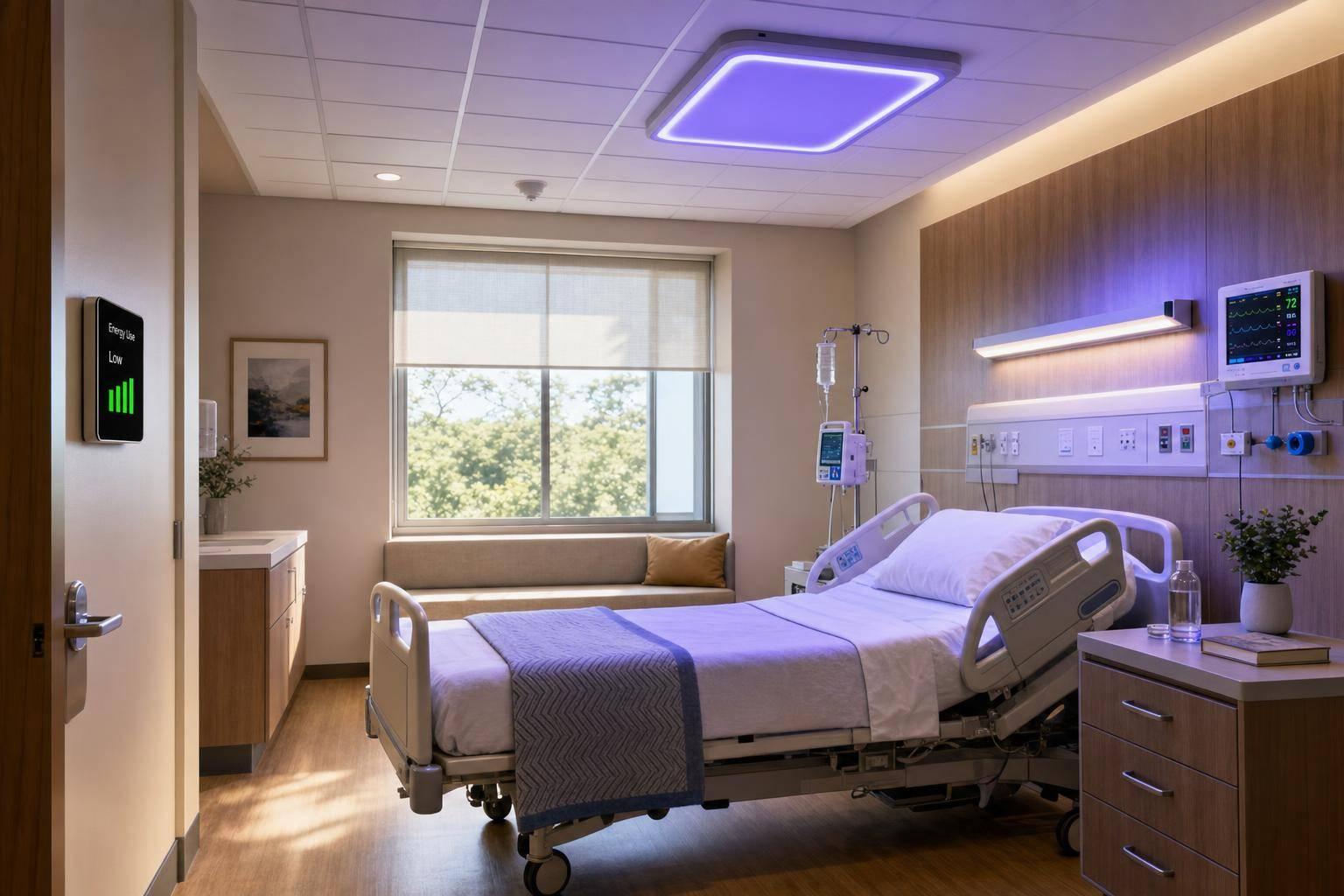
Yes - 405 nm antimicrobial LED lighting can help lower surface and air bioburden in occupied hospital rooms while also cutting lighting energy use.
If I had to sum it up in plain English, it’s this:
Here’s the simple takeaway: if you want a lighting upgrade that supports infection control and trims utility costs, 405 nm antimicrobial LEDs are worth a close look.
| Topic | Key point |
|---|---|
| HAIs | 1 in 25 patients in the U.S. gets one |
| Main gap | Contamination returns between cleanings |
| Best-fit light | 405 nm visible light for occupied spaces |
| UV-C vs. 405 nm | UV-C needs empty rooms; 405 nm can run during care |
| Energy use | PWM may cut power use by about 37% |
| Best use | Add it to cleaning, not instead of cleaning |
I’ll keep the rest of this simple: how the light works, what the studies found, where it fits best, and what to check before a hospital retrofit.
Many microbes contain natural porphyrins inside their cells. When 405 nm light hits those compounds, it triggers reactive oxygen species, or ROS, which damage proteins, lipids, and DNA. The effect is slower than a one-time disinfection blast, but that’s exactly why continuous illumination makes sense in care spaces that stay in use.
Because 405 nm visible light is made for occupied spaces, it can work in places like patient rooms, ICUs, NICUs, and operating rooms.
UV-C works well, but there’s a catch: the room has to be empty. Visible-light antimicrobial systems don’t have that limitation. They can stay on during normal clinical activity, which makes them a practical option where patients, nurses, and other staff are present.
| Feature | UV-C Disinfection | 405 nm Visible Light |
|---|---|---|
| Room Occupancy | Unoccupied only | Safe for occupied rooms |
| Operation Mode | Episodic (15–30 min bursts) | Continuous (8–24 hours/day) |
| Mechanism | Direct DNA/RNA disruption | Indirect damage via ROS |
| Use Case | Terminal cleaning | Ongoing bioburden reduction |
That’s why 405 nm lighting is being studied as a continuous infection-control layer in active care settings.
Clinical studies now track how this plays out in day-to-day hospital use. A 2023 prospective cohort in a neurosurgical department found lower wound infection rates and cleaner surfaces in the 405 nm-lit ward than in the standard-lit ward. Another hospital retrofit study reported drops in E. faecalis, S. aureus, and E. coli on high-touch surfaces.
Taken together, those findings point to a simple idea: lowering environmental bioburden may help cut HAI risk without adding to the facility’s energy burden.
That leads straight to the next issue: how these systems trim utility use while also supporting infection control.
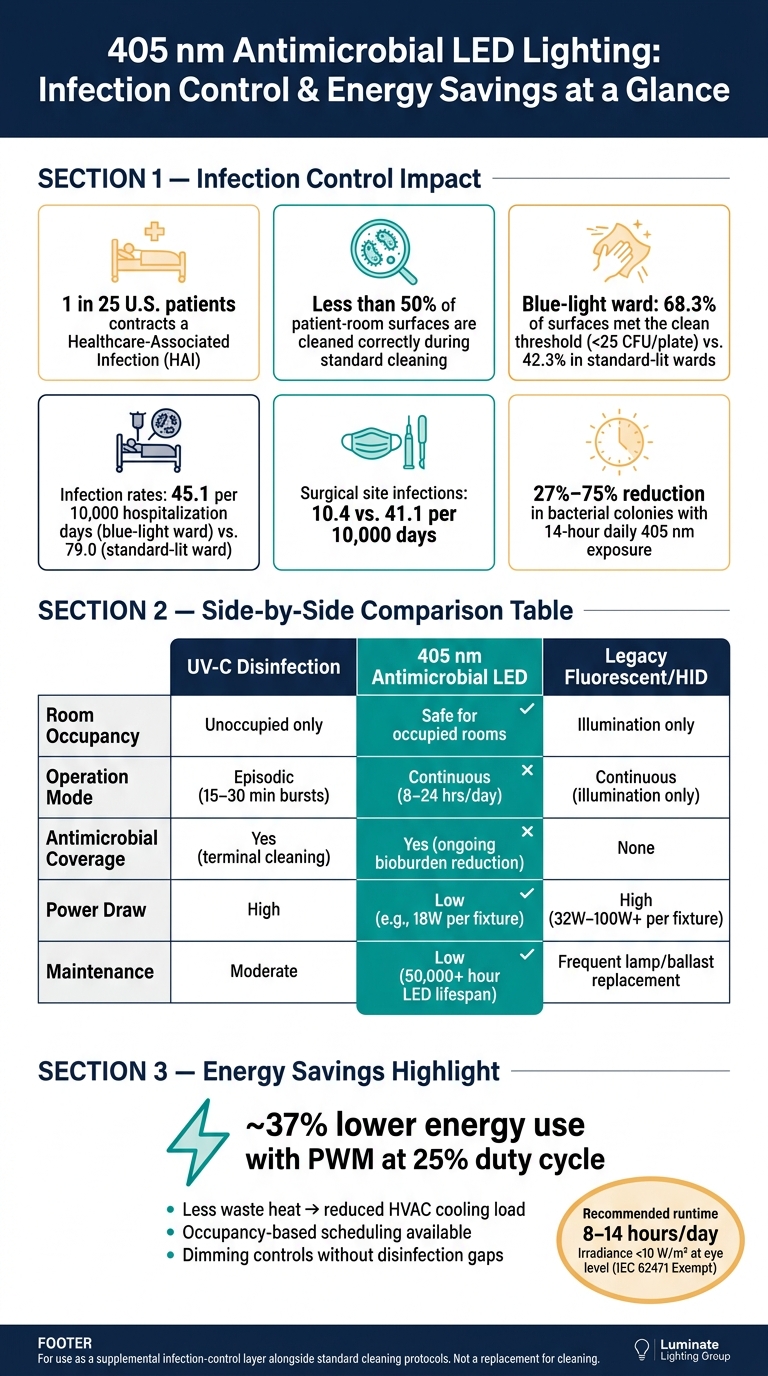
405 nm Antimicrobial LED vs. UV-C vs. Legacy Lighting: Key Metrics for Healthcare Facilities
Once the mechanism is clear, the next question is simple: does it lower infection rates in practice? The data points in that direction. Continuous 405 nm light helps keep bioburden lower between cleanings, with a strong effect on high-touch surfaces. In a year-long neurosurgical ward study, the share of surfaces that met the clean-surface threshold of fewer than 25 CFU/plate increased to 68.3% in the blue-light ward, compared with 42.3% in the standard-lit ward at the 5-month mark.
This kind of lighting works as a support for standard cleaning, not a substitute for it. It helps slow recolonization in the time between scheduled disinfection cycles, which is where problems can creep back in. Restelli and colleagues concluded that blue light can safely add to standard cleaning protocols.
The clinical results make the contrast pretty clear. In the same neurosurgical ward study, infection rates were 45.1 per 10,000 days of hospitalization in the blue-light ward versus 79.0 in the standard-lit ward. Surgical site infections were 10.4 versus 41.1 per 10,000 days, respectively.
That matters because the cleaning program itself did not change. In other words, the lower rates came from adding antimicrobial lighting on top of the usual process, not from extra cleaning steps or a different disinfection routine.
That same always-on coverage also affects energy use, which the next section addresses.
The infection-control upside helps make the retrofit case easier, but there's another reason these systems stand out: they can cut operating costs at the same time. That mix - lower bioburden and lower energy use - makes the spend easier to defend.
Modern antimicrobial LED fixtures use much less power than the fluorescent or halogen lighting they replace. And the savings don't stop at fixture wattage. LEDs give off far less waste heat, which matters in hospitals and clinics where cooling systems already work hard. Less heat from lighting can reduce HVAC cooling load and trim utility bills.
There’s also a smart way to push energy use down further. With pulse-width modulation (PWM), the system cycles light on and off at a high frequency instead of running at full output all the time. That approach can lower average power use while still keeping disinfection performance in place. One study reported about 37% lower energy use at a 25% duty cycle.
Controls matter too. The goal isn't just to cut power. It's to do it without leaving dead zones in the disinfection plan.
Because 405 nm systems can operate in occupied rooms, facilities can use scheduling and dimming controls without creating disinfection gaps. That gives teams more room to fine-tune runtime based on how each space is used.
A simple setup often includes:
From there, the next step is practical: start with the highest-risk spaces, then match light output and runtime to how those rooms are used.
| Feature | Legacy Fluorescent / HID | Antimicrobial LED Systems |
|---|---|---|
| Power Draw | High (32W–100W+ per fixture) | Low (e.g., 18W white + variable disinfection channel) |
| Maintenance Needs | Frequent lamp and ballast replacement | Long-life LEDs (50,000+ hours); fewer replacement cycles |
| Occupied-Room Use | Illumination only | Safe for continuous use in occupied spaces |
| Antimicrobial Coverage | None | Yes; ongoing inactivation of bacteria and fungi |
Once the infection-control and energy case is clear, the next step is deciding where an upgrade will do the most work.
Begin with the highest-risk rooms. ICUs, NICUs, burn unit isolation rooms, and operating rooms are smart places to start. Inside those rooms, pay close attention to sinks, counters, and other high-touch surfaces, since pathogens are more likely to remain there between cleaning cycles.
Before you spec even one fixture, set clear targets. A 2019 NICU retrofit study found lower ATP counts and successful inactivation of E. faecalis, S. aureus, and E. coli under 405 nm lighting. Hospital use in occupied settings has also shown a 27% to 75% reduction in bacterial colonies with 14-hour daily exposures.
Many teams aim for 8 to 14 hours per day while keeping irradiance below 10 W/m² at eye level for 8-hour exposures so the system stays within IEC 62471 safety limits. That kind of target-setting matters. If you don't define runtime, exposure levels, and the surfaces you want to protect, it's hard to judge whether the retrofit is doing its job.
After you lock in the target spaces, the next move is figuring out how the fixture should be built and controlled.
Picking the right fixture goes well beyond choosing a 405 nm light source. In healthcare procurement, three spec points tend to matter most:
This isn't a one-team decision. Facilities engineering, infection prevention, and clinical staff all need to weigh in.
The case for antimicrobial lighting is strongest in spaces where infection risk and energy costs are both high. Continuous 405 nm coverage adds a practical layer of bioburden suppression between cleaning cycles without disrupting occupied rooms or forcing staff to clear the space.
Lower wattage, less cooling demand, and PWM controls add up over time. That mix - lower infection risk and lower operating costs - makes the retrofit easier to justify.
Luminate Lighting Group can help healthcare teams plan energy audits, photometric layouts, fixture specs, and rebate documentation through our proven process.
Yes - 405 nm antimicrobial lighting can be safe for patients and staff when it meets photobiological safety requirements and is used in the right operating modes.
One prospective neurosurgical study described a 405 nm blue-light system as safe for clinical use in occupied rooms. The same study noted that 440 nm and 480 nm are linked to photoretinitis and circadian effects, respectively.
In clinical and environmental studies of 405 nm blue antimicrobial lighting, measurable bioburden reduction usually shows up over days to months, not minutes.
One prospective cohort study found differences in environmental bacterial load after 1 month, with statistically meaningful results by 5 months. In occupied rooms, whole-room visible/405 nm disinfection often relies on multi-hour exposure windows, or runs for 8 to 14 hours, to help limit pathogen growth.
Antimicrobial lighting retrofits work best in spaces that need a very high level of sterility, like operating theaters, ICUs, and inpatient isolation rooms. In these areas, continuous or scheduled disinfection cycles can support standard terminal cleaning protocols and add another layer of protection.
High-touch spots in patient rooms, such as sinks and counters, can benefit too. An LED upgrade can improve light levels in these key areas, cut energy costs, and help facilities meet infection control and energy code requirements.


