.svg)
Summary of 2025 commercial lighting code: 5% LPD reductions, expanded daylighting, occupancy sensors, plug-load demand response and Jan 1, 2026 permit compliance.

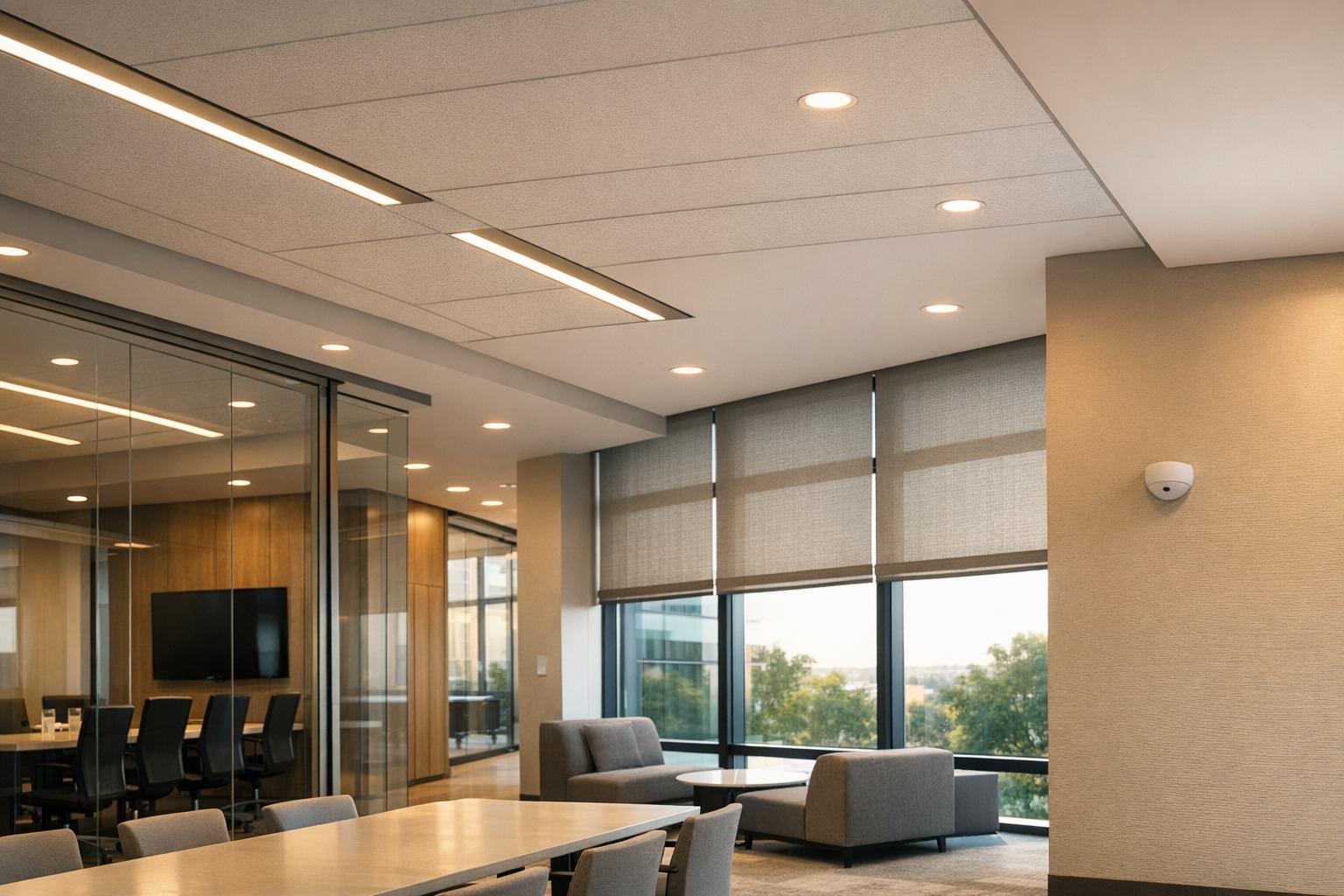
The 2025 Energy Code updates for commercial lighting are set to take effect on January 1, 2026, impacting all building permit applications filed on or after this date. These updates aim to improve energy efficiency, reduce greenhouse gas emissions, and align with California's long-term sustainability goals. Key changes include:
These updates align California's Title 24 with ASHRAE 90.1 and the International Energy Conservation Code (IECC), making compliance easier for businesses operating across multiple states. While exemptions exist for specific safety-critical lighting needs (e.g., healthcare facilities), the changes encourage the adoption of high-efficiency LED fixtures and advanced lighting controls.
Preparing early is crucial. Commercial property owners should:
The updates are expected to save $4.8 billion in energy costs and reduce four million metric tons of greenhouse gas emissions, offering financial and environmental benefits for businesses that comply.
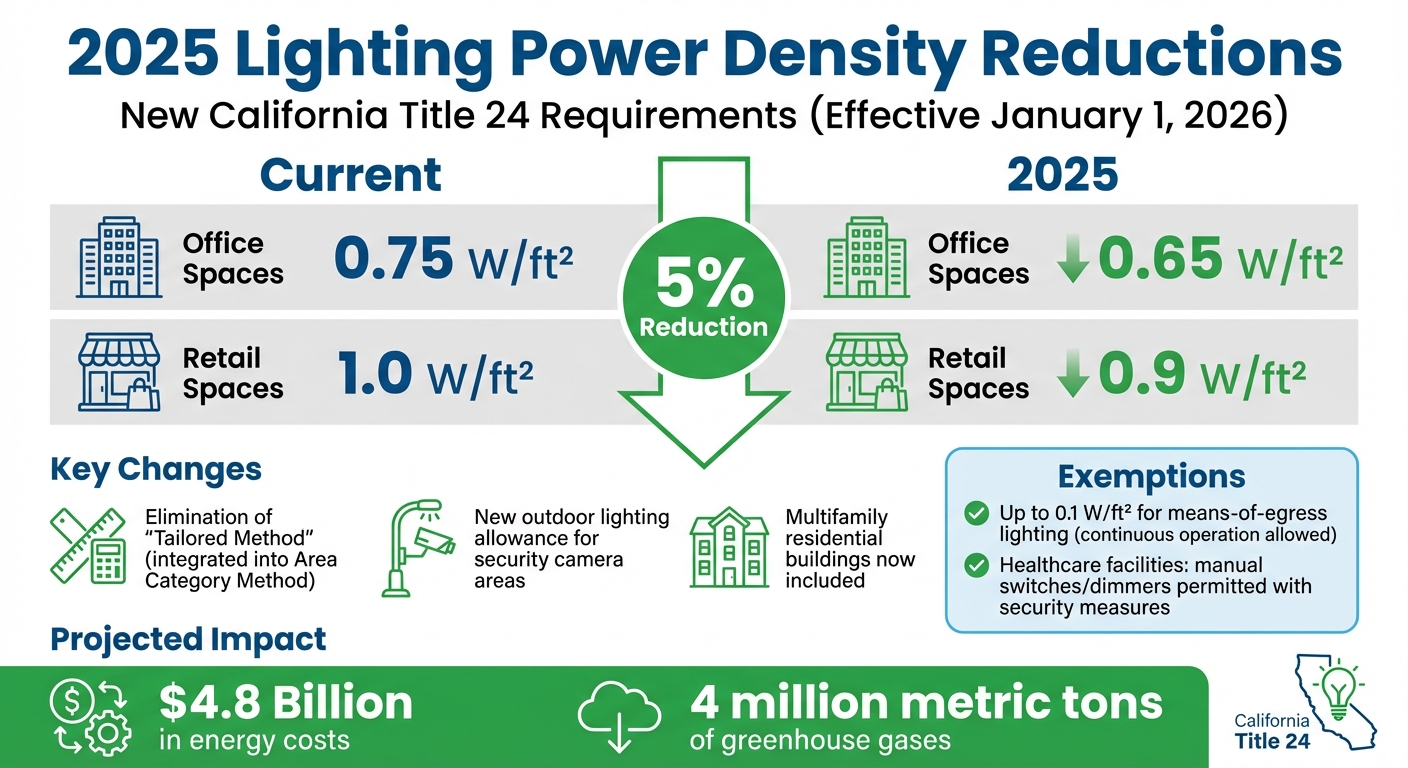
2025 California Energy Code Lighting Power Density Requirements Comparison
The updated regulatory standards for 2025 bring notable changes to Lighting Power Density (LPD) requirements, reshaping how commercial spaces approach energy efficiency and compliance. These changes focus on reducing energy consumption while encouraging the use of advanced lighting technologies and controls.
The 2025 LPD updates introduce a 5% reduction in power limits across various commercial space types. For instance, office spaces now have a lower limit, dropping from 0.75 W/ft² to 0.65 W/ft², while retail spaces are reduced from 1.0 W/ft² to 0.9 W/ft². Achieving these targets will require the use of high-efficiency LED fixtures that deliver maximum lumens per watt.
Another key change is the elimination of the "Tailored Method." Its allowances have been integrated into the Area Category Method's Additional Power Allowances, simplifying the compliance process. For outdoor lighting, a new additional power allowance has been introduced for spaces equipped with security cameras, acknowledging the need for adequate illumination in safety-critical areas.
The updated regulations also extend stricter LPD requirements to multifamily residential buildings, aligning them with the standards for commercial spaces. These buildings must now meet the same LPD targets and incorporate advanced lighting controls. While this raises the bar for energy efficiency, it also introduces specific challenges, leading to exemptions for certain safety-critical lighting needs.
Not all lighting projects are subject to the full scope of the new LPD requirements. California's Title 24 provides some flexibility, allowing up to 0.1 W/ft² of designated means-of-egress lighting to remain continuously on without being subject to standard area or automatic shutoff controls. Martin Mercier, Strategic Marketing Manager at Cooper Lighting Solutions, explains:
"California's Title 24 allows up to 0.1 W/ft² of designated means-of-egress lighting to remain continuously On without the usual area/automatic shutoff controls".
Healthcare facilities also benefit from certain exemptions. For example, hospitals can use manual switches and dimmers for critical areas, provided these are secured to prevent tampering. Additionally, these systems must include a pilot light or status indicator for remote monitoring.
These exemptions ensure that essential safety lighting can operate continuously or under manual control without compromising overall compliance. By balancing strict energy limits with practical allowances, the updated LPD requirements promote energy efficiency while addressing the unique needs of specific applications. This approach supports both sustainability goals and operational flexibility.
The 2025 codes bring more than just stricter power density limits - they also introduce smarter lighting controls that adapt to occupancy and daylight changes. Let’s break down how these updated sensor and daylight harvesting requirements contribute to energy savings.
The new standards place greater emphasis on automatic occupancy-based controls in commercial spaces. For instance, occupancy sensors are now required to dim or turn off lighting within 20 minutes of detecting a vacant space. In offices larger than 250 square feet, lighting zones cannot exceed 600 square feet and must reduce power by at least 80% within 20 minutes of being unoccupied. Additionally, if occupancy is detected in one zone, adjacent zones must operate at no more than 20% power.
Another key update is the shift from stepped dimming to continuous dimming, allowing lights to gradually adjust from 100% to as low as 10%, simplifying control mechanisms. Healthcare facilities also see tailored adjustments: manual switches and dimmers can be secured under lock and key to prevent tampering, provided they include a pilot light or status indicator for remote monitoring. Emergency lighting systems now need to comply with updated UL 924 standards, ensuring they automatically switch to emergency mode during power outages.
Daylight harvesting requirements have also evolved. Zones exceeding 75 watts must now incorporate daylight harvesting, with daylight zones clearly outlined for areas larger than 250 square feet. When natural light levels surpass 150% of the design standard, lighting power must drop by at least 90% in most spaces and 100% in parking garages.
Demand response systems now extend beyond entire buildings to individual spaces, including plug loads for lighting and HVAC systems. Charles Knuffke, Systems VP & Evangelist at Wattstopper, highlights this shift:
"Now, the code will require new buildings to include plug loads as to be part of their demand response. These requirements will be tailored to individual spaces now, and not just entire buildings."
Additionally, occupancy sensors can now double as data inputs for HVAC systems, enabling ventilation to be completely shut off during standby modes. California projects these combined updates will result in $4.8 billion in statewide energy savings.
Keeping up with state implementation schedules and planning ahead for compliance is essential for maintaining energy-efficient commercial lighting systems that meet evolving regulations.
California is leading the way with its 2025 Building Energy Efficiency Standards (Title 24, Part 6), which will apply to all building permit applications submitted on or after January 1, 2026. The state’s triennial code update cycle ensures it stays aligned with advancements in technology, such as LED lighting and sophisticated control systems. Experts often highlight California's forward-thinking approach to energy standards.
In contrast, most other states adopt national model codes, like the International Energy Conservation Code (IECC) and ASHRAE 90.1, to create their own energy codes. California’s 2025 Title 24 updates are designed to align more closely with these national standards, including ASHRAE and IECC requirements. This move toward harmonization simplifies the process for designers working across multiple states. However, differences in adoption timelines still pose challenges.
These varying timelines underscore the importance of taking specific steps to ensure compliance.
Once state schedules are clear, the following actions can help streamline your compliance process.
Meeting the 2025 energy code updates isn’t just about knowing the rules - it’s about implementing practical, cost-effective solutions that align with these new standards.
Luminate Lighting Group provides customized LED retrofit options designed to meet the updated power density requirements. These include:
These retrofits address the 5% reduction in Lighting Power Density expected across various commercial spaces in 2025. They also incorporate advanced controls to meet the new automatic daylighting threshold, which has dropped from 120 watts to 75 watts. For systems exceeding 4,000 watts, demand response controls are integrated to align with the updated requirements.
In addition to retrofits, Luminate Lighting Group offers energy audits and photometric analysis to ensure compliance with the new standards.
The process doesn’t stop at installation. Functional testing is performed to confirm that systems like occupancy sensors, bi-level lighting, and daylight harvesting are working as intended. This step is critical for meeting performance-based code requirements and qualifying for utility rebates.

To maximize the value of these upgrades, Luminate Lighting Group helps clients access financial incentives. Utility rebates are leveraged to significantly reduce the typical nine-month payback period. Additionally, the team handles all documentation for utility rebates and 179D tax deductions, ensuring compliance with ASHRAE energy reduction goals. These incentives not only lower upfront costs but also enhance the overall return on investment.
Starting January 1, 2026, any permits filed must comply with the 2025 Energy Code. This means all designs submitted on or after that date must align with the updated standards. Key changes include a 5% reduction in lighting power density for various space types, a lowered 75-watt threshold for automatic daylighting controls, and a new requirement to integrate individual space plug loads into demand response systems.
Planning ahead is essential. The updated code mandates that daylight zones for spaces larger than 250 square feet be clearly defined in architectural plans. This requires early collaboration between lighting designers and architects to ensure compliance documentation is ready before filing permits. Charles Knuffke, Systems VP at Wattstopper, highlights the importance of these changes:
"Now, the code will require new buildings to include plug loads as to be part of their demand response. These requirements will be tailored to individual spaces now, and not just entire buildings".
By coordinating early, your project can align with the compliance strategies outlined in the new regulations.
Professional expertise is crucial for navigating these technical requirements while maximizing potential financial benefits. Licensed professionals can handle compliance documentation, such as the Certificate of Installation (CF2R-LTG), and verify the installation of high-efficacy lighting and controls as required by the updated standards. They also ensure that LED sources and dimming systems are compatible - an important factor for meeting the new continuous dimming requirement, which ranges from 100% to 10%.
Upgrading early has additional benefits, particularly with the 179D commercial building tax deduction set to expire at the end of 2025. Taking action now can help facilities take advantage of these financial incentives while preparing for the new code.
For facilities navigating these updates, Luminate Lighting Group offers comprehensive support. From initial energy audits and photometric analysis to LED retrofits with integrated controls, their team ensures full compliance with the 2025 standards. They handle technical specifications, compliance documentation, and financial incentive applications, helping facilities transition smoothly while optimizing energy savings and rebates.
The 2025 Energy Code brings fresh standards for commercial lighting systems, especially when it comes to renovations, additions, or alterations. Some of the key changes include:
These updates are designed to boost energy efficiency while cutting operating costs. For older buildings undergoing upgrades, meeting these standards can lead to perks like utility rebates, tax incentives, and improved lighting quality - all while contributing to broader sustainability efforts.
Advanced lighting controls bring a host of benefits, from cutting energy costs to improving operational efficiency. They’re also key to meeting the 2025 commercial energy code requirements. Features like occupancy sensors and daylight-responsive dimming ensure lights are only used when necessary, which not only lowers electricity bills but also extends the lifespan of lighting systems. Multilevel dimming takes it a step further by allowing precise adjustments, striking the perfect balance between energy efficiency and comfortable lighting.
Beyond saving money, these systems enhance safety and comfort by delivering consistent illumination, reducing glare, and ensuring emergency lighting is always ready. They also simplify compliance with energy codes through programmable schedules, zoned lighting, and seamless integration with building management systems. By working with Luminate Lighting Group, businesses can implement custom solutions that maximize these advantages, streamline code compliance, and take advantage of financial perks like utility rebates and 179D tax deductions.
To get ready for the 2025 Energy Code changes, businesses should start by reviewing the updated compliance requirements. This will help you understand the new standards for lighting power allowances and control systems. Begin with a detailed audit of your current lighting setup - take note of fixture types, wattage, and control configurations. Pay extra attention to manual controls, dimming features, and daylight-responsive systems, as these are key areas highlighted in the updates.
Working with a qualified lighting professional, like Luminate Lighting Group, can make the process much smoother. They can assist in designing and implementing energy-efficient LED retrofits and advanced control systems that meet the new standards while boosting energy savings and qualifying for rebates. Don’t forget to complete all necessary testing and documentation well ahead of the deadline to avoid last-minute compliance headaches. Preparing early not only ensures you meet the new requirements but also positions you to take advantage of available incentives and tax breaks.


