.svg)
Battery-backed LED fixtures meet energy and life‑safety codes, deliver 90‑minute emergency illumination, and simplify testing.

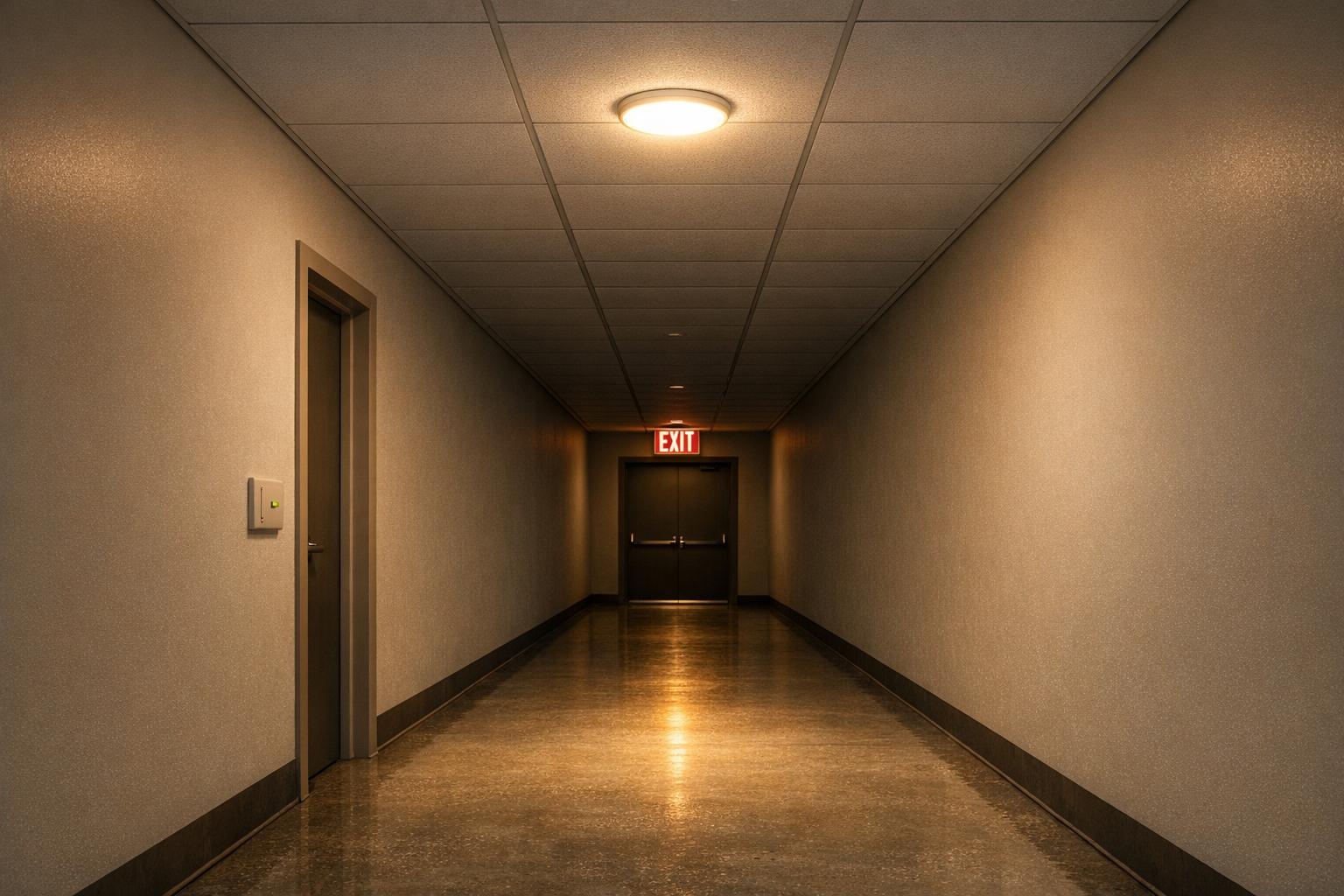
Battery backup lighting is essential for meeting both energy efficiency and life-safety regulations. It ensures compliance with strict energy codes like ASHRAE 90.1 and IECC, which require reduced energy use through dimming and occupancy controls, while also adhering to safety standards like NFPA 101, which mandates emergency lighting during power outages.
Key takeaways:
Battery-backed LED fixtures balance energy-saving measures with safety requirements, making them a practical choice for commercial and municipal buildings. They simplify compliance, reduce maintenance costs, and ensure safety during emergencies.
For practical compliance: Use distributed battery systems, ensure proper placement for consistent illumination, and perform regular testing to meet code standards.
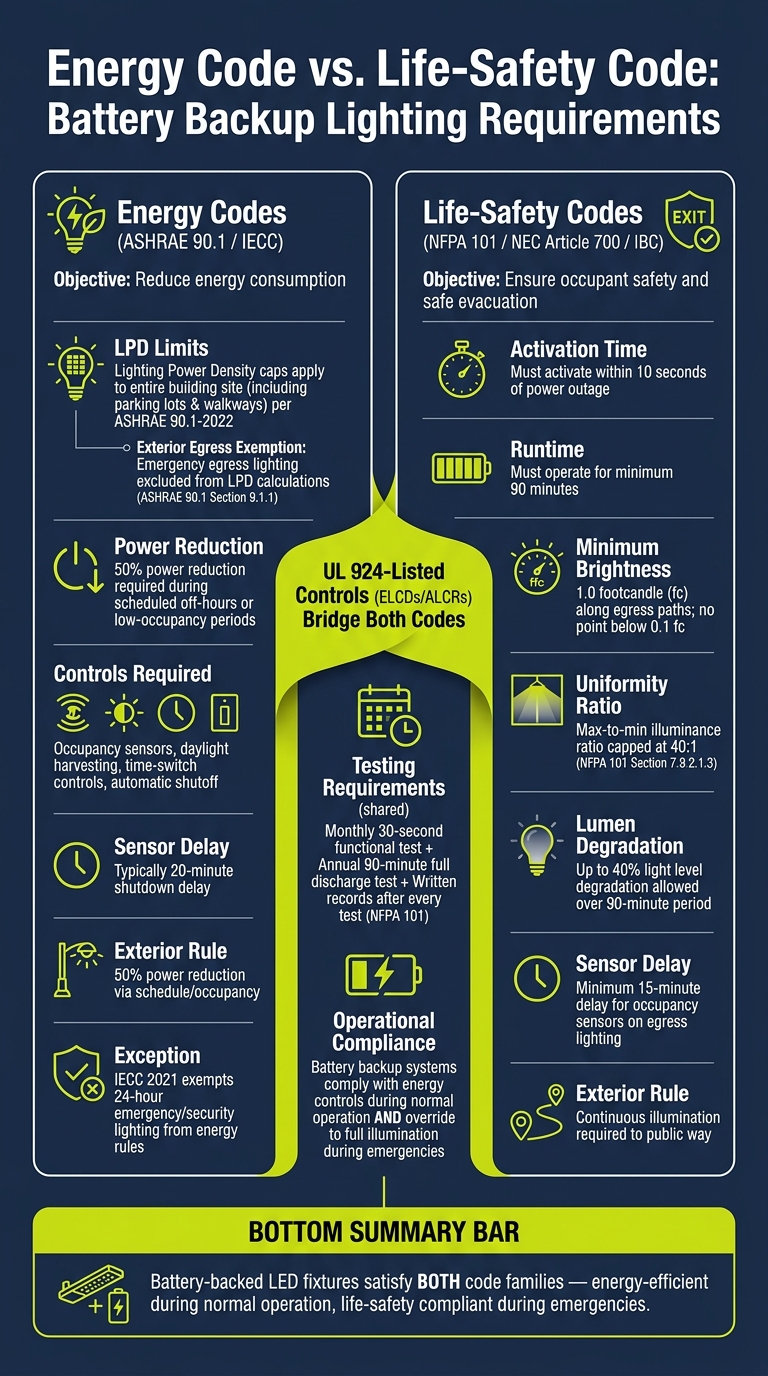
Battery Backup Lighting: Energy Code vs. Life-Safety Code Requirements
When it comes to energy efficiency, ASHRAE 90.1 and the IECC provide the baseline for how exterior lighting should operate and how much energy it can consume. Notably, ASHRAE 90.1-2022 expanded its scope to cover the entire building site, including parking lots and walkways:
"The 2022 version of 90.1 clarified the scope of 90.1 to include the site, not just the building."
This change means that areas like perimeter walkways and other outdoor zones must comply with Lighting Power Density (LPD) limits and control requirements. Exterior lighting systems must include controls that reduce power by 50% during scheduled times or when occupancy is low. Additionally, automatic shutoff systems - such as occupancy sensors or time-switch controls - are mandatory. To pass inspection, commissioning documentation like zoning diagrams and sequences of operation must also be provided.
However, there’s a key exception: IECC 2021 exempts 24-hour emergency and security lighting from its energy efficiency rules, as long as this lighting remains off during normal conditions and activates only when required. These provisions balance energy savings with the need for safety.
On the safety front, NFPA 101 and NEC Article 700 define the minimum standards for emergency lighting. These systems must activate within 10 seconds of a power outage, operate for at least 90 minutes, and maintain a minimum brightness of 1 foot-candle (fc) along egress paths, with no area dropping below 0.1 fc.
Uniformity is another critical factor. To prevent hazardous dark spots, NFPA 101 Section 7.9.2.1.3 caps the maximum-to-minimum illuminance ratio at 40:1. Over the 90-minute emergency period, light levels can degrade by up to 40% due to battery voltage drops, but designers must confirm this through photometric analysis using the reduced lumen output of the battery pack.
"Emergency illumination systems are required in most commercial buildings and are powered by an emergency power system." - Orlando Cruz, PE, and Supasit Jong, PE
In colder climates, additional measures - like cold-weather battery packs or remote-mounted systems - might be necessary to ensure reliable performance. These overlapping energy and safety requirements call for integrated lighting solutions and control systems.
Bridging the gap between energy efficiency and life-safety codes often involves battery-backed systems. These systems must balance energy-saving measures with evacuation requirements. While energy codes push for lights to be off or dimmed when spaces are unoccupied, life-safety codes demand continuous illumination during emergencies. To manage this, UL 924-listed control relays (ELCDs/ALCRs) are used. These devices allow normal energy-saving operations but override controls during a power outage.
NFPA 101 permits occupancy sensors to manage egress lighting, as long as they include a minimum 15-minute delay. On the other hand, energy codes typically allow a 20-minute delay for non-emergency spaces.
Here’s a quick comparison of how life-safety and energy codes differ:
| Requirement | Life-Safety (NFPA 101 / IBC) | Energy Code (IECC / ASHRAE 90.1) |
|---|---|---|
| Objective | Ensures occupant safety and evacuation | Reduces energy consumption |
| Light Level | Min. 1.0 fc (normal), 0.1 fc (emergency) | Based on LPD limits |
| Controls | Must remain "On" when occupied | Must turn "Off" or reduce when unoccupied |
| Sensor Delay | Minimum 15-minute delay | Typically 20-minute shutdown delay |
| Exterior Rule | Continuous illumination to public way | 50% power reduction via schedule/occupancy |
Both code families share a focus on testing. Battery-backed systems must undergo a 30-second test each month and a full 90-minute discharge test annually to ensure battery reliability. Using fixtures with built-in self-testing features can simplify this process and reduce maintenance burdens over time.
Battery backup systems play a key role in meeting energy code requirements while ensuring safety. Battery-backed LED fixtures are engineered to address both energy efficiency and emergency lighting needs. According to ASHRAE 90.1 Section 9.1.1, emergency egress lighting is exempt from Lighting Power Density (LPD) calculations. This exemption allows for more flexibility in wattage allocation for general lighting, all while maintaining safe illumination along exit routes and perimeter walkways.
These battery-equipped luminaires operate on the same branch circuit as normal lighting, meaning they also comply with mandatory energy controls like occupancy sensing, daylight harvesting, and scheduled dimming. As Jarvis Staff explains:
"The energy code that governs commercial lighting in most of the United States is ASHRAE/IES Standard 90.1... IECC's commercial provisions reference ASHRAE 90.1 as a compliance path, so the requirements are closely aligned."
This integration ensures that backup lighting activates immediately during power outages, seamlessly combining energy efficiency with emergency preparedness.
Modern battery backup lighting systems, such as "Directly Controlled Emergency Luminaires", are designed to override any active dimming when power is lost, reaching the required illumination level within 10 seconds. This feature ensures compliance with NEC Article 700 and NFPA 101 standards.
For outdoor egress paths and security perimeters, distributed battery systems provide added reliability. Unlike centralized systems, they eliminate a single point of failure - if one fixture's battery pack malfunctions, nearby fixtures continue to illuminate the path. In colder climates, using cold-weather battery packs or interior-mounted modules ensures the required 90-minute runtime.
These technical advantages not only enhance safety but also simplify maintenance and reduce costs, as discussed below.
Battery backup systems are also practical for retrofitting commercial spaces. Distributed systems with integrated battery drivers are often more economical than centralized, generator-based setups. Centralized systems require two-hour fire-rated rooms and dedicated emergency branch circuits. In contrast, luminaires with built-in battery drivers connect directly to existing circuits, cutting down on infrastructure costs.
| Feature | Distributed Battery Packs | Centralized Generator/Inverter |
|---|---|---|
| Reliability | No single point of failure | Generator or transfer switch failure affects all lights |
| Installation | Connects to existing branch circuit | Requires dedicated wiring and fire-rated rooms |
| Maintenance | Self-testing LED units; long lifespan | Requires specialized engine and transfer switch testing |
| 10-Second Startup | Easily met | Generator must reach operating speed in time |
LED fixtures with integrated battery packs are easier to maintain compared to older standalone emergency units. Traditional units require constant-charging circuits and separate inspection routines. Many modern systems now feature self-testing and self-diagnostic capabilities, automating the required monthly 30-second tests and annual 90-minute discharge tests. This automation significantly reduces maintenance efforts over the system's lifespan.
When choosing fixtures, keep in mind that battery backup systems typically cut lumen output by about 50%. Use the emergency-mode lumen values during photometric analysis to ensure you meet the required 1.0 footcandle (fc) standard.
For outdoor perimeter areas where temperatures can drop below 32°F, standard battery drivers may not perform reliably. In these cases, opt for fixtures with cold-weather battery packs or install the battery module on the interior side of the wall to maintain functionality. Additionally, fixtures that include dimming or occupancy sensors must be UL 924-listed as "Directly Controlled Emergency Luminaires." Place fixtures strategically to illuminate all designated exit access components, such as corridors, exterior walkways, stairs, and any paths leading to a public way. Don’t overlook additional coverage for spaces like electrical rooms and public restrooms that exceed 300 square feet. To ensure visibility along egress paths, maintain a maximum-to-minimum uniformity ratio that does not exceed 40:1.
These considerations directly influence the commissioning and testing processes discussed below.
Commissioning and testing are essential to confirm compliance with both energy and life-safety standards. The table below outlines the key testing requirements:
| Testing Requirement | Standard | Frequency |
|---|---|---|
| Functional activation test | NFPA 101 | Every 30 days (30 seconds) |
| Full discharge test | NFPA 101 | Annually (90 minutes) |
| Voltage maintenance check | NFPA 110/111 | At initial acceptance |
| Written records | NFPA 101 | After every test |
Proper commissioning ensures the design meets code requirements long-term.
Fixtures equipped with self-testing features can reduce the need for manual inspections. For high-mounted fixtures, choose models that allow ground-level testing using a laser pointer, making maintenance more efficient. Always document test results, whether generated automatically or manually, to provide a record for the Authority Having Jurisdiction (AHJ).
It's critical to involve the AHJ early in the design process. Since jurisdictions may interpret "designated exit access" and exterior emergency lighting requirements differently, clarifying these expectations upfront can save time and prevent expensive adjustments later.

Navigating the complexities of design and installation becomes easier with expert guidance. Luminate Lighting Group offers end-to-end support, helping commercial clients achieve compliance with ease.
Their team creates detailed photometric layouts based on emergency-mode lumen values, ensuring that lighting designs meet required footcandle levels before installation begins. They also conduct thorough energy audits to identify gaps in existing systems and develop upgrade plans tailored to meet both energy efficiency and life-safety standards. For clients in industries like warehousing, industrial, office, and municipal sectors, this comprehensive approach can also unlock utility rebates and the 179D tax deduction, reducing the overall cost of compliance efforts.
Battery backup lighting serves a unique role by addressing two distinct code requirements at once. During regular operation, these fixtures comply with energy code standards - such as dimming, occupancy sensing, and automatic shutoff. But when the power goes out, UL 924-listed controls kick in, bypassing energy-saving settings to deliver the 1.0 footcandle average needed for safe egress within 10 seconds. This dual-purpose design bridges the gap between energy efficiency and safety regulations.
Energy codes focus on reducing light output to conserve energy, while life-safety codes require constant illumination for egress. These objectives can feel conflicting, as energy standards like ASHRAE 90.1/IECC and life-safety codes such as NFPA 101/IBC often seem to pull in different directions. A well-designed battery backup system eliminates this conflict by seamlessly balancing both needs.
"The means of egress serving a room or space shall be illuminated at all times that the room or space is occupied." - International Building Code (2015 Edition), Chapter 10
Importantly, emergency egress lighting loads are excluded from Lighting Power Density calculations (ASHRAE 90.1 Section 9.1.1). This exemption allows designers to prioritize safety without exceeding energy limits.
When it comes to Lighting Power Density (LPD) limits, whether battery backup lights are included depends on how the fixtures function. According to energy codes like the IECC, emergency lighting that automatically shuts off during normal operation is typically exempt. However, if a fixture is used as both standard and emergency lighting, its wattage must be factored into the total connected lighting power. Luminate Lighting Group provides guidance to help meet these regulations.
UL 924-listed devices, such as Automatic Load Control Relays (ALCRs), play a crucial role in ensuring emergency lighting functions properly alongside dimming and occupancy sensors. Under normal conditions, these devices regulate light levels and monitor occupancy. However, during a power outage, the ALCR overrides local controls, switching the lights to full brightness to meet egress lighting requirements. For more intricate dimming setups, a Branch Circuit Emergency Lighting Transfer Switch (BCELTS) can be utilized to transfer lighting to an emergency power source seamlessly.
Emergency lighting systems are required to operate for at least 90 minutes and maintain a minimum of 87.5% of nominal voltage to meet code standards. For fixtures equipped with built-in battery packs, they must sustain at least 60% of their initial emergency lumen output during this period. Regular testing and upkeep are critical to ensure these systems remain compliant and safe. If you need guidance on meeting these standards, Luminate Lighting Group is here to assist with your lighting system needs.


