.svg)
Practical lighting strategies for assisted living: layered LED systems, circadian tuning, glare reduction, and room-specific solutions to improve safety and sleep.

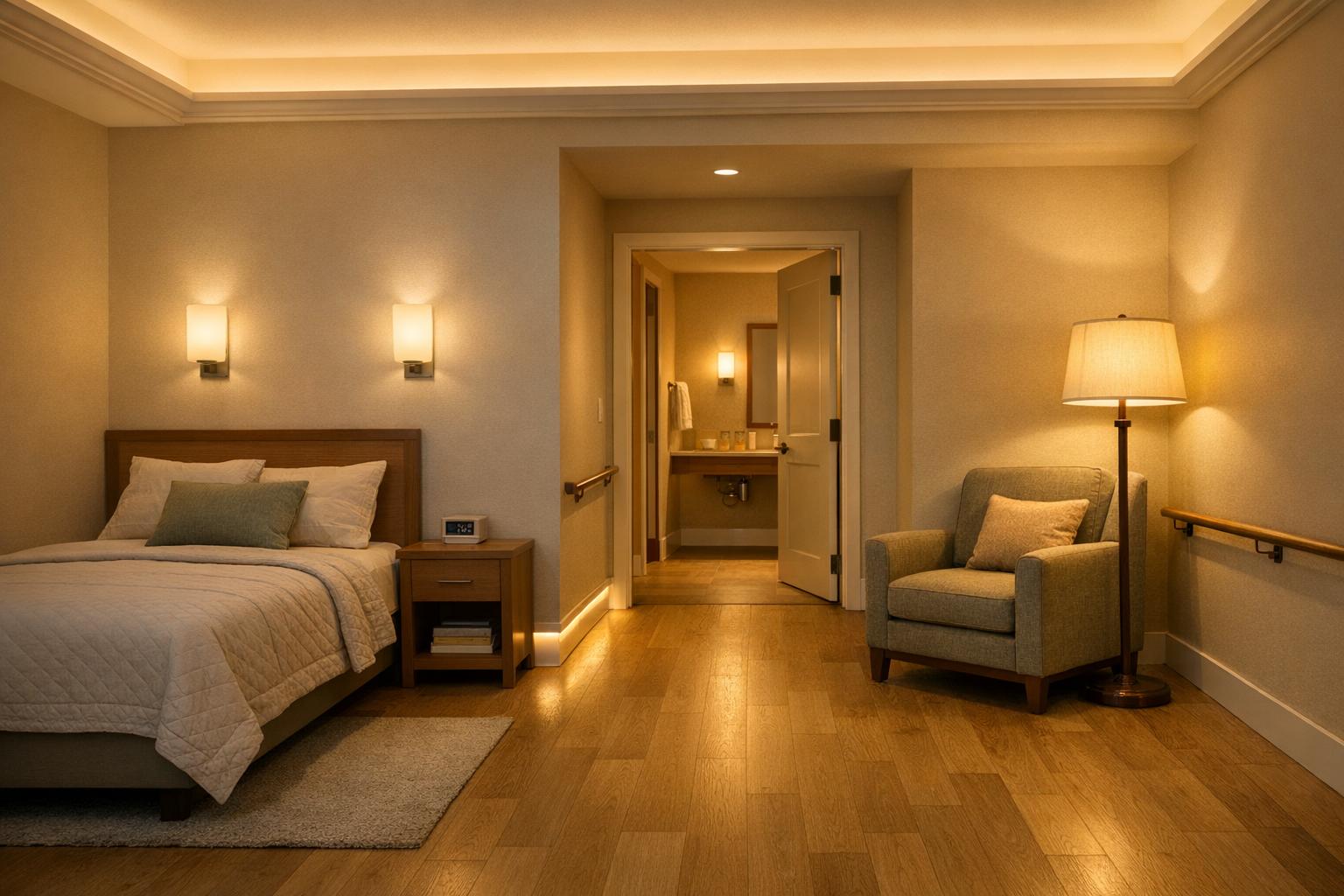
Lighting in assisted living facilities isn't just about visibility - it's about safety, comfort, and well-being. Poor lighting can increase fall risks, disrupt sleep, and cause anxiety, especially for seniors with vision impairments or dementia. Here's what matters most:
Key strategies include layered lighting, motion-activated systems, LED technology, and circadian lighting to improve safety, independence, and quality of life. Each area - private rooms, bathrooms, hallways - requires tailored solutions to meet seniors' specific needs.

Essential Lighting Requirements for Senior Living Facilities
As people age, their eyes undergo changes that can significantly impact how they perceive light. One of these changes is senile miosis, where the pupils shrink, limiting the amount of light that enters the eye. Additionally, the lens becomes thicker and develops a yellowish tint, which scatters light and makes it harder to distinguish similar colors, particularly blues and greens. These changes in light perception increase the likelihood of accidents, especially in dimly lit environments. Seniors also experience a decline in contrast sensitivity, making it more difficult to differentiate between surfaces.
Unfortunately, many assisted living facilities fail to meet recommended lighting standards, which can create hazardous conditions. For example, reduced depth perception makes navigating stairs or slight elevation changes risky, while slower adaptation to sudden changes in brightness - like stepping from bright sunlight into a dim interior - can cause disorientation.
Another major issue is glare sensitivity. The thickened, yellowed lens scatters light more intensely, so unshielded bulbs or reflective surfaces can create glare that temporarily impairs vision and mimics obstacles. Lighting designer Craig DiLouie explains:
"The visual system undergoes physiological changes with age that can reduce visual acuity and color discrimination while heightening sensitivity to glare."
To address these challenges, lighting design must adapt to the needs of aging eyes. Increasing overall light levels (lumen output) can compensate for reduced pupil size. Using higher color temperatures - around 3000K - with a high Color Rendering Index (CRI of 80 or above) can improve color recognition. Indirect or diffused lighting helps minimize glare, while well-lit transition zones, like entryways, can ease the adjustment between different light levels. These targeted solutions are essential for creating safer and more accessible spaces.
Proper lighting is a key factor in promoting safety and independence for seniors, especially in environments where vision impairments can pose serious risks. Poorly lit areas dramatically increase the likelihood of falls, which are a leading cause of injury among older adults. Over 75% of falls occur at home, with many taking place at night in assisted living facilities. This makes adequate lighting not just a convenience but a necessity.
Beyond fall prevention, well-planned lighting can reduce disorientation and anxiety, particularly in residents with cognitive impairments. Shadows or uneven lighting - sometimes referred to as "scalloping" - can be mistaken for obstacles or uneven flooring, increasing the risk of missteps. Dr. Warren Wong highlights the importance of these considerations:
"You don't want to risk having a fall and being unable to get help."
Lighting also plays a critical role in maintaining circadian rhythms, which are often disrupted in older adults. Between 40% and 70% of seniors struggle with chronic sleep issues. Tunable lighting systems that provide cooler, blue-enriched light in the morning and warmer, amber light in the evening can help regulate sleep-wake cycles, reducing agitation and improving overall well-being - especially for residents with dementia.
Additionally, higher light levels combined with focused task lighting empower seniors to perform everyday activities like reading, cooking, and personal care with greater ease and confidence. Thoughtful lighting design isn't just about visibility - it's about supporting independence and enhancing quality of life.
For seniors, proper lighting is not just about comfort - it's about safety and functionality. Layered lighting, which combines ambient, task, and accent lighting, works best in these spaces. Aim for ambient lighting at 300 Lux, but for those over 75, lighting levels may need to be up to four times brighter.
Stick to warm color temperatures (2,700K–3,000K) to create a cozy, home-like atmosphere. Use fixtures with a CRI of 90 or higher to ensure accurate color perception - important for tasks like choosing clothes or identifying medications. Task lighting, such as reading lamps, should provide 300–500 Lux, while direct lighting for medical purposes should reach at least 1,000 Lux.
To reduce glare and eliminate tripping hazards, opt for ceiling- or wall-mounted fixtures with diffusers. Place light switches no higher than 48 inches for wheelchair accessibility, and choose rocker or touch-style switches, which are easier for individuals with arthritis to operate. For nighttime safety, install low-level lighting no more than 2 feet above the floor to illuminate pathways without disrupting sleep.
These thoughtful lighting choices lay the groundwork for addressing safety in more hazardous areas, such as bathrooms.
With nearly 80% of senior falls occurring in bathrooms, lighting here demands extra care. Motion-activated systems can provide instant illumination, removing the risk of fumbling for switches in the dark. Research from the University of North Carolina highlights that amber LED strips on doorframes reduced falls by 34%.
To minimize glare from shiny surfaces like tiles and porcelain, use fixtures with diffusers or shields to hide the light source. Choose LED bulbs equivalent to 100W–150W incandescent bulbs for adequate brightness. Keep daily-use lighting within a color temperature range of 2,700K to 3,500K, and consider warmer, dimmer amber tones at night to promote better sleep.
Auto-detect nightlights near key areas like toilets, sinks, and entrances provide low-level illumination for nighttime safety. Ensure consistent lighting across the bathroom to avoid shadows, which could be misinterpreted as obstacles.
Dr. Sheryl Zimmerman from the University of North Carolina at Chapel Hill emphasizes the practicality of such solutions:
"A successful lighting system could be particularly attractive to ameliorate falls due to its low cost, lack of staff involvement, and easy installation".
These strategies contribute to a safer, more accessible environment for seniors.
Hallways require bright, even lighting to ensure safe navigation and reduce shadows, which can interfere with depth perception. Maintain a uniformity ratio of 3:1 (average to minimum lighting) to prevent dark patches. For spaces with 8-foot ceilings, position downlights 6.5–8 feet apart and 18–24 inches from walls to achieve balanced vertical illumination. Use cooler color temperatures (3,500K–4,000K) to improve clarity in hallways, while warmer tones (2,700K–3,000K) work well in common areas for a more inviting feel.
In transition zones like lobbies, brighter lighting helps aging eyes adjust when moving from outdoor to indoor settings. Highlighting end walls or "destination" points can guide movement through corridors, while color-coded lighting or unique fixtures help differentiate wings or floors. At night, dim corridor lighting to 5–10% for safe navigation without disturbing nearby residents.
Common areas should generally provide 300–500 Lux during the day, with the option to increase up to 1,500 Lux for specific activities. Fixtures with a CRI of 90 or higher are ideal for accurately perceiving textures, food colors, and skin tones. Additionally, wall-mounted sconces in circulation areas should not extend more than 4 inches from the wall when mounted between 27 and 80 inches high, in line with ADA standards.
LED lighting has become the go-to choice for assisted living facilities - and for good reason. These lights use 70% less energy than traditional fluorescent systems and can last over 75,000 hours, more than double the typical 30,000-hour lifespan of older systems. This means facility managers can go up to 10 years without needing to replace bulbs, cutting down on maintenance costs significantly. Plus, LEDs provide steady, flicker-free brightness and boast a Color Rendering Index (CRI) of 90 or higher. This high CRI helps seniors differentiate colors more easily, which is crucial for tasks like identifying medications or picking out clothes. As John Casadonte, Vertical Marketing Manager at Cree, puts it:
"LED lighting is an attractive opportunity to improve residents' experience while dramatically reducing energy and maintenance costs".
While LED fixtures may cost 1.5 to 2 times more upfront than traditional options, the savings in energy and maintenance quickly make up for the initial expense. Considering that lighting accounts for 42% of a healthcare facility's electricity use, the investment pays off in no time. Beyond these practical benefits, advanced LED systems now also cater to residents' circadian rhythms, further enhancing their value.
Tunable-white LED systems take lighting a step further by adjusting color temperature and brightness throughout the day to support residents' natural circadian rhythms. In the morning, cooler, blue-enriched light at 6500K helps boost alertness and suppress melatonin. As evening approaches, the lighting shifts to warmer tones at 2700K, signaling the body to wind down for rest. This is especially helpful for older adults, as 40% to 70% experience sleep issues.
The benefits are more than theoretical. A 2015 study at the ACC Care Center in Sacramento showed that using tunable-white LED lighting, which transitioned from 6500K in the morning to 2700K at night at 20% output, led to fewer falls in corridors, reduced agitation, and a noticeable decrease in the use of psychotropic and sleep medications. Lisa Warnock, Principal and Founder of Glow Interior Designs, explains:
"Tunable lighting is a natural fit for residents who don't get to spend much time outdoors. These systems mimic the sun's natural color temperature and intensity throughout the day inside a building".
Choosing the right fixtures and installing them properly is just as important as picking the right lighting technology. Fixtures should prioritize safety, accessibility, and function. Ceiling-mounted and wall-mounted lights are better than floor lamps, especially in dementia care areas, as they reduce tripping hazards. In circulation zones, wall sconces should not extend more than 4 inches from the wall when mounted between 27 and 80 inches high to meet ADA standards. To minimize glare, use fixtures with frosted covers or acrylic reflectors that diffuse light evenly. Avoid placing lights at eye level; instead, opt for indirect lighting, like upward-facing sconces, for common areas. For added convenience, motion-activated lights in hallways and bathrooms ensure residents can move around safely without searching for switches.
Task lighting also plays a critical role. Adjustable lamps near beds or in hobby spaces should provide 300–500 Lux for reading, with an option to increase to 1,000 Lux for detailed tasks like medical examinations. Low-level guide lights positioned no more than 2 feet above the floor are ideal for transition zones, such as entryways and lobbies. These areas also need higher illumination levels to help aging eyes adjust when moving from bright outdoor light to dimmer indoor settings. Consistent lighting levels throughout a facility are vital as well, since older eyes take longer to adapt to changes in brightness.
Every decision, from fixture placement to brightness levels, directly impacts resident safety and comfort, making thoughtful planning essential.
Thoughtfully designed lighting in dementia care areas can promote independence by reducing visual confusion. Dementia often affects depth perception, making shadows and contrasts disorienting. For example, high-contrast areas might appear distorted or even threatening. Sarah Gengelbach, Senior Electrical Engineer at Progressive Companies, explains:
"Dark spots can feel ominous to the brain and may cause distress to residents. Even and consistent lighting will help residents move more easily throughout a space."
To create a more uniform lighting environment, consider using indirect lighting methods like cove or upward-facing fixtures. These distribute light evenly, reducing harsh contrasts. Frosted bulbs and shielded fixtures help diffuse light, cutting down on glare, while matte, non-reflective flooring eliminates confusing reflections. Additionally, installing window shades or blinds can control intense sunlight, particularly in corridors.
Traditional light switches can be challenging for residents with cognitive impairments, but automated systems offer a practical solution. Motion sensors in hallways and bathrooms can activate lights automatically, ensuring ease of use. For residents who prefer manual controls, illuminated switches are easier to locate, especially at night.
For caregivers, centralized Light Management Systems (LMS) streamline control across the entire facility. These systems allow for time scheduling and automatic dimming, making it easier to manage lighting needs. A notable example is St. Ann's Home, a 388-bed skilled nursing facility, which installed the Encelium Extend Networked LMS in 2019. This system combined occupancy sensing with daylight harvesting, improving comfort for residents and staff while also cutting energy costs.
Directional lighting can also be employed to enhance orientation, further supporting residents' independence.
Clear and intuitive lighting is key to helping residents navigate their surroundings. Low-level guide lights, positioned within 2 feet of the floor, provide gentle illumination for pathways without causing glare or disturbing sleep. Additionally, using color contrasts between floors and walls can help define spatial boundaries and improve depth perception. In areas like lobbies, brighter lighting levels make transitions from outdoor to indoor spaces easier, while seating areas allow residents time to adjust.
Tunable-white lighting systems, which mimic the natural daylight cycle, can further aid orientation. These systems use cooler, brighter light in the morning to signal the start of the day and warmer, dimmer light in the evening to encourage relaxation. Lisa Warnock, Principal and Founder of Glow Interior Designs, highlights the importance of this approach:
"For seniors with cognitive impairments, sleep disturbances, or those prone to sundowning, adjusting the lighting to support their natural biological rhythms can help regulate sleep/wake cycles, reduce agitation, and improve overall well-being."
This combination of thoughtful lighting design and advanced systems creates an environment that is both functional and comforting for residents.
This guide highlights how every aspect of lighting design - from tailored illumination for specific rooms to selecting the right fixtures - contributes to creating a safe and comfortable environment in assisted living facilities. Effective lighting must address key priorities: providing seniors with up to four times more light than younger adults, reducing glare and shadows to prevent disorientation, and incorporating circadian-friendly systems to promote healthy sleep–wake cycles. The stakes are high - residents in poorly lit spaces face a 1.5 times higher risk of falls compared to those in well-lit areas.
Modern lighting technologies offer practical, energy-saving solutions. LED and tunable-white systems, for instance, can lower energy use by up to 70%, while their extended lifespan of over 75,000 hours significantly reduces maintenance efforts. When paired with smart controls like occupancy sensors and daylight harvesting, these systems adapt seamlessly to residents' needs throughout the day - providing bright, cool-toned light in the morning for alertness and softer, warmer light in the evening to encourage relaxation and better sleep.
Customizing lighting to meet the unique needs of each facility is essential. As Chris Ebert, Principal at Ankrom Moisan Architects, explains, designs must consider seniors' altered color perception, sensitivity to light intensity, and susceptibility to glare.
To bring these solutions to life, Luminate Lighting Group specializes in delivering energy-efficient, custom lighting systems tailored to healthcare facilities. Their services include selecting the right fixtures, creating precise photometric layouts, integrating circadian lighting, and ensuring compliance with industry standards - helping facilities reduce energy costs, improve safety, and access utility rebates.
Well-designed lighting transforms assisted living spaces into supportive environments, enabling residents to enjoy greater independence, improved sleep, and safer mobility.
Lighting in assisted living spaces should maintain levels around 20 foot-candles (roughly 200 lumens per square foot) in general areas. This ensures both safety and good visibility. For areas or tasks that demand greater clarity, it's best to increase lighting to 50 foot-candles (approximately 500 lux). This adjustment helps meet the visual needs of older adults, promoting both comfort and safety.
To reduce glare and shadows for seniors, prioritize even lighting throughout spaces and steer clear of direct glare sources. Combine different types of lighting - like soft ambient light with task and accent lighting - to cut down on shadows and boost overall comfort. Incorporating transition zones with medium-bright lighting can make moving between areas smoother. These approaches not only improve safety but also create a more visually comfortable setting for older adults.
Circadian lighting can make a real difference for senior residents, offering improvements in sleep, mood, and overall well-being. This is especially true for residents with dementia, as research shows it might even boost care quality, reduce the need for certain medications, and lead to better health outcomes.
Although the initial cost of installing circadian lighting might be higher, the potential long-term benefits - like increased resident satisfaction and possible savings in healthcare expenses - can make it a worthwhile investment. When considering this option, it's essential to weigh the specific needs of residents, the facility's objectives, and the available budget.


