.svg)
Select, install, and maintain cold-rated LED fixtures for freezers and refrigerated warehouses—IP ratings, lumen planning, ROI, rebates, and longevity.
LED lighting is the best choice for cold storage facilities. Unlike older systems like fluorescent or metal halide lights, LEDs perform better in freezing temperatures, save energy, and improve safety. Here’s why:
Facilities can also leverage utility rebates and tax incentives, like the 179D deduction, to reduce upfront costs. This guide explains how to choose the right fixtures, optimize placement, and maintain systems for long-term savings and safety. LEDs are a reliable, cost-effective solution for cold storage lighting needs.
Cold storage environments demand lighting solutions that can withstand extreme conditions. Standard commercial lighting, typically rated for temperatures between 35°F and 95°F (1.67°C to 35°C), often fails in freezing conditions. To avoid disruptions and ensure safety, it's crucial to focus on three key factors when choosing LED fixtures for these facilities.
The temperature rating of your fixtures must align with the needs of your storage environment. For facilities handling perishable goods, opt for fixtures rated for at least –4°F (–20°C), while frozen storage requires ratings as low as –40°F (–40°C).
When reviewing specifications, check for dual ratings that cover both the ambient environment and the internal operating range of the LED drivers. These drivers need "cold start" capabilities to function at –40°F, as lower temperatures demand higher forward voltage to start the LEDs. Without this feature, the lights may fail in critical conditions.
Interestingly, LEDs perform better in cold conditions compared to fluorescent lamps, which lose brightness. However, exposing LEDs to temperatures beyond their maximum junction limit can drastically shorten their lifespan - by as much as 30% to 50% for every 18°F (10°C) increase. For environments with significant temperature fluctuations, sealed fixtures with pressure-equalizing vents can help protect gaskets from damage caused by pressure changes.
Ingress Protection (IP) ratings are vital for determining how well a fixture resists solids and liquids. In cold storage, where condensation is common due to the clash of warm, humid air and cold surfaces, this becomes especially critical. For standard areas with condensation, fixtures should have a minimum IP65 rating. Facilities requiring high-pressure wash-downs or experiencing heavy condensation should upgrade to IP66 or IP69K-rated fixtures. The IP69K rating, in particular, is ideal for food processing zones, as it withstands high-pressure, high-temperature steam cleaning.
| IP Rating | Protection Level | Best Application |
|---|---|---|
| IP65 | Dust-tight; resists water jets | Walk-in coolers, corridors, standard cold storage |
| IP66 | Resists high-pressure water jets | Intense condensation or light wash-down areas |
| IP67 | Resists temporary immersion | Areas with frequent cleaning or extreme moisture |
| IP69K | Withstands high-pressure, high-temp water jets | Food processing requiring strict sterilization |
It's also important to distinguish between "Damp" and "Wet" UL listings. Damp-rated fixtures handle humidity and condensation, while Wet-rated fixtures are designed for direct liquid exposure during cleaning. Additionally, ensure gaskets are made from silicone or similar materials that can endure repeated thermal cycling to prevent cracking or drying out.
Lighting specifications like lumens, color temperature, and Color Rendering Index (CRI) directly influence worker safety and efficiency in cold storage environments.
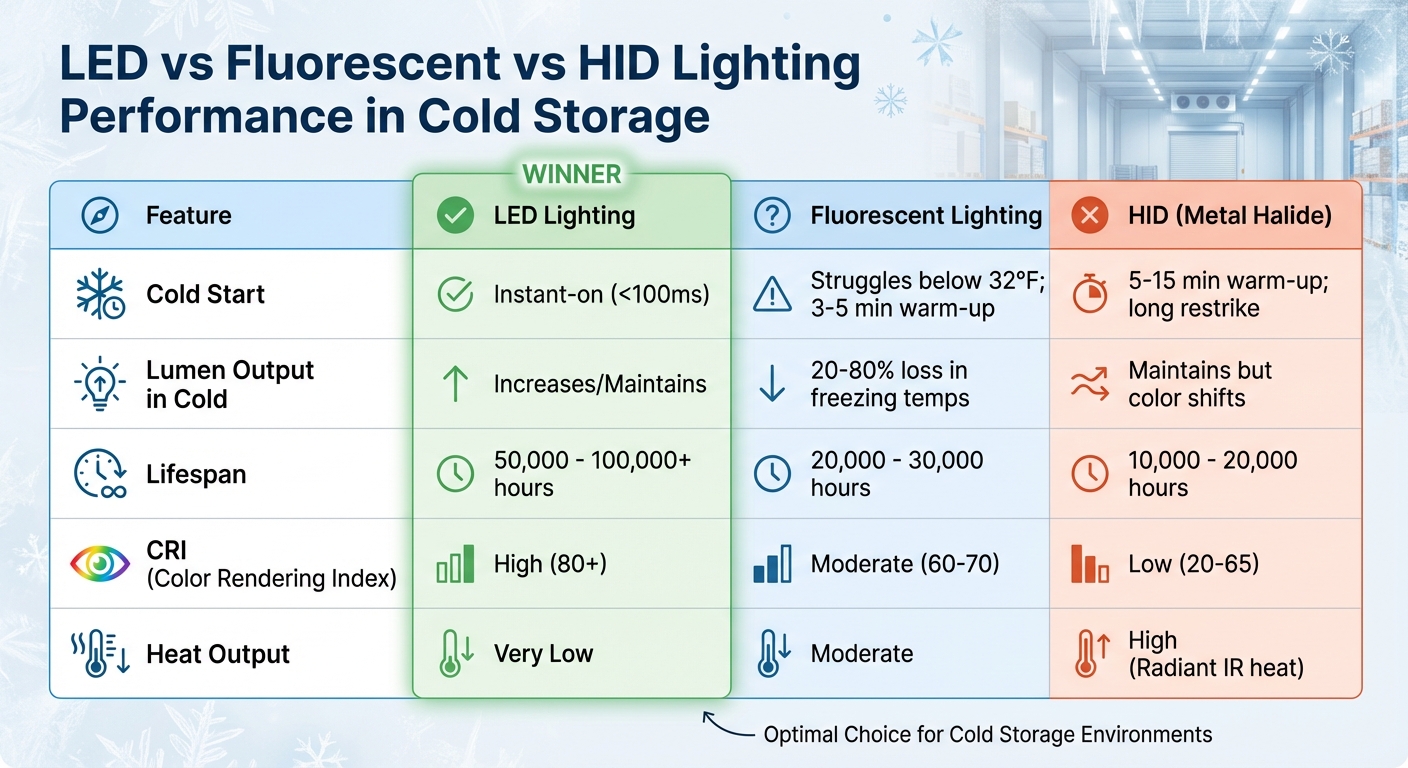
LED vs Fluorescent vs HID Lighting Performance in Cold Storage Facilities
Switching to LED lighting in cold storage facilities offers a range of measurable benefits that go beyond simply replacing old bulbs. The technology not only reduces costs but also improves safety and operational efficiency in these demanding environments.
LEDs excel in cold environments, unlike traditional lighting. When temperatures drop, LED junction temperatures remain low, which actually enhances their efficiency and light output. In sub-zero conditions, LEDs perform better rather than worse, making them ideal for cold storage.
One of the biggest advantages is their energy efficiency. LEDs convert about 80% of their energy into light, whereas incandescent bulbs lose 80% as heat. This is especially important in cold storage, where less heat from lighting reduces the strain on refrigeration systems. Switching from fluorescent to LED can slash lighting-related energy costs by up to 50%, and advanced smart LED systems can cut energy use by 50% to 75% compared to older systems.
A real-world example illustrates the savings: In December 2025, HyLite LED Lighting retrofitted a 40,000-square-foot refrigerated warehouse by replacing 120 metal halide high-bay fixtures (460W each) with 160-watt LED high bays. Operating 20 hours daily, this change reduced annual energy consumption from over 400,000 kWh to about 140,000 kWh, saving 262,000 kWh annually. At $0.10 per kWh, this translated to $26,000 in annual savings.
LEDs also pair well with occupancy sensors. These sensors allow lights to automatically turn off in unoccupied areas, adding another 20% to 30% in energy savings on top of the LED switch.
"The pairing (quick sensors with cold-tolerant LEDs) offers one of the most impactful energy-saving opportunities in any refrigerated warehouse." - HyLite LED Lighting
With energy and maintenance savings combined, the payback period for LED upgrades can be surprisingly short, making them a practical choice for cold storage facilities.
LEDs are built to last. Their lifespan ranges from 50,000 to 100,000 hours, far outpacing the 10,000 to 20,000 hours typical of metal halide lamps. In cold storage, sub-zero temperatures act as a natural heat sink, often extending the lifespan of LEDs even further.
This extended lifespan is particularly valuable in freezing environments, where maintenance is both challenging and costly. Servicing high-bay fixtures in these conditions requires specialized equipment and protective gear, making every avoided maintenance call a significant cost and safety win.
For comparison, metal halide lamps typically need replacement every 12 to 18 months due to dimming. LEDs, on the other hand, can last five to ten times longer, drastically reducing the frequency of replacements. This means less downtime in facilities that often operate 24/7, where even brief interruptions can disrupt workflows and compromise safety. Fewer maintenance needs also contribute to a safer and more productive workplace.
Beyond energy and maintenance benefits, LEDs enhance safety and efficiency through better lighting quality. With a Color Rendering Index (CRI) of 80 or higher, LEDs allow workers to read labels clearly, identify products accurately, and detect signs of damage or spoilage. Studies show that high CRI lighting can cut picking errors by up to 20% in warehouse settings.
For example, a 250,000-square-foot cold storage facility in Ontario, California, completed an LED retrofit in March 2024. By replacing 400W metal halide lamps with 180W LED UFO high-bays, the facility reported an 8% reduction in picking errors in monitored aisles. The instant-on capability of LEDs also eliminated the 15-minute warm-up delays that used to follow automated defrost cycles.
Another example comes from Gordon Food Service, which upgraded to Orion LED fixtures. The retrofit not only saved $141,754 annually and reduced carbon dioxide emissions by 1,134 tons but also improved worker safety and comfort with better lighting coverage.
Unlike HID or fluorescent lamps, which can take 5 to 15 minutes to warm up, LEDs provide instant illumination. This is critical in environments with active forklift operations and narrow aisles, where even brief dark periods can increase the risk of accidents. LEDs also feature wide beam angles (typically 120°) and specialized optics that eliminate shadows and dark spots, further enhancing safety.
| Feature | LED Lighting | Fluorescent Lighting | HID (Metal Halide) |
|---|---|---|---|
| Cold Start | Instant-on (<100ms) | Struggles below 32°F; 3-5 min warm-up | 5-15 min warm-up; long restrike |
| Lumen Output in Cold | Increases/Maintains | 20-80% loss in freezing temps | Maintains but color shifts |
| Lifespan | 50,000 - 100,000+ hours | 20,000 - 30,000 hours | 10,000 - 20,000 hours |
| CRI | High (80+) | Moderate (60-70) | Low (20-65) |
| Heat Output | Very Low | Moderate | High (Radiant IR heat) |
LEDs also produce minimal infrared heat, which helps maintain stable temperatures and reduces the heat load on workers. This combination of thermal comfort, better visibility, and fewer maintenance interruptions creates a safer and more efficient work environment.
Proper lighting design and installation play a key role in getting the most out of LED fixtures in cold storage environments. Let’s dive into some practical tips to ensure optimal performance.
When it comes to placing fixtures, mounting heights between 20 and 60 feet work best. For spaces with ceilings under 20 feet, low bay fixtures are typically more suitable. To achieve even lighting, aim for a 3:1 to 4:1 height-to-spacing ratio. For example, a 25-foot ceiling would call for about 25-foot spacing between fixtures.
The storage layout also influences the type of fixtures you’ll need. Linear LED fixtures are ideal for narrow aisles to illuminate vertical racking. Meanwhile, UFO-style high bays are better suited for open freezer areas, as they provide wide, consistent light coverage. Avoid placing fixtures near doorways where warm air can cause condensation and ice buildup due to temperature swings. These placement strategies directly contribute to the energy efficiency and performance gains discussed earlier.
Here’s a real-world example: In February 2026, a warehouse in Williston, ND, replaced 72 T5 fluorescent fixtures with 200-watt LED UFO fixtures installed at a height of 20 feet. The result? The facility achieved an average of 60.33 foot-candles with a 1.42 uniformity ratio, cutting energy use by 46% and realizing an ROI in less than 19 months.
Choosing the right beam angles is essential for minimizing light loss and maintaining consistent coverage. For ceilings between 20 and 30 feet, opt for wide beam angles (120°–140°). For ceilings higher than 30 feet, narrower, more focused angles work better. In narrow aisles, a 60° beam angle ensures proper lighting for racks, while open areas benefit from 90°–120° coverage.
Cold storage facilities typically require 40 to 60 foot-candles of light, with picking areas needing 30 to 50 foot-candles for precise work. To prevent uneven lighting or over-illumination, consider using a professional photometric plan to determine the exact number and placement of fixtures.
Extreme cold adds unique challenges to installation, but with the right approach, you can ensure long-term reliability. Fixtures for freezer environments should have drivers that can handle cold starts and continuous operation at temperatures as low as -40°F (-40°C). Look for fixtures with high IP ratings (IP65 to IP69K) to block out moisture and prevent internal frosting.
Pay attention to sealing and insulation. All conduit and wiring entries should be properly sealed to avoid thermal leaks and moisture issues. Use cold-rated wiring with 5.0mm terminal blocks that won’t stiffen in sub-zero conditions. Silicone gaskets are a better choice than standard rubber, as they stay flexible through freeze-thaw cycles.
Battery management is another critical factor. Standard lithium batteries can’t charge below 32°F (0°C) without risking permanent damage. Solutions include integrated battery heaters or mounting batteries in a conditioned space outside the freezer. Finally, to protect fixtures during defrost cycles, slope mounting surfaces or add drip shields to prevent water pooling on housings.
These steps ensure that your lighting system performs efficiently while withstanding the challenges of cold storage environments.
LED fixtures in cold storage environments can operate for an impressive 50,000 to 100,000 hours - equivalent to about 5 to 11 years of continuous use. Interestingly, these lights perform even better in cold conditions because lower temperatures help cool their internal components, enhancing efficiency. However, certain parts, like drivers, batteries, and seals, are more prone to wear and require regular upkeep to ensure reliability.
For instance, LiFePO4 batteries are particularly sensitive to temperatures below 32°F (0°C), where lithium plating can cause irreversible damage. Regularly checking battery health and confirming the functionality of battery heaters is essential, especially if the batteries are installed inside freezers. Following proper installation practices is also key to maintaining the integrity of components, ensuring they perform well in sub-zero conditions.
"The real engineering challenges are the supporting systems: drivers, emergency batteries, seals and junction boxes." – COMLED
Physical components, like gaskets, also demand attention. Freeze–thaw cycles can degrade even high-quality silicone gaskets, leading to cracks or hardening. Regular inspections are necessary to maintain the fixture's IP65+ rating, which protects against moisture ingress, internal frosting, and corrosion. In areas that require regular washdowns, features like drip shields or slope-mounted fixtures can prevent water pooling on housings, further extending their lifespan. Modern LED systems now offer modular designs or clip-fixed drivers, making it easier to replace parts without having to remove the entire fixture.
A great example of the impact of proactive maintenance comes from United States Cold Storage Inc., which retrofitted their 40,000-square-foot warehouse in Hazleton, PA, back in 2013. They replaced 465-watt high-pressure sodium lamps with 160-watt Digital Lumens Intelligent LED fixtures paired with the LightRules control system. The result? Energy costs dropped from $0.46 to $0.035 per square foot annually - a 93% reduction. Plus, the retrofit eliminated lamp replacement costs and paid for itself in just 14.6 months. This highlights how maintenance and monitoring strategies can deliver significant savings.
Incorporating IoT monitoring into lighting systems adds another layer of efficiency. These systems provide real-time alerts when fixtures start to dim or fail, enabling timely maintenance - an especially critical feature in –20°F freezers. Regular cleaning is equally important since dust and debris can block light output and lead to overheating. For every 18°F (10°C) rise in junction temperature, LED lifespan can shrink by 30% to 50%.
| Maintenance Component | Inspection Action | Prevention Goal |
|---|---|---|
| Gaskets/Seals | Inspect for cracks or hardening due to thermal cycling | Prevent moisture ingress and internal corrosion |
| Emergency Batteries | Check charging status and thermal management systems | Ensure safe operation in sub-zero environments |
| Fixture Housing | Clean surfaces to remove dust and debris | Avoid overheating and maintain optimal light output |
| Mounting Hardware | Examine for corrosion or loosening caused by vibration | Prevent fixture failure and safety risks |
Once you've secured operational savings, it's time to dive into how rebates and tax incentives can further boost the returns on your LED retrofit project.
Across the U.S., utility companies provide rebates for energy-efficient lighting upgrades. While the specifics vary by provider, most programs require pre-approval and documented proof of energy savings before installation begins. For cold storage facilities that run 24/7, investigating local utility rebate programs can significantly cut down upfront retrofit costs.
In 2025, qualifying projects can earn deductions ranging from $0.58–$1.16 per square foot (base level) to $2.90–$5.81 per square foot for projects meeting prevailing wage and apprenticeship (PWA) requirements. The deduction grows by $0.02 (base) or $0.12 (with PWA) for each percentage point of energy savings over the 25% minimum, capping at 50% energy savings.
You can choose between two methods to qualify:
However, under the One Big Beautiful Bill Act of 2025, the 179D deduction won't apply to properties where construction begins after June 30, 2026. These financial incentives not only reduce upfront costs but also improve long-term ROI.
| 2025 Tax Year Criteria | Min Deduction (25% Savings) | Max Deduction (50% Savings) | Increase per 1% Savings |
|---|---|---|---|
| Energy Criterion Only | $0.58 / sq. ft. | $1.16 / sq. ft. | $0.02 |
| Energy + PWA Requirements | $2.90 / sq. ft. | $5.81 / sq. ft. | $0.12 |
Maximizing these savings opportunities often requires expert guidance. That’s where Luminate Lighting Group comes in. We specialize in helping cold storage facilities take full advantage of utility rebates and tax incentives through comprehensive energy audits, photometric planning, and rebate management. From securing pre-approvals to submitting accurate documentation, we handle the entire rebate application process.
When it comes to the 179D tax deduction, our team collaborates with qualified professionals to ensure eligibility - whether through energy modeling or measurement-based approaches. By combining technical know-how with financial strategy, we help cold storage operators cut upfront expenses, enhance ROI, and meet energy efficiency goals while staying compliant with wage requirements.
This guide has explored the technical, financial, and operational perks of using LED lighting in cold storage facilities. Upgrading to LEDs isn't just a lighting change - it's an investment with measurable returns. By choosing fixtures designed for extreme cold (rated for temperatures as low as -40°F), ensuring adequate moisture protection (IP65 or higher), and incorporating smart controls, facilities can cut energy use by 50% to 75% compared to older systems. Plus, LEDs provide instant illumination, eliminating the 5–15 minute warm-up time typical of HID lamps.
Most LED retrofit projects in cold storage environments pay for themselves within 1 to 3 years. Utility rebates and the 179D tax deduction can significantly lower upfront costs, making the switch even more appealing. LEDs also boast lifespans of up to 100,000 hours, slashing maintenance expenses and reducing the need for frequent replacements in challenging freezer conditions. Additionally, their low heat output eases the burden on refrigeration systems, delivering even more energy savings.
Luminate Lighting Group takes these benefits to the next level by offering tailored solutions that integrate seamlessly into your operations. From custom photometric layouts and fixture selection to rebate assistance and 179D documentation, our team handles every step of the LED upgrade process. Our application engineers design lighting plans specifically for your facility's layout, racking systems, and workflows, ensuring you get the most out of your investment.
Whether you're managing a blast freezer at -40°F or a standard cold storage warehouse, the right LED lighting strategy can provide immediate operational improvements and long-term cost savings. Partner with Luminate Lighting Group for solutions that optimize performance, cut costs, and secure rebates - all while meeting the unique challenges of refrigerated environments.
When picking an LED fixture for cold storage, temperature tolerance is key. The fixture must be able to handle the freezer's operating temperature. Here's what to look for:
Additionally, make sure the fixture has proper moisture resistance. Look for an IP65 rating or higher to ensure it can withstand condensation and humidity commonly found in cold storage areas. This combination of temperature and moisture resistance will keep your lighting system running efficiently.
For cold storage areas, it’s best to use fixtures with an IP65 rating or higher, like IP66 or IP69K. These ratings guarantee strong protection against moisture, condensation, and freezing temperatures, ensuring your lighting system stays reliable and lasts in tough conditions.
The fastest way to gauge ROI, rebates, and the 179D deduction for LED upgrades is by relying on financial models that consider project costs, energy savings, and available incentives. When it comes to rebates, check utility programs set to offer higher incentives in 2025. For estimating 179D deductions, pair energy modeling with depreciation methods such as MACRS or bonus depreciation. To get the most out of these benefits, aim to complete installations before the year ends.


