.svg)
A practical 7-step checklist to evaluate energy analytics platforms—features, integration, security, costs, ROI, and trial tips.


Looking to cut energy costs and meet compliance standards? Energy analytics platforms can help you reduce waste, lower utility bills, and meet sustainability goals. The right platform offers tools like real-time monitoring, AI-driven diagnostics, and automated reporting to pinpoint inefficiencies and track savings.
Here’s what to focus on:
Pro tip: Request tailored demos and trials to test usability and performance with your actual data. Engage vendors for references and ensure their support meets your needs.
Energy analytics platforms are a smart investment for reducing costs, improving efficiency, and staying ahead of compliance requirements. Start by assessing your needs and testing potential solutions.
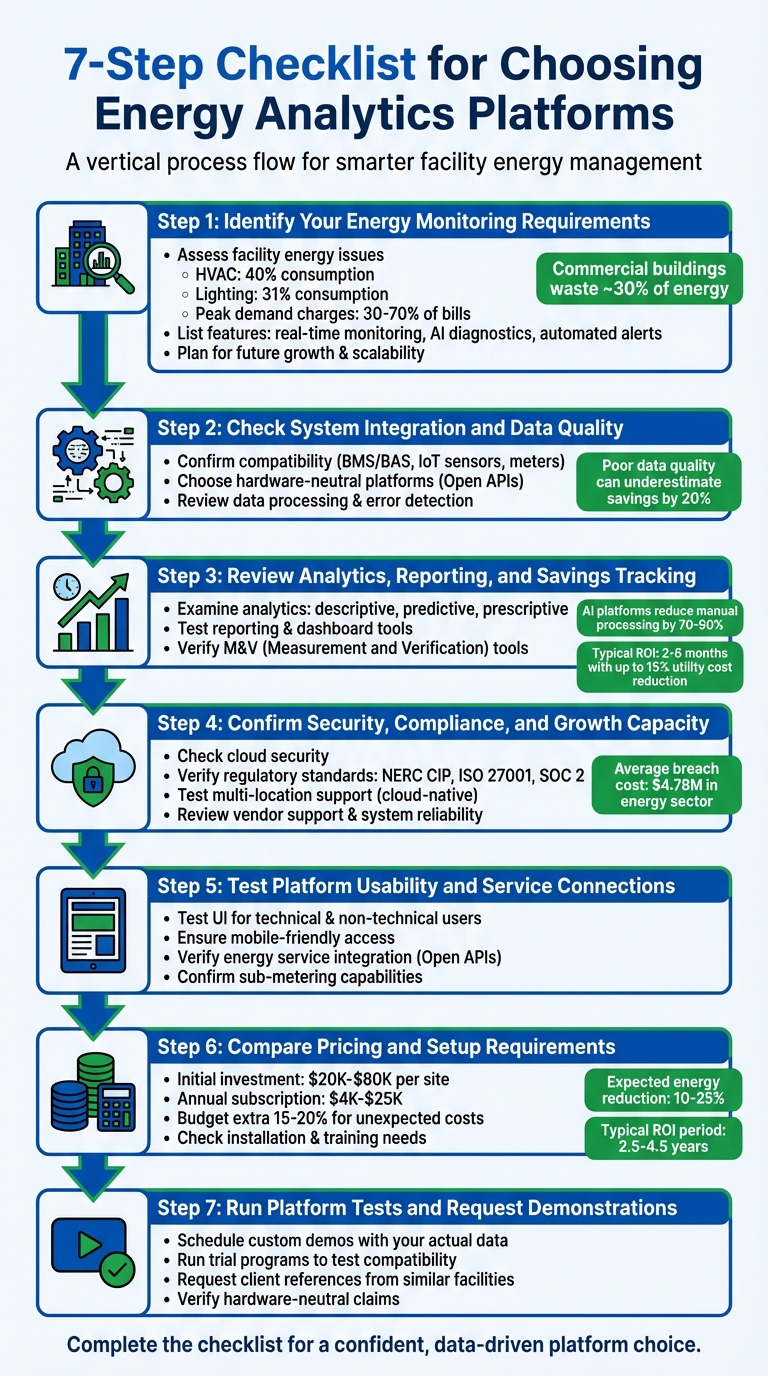
7-Step Checklist for Choosing Energy Analytics Platforms
Start by identifying the energy challenges specific to your facility. Did you know that commercial buildings waste about 30% of their energy due to inefficiencies? Common culprits include HVAC systems running during off-hours, scheduling errors, or control conflicts. If your utility bills seem unusually high, it might be due to peak demand charges, which can account for anywhere from 30% to 70% of your total bill.
Relying solely on monthly utility bills can leave you in the dark about inefficiencies like equipment starting up simultaneously or leaks in compressed air systems. For instance, HVAC systems alone typically consume 40% of a commercial building's energy, while lighting takes up another 31%. On top of that, regulatory requirements are becoming stricter. Facilities are now expected to meet energy benchmarking and carbon emission standards, such as NYC Local Law 97.
Understanding these challenges will help you determine the features your energy monitoring platform must have.
Once you've identified your challenges, focus on the platform features that will address them. Real-time monitoring and sub-metering are key for pinpointing where energy is being consumed - right down to the circuit level. This allows you to catch issues like demand spikes or waste from after-hours usage before they escalate into bigger expenses.
Look for platforms equipped with AI-driven fault detection and diagnostics (FDD). These tools can identify underperforming equipment and provide insights into the root causes of problems. Automated alerts based on threshold limits are another must-have, ensuring you can quickly respond to anomalies or equipment malfunctions.
If you manage multiple utility accounts, choose a platform that consolidates and audits utility bills. Additionally, ensure it captures at least 30 days of consumption data to establish a reliable baseline for comparison.
Your energy analytics platform should grow with your business. As Noda.ai puts it:
Adding building 40 to your portfolio should be significantly easier than adding building four.
To avoid being locked into outdated or proprietary systems, opt for hardware-neutral platforms that can integrate seamlessly with new equipment or sensors. This flexibility eliminates the need for costly custom solutions.
Cloud-based, wireless IoT platforms are ideal for scaling across multiple locations. They reduce the need for expensive on-site servers or complex cabling, making expansion more affordable and efficient. Ensure the platform supports remote monitoring for multiple sites, so you can manage your growing portfolio easily. Finally, check with vendors about their development plans to confirm the platform will continue to receive updates and new features.
Your energy analytics platform should work effortlessly with the equipment you already have in place. Platforms designed to be hardware-neutral are the best choice since they can integrate with nearly any device, whether it’s a Building Management System (BMS/BAS), IoT sensors, utility meters, or even weather APIs. This kind of built-in compatibility helps avoid time-consuming custom integrations.
If you’re dealing with a mix of BMS vendors and systems of varying ages, look for a platform that provides a unified, machine-readable model. This standardizes analysis across all properties, no matter the differences. Make sure the platform supports open APIs and allows you to retain all your historical energy data. Dexma emphasizes the risks of choosing a closed system:
"If you choose a closed, on‐premise energy management platform without possibilities of integration, new features will require extra development – probably by your energy software provider."
Once you’ve confirmed that your platform integrates seamlessly with your equipment, the next step is to ensure your data is reliable.
Accurate and consistent data is the backbone of any effective energy analytics system. The most advanced platforms use AI and NLP to standardize naming conventions, which helps maintain consistency across your portfolio. This process ensures that data comparisons are meaningful and reliable.
Automated data auditing is another key feature to look for. For instance, the Maryland Department of General Services relies on EnergyCAP to flag anomalies in utility bills, such as overlapping dates, multiple bills in one cycle, or unexpected spikes in costs. Alerts are sent immediately to their Energy Office, allowing them to address issues before payments are made. This approach has led to energy savings averaging 14% across multiple buildings.
It’s also essential to have a plan for addressing missing data or gaps from your BMS. Poor-quality data can lead to underestimating energy savings potential by as much as 20%. The best platforms include tools for data cleansing and filling in gaps, ensuring that recommendations are based on complete and accurate information. If you’re hesitant about fully automating decisions, consider starting with a "recommendation-only" mode. This allows you to evaluate the platform’s accuracy and build confidence before enabling automated execution.
The next step is to evaluate how these platforms handle analytical insights, reporting accuracy, and savings verification.
Energy analytics platforms typically operate across three levels of analysis. Descriptive analytics focus on historical data, highlighting consumption trends, anomaly detection, and usage patterns. Predictive analytics take it a step further, forecasting issues like equipment failures or future energy load demands. Finally, Prescriptive analytics provide actionable recommendations, often ranked by their potential impact on energy costs, carbon emissions, or operational performance.
Some advanced platforms even attach a dollar value to identified faults, helping teams prioritize tasks based on financial importance. When comparing platforms, ask vendors to clarify where their software fits within this analytics framework and whether they can assign financial values to their recommendations.
These insights naturally integrate with the platform's reporting tools for a more comprehensive approach.
Your chosen platform should offer a unified interface that provides both a broad view of your portfolio and detailed insights at the building level. Ian Beynon, Head of Energy at Royal Mail, emphasized the importance of this feature:
"With EnergyCAP, we can finally unlock that insight and drive action".
The best dashboards allow you to monitor high-level ESG metrics across your portfolio while also diving into specific systems or equipment within individual buildings.
AI-powered platforms can significantly reduce the time spent on repetitive tasks, cutting manual invoice processing and data entry by 70% to 90%. Look for automated reporting features that can generate and schedule custom PDF reports. Visual tools, such as heatmaps, interactive charts, and widgets, simplify complex data, making it accessible to both technical and non-technical users. Additionally, ensure the platform supports custom thresholds for automated alerts and lets you create personalized dashboards tailored to your Energy Performance Indicators.
Strong reporting capabilities naturally support precise savings tracking.
Accurate savings tracking relies on M&V (Measurement and Verification) techniques that account for variables like weather, occupancy, and seasonal changes. This ensures that reported savings reflect actual improvements rather than external influences.
Your platform should quantify the energy, cost, and emissions impact of every recommendation, enabling your team to focus on initiatives with the greatest financial return. AI-driven platforms often deliver up to a 15% reduction in utility costs, with most organizations achieving measurable ROI within two to six months.
For upgrades like LED retrofits, check if the platform tracks utility rebates, tax incentives, and 179D deductions. Some systems now automate data collection for Scope 2 emissions tracking and generate compliance-ready reports for frameworks like CDP, GRI, and SASB. This functionality is becoming increasingly critical as sustainability reporting standards grow more rigorous across industries.
Optimizing energy use is essential, but ensuring robust security, meeting compliance requirements, and planning for future growth are just as critical. After evaluating analytics and reporting features, the next step is to confirm that the platform aligns with your organization's security needs, regulatory standards, and scalability goals.
Energy platforms often handle sensitive data, making security a top priority. The risks are clear - the average cost of a data breach in the energy sector hit $4.78 million in 2023, while destructive cyberattacks averaged $5.24 million. Even more alarming, 45% of all security incidents in the energy sector stem from third-party breaches, far exceeding the global average of 29%.
To safeguard your data, the platform should implement strong encryption for data at rest and in transit, along with cryptographic integrity checks to protect audit trails. Role-based access control (RBAC) and fine-grained permissions are also essential, allowing you to tightly manage who can access specific data within your organization. For those with stringent compliance needs, some vendors offer on-premise solutions, ensuring sensitive energy data stays within your corporate network and maintains full data sovereignty.
Regulatory compliance is equally crucial. For critical infrastructure, frameworks like NERC CIP standards - specifically CIP-011-4 for information protection and CIP-015-1 for network security monitoring - are key. Additional certifications, such as ISO 27001 for information security and SOC 2 Type 2 for data privacy, provide further assurance. Always verify the certifications a vendor holds and request supporting documentation.
An often-overlooked detail is data ownership. Confirm upfront who retains ownership of your historical energy data in case you switch platforms later. This can prevent significant complications during vendor transitions.
As your organization grows, your energy platform must scale effortlessly. Cloud-native architectures are ideal, offering near-limitless scalability to accommodate new buildings without hitting capacity limits.
The most effective platforms leverage AI and machine learning to standardize data from various Building Automation Systems (BAS), eliminating the need for manual adjustments when adding new facilities. Look for platforms that integrate seamlessly with multiple meters and sensors through open APIs, reducing the costs associated with custom integrations.
For organizations operating across multiple states or regions, the platform should support diverse utility types and regulatory requirements, all within a single, unified dashboard. This centralized functionality becomes increasingly critical as your portfolio expands, ensuring streamlined management and reliable performance.
Vendor support plays a pivotal role in the success of your energy platform. Request a disaster recovery plan and ask about contingency measures for potential security breaches or server outages. Cloud-based platforms typically offer high reliability, thanks to redundant servers and advanced infrastructure that minimize downtime.
When evaluating options, consider the total cost of ownership, which includes installation, training, and ongoing support fees. Don't overlook maintenance costs, as they can vary significantly between vendors.
Automated compliance reporting can cut manual effort by up to 90%, but this benefit depends on the quality of vendor support during implementation. Ask about onboarding timelines, the availability of training resources, and whether a dedicated account manager will be assigned to your organization. Additionally, check if the vendor provides uptime guarantees and what compensation is offered if those guarantees are not met.
Once you've tackled security and scalability, the next step is to ensure your energy analytics platform is user-friendly and integrates effortlessly with your existing energy systems. A platform that’s complicated or disconnected can slow progress and frustrate users.
Look for a platform that consolidates all your consumption data into a single, customizable dashboard. This helps both technical and non-technical users make sense of the data. Role-based customization is especially useful - finance teams might focus on cost metrics, while facility managers monitor equipment performance.
A mobile-friendly interface is essential for real-time monitoring and adjustments on the go. Fast load times are also critical to keeping workflows smooth. As Facilio emphasizes:
If it's complicated, nobody will use it. So, ensure the software is easy to use for both technical and non-technical users.
Beyond just displaying data, the platform should transform findings into clear action plans. This "closing the loop" capability ensures not only that issues are identified but also that corrective measures are tracked and verified. For instance, in Massachusetts, the Division of Capital Asset Management and Maintenance implemented an Energy Information System across 420 buildings. By tracking 5-minute interval data from 953 meters, the system pinpointed operational savings opportunities - like delayed starts and early shutdowns - leading to an average energy savings of 14% in 23 targeted buildings.
Once you’ve confirmed the interface is intuitive, it’s time to focus on how well the platform integrates with existing energy services.
Choose a platform that connects seamlessly with most equipment through Open APIs, avoiding the need for expensive custom integrations. Open APIs enable smooth connections to tools like property management software, tenant apps, and specialized services such as Luminate Lighting Group's smart lighting controls and energy audits.
Advanced platforms often use AI to standardize data from various Building Automation Systems, eliminating the need for manual relabeling. This is crucial because peak demand charges can make up 30% to 70% of a commercial customer’s utility bill. Additionally, ensure the platform supports automated data imports from utility providers and integrates directly with your energy infrastructure, reducing the risk of manual entry errors. For organizations using sub-metering, confirm the system can identify inefficiencies at granular levels, such as by equipment, tenant, or floor.
Once you've confirmed usability and integration capabilities, it's time to dive into the financial details. Energy analytics platforms come with a range of costs, and not accounting for long-term expenses can throw your budget off track.
For small and medium-sized facilities in 2026, the initial investment typically ranges from $20,000 to $80,000 per site. This covers hardware like meters, sensors, and gateways, along with integration fees and system setup. On top of that, annual subscription fees can fall anywhere between $4,000 and $25,000, depending on the size of your portfolio and the modules you choose. For instance, a grocery chain with 18 locations spent about $1.1 million over three years and managed to cut electricity use by 17%, achieving a simple payback period of 3.4 years.
Don’t overlook hidden costs. It’s wise to set aside an extra 15–20% of your budget to cover unexpected expenses like emergency hardware repairs, cybersecurity updates, and compliance renewals. Keep in mind that hardware-closed systems often require pricey consultants to add new data sources, while hardware-neutral platforms with open APIs help you sidestep such ongoing fees .
The payoff can be worth it. Many platforms help reduce energy consumption by 10–25%, with returns on investment typically realized within 2.5 to 4.5 years. Some systems even identify billing errors during utility audits, covering the cost of their subscriptions. On the flip side, failing to comply with energy regulations could lead to fines as high as $50,000, making compliance a key factor when selecting a platform.
Cloud-native, hardware-neutral platforms generally have quicker setup times compared to hardware-closed systems, which often require specialized engineering work. Standard energy assessment training usually lasts about a week and combines theory with hands-on practice .
Labor costs are another factor to consider. The average salary for an energy analyst in the U.S. is approximately $74,085, which could impact your operational expenses. Make sure your subscription includes training, documentation, and technical support . Systems with steep learning curves may require certified integrators or dedicated in-house experts to ensure smooth operation. Finally, review the service level agreement (SLA) and technical support details in your contract to avoid unexpected challenges.
Before committing to a contract, it's crucial to see the platform working with your actual data. A generic demo won't show how well the system can handle your facility's unique needs or the complexity of your operations.
Once you've reviewed integration and data quality, take the next step by requesting a tailored demonstration. This should focus on your specific requirements. The platform needs to handle lifecycle management tasks, such as energy audits, proposal creation, material procurement, and project tracking seamlessly. Test how quickly it can generate proposals using audit data. Also, ensure the platform includes real-time monitoring and control capabilities, such as adjusting lighting based on occupancy, time, or ambient light.
"The differences between auditing tools – in terms of capabilities, usability, extensibility, support, and other factors – can be vast." - Jason Lopez, StreamLinx
Trial programs are essential for testing the platform's compatibility with your existing systems. Use them to connect your energy meters and sensors to verify that the platform collects and analyzes data accurately. Confirm that it’s hardware-neutral so you don’t face unexpected costs for custom integrations. Evaluate its speed - slow platforms can drag down efficiency. Check for measurement and verification (M&V) tools that track energy savings and compare them to your targets, especially if you're bidding for public projects. Make sure users can access real-time data remotely and that the system supports multiple user roles with customized permissions. These trials will give you a clear picture of the platform's performance under real-world conditions.
After evaluating technical features like speed, data reliability, and usability, ask for client references. Specifically, request references from facilities similar to yours that use the platform. During these conversations, dig into details. For example, does the platform maintain fast load times when handling large datasets with millions of data points? Is the vendor responsive to feedback, and do they have a clear process for adding new features? Assess whether the reporting tools are versatile enough to meet the needs of different stakeholders, from executives to sustainability teams. Most importantly, confirm that the platform truly operates as hardware-neutral or whether additional costs were required for custom integrations. Finally, inquire about any data security incidents and how effectively the vendor managed recovery.
"Purchasing energy audit software is an investment in your business. And as with any investment, true value is revealed over time." - Jason Lopez, StreamLinx
Picking the right energy analytics platform can lead to significant savings, better efficiency, and progress toward sustainability goals. With connected energy management solutions, organizations often see a 20% boost in energy cost savings and a 30% drop in total energy use. Analytics-driven improvements - like fixing scheduling mistakes or resolving control conflicts - can deliver these results without requiring expensive retrofits. This highlights the value of platforms that go beyond mere data collection.
What sets the best platforms apart is their ability to turn raw data into actionable insights with measurable financial outcomes. Instead of just offering static dashboards, these platforms provide decision-support tools that help cut peak demand charges, which can make up 30% to 70% of a commercial utility bill. Some of these tools even deliver a return on investment in less than six months .
"The most effective implementations aren't about removing humans from the loop, but rather seek to reduce the volume of low-stakes, repetitive decisions your team has to make manually, so their attention can go where it's actually needed." - Noda
Beyond immediate savings, the right platform also supports long-term sustainability efforts. It can track carbon emissions, supply auditable data for ESG reporting, and enable predictive maintenance to extend the life of assets . Additionally, these platforms offer the flexibility to adapt to grid conditions and time-of-use pricing . By carefully assessing your needs and thoroughly testing options, you can choose a platform that provides both short-term operational wins and long-term strategic advantages.
Before choosing an energy analytics platform, it's important to collect some critical information to ensure it aligns with your requirements:
Having this information upfront will help you identify a platform that can effectively analyze and optimize your energy usage.
To make sure everything works smoothly, confirm that the energy analytics platform can connect with your Building Management System (BMS) and meters. Verify that it supports your specific BMS vendor and software version, and that it can access real-time data from meters and sub-meters. It’s a good idea to review API or direct data connection options and perform a system audit. This helps spot any potential issues early, ensuring uninterrupted data flow and efficient energy management.
To demonstrate ROI swiftly during a trial, evaluate how well the system identifies and minimizes energy waste in real-time. Pay close attention to its precision in spotting inefficiencies and estimating potential savings, particularly in areas like HVAC, lighting, and equipment performance. Check if the system offers actionable recommendations for immediate changes - such as fine-tuning lighting or HVAC controls - that could translate into noticeable savings within 12 to 36 months.


